

Alexander Grabovetskiy, woodcarver, School of Woodcarving · Published 2022
Why set three petals of a carved flower against the other two?
Quick answer: Setting three petals against two keeps a carved flower from repeating itself. In part 8-2 I put the three at probably 62% of the space and the other two at 38%, in opposition. With the two carved just like the three, I said, no conflict shows.
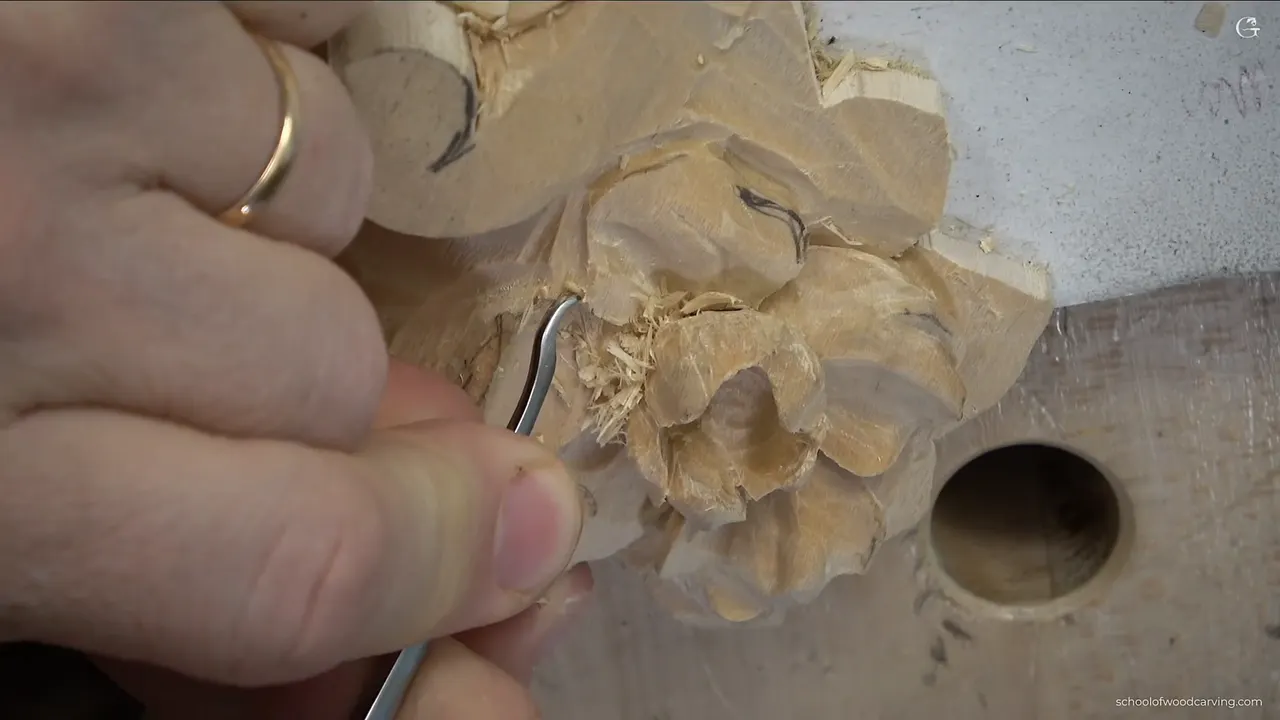
Three petals set against two is how I keep a carved flower from repeating itself. In part 8-2 of Acanthus over Moldings I put it as numbers: the three petals probably take 62% of the space, and the other two take 38% (03:50 to 04:09).
Look at the last flower you carved. Did every petal move the same way? Then you know what a flower with no conflict looks like. If I did exactly the same on the two as on the three, I told the camera, I would not see any conflict going on (04:12 to 04:24).

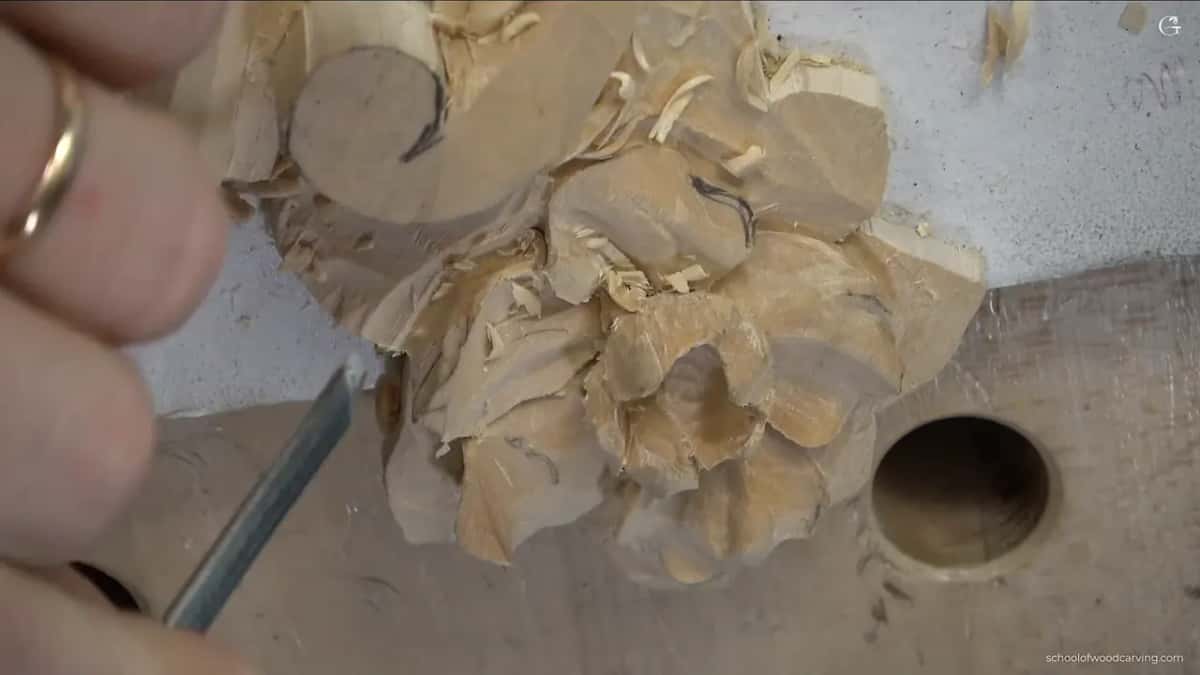
What did I have to fix after the veiner?
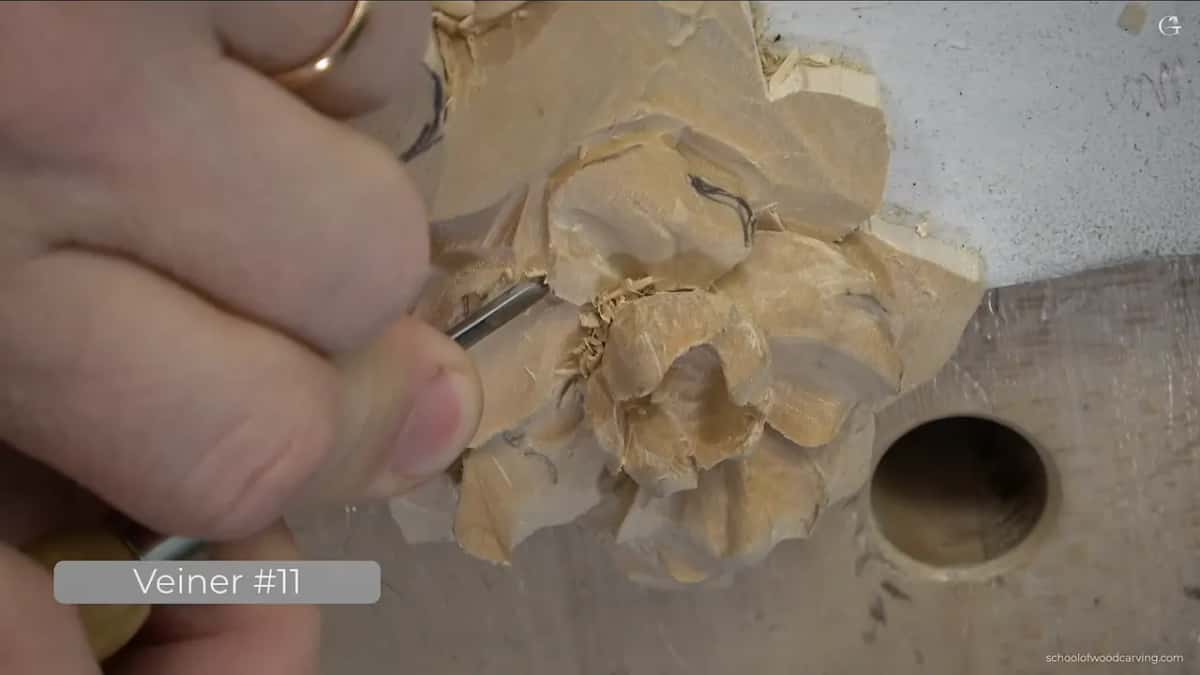
At the start I said it was still going to be the number 9, four millimeters (5/32 in), and that I would get my goggles also. Not goggles, whatever you call those things (00:36 to 00:49). Then I changed course. I could use a half millimeter (0.02 in) number 11 veiner instead, I said, and it would give the same result and get right underneath (01:02 to 01:23).
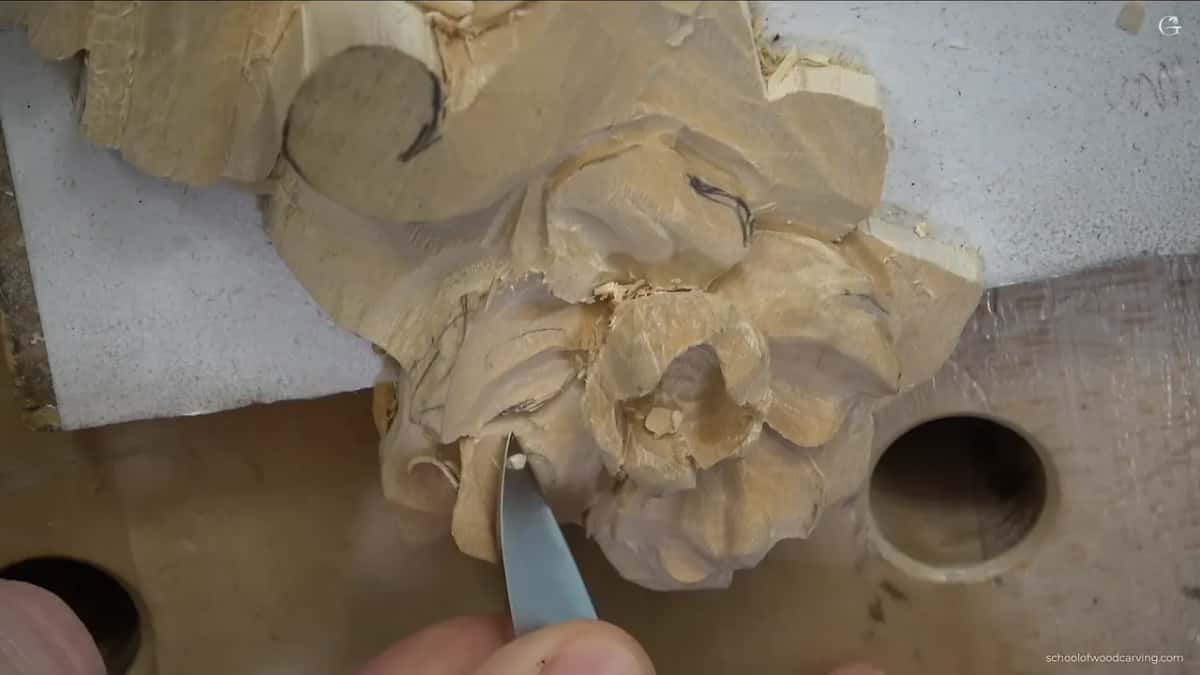
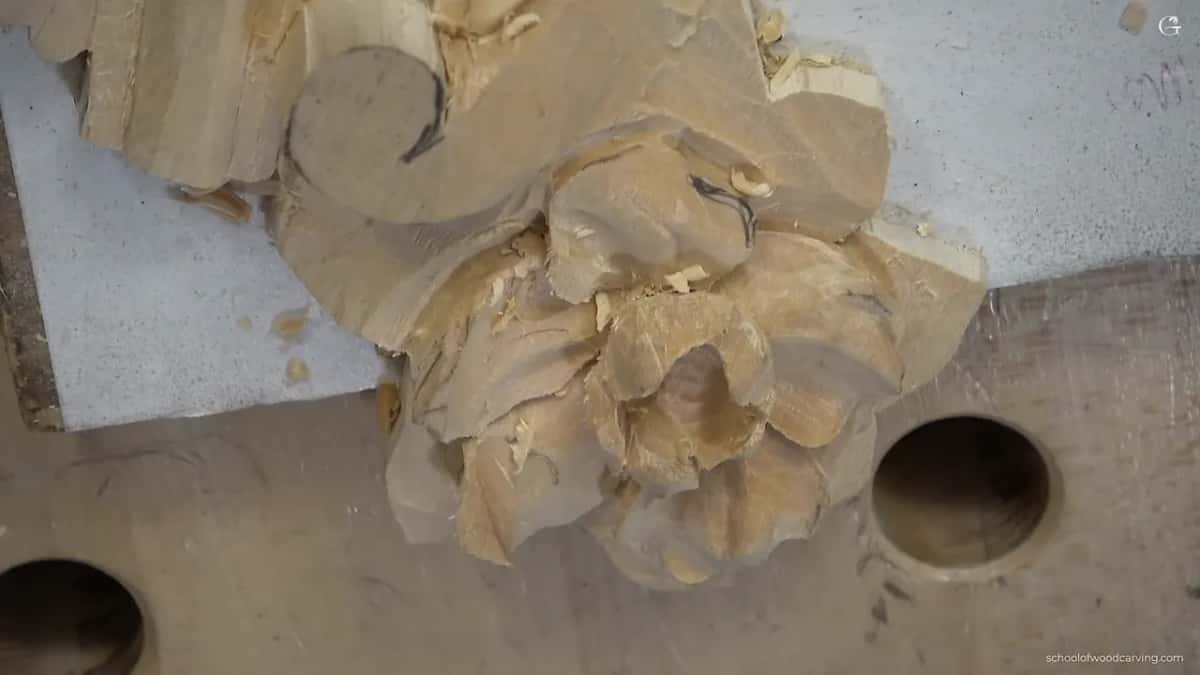
"Push too hard, and I destroy it slightly." That was the look of my previous one. It was not completely destroyed, but you know (01:25 to 01:42). So I needed a little deeper excavation right inside it, and a fix for the previous one (01:42 to 01:50).
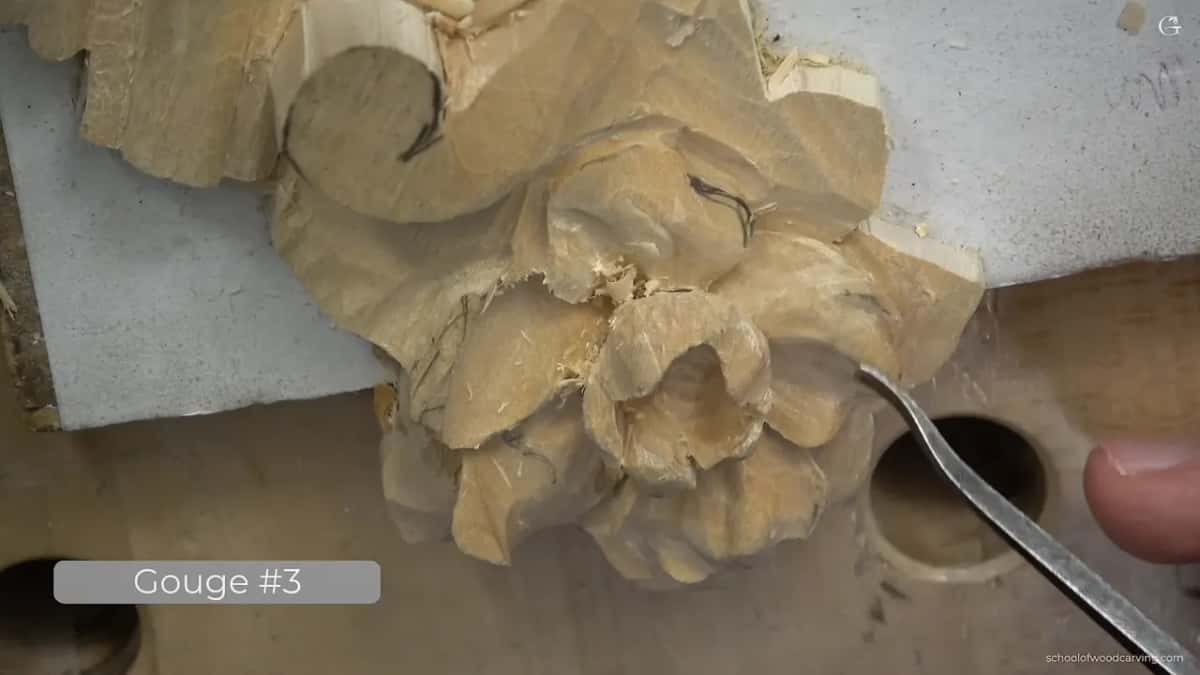
For the fix I took a number 3, an eighth of an inch (3 mm), good for a clean cut, a clean up job (01:52 to 02:07). I said I would not do too crazy movements. This petal already had some movements on it (02:35 to 02:48).
Why do three petals stand against two?
I sent you back to my Design course for this one, where everything in nature is divided into something like a golden ratio (02:53 to 03:09). To simplify, 62% versus 38%, and a constant war (03:09 to 03:20).
I call that concept peace and war in design (03:16 to 03:23). Everything fights everything, I added, though not necessarily fight, but there is a position (03:23 to 03:32). Take away the minus and the plus does not really matter in electricity (03:32 to 03:38). A human has a man and a female (03:38 to 03:44).

On this flower, I said, I've got those three petals, and they probably conquer 62% of overall space. Those two guys conquer 38%. That puts the two in opposition to the three, even on the level of a flower, so you can communicate that idea (03:50 to 04:15).
Let's say the three are plus and the two are minus. Just watch the design concepts, I added, and you will understand what I'm talking about (04:27 to 04:37). It applies to the overall project, to the inside of a flower, even to the level of a leaf or a petal (04:40 to 04:58).
Where does the center line of one petal fall?
On a golden ratio too. Look inside a single petal, I said, and see its center line (04:55 to 05:03). Take that spot, take this spot: 62% approximately, and 38% on the opposition, even on that level (05:03 to 05:19). The line is not really in the center, and you can see that everywhere (05:19 to 05:28).
I hope it makes sense. Trying to communicate that everywhere, I added (05:28 to 05:36). And then: "Not that you have to do that, but I think it's a good idea" (05:36 to 05:43).
Which small tool hollowed the two petals?
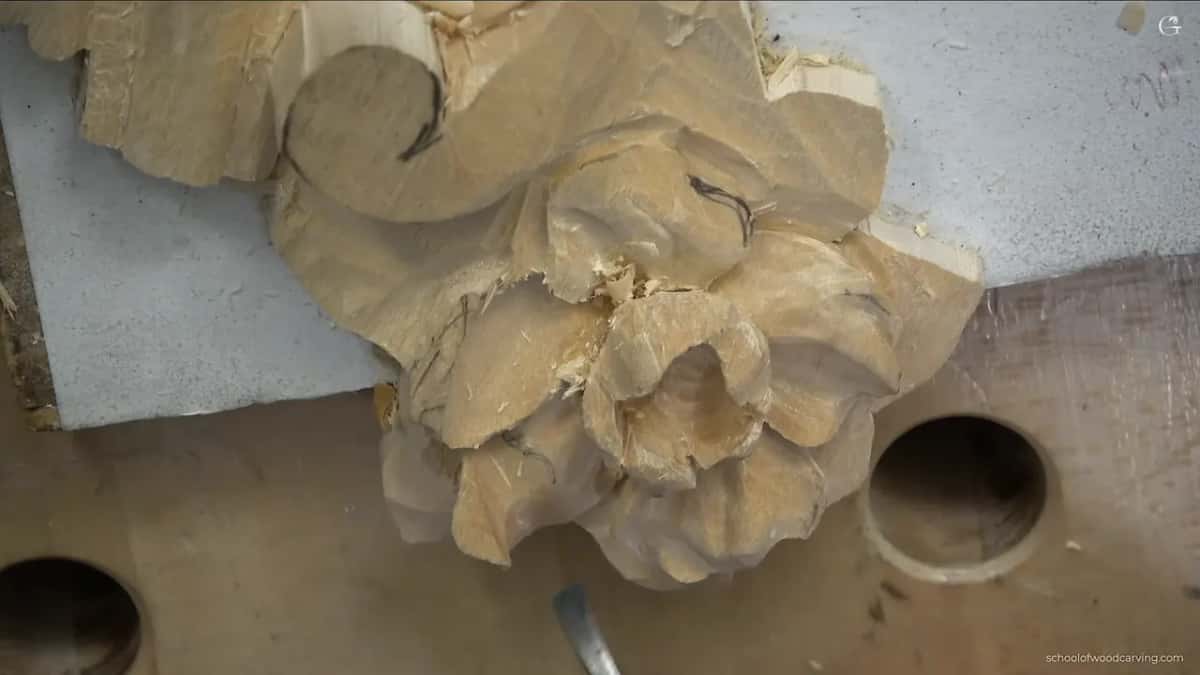
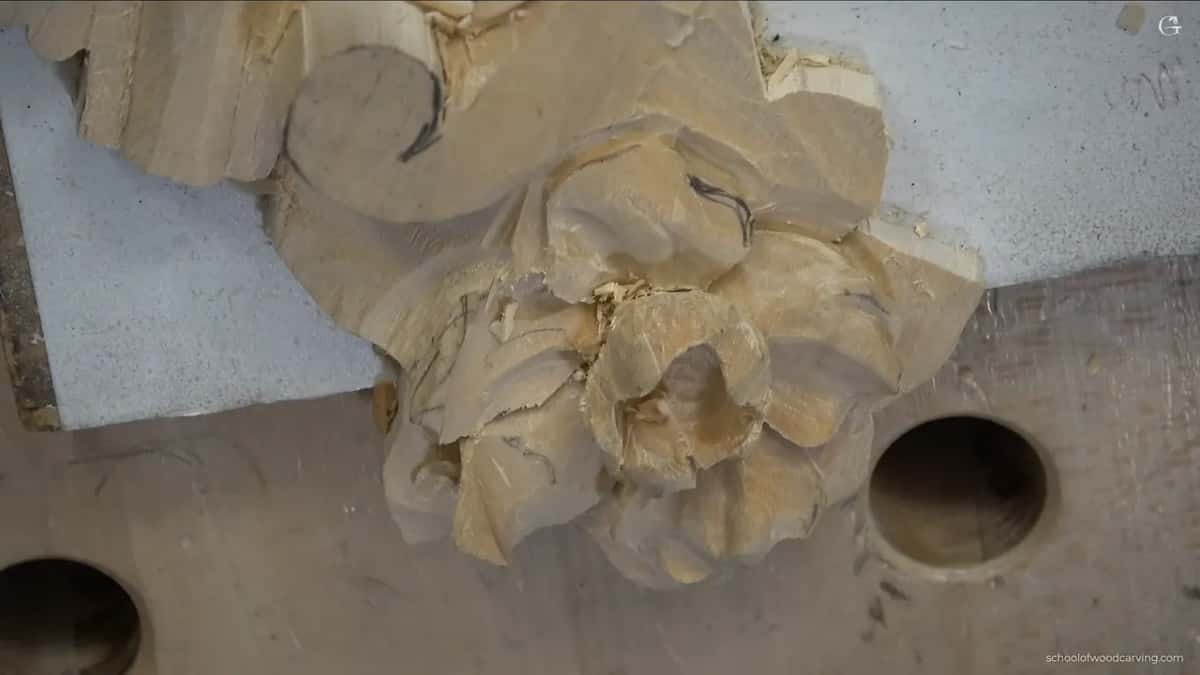
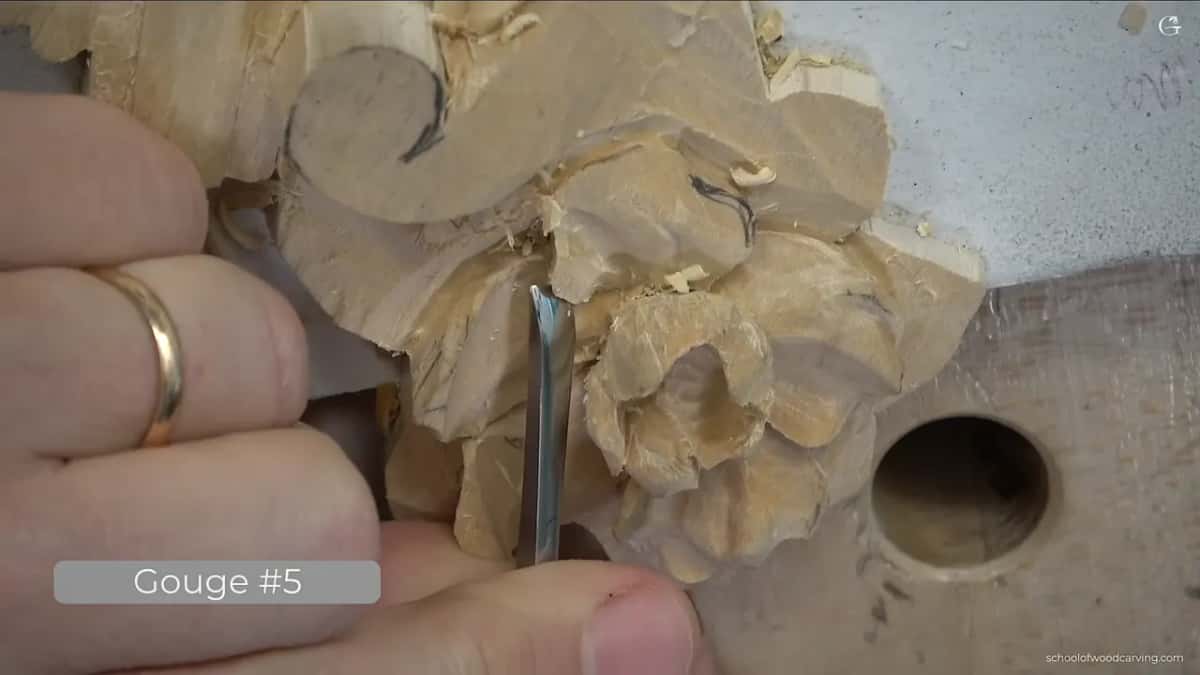
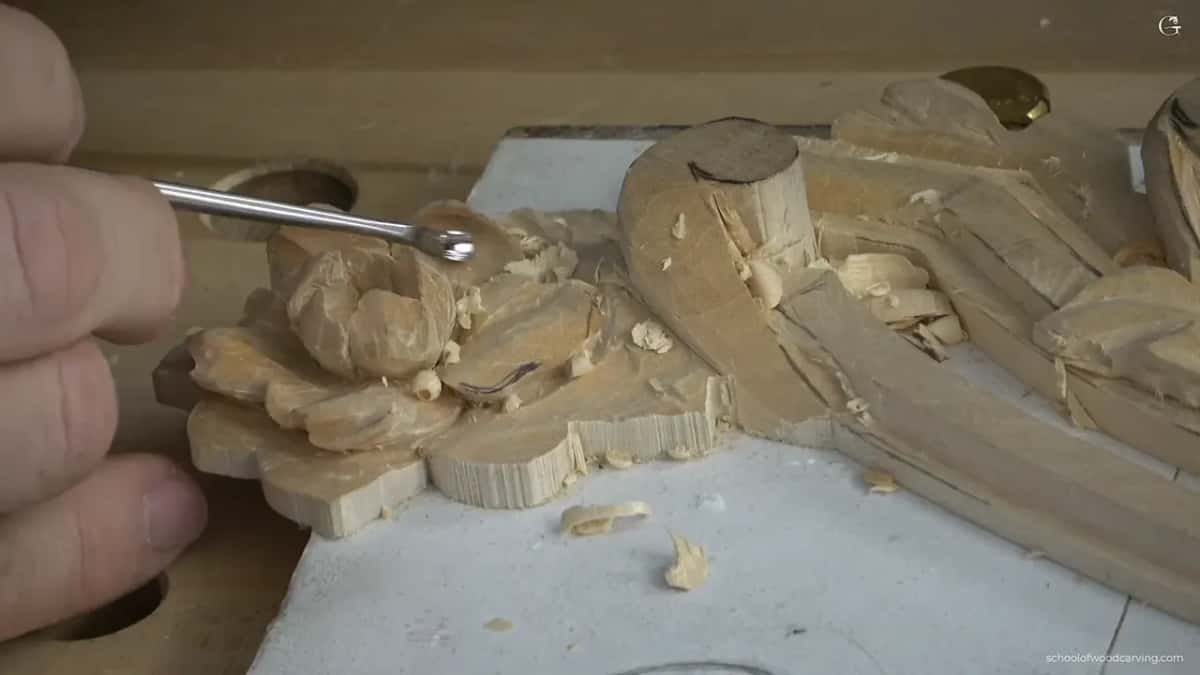
A small spoon. The middle part of every petal bulges slightly, I reminded you, so it is convex, and I have to carve a concave on both sides of it (06:01 to 06:16). Underneath my previous petal I had already done some of that. On this side the plan was a number 6, really small, tiny (06:16 to 06:36).
Then came a change of mind. Using the 6 was not required, and a different one would do, even the number 9 from before. A variation of tools (06:36 to 06:50). So I took a four millimeter (5/32 in) number 9, the same small spoon, and played with it (07:02 to 07:09).
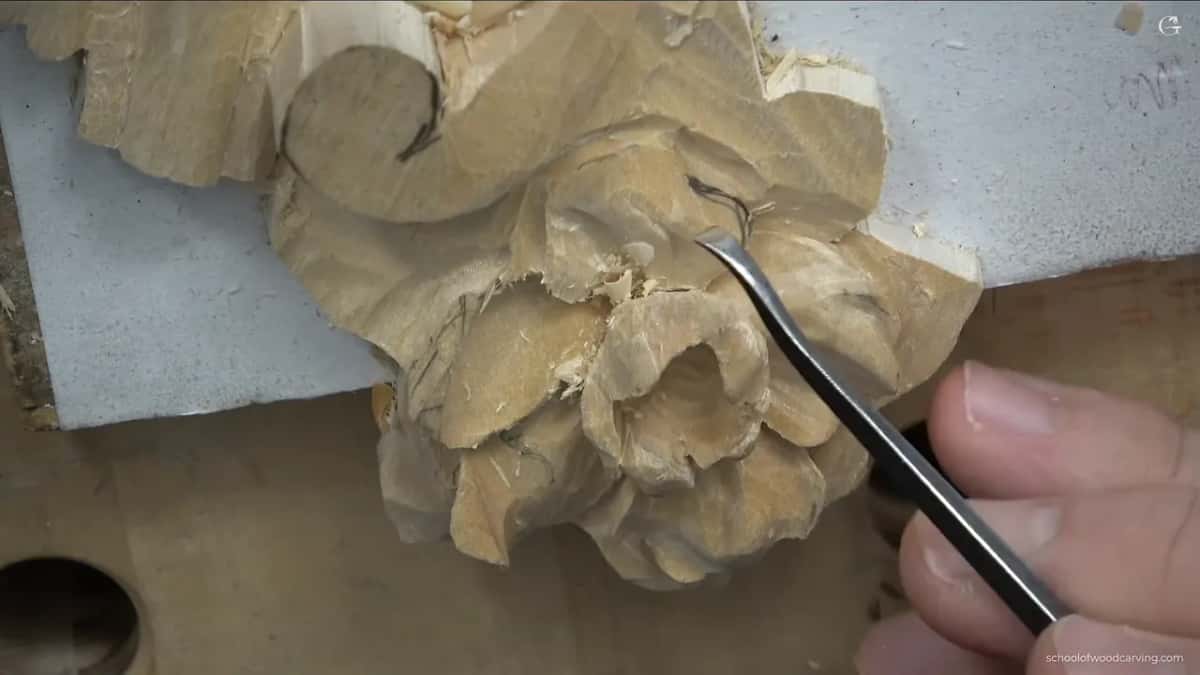
With a small tool, even with the middle of my flower in the way, I still get my cut in the right direction, with the grain (07:34 to 07:50). I lost my overlapping part. Absolutely okay. Also a little cut on this side (08:22 to 08:32). Okay, that is good, I said, three times in a row (08:54 to 09:01).
What line did the knife leave?
A sharp one. After the spoon I needed to blend everything again, without heavy movements, and then attack that line once more (09:01 to 09:17). A couple of ways would do it, and one was just a knife. An undercut with the knife gave me pretty much right away a sharp line (09:22 to 09:43).
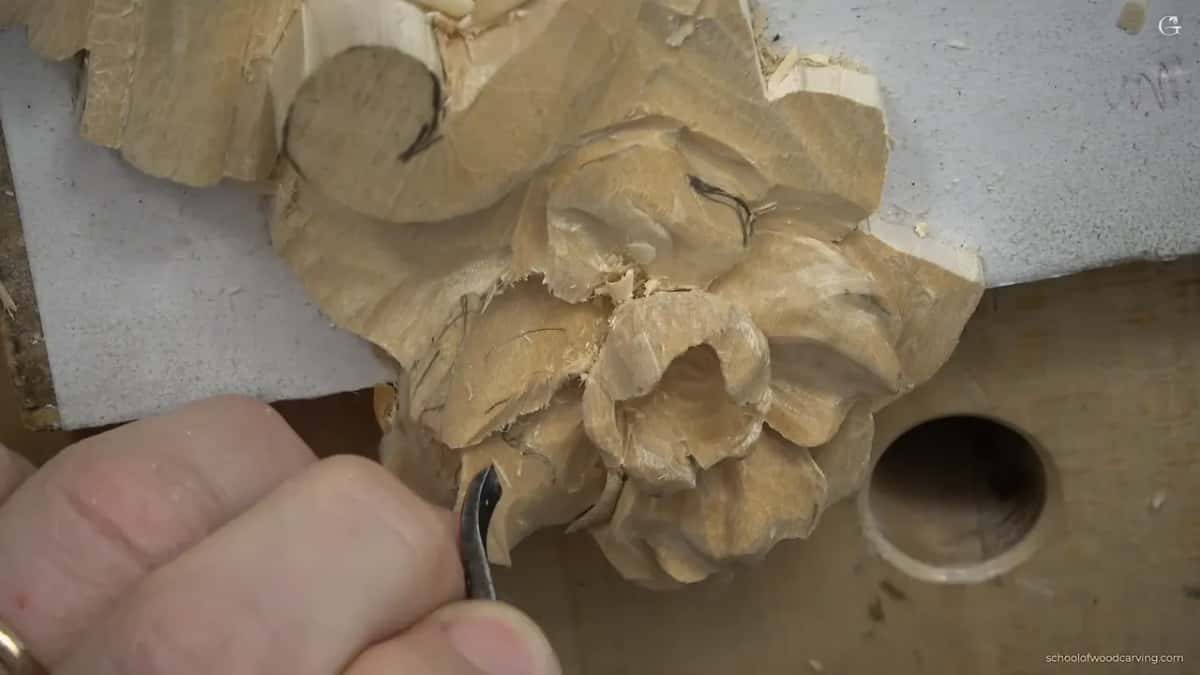
Let's remove it and see how beautiful a sharp line it gives me. I can get even deeper (09:59 to 10:14). Out came the chip. Forget about all the junk, I told you, and look at the result (10:17 to 10:29). The knife can blend everything too, and clean (10:29 to 10:38).

How did I keep the edge from looking like a straight line?
Number 9 again. Closer to the edge (10:53 to 11:21). The shape was somewhat finalized, and I did not want to see a straight line. Curly movement was what I wanted, a little bit (11:24 to 11:38).
To blend a little inside and make it nicer, I used the same number 3 spoon as before. Later I would probably spend slightly more time to get really close and get rid of most of those ridges (11:42 to 12:24). Now it's good. I was somewhat happy with what I saw (12:27 to 12:36).
Where did the shadow above the leaf come from?
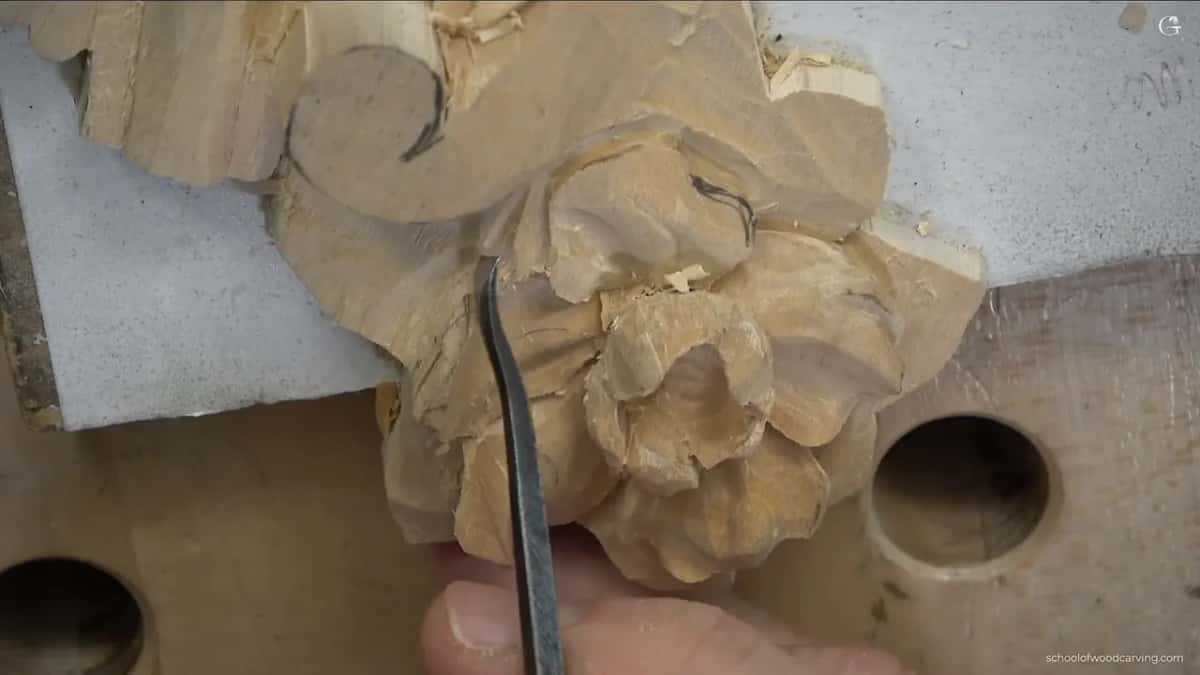
Short cuts. First I probably had to walk around and remove the material around those petals, so they release (12:45 to 12:59). I had too many tools out, I said, and did not want that. So the number 11 came back, two and a half millimeters (3/32 in), the same 11 as before (13:03 to 13:26).
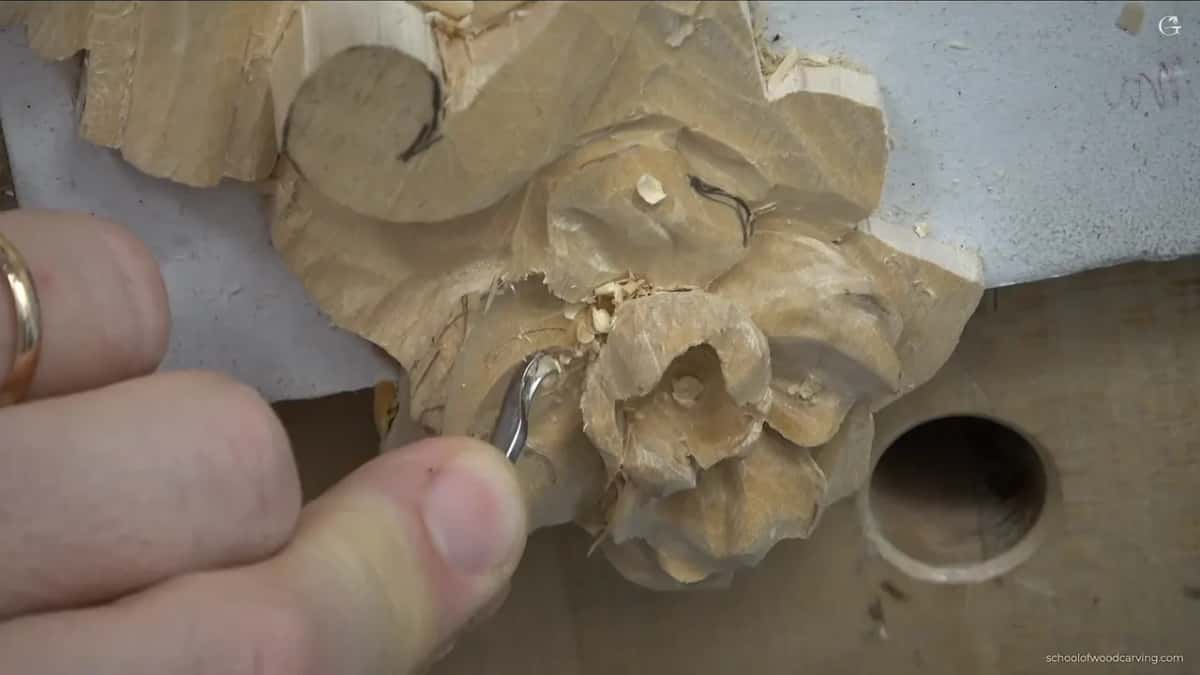
My cuts were really short. No forcing. Still, a really beautiful shadow was the goal. To really kind of raise it, on the petal above the leaf (14:01 to 14:22). And that's it. No overdoing it (14:22 to 14:45).
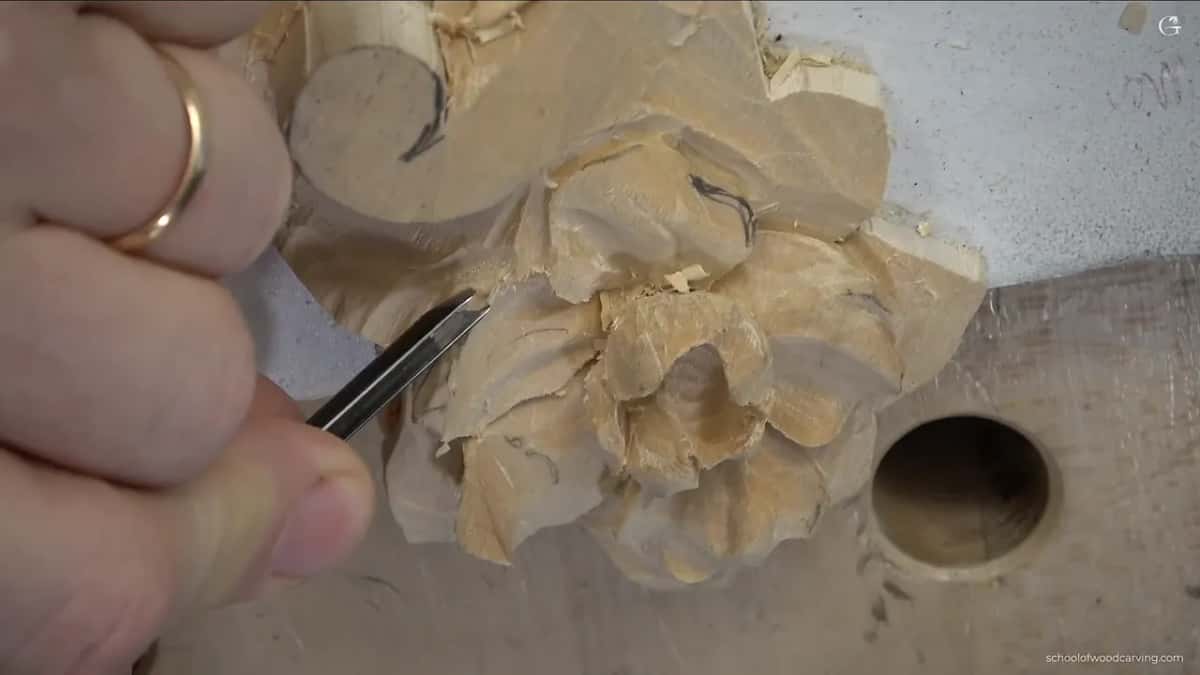
The number 9 of one millimeter (0.04 in) cleaned a little inside, to get rid of whatever I did not need (14:45 to 15:02). The edges still needed attention, and maybe just a knife would do, a tiny small one. I could create some of the shapes with it, although I probably had to get something else (15:05 to 15:40).
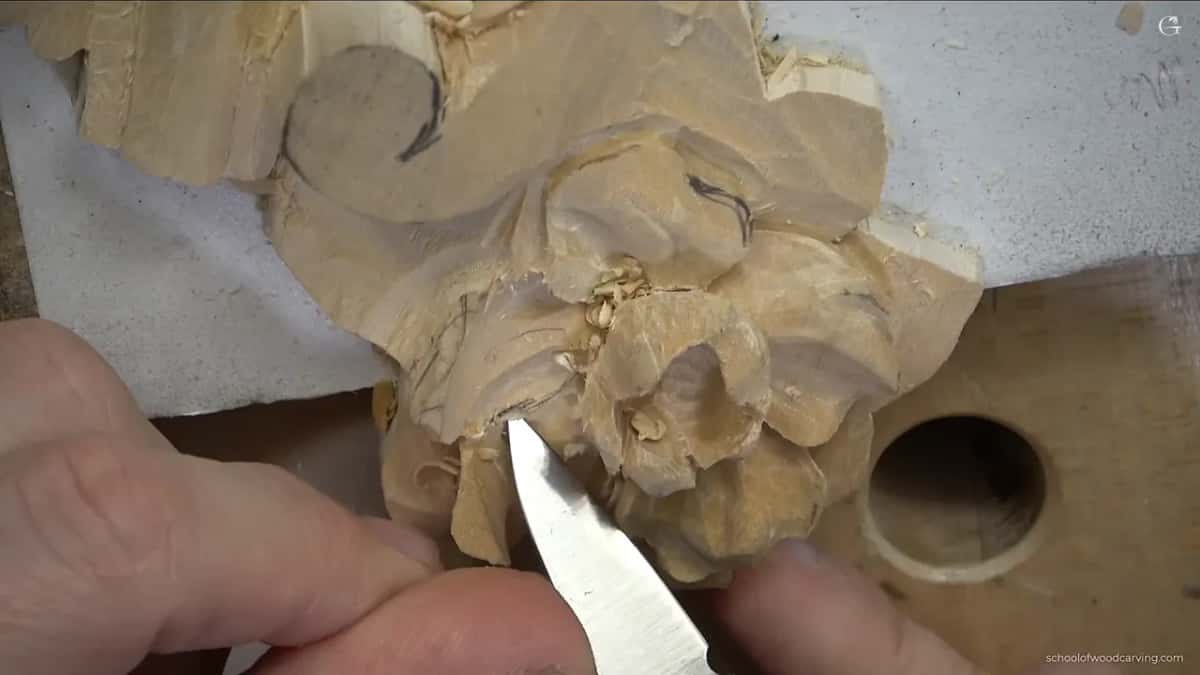
Then the number 5 took over, with my tool upside down, to give a little overall shape to the petal (15:40 to 16:01). Lots of junk chips showed up. It's up to you, I said, and "You can always blow on it and that's gonna fly away." I tried not to blow because of the camera, but it is a normal practice, especially with details and small chips (16:06 to 16:42).
Which words did the Design course give me?
In Design principles lesson 2, my peony was the hero of the picture, and every hero has an antagonist (00:04 to 00:41 of part 2-2). In art, I said, we call it the law of war, the law of conflict. Nature holds a conflict in everything (01:08 to 01:19).
Spalting made the example. Spalting is a war between fungi, and on a piece of wood you can see the border, a black or dark brown line between them. One fungus conquers the most territory and becomes the hero of that piece, surrounded by other fungi, usually in two or three colors (01:22 to 02:22). They don't cross each other (02:42 to 02:45).
At the peony, the antagonist falls on a golden ratio too (04:00 to 04:44). Between those two sits the main problem and the main fight. Main conflict, if you wish (04:44 to 04:51). A design holds several golden ratio points, so it is not just one flower and a few petals. You really have to hit the antagonist. If there is no fight, there is no interest (04:59 to 05:13).
Two lesser golden spots in part 2-3 fight each other as well, while supporting the main ones, so they stay much smaller (01:04 to 02:04). When you look at flowers, I said, it is not just an expression of beauty, it is a war of ideas, even in simple design (03:13 to 03:22).
Did three against two show up on the butterflies plate?
There it did. Butterflies lesson 12 explains my approach to design in part 12-2: some conflict going on, like plus and minus in electricity, male and female, red and blue (00:53 to 01:17). The overall movement goes one direction, and another movement goes the opposite way. The space they take is again the 60/40 rule, or 62% versus 38% (01:23 to 01:52).
Not really necessary for this design, I added. Do the same movement, and that is absolutely okay. I decided on the opposite direction, and if I don't like it, that's okay (01:57 to 02:19).
Later I would do exactly the same in the opposite direction, filling that part, with just the two. Those three versus two, again 60/40, so it's going to be Fibonacci. Two, three (04:33 to 04:52). Too busy was not what I wanted (05:12 to 05:15).
Butterflies lesson 13 says it again. I am really big on design built on a conflict between two oppositions, like plus and minus in electricity, which produces light (01:26 to 01:52). Guys a thousand years ago in northern Europe did not necessarily follow that idea. I just decided to do it in this case, and you really don't have to (02:19 to 02:43).
Did the furniture panel flowers repeat as well as fight?
Both. In furniture panel lesson 34, the 62% and the 38% have to be in opposition, with a conflict between themselves, but still the elements have to repeat (01:55 to 02:33 of part 1). An element ran from the inside of that flower, and I do have that element on this side, but much smaller (02:33 to 02:46).
Part 3 of that lesson carries on: whatever flow goes this way, I am going to repeat that same flow on this petal, and maybe those two guys will go in opposition movement. That keeps my law of conflict (05:04 to 05:40).
Over in lesson 37 of the panel course, the second one is the same, but it goes in opposition (06:32 to 06:36). Some of you do not pay attention to design rules and golden ratio proportions. For me it is a big deal (06:40 to 06:52). One is much smaller than the other, and that is why. Maybe it should not be a big deal for me either (07:13 to 07:41).
This guy is in opposition to that guy, so they are on two different spectrums, or walks of life, or political views if you wish (07:49 to 08:13).
Where else did the small rebel show up?
In Grape Onlay lesson 9, I made a repetition of the movement on a little guy that would be in rebellion to the main one. In conflict, I should say. Again, that is just one of the concepts of design (04:50 to 05:25).
Modern Acanthus lesson 1 uses the war idea for tools. Treat your tools as the army, and you are going to fight. If you do not like the war idea or the conflict idea, think like a dance between metal and wood (01:42 to 02:04).
Did I hold to the same ratio inside Acanthus over Moldings?
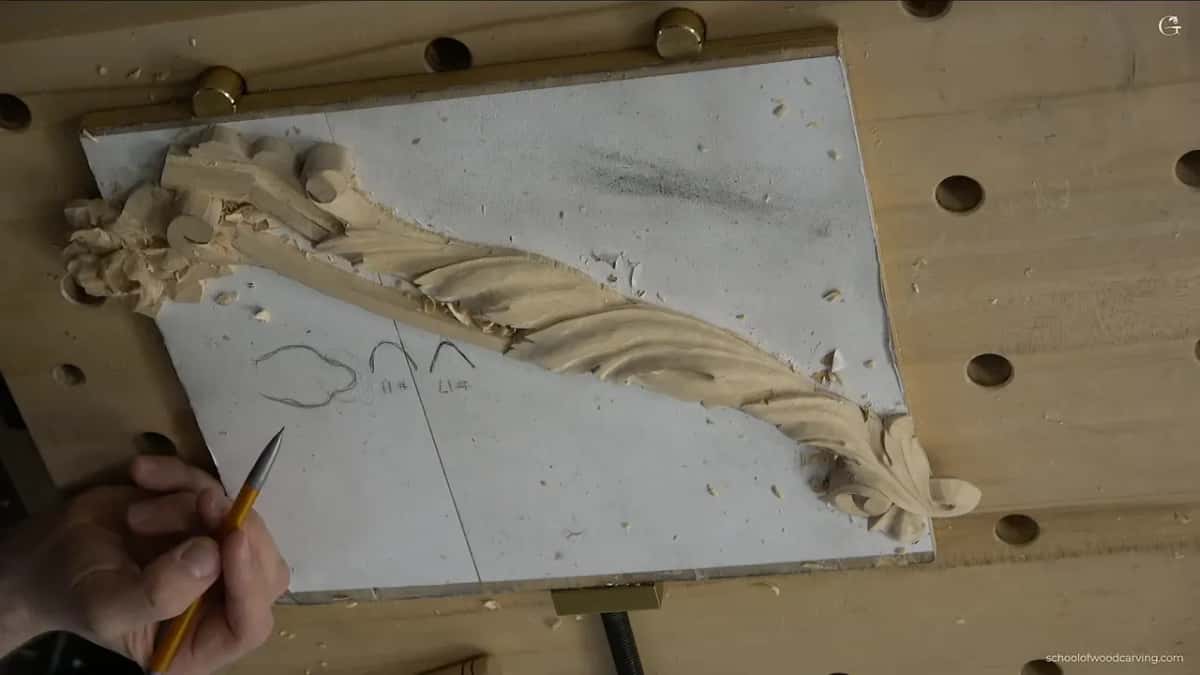
Yes, and loosely. In lesson 7 a petal ran about 61% on one side and about 38% on that side. Not that I measured it, it just happened (00:06 to 00:27 of part 7-1).
In lesson 8 my central line was to be about 60% and 38%, or 62 and 38 approximately, with concave, convex, concave inside the leaf (04:57 to 05:26 of part 8-3). "It's not always the case," I added. Applicable to that style, and even in that style you can have some variations. I am okay with that (05:34 to 05:53).
By lesson 9 the point where a petal rolls backward still falls on a golden ratio, 62% on one part, 38% on the other, approximately. Yes, I like the golden ratio approach even on the level of those details. You don't really have to, I said, but I think it is wise (19:42 to 20:31 of part 9-1).
And in lesson 10 a shell's movement would oppose the acanthus. Acanthus is dominating in this case, since it just goes one direction. Just like in politics, "there's always multiple views, different oppositions" (06:42 to 07:27 of part 10-2).
What stood against what, side by side?
The table lines up each lesson, what I set against what, and how strict I said I was.
| Lesson | Opposition | Strictness |
|---|---|---|
| This video, 8-2 | Most of the space goes to three petals, two take less | Probably approximately |
| Design lesson 2 | A hero and its antagonist, both on golden points | Nature's rule |
| Butterflies 12 | Three against two, the second going the opposite way | Not necessary |
| Panel lesson 34 | Opposed parts that still repeat, one much smaller | Elements repeat |
| Panel lesson 37 | One shape in opposition, much smaller than the other | Big deal |
| Grape onlay 9 | A little guy in rebellion to the main movement | One concept |
| Moldings lesson 10 | A shell opposing the dominating acanthus | Multiple views |

What will you set against what on your bench?
Got a flower on your bench with every petal moving the same way? What would it look like with two of them set against the other three? My example is part 8-2, and I told you it is a good idea, not a must.
This video is one part of lesson 8. Before it sits lesson 7, after it lesson 9, and the course page holds the whole piece. My Principles of Design course covers the war of ideas.
The idea behind the numbers is the golden ratio, and the Fibonacci talk on the butterflies plate goes back to the Fibonacci sequence. Wood carving lives under woodworking, and a gouge is a kind of chisel. My flower sits in relief, which means it stays on the board. The spoon gives the small curved tool its name. I watched the shadow on a petal of a flower, and in the Design course my hero was a peony. I used spalting, a war between fungi, as an example. A knife gave the sharp line.
Which two petals will you set against the rest?
How it's done
- Weigh the petals. The three probably covered 62%, the two 38%.
- Set the two against the three. Carved just like the three, the two would show no conflict.
- Find the center line. Inside one petal the center line sat on a golden ratio, about 62% against 38%.
- Hollow beside the bulge. The middle bulges and is convex, so a small spoon, a 4 millimeter (0.16 in) number 9, carved the concave on each side.
- Undercut with a knife. A sharp line came right away from the undercut.
- Curve the edge. A straight line was out. Number 9 again, with a little curly movement.
- Shade the petal. A number 11 of 2.5 mm (0.1 in), really short cuts and no forcing, raised the petal over the leaf for shadow.
Frequently asked questions
How much space should three petals take against two?
The three probably conquer 62%, I said in part 8-2, while the other two conquer 38% of the flower's space. Those two stand in opposition to the three. Carving all five alike would leave no conflict to see, and the same idea reaches a single petal's center line.
Do you have to follow the 62% and 38% rule in a flower?
Not that you have to do it, I told the camera, though I think it's a good idea. For my butterflies plate I called the rule not really necessary. The same movement is absolutely okay, and I decided to go the opposite way.
Can petals fight each other and still repeat?
Yes, I said so in a furniture panel lesson. The 62% and the 38% have to be in opposition and have a conflict between themselves, but the elements still have to repeat. I had that element on this side too, but much smaller.
What to carve next
- Acanthus over Moldings, the course page
- Acanthus over Moldings lesson 7
- Acanthus over Moldings lesson 8
- Acanthus over Moldings lesson 9
- Acanthus over Moldings lesson 10
- Principles of Design in Wood Carving
- Design principles lesson 2
- Carving Plate with Butterflies lesson 12
- Carving Plate with Butterflies lesson 13
- Carving Furniture Panel lesson 34
- Carving Furniture Panel lesson 37
- Carving Grape Onlay lesson 9
- Carving Modern Acanthus lesson 1