
Alexander Grabovetskiy, woodcarver, School of Woodcarving · Published 2023
Can you rough out a carving with a hand plane instead of a gouge?
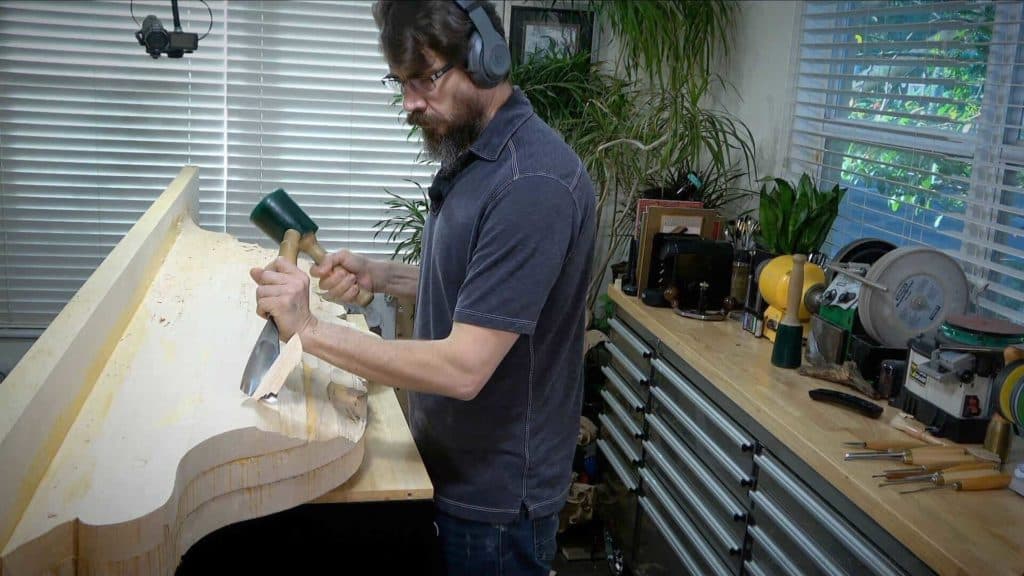
Quick answer: Roughing out my Venice Room piece with just a plane is, in my words in video 10, a year of work for me. I take really deep cuts with a huge gouge, and one cut takes at least half an inch (about 13 mm). My other lessons show where a plane does get its turn.

"If I would just use a plane, it would take me a year, to do that." That was my answer in Venice Room 1.10, and the same video is where I told the camera about the huge gouge I was using.
Other lessons of mine show a plane too, and I do pick one up. Every lesson I name here is linked.
Ever looked at a thick, rough block of wood and wondered if a hand plane could take it down? Ever wondered how much wood one cut of a big gouge can remove? Then this video is for you.
What this page holds
- My words in video 10 about a year and a plane.
- The size of the layers in video 9, plus the gouge, the mallet, in inches, millimeters and ounces.
- The gouge I called my workhorse in video 11.
- Where I do pick up a shoulder plane or a block plane.
- Sander, machine planer and router plane, each beside a plane.
- A table of every video.
What did I say when a viewer asked about a plane?
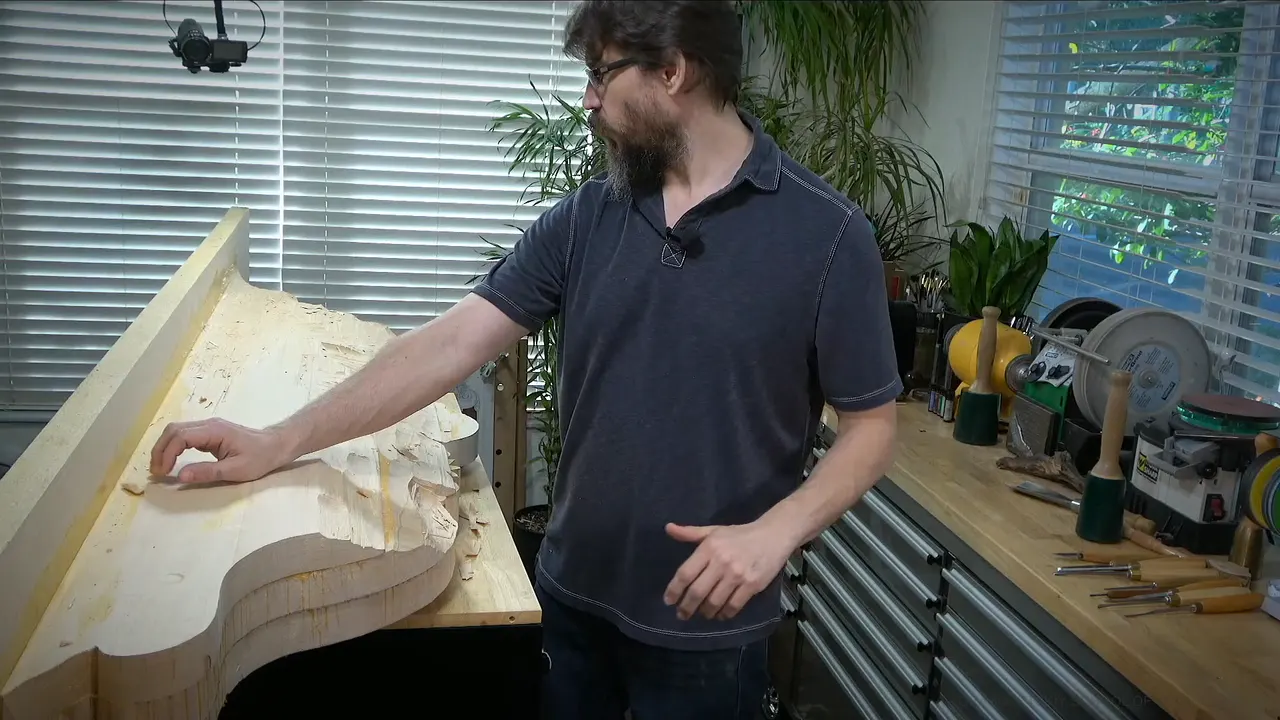
My answer was a year. Video 10 opens with me picking up where I left off. It looks kind of rough, I said, but that's okay for me.
Then comes the story. I posted a video on Instagram, and one of the guys said why don't I use just a plane, to plane it. Or whatever he meant, I said, I don't know.

The gouge came next. I take really deep cuts with it, I said. It's a huge gouge. "So one cut takes at least half an inch." In metric, about 13 mm.
Next I said I was going to shut up. My plan was to continue to work on "establishing just the three-dimensional look of it" and I really don't need to talk to you at this stage, I said. I planned to use just my headphones and work on the piece. "That's it."


How thick were the layers when I picked up a big gouge?
About six inches thick (about 152 mm) at that point, I said in video 9, and they were going to go all the way to nine inches (about 229 mm) right there, "maybe a little bigger." Off camera I had added a second layer and a third, exactly the same operation as the first layer, just the jigsawing. I did not want to repeat myself. Maybe I'm going to change the design a little bit, I added.
Then came the tools. "Today is the day," I said. I was going to take a big gouge and start establishing my form. "That is actually the step number one, establish the form." Before I work on details, I need to make sure the shape is right in three dimensions.
The big gouge I named was three and one-eighth inches wide, which I called exactly 80 millimeters (3 1/8 in is about 79 mm). The mallet I named was a really heavy-duty one, 30 ounces (about 850 g). Drawers were my system that day, I said, and I know exactly the place for every tool.

The mallet had a rubber head, and I gave my reason. I want to protect the ends of my gouge. I'd rather not use a mallet made of wood because of the noise, of course, and I don't like a brass one on heavy-duty work.
Another way to take off wood came next. The second approach, I said, is a hatchet, if you have one. I have a beautiful handmade hatchet, just a small one, and you can use it to do some roughing out. Be really careful with that, I said. A hatchet is also a kind of really quick way to remove a lot of material, "but for me, it's about the same as if I would just use a gouge."

I'm not suggesting you do what I was doing, I said. "I don't like to carve and remove the material along the grain," I said, "but in this case, I have to remove a lot of material." If I wanted to, I said, I could use a number nine and go across the grain, "but this is going to work, too."
At the end of that day, if you asked why I left so much material, or why I glued so much at the beginning, I said it is because I do have a big shell right in the middle. I need that chunk of the material to develop that.
What did I call my workhorse in video 11?
A gouge three and one-eighth inches wide (about 79 mm), number seven, which I called "really a workhorse for me in this case." Video 11 opens with "Now, I am happy with the overall shape of what I've done" and with me saying I was ready to work on details.

The segment before it was the speedy one, I said, just because there's nothing to explain. It was just roughing out, mainly with big, huge gouges. Do I need to clean it? I said no, "because right now it's just the overall shape."
Does a hand plane ever get its turn in my carving?
Other lessons show one in use. The first is the Greek acroterion course, where a shoulder plane and block plane both show up.
Where did I use a shoulder plane in the Greek acroterion?
While making sure I was not going deeper than about 1/16 of an inch (1.6 mm) in one section, I said, "Of course, probably the easiest way would be just to take a shoulder plane, and that's probably what I'm going to do." My plan was to place it against my wall and start removing slightly. I also mentioned my marking gauge, and making my cut even deeper now, so the line is going to be absolutely straight.
Then came my opinion of it. It's still a hand plane, still hand tools, I said, and "they used hand planes in ancient times." They found some Roman hand planes. They're claiming even Egyptians used hand planes, and the Roman ones looked a little differently from what we see right now.
One video on, I said, "I actually do like to use my hand planes a lot." All of this sits in the first Greek acroterion lesson.

The notch comes in video 5 of that lesson. I made a small notch, and I said what I was doing: "I'm actually creating the small shoulder for my shoulder plane right here, for I can use my shoulder plane easily." Because I created it, I know I can ride on my piece safely. Right then I carved against the grain. It looked like the plane needed some sharpening.

Later in the same video I said a block plane is something I could actually use, and it's probably a good idea. In Greek acroterion lesson 5 I said it's still the same tools, same knives, same chisels, same gouges, same hand planes for thousands of years, what they used.
How do I run a block plane across a glue face?
In Carving Hazelnuts, video 3, I said a block plane is what I would use, and to make sure you know where you're going to glue it. For anyone not familiar with block planes or any planes, "it is always better not to plane straight with the grain." I usually like 45 degrees, like so, the same idea as with a chisel. I'm kind of slicing it, and that way you're getting really beautiful shavings.

The planer was another option, I said, taking the wood to the planer to plane that side clean, "but I don't need it. I want to really save the material." All I need is just a flat surface for gluing, I said. I'm not going to worry about some of the tool marks. The Carving Hazelnuts lesson has the whole video.
The flower rosette course shows a block plane too. There I called a block plane "not necessary step" and I said "You don't have to, but I usually like to use my block plane and just take those plane marks." I just clean a little bit. Look in lesson 1 of the rosette course.

Why did I name a sander when a plane would work?
A sander was much quicker, I said, in workshop 5 of the dining table apron course. "Okay, it looks wonderful," I said. I could use a scraper, I said, and I can use a plane, "but that was much quicker." I named my sander and said again that it was just much quicker.
Workshop 4 of the apron lesson brings opposite news. "So my board is 13/16, and that should work. I don't have to plane it, so that is actually good news." That board is 13/16 in, which is about 21 mm in metric. Rip it and just carve it, I said.
Which boards go through a machine planer?
My big planer takes boards about 25 inches wide (635 mm), I said in the first video of my first Venice Room lesson. I do have some machines involved, of course, and I had done my first layer already.
In my April 2020 livestream the question was whether I show how I glue laminated pieces of wood together. The process is not really complicated, I said. "You plane your pieces of wood" and I have a huge planer, a couple of planers actually. "And I'm talking about machines, I'm not talking about hand planes." One is a 25 inch planer (635 mm), the other a 16 inch planer (about 406 mm).
Venice Room 5, video 11, goes further. I already broke some of the rules, I said, even when I used the machining, like when I used to plane my wood. "Yeah, I've done some hand planing, but it's not much. A machine would take me much quicker." Right after that I talked about my rasps.

When does a block plane check an edge on a straight line?
Workshop 79, video 9, has a block plane too. I had that surface absolutely flat, I said. Just at the edge, a block plane could get me that absolutely straight line, I said. "So now I know it's absolutely straight line." Lesson 79 holds the video.

Can a big gouge work like a plane?
A big tool can, I said in Venice Room 24. With a big tool I can just ride, and control the height, how deep I go. Riding really almost flat to the bevel, I catch the high spots, almost like planing. The cuts come out really nice, and the surfaces really beautiful. "And it works just like a plane, or a planer I should say. Or hand plane."

Roman acanthus lesson 16 has a second case. Even with a small tool you still have to be kind of slicing, I said, so you don't just push like this. Then I said you could go with the grain if you feel comfortable and clean it even nicer. "I know some wood carvers would say anathema to me, so they don't like that way. But on another hand, why not? It actually works exactly the same as if you would use a hand plane."

Floral and molding lesson 4 has a body line. With long cuts I'm trying to use my body very much, I said. I'm pushing not with the hands but with my whole body. My hands stay almost at the same position toward the body, and I said it is the same idea as using a plane.

Do I need a router plane to level a background?
Without a router plane, I said in the furniture panel course, it's still possible, and there's a lot of wood carvers in history who've done it. That was the same operation I was doing right then with the flatter gouge. It just makes more sense with the router plane, I said, and they had router planes in the 18th century, one of the furniture maker's tools.

"But as you see, it's still possible to do just with the gouges." You can get really close, I said, get it really clean and nice, and make it really flat and beautiful with no problem. You just have to be a little more careful. Find it in Carving Furniture Panel.
Later, in lesson 38, I said this about a router plane. "If you would ask me, why don't I use just a router plane and just to take the whole thing out, I could, but I don't know." In the same video I said, "But I think router plane is a good invention, you know, for the furniture making."
The rosette course puts it another way. When you're carving by hand, I said, it's better not to use any machines, like a router, just a powered one. "So router plane would be the true hand done." Watch lesson 5 of the rosette course.

Which videos name a plane, and what did it do?
This table lists each one beside what the plane did.
| Video | What the plane did in that video | Nearby words |
|---|---|---|
| Venice 1.10 | A year with a plane, a huge gouge instead | Deep cuts |
| Greek 1.2 | A shoulder plane to set against my wall | Hand tools |
| Greek 1.5 | A notch made as the shoulder for the plane | Ride safely |
| Hazelnuts 1-3 | Block plane at 45 degrees, for a flat glue face | Beautiful shavings |
| Rosette 1.2 | A plane that I called not a necessary step | Just clean a little |
| Apron 5 | A scraper or a plane, though a sander was quicker | Much quicker |
| Apron 4 | A board that needed no plane, only a rip | Good news |
| Room 5.11 | Hand planing that is not much, a machine quicker | Not much |
| Room 79.9 | Block plane along an edge, for a straight line | Absolutely straight |
| Lesson 24.11 | A big tool ridden almost flat on its bevel | High spots |
| Roman 16.2 | A cut that works exactly as a hand plane would | Why not |
| Panel 15.10 | A flatter gouge where a router plane could go | Still possible |
| Rosette 5.2 | A router plane for carving by hand | True hand done |
The course page holds twelve workshops, and Venice Room 2 comes right after lesson 1. Each video named here sits inside tuition to the school, paid monthly or yearly and renewed automatically until you stop it.
How it's done
- Pick up where you left. Video 10 opens with me picking up where I left off, rough as the piece looks, and I say that is okay for me.
- Answer the plane question. The viewer's plane question gets one answer from me, a year of work with a plane.
- Use a huge gouge. A huge gouge does my deep cuts in video 10, and not a plane.
- Set the form first. In video 9 I called establishing the form step number one, before any detail, with a big gouge and a 30 ounce (about 850 g) mallet.
- Stop talking and carve. I say I will shut up and continue to work on the three-dimensional look, using just my headphones.
Frequently asked questions
Which plane question came from Instagram?
After a video I posted on Instagram, a guy asked why I don't just plane it. Not knowing what he meant, I gave my answer. That answer was a year, and then I turned to my huge gouge.
Which gouge did I use most in the roughing out?
In video 11, the number seven. Big, huge gouges did the segment before, mostly that one, and I called it really a workhorse for me in this case. I just roughed out, and I said I did not need to clean it.
Where else do I use a hand plane?
The Greek acroterion course has a shoulder plane, then a block plane. Carving Hazelnuts uses one for the glue face. The rosette course has one more, a step I called not necessary.
What to carve next