
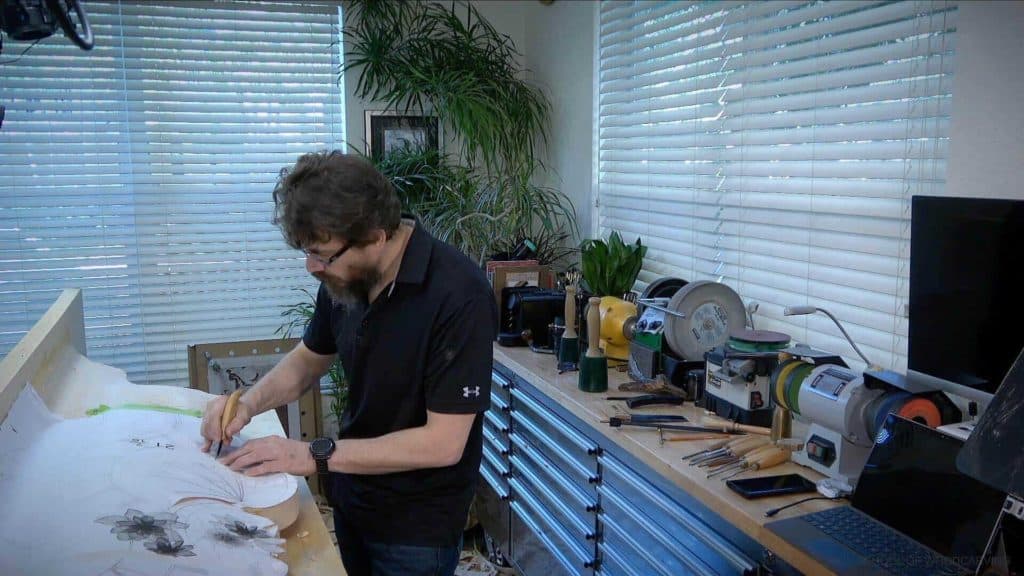
Alexander Grabovetskiy, woodcarver, School of Woodcarving · Published 2023
Is a brand new carving tool ready to use?
Quick answer: A brand new tool may arrive sharp, and I still check it. In video 12 of my first Venice Room lesson I called a knife brand new, then said it looked like it needed sharpening. In other lessons I say a new tool has a short, high bevel that I reshape.

"And looks like my knife needs to be sharpened." I said that in video 12 of Venice Room 1, not long after I called a knife "brand new." Other lessons of mine tell what I do with a new tool. Each passage is named below, with the words around it.
Ever opened a new gouge or knife and wondered if it is ready to carve? Do you sharpen it first, or start right away? Would it help to hear what I say about my own new tools? Then read on.
What this page holds
- The knife of video 12, a tool roll, a buffing machine and an 8B pencil.
- A set and two knives that arrived new, and what I check on a new tool.
- New gouges I reshaped, and a story about my first tool set.
- A table of thirteen passages.
What about my new knife in video 12?
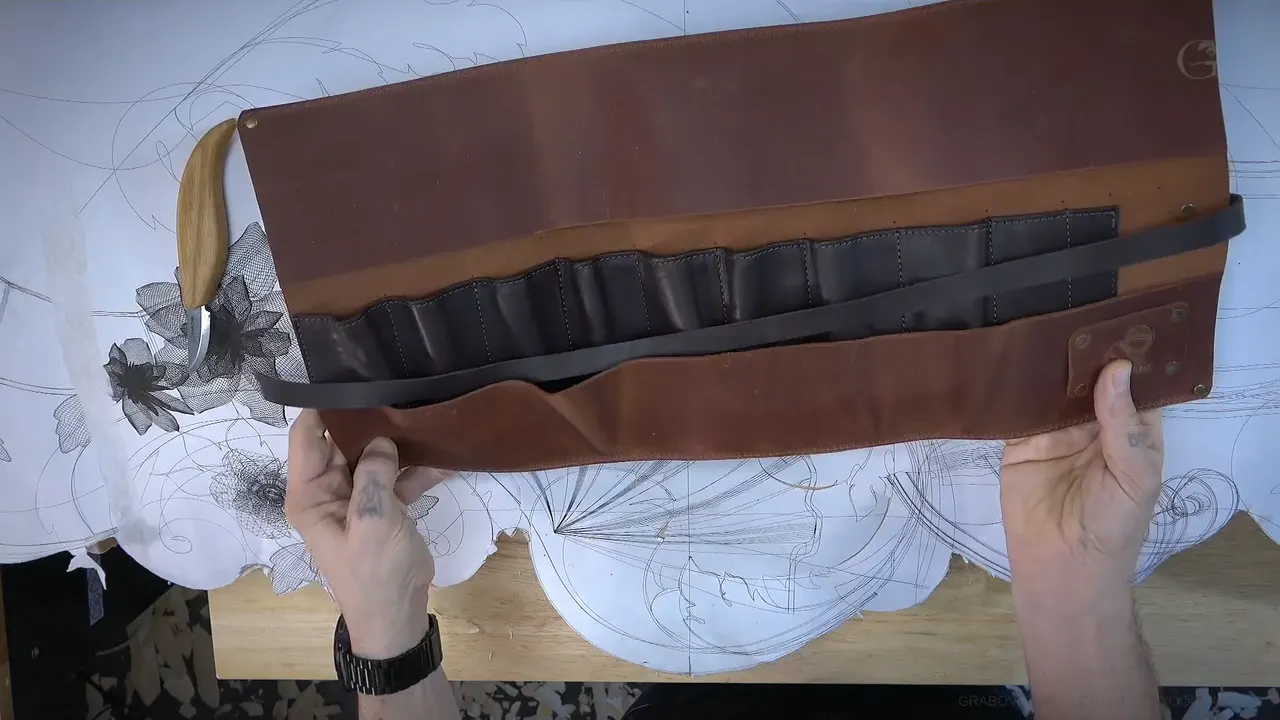
Partway through video 12 I said, "by the way, using that brand new knife sent to me." A story followed. "Yesterday, I got a surprise from them. Straight from Ukraine. The package." They also sent a beautiful leather tool roll, "for free, of course." It was gorgeous, I said, and probably the most beautiful tool roll I ever had.
I don't use tool rolls a lot, I told you, but sometimes I take one "when I'm teaching in person some places." After that came "So let me get this out." My very next remark was that "looks like my knife needs to be sharpened." Then I added that this was what I would "need for the beginning."

How did I plan to sharpen it?
Later in video 12 I came back to it. "I'm going to need to sharpen my knife because even for paper, it's not good." I described a machine too, a German one, "not really sharpening system." It is "more like a buffing system" with four paper wheels, and it "doesn't sharpen it" in my words. Paste does the buffing. My next words were "Let me do that."

What else is in video 12?
The video opens with a plan to skip details: "I don't really need to do those details right now." I can "always add and change those details if I need to." I wanted "just the main idea" and some details would change, "so they're not going to stay original."
First came "I've done mistake" then I took it back: "Not a mistake. That's not end of the world." I did not need to outline "this notch" right now. What I need, I said, was "that big chunk," a claw, "if you wish."

My tool for the shell was a pencil, an 8B, "really soft." You don't have to use a soft one, I said, and "you can use any pencil, pretty much." I like it so soft because I can do a quick outline.

I also told you why I like the project. "For me, it feels like somebody with me right in my shop and watching me." I even apologized in advance for being quiet at times.
Near the end I talked about the computer. "You have to understand when you generate it in three-dimensional world on a software, so I had to keep in mind the mindset of those people who's going to look at it." It's "not necessarily going to be exactly the same in real life." And "we are talking about 15th century carving, and the 15th century carving is never perfect lines, never." My last line was a plan to take a number nine and start carving.
Where else did I say brand new?
The same two words turn up in lessons about tools, sharpening and carving. Here is each passage with the lesson that holds it.
Do new tools come sharp?
In my All about tools for Wood Carving course I had a set that was brand new. A seller's page said not to buy the tools if you don't plan to sharpen them, and that's true of any brand, I said. "Doesn't matter what brand you buy, you still have to sharpen those tools, even if they come out the box sharp and ready to go."
Of the one brand I named, I said most of the time you can carve right away. But how long, I asked, "with pre-sharpened tools? One day, two days, maybe longer." The edge holds, I said, until "a certain point" when it needs sharpening again.
For my own tools I go further. "Any tools, any brand I buy, doesn't matter high-end or not too high-end, I still have to reshape, I have to resharpen, and I have to re-strop it or rebuff it."
That day I took a beginner's view of the set and looked at the steel. "You can see it has machine marks and it's never been really sharpened, and I'm pretty sure I have to buff it, so I can't just use it." My goal was "just to try it, if I'll be able to carve or not" and the plan was grapes on a block of wood.
Can you carve a whole project with tools you did not reshape?
My micro tools sharpening lesson answers why you should spend a lot of money if you don't carve professionally. My words: "I did not even reshape, I just took out of the box and carved the whole project, just buffed that little bit. And they hold edge, no problem so far." That was a project of grapes, in a video on YouTube.
There was a time, I added, when I carved with one knife and one gouge. For professional work, though, "you can't get that with one tool."
How did a new knife do without sharpening?
Furniture Panel 15, video 5, has "a nice surprise" early on: "some new tools, some new toys, and the best part of it, I did not have to pay for it." A European company in Ukraine had sent me "just a few knives and a few gouges to try out."

Of the first knife I said, "I even didn't strop or even didn't sharpen it," so I used it as it came. A moment later: "It's too early for me to tell you the truth, and I don't want to be biased. Just because I've got those tools for free, it doesn't mean I have to give a really good or bad or whatever review." I wanted to "honestly judge it."
Is a knife ready the day it arrives?
Greek Acanthus 11, video 1, has me holding one of my favorite knives. Some of you had ordered it and still couldn't "get a grip of this knife." My answer: "You really do have to hone that. You can see mine is just like a mirror, and that's what your knife should look like. So you have to resharpen and re-hone it to make it work for you." Straight from the box, I said, "it's just not going to work as nice."

Why does a new tool need a different bevel?
The Stropping, Honing and Buffing lesson names three stages. The first: "when you get brand-new tool, so you have to actually reshape it. Okay? So the stage number one, you have to actually establish the right bevel." I held a tool up and said, "That bevel is just not acceptable at all, because it's really short, and it's really high."
To carve, "you have to raise until you hit the wood." The space between my surface and the handle was "big four inches" (102 mm), and I still wasn't grabbing anything. "So we talking about right now five inches" (127 mm) "until I grab the material, and that's no bueno."

What does a high bevel do to your hand?
Part 1 of my sharpening class in Maine calls it "question number one in sharpening": "what bevel are we supposed to have?" I took a new tool from the room and said, "that is pre-established bevel." With it your hand goes up "really high" to carve. That lifts the elbow and the shoulder too, I said, "and after carving long time, you getting pain."

What do I do the day a new tool arrives?
Part 4 of that class gives my rule. "When I get my brand-new tool, they always, always wrong bevel. Not wrong, I shouldn't say wrong because it's not wrong." The makers supply a higher bevel "just in case if you want to use mallet, or you've got thicker hand."
My routine comes next. If a new tool is sharp, "I'll use it until it's dull, and I don't hone it, okay? I wait until it's dull." That "usually lasts couple days, three days" and then "I want to reshape it." I decide the bevel by how I'll use the tool, and my tools mostly get "low bevel. Plus micro bevel on inside." At the station I start sometimes with 80 grit or even rougher.

How long a bevel do I give it?
Hashemi Flowers 24, video 4: "Almost on all of my tools, I have a long, long bevel." New ones come with a bevel that is "usually really short." I use a short bevel on harder woods, like oak, and the long one "almost everywhere, pretty much. Actually, on oak also. But it makes it a lot easier to slice through the fibers when you do have a really, really, really low bevel. So, a lot less resistance, I should say."

The spoon gouge lesson has a line about one tool: "When it comes brand new, it's not what I like." In Sharpening Straight Gouge, video 3, two tools sat side by side. One had a "really high angle." The other "we just did ourselves": "We reshaped the tool and repolished that. And this tool is ready to go."
Any trouble with the steel of a V tool?
V Tool Sharpening 3 names a second kind of problem, and this one is about the metal. "Sometimes, when you buy a brand-new tool, you do have a problem with the metal on the sides. Sometimes it's thicker on one side and thinner on another side."

I wouldn't tear my hair, I said. "It's still workable. You sharp it, and you use it. You don't throw away."
Which new gouges needed reshaping?
Acanthus over Moldings 1, video 2: "This one is brand new, and in this case, it is number 10, but actually, it's pretty close to number nine." It had "a really, really, really high bevel. Obviously, I had to regrind this one, and I got rid of that high heel, but it's going to help me in this case. It really helps to create the straight down cuts."

Next, Sharpening Fingernail Gouge. I called the chisel "actually brand new," one of a couple I got as a gift, and said "I need to regrind, like I do on all of my new tools."
The skew bent gouge lesson starts with a number eight, 5/8 of an inch (about 16 mm), whose edge is "kind of rough." It had "never been sharpened, never been honed." Pretty much a brand-new tool, I said, and "I need to rework."

And in the next lesson, Venice Room 2, video 1, I said, "I think I need to reshape this one. This is a new gouge, and I never reshaped that one."

What was my own first set like?
It comes up in the first video of that straight gouge lesson. "I remember when I bought my first tool set, and I paid like half a thousand dollars for just a few gouges." Each one was ready to carve, I said. "I knew how to sharpen one gouge, but I didn't know how to sharpen so many, like in a set. And I had to develop that."
Which videos use the words?
The table sets thirteen of them next to the words around them.
| Where I said it | What I said about the tool |
|---|---|
| Venice Room 1-12 | A brand new knife, and a note to sharpen it |
| Venice Room 2-1 | One new gouge I never reshaped |
| A tools video | A set to try, and any brand gets sharpened |
| Micro tools sharpening | A whole project, just buffed a little bit |
| Furniture Panel 15-5 | A knife I did not sharpen or strop, too early to tell |
| Greek Acanthus 11-1 | A knife that does not work as nice until it is honed |
| Stropping and Compound 1 | A bevel short and high, stage number one |
| Sharpening class 1-1 | A high hand, then pain after a long time |
| Sharpening class 1-4 | Carve with it, wait for the dull edge, then reshape |
| Hashemi Flowers 24-4 | Their bevel is really short, and mine is long |
| Acanthus over Moldings 1-2 | A number 10 with a high bevel, reground |
| V Tool Sharpening 3 | Metal uneven on the sides, still workable |
| Skew Bent Gouge 1 | Never been sharpened, never been honed |
The course page holds every video of these workshops, and Venice Room 1 holds videos 11, 12 and 13 with the rest of that lesson. Carving Tool Sharpening holds the sharpening videos named here. Every video named here sits inside tuition to the school, paid monthly or yearly and renewed automatically until you stop it. Wikipedia has short pages on Venice and on the gouge.
How it's done
- Check the bevel. On a new tool I look at the bevel first, because new ones come with a high bevel.
- Carve while it is sharp. A sharp new tool gets carved with, and I do not hone it. A few days is usual before it dulls.
- Pick the new bevel. How I plan to use a tool decides its bevel, and most of mine get a low one plus a micro bevel inside.
- Begin at the station. Reshaping is the first stage. I start sometimes with 80 grit or even rougher.
- Finish on leather or felt. After that I strop or buff it, and the tool goes to work.
- Do not throw out odd metal. If one side of a V tool's steel is thicker than the other, it is still workable. You sharpen it, and you use it.
Frequently asked questions
Did the new knife of video 12 get sharpened?
Right after the tool roll I said my knife needed to be sharpened. Later I said I would need to sharpen it because even for paper, it's not good. I described a German machine, and my next line was "Let me do that."
What kind of machine was it?
To me it was more of a buffing system than a sharpening system. It has four paper wheels and buffs with paste instead of sharpening.
Does a new tool come sharp?
It can. In a tools video I said you must sharpen any brand, even when it shows up sharp. My micro tools lesson has me carving a whole grape project with tools I did not reshape, just buffed a little bit.
What to carve next
- Venice Room part 1 course page
- Venice Room 1
- Venice Room 2
- All about tools for Wood Carving
- Carving Tool Sharpening
- Sharpening class in Maine
- Stropping, Honing and Buffing
- Hashemi Flowers 24
- Sharpening Straight Gouge
- Sharpening V Tool
- Sharpening Fingernail Gouge
- Sharpening a Spoon Gouge
- Sharpen Skew Bent Gouge
- Sharpen Micro Tools
- Greek Acanthus 11
- Furniture Panel 15
- Acanthus over Moldings 1