
Alexander Grabovetskiy, woodcarver, School of Woodcarving · Published 2023
Should you take your watch off when you carve wood?
Quick answer: In Venice Room 1-14 I said taking the watches out was maybe a good idea, with a lot of shaking going on. Elsewhere a watch was in the way, or viewers did not have to see it. Each line follows, with the work around it.
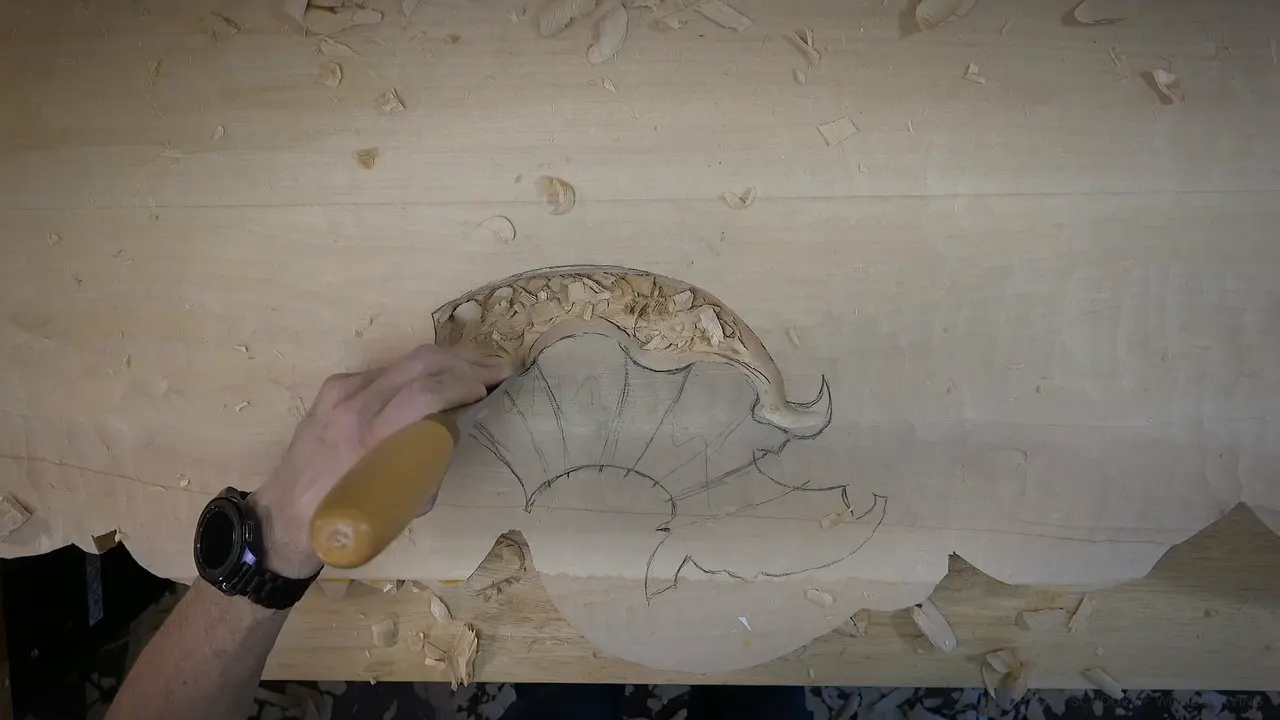

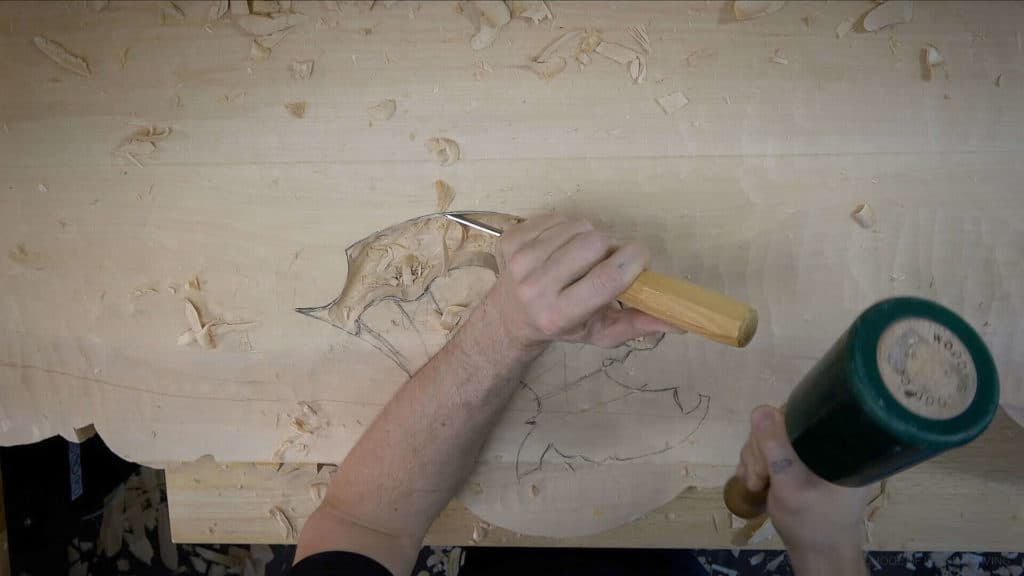
"Maybe it's a good idea to take my watches out because there's a lot of shaking going on." I said it in Venice Room lesson 1, video 14. A pattern is drawn on a pale board, with chips already lying on it.
Other lessons have me taking a watch off too. Why I did it changes with each video. Every lesson I name here is linked, and you can go and look.
Ever started a hard job and felt something on your wrist get in the way? Does your bench jump once a mallet comes down? These lines are for you.
What this page holds
- The watch in video 14, and the tools around it.
- Gouge sizes in inches and millimeters, and one gouge that is not quite what its mark says.
- Videos where a watch came off, with my reason when I gave one.
- A piece that shakes in the vise.
- One small table.
Which tools did I name before the watch line?
The video opens in the middle of a job. I wanted to see if a number seven would work on the inside, a smaller number seven, "like 35 millimeters" (about 1.4 in), which I also called an inch and a quarter (about 32 mm). It was a little too big, but that's okay.

Then, "Okay, let me get number 11." That one is five-eighths of an inch, 16 millimeters (5/8 in is about 16 mm). The plan was to clean that stuff out a little better. Long bend, I called it. And that's 5/8 of an inch.
The watch line came next, with a maybe in it. Nothing in it says every carver must.

Which tools did I say I would use for authentic 15th century work?
Mostly gouges and veiners. "I would like to be authentic to 15th century in this project," I said, "which means mostly I'm going to use gouges and veiners, and try not to use any V tool, but we'll see." The 15th century was my word, and so was that "we'll see" at the end.

A smaller eleven came next. Its size was "about half an inch" (about 13 mm), or "maybe about 14 millimeters, I'd say" (about 0.55 in). Why do I like it? The U shape. When I look at it, the U shape makes sense in this case.
The plan was to go in right there. "Okay, you can see it starts chipping." Carrying on with the grain would be a mistake, so I had to attack from the opposite direction.

"That would be enough for now." A smaller number eleven was what I needed, to go inside even deeper. A pause followed: "Now, let me think. I can probably start cleaning."
What is marked on my number nine, and what is it really?
For the cleaning I would take a number six at 20 millimeters (0.79 in), and chop straight down 3/4 of an inch (about 19 mm). "That's pretty much how much you can go with that."

Then: "Maybe. No, it's not. Let me switch to number three and half an inch, 14 millimeters to be exact." The half inch is about 13 mm, and the 14 millimeters is about 0.55 in. I said both.
Something smaller was needed right there, and the tool went back. Number nine was next on my list, named a half-inch tool, yet it is not really one. Why they marked it that way, I had no idea. The mark says 14 millimeters, and you can see it right there, number nine. Really it is 5/8 of an inch, about 16 millimeters. "But it's okay. It's close enough."

How did the video end after the number nine?
It was good, I said, so we had pretty much outlined that part. I needed something flatter. Number three at 20 millimeters, three quarters of an inch, was the tool for chopping right there, and around.

The last lines were about the mess. "Looks messy, but it's okay because that is not the final background yet." All I needed was the main idea. A little bit of cleaning going to help me see it better, but I really didn't need to do that. The last line in the transcript is "Maybe a little."

Which other videos have a watch coming off?
Here they are, one by one, with the reason I gave when I gave one.
Where else did I say "It's in the way"?
The Roman acanthus course has it, in lesson 16, part 1. I took a number seven, about 20 millimeters (about 0.8 in), to use upside down. About the watches, I said: "It's in the way." I planned to make it more round, and to attack from both sides.

Later in that video my tool needed a little buffing. It did not do what I wanted. It leaves a black mark, I said, which means my steel or metal is taking out. It's actually sharpening. One more try, and then: "Oh, yes. Much better."
What was my watch line in the April 2020 livestream?
My April 2020 livestream has me showing a tool. "Take a look. Out of the box." It gives me an absolutely beautiful, clean result, I said. Then: "Oh, I need to take out my watches. You don't need to see them."
I really, really liked that tool. A closer look came next, for you can see the quality of the work, I told the viewers.
What was the job in Venice Room 104 when my watches came out?
The area I was going to outline was an inner part. The distance between the highest spot and the lowest spot, on the side of my future flourish, will be about 10 millimeters, maybe about 11 millimeters or so (about 0.4 in).

I would take number 11 and my mallet. A heavier mallet, probably, like 30 ounces or so (about 850 g), and I would outline it. Then came the watches line, with no reason given in that passage. After that came the deepest spot, approximately 10 millimeters. See lesson 104 for the video.

How does a watch end up beside a knife in Venice Room 110?
There I said I had an idea, a little change, and I hoped viewers would like it. For me, that line was just a little too boring. "Why don't I make some waviness," I asked, like real-life waves, along the edge. Some slight concaves and convexes could go there too.
Probably just a knife, I said, and then: "Get rid of my watch." After it came "And I'll create that waviness." That passage gives no reason for the watch either. The video is in lesson 110.
How did my watch line sound in workshop 120?
The outline came first. "Carefully going to start outlining. The first cut going to be right on the line." A little later I said, "You know what?", and then came the watch line itself, "Let me take out my watch." My next words were "I don't want to distract" and I added a plain "And let me continue."
After that, I said, I stay away approximately one-eighth of an inch (about 3 mm) from the edge, so you can see that ridge. With the smaller tool it is more obvious. A decision came: how deep did I really want to go? It had to look like a 3D movement, and I really would like to see much deeper shadow, even if I have to lose some inner details. Later came a big number seven, three inches (about 76 mm), and I thought it would give me a really nice result. Number two, or number three would work, but I said I would try number two first. "And that is perfect." The whole video is in lesson 120.

How do I carve when my piece shakes in the vise?
In Roman acanthus 16, part 2, I said it plainly. "Some of you probably don't like that my pieces are shaking while I'm carving, but that's the way I work." My setup is two vises. That way I can attack from different points, and I'm used to that.

If you don't like that shaking, please use a stable work bench and fasten it really nicely. For me it doesn't create a lot of problem. On those carver vises I have done huge pieces, like in the lesson with the lion, or a lion head, I should say. And I still use exactly the same carver vise.
In lesson 5 of that course, part 3, I promised to teach you the way I do it, and most of my carvings I do just like what you see right here. I put it another way. "Sometimes it's shaking, sometimes it's just kind of flimsy." I took the word back. I should not say flimsy, but on portable workbenches and so on, that is a condition I work.

Now a story. In Russia, there was a movie I saw about the school of spies, where they taught future spies to write while the table would float and move. They had to learn to write with the pen on the floating, shaking table, and write that accurately. Think of yourself learning the same skills, I said.
A really stable workbench is absolutely fine, I said. I like my portable workbench, and I really like the vise I'm using right now. It's a very tough vise. I can rotate it, and I can take it out really quickly. A shaking workpiece doesn't bug me. Maybe sometimes it's hard to watch, but I promised to show you the way I'm carving, and that's the condition most of the time.
What if the bench is only shaking today?
That is a line from Carving Hazelnuts lesson 4. Just before it I said I would go perpendicular to the grain. Then: "My bench is kind of shaking today."

Lesson 154 of the Venice Room, part 1, had my plan to refasten my piece more solidly on the workbench, because right now it's kind of loose, and it's just vibrating. A moment later, my clamp was in place, so it should be a lot less vibration, I hoped. Then: "And yes, it is. It's just actually excellent. And I can get my cuts much deeper."

Lesson 76, part 11, has a mallet that could help me, and it would be much easier. There is some vibration, of course, but "it doesn't bug me."

Is every kind of shaking the same?
The jigsaw in the first Venice Room lesson, video 6, has a vibrating of its own. Look really close, and there are three different positions on it, zero, one, two and three. Set it to three, and it is going to be vibrating like this, a lot more progressive, but it gives me a lot rougher cut. Right then I was on zero, which gives me a really, really nice cut, almost perfect.
Go too aggressively with a router plane, I said in Furniture Panel lesson 19, and it leaves some marks, jump marks. "Even if you don't see that, but that vibration when it just gives that resistance, creates those marks." A scraper is my preferred way to get rid of them.

Which videos sit right before this one in lesson 1?
Video 13 begins with three-quarter of an inch, and being really aggressive on this side. That is my marriage line. So I have to attack from the opposite direction. From the same direction, it would split, and that would damage my overall shape.
Nine was the number I used, almost three-quarter of an inch, 20 millimeters to be exact (0.79 in), with a really long bevel. I wanted to see it really deep, and right then I was about one inch deep, 25 millimeters, at the deepest spot. Careful not to undercut, I said, because if I force it, I lose the detail.
In video 12 I outlined with an 8B pencil, really soft. I like it so soft that I can do a quick outline. The details could wait. "Just the main idea."

Which video says what about the watch?
This table lists each video beside my words about the watch.
| Video | What I said about my watch | The reason |
|---|---|---|
| Venice 1-14 | A good idea, maybe, to leave the watches off | Shaking |
| Roman 16-1 | The watches go, and the seven goes upside down | In the way |
| Livestream 2020 | I take my watches out, you don't need to see them | Not for viewers |
| Workshop 104-3 | My watches come out before a number eleven outlines | None given |
| Workshop 110-2 | Rid of my watch, then waviness along the edge | None given |
| Venice 120-3 | My watch comes out, then the work goes on | Not to distract |
The course page holds the first twelve workshops of the Venice room, and Venice Room 2 comes right after lesson 1. Every video named here sits inside tuition to the school, paid monthly or yearly and renewed automatically until you stop it.
How it's done
- Say the shaking. Video 14 has the shaking said out loud, and a maybe on the watches.
- Pick up the first tool. Seven of 35 millimeters (about 1.4 in) came first, and an eleven of 5/8 in (16 mm) after it.
- Name what is in the way. Watches were in the way in Roman acanthus 16, and I said so.
- Think of the viewers. In workshop 120 I took my watch out, said it was so I would not distract, and went on.
- Fasten the piece. Lesson 154 has my plan to refasten the piece on the workbench, and then the clamp was in place.
Frequently asked questions
Is a watch off for every carver?
Lesson 1 has me saying maybe, with the shaking as the reason. In other videos the reasons differ, and in some I did not say why. I never call it a rule.
Which video says a watch is in the way?
Roman acanthus lesson 16, part 1. Number seven, about 20 millimeters (just over 3/4 in), was going upside down, and the watches were in the way.
Why did my watch come off in the livestream?
The livestream had me holding a tool I really liked. I told the viewers they did not have to see them, and then I held the tool closer for the quality of the work.
What to carve next