
Alexander Grabovetskiy, woodcarver, School of Woodcarving · Published 2023
What are bench cookies used for in wood carving?
Quick answer: Bench cookies show up in the second video of my first Venice Room lesson, under a board ten foot long (about 300 cm), ready for my jigsaw. I called them a lifesaver sometimes. Other lessons use them under a corbel I called super heavy, and one lesson has a job they do not suit.
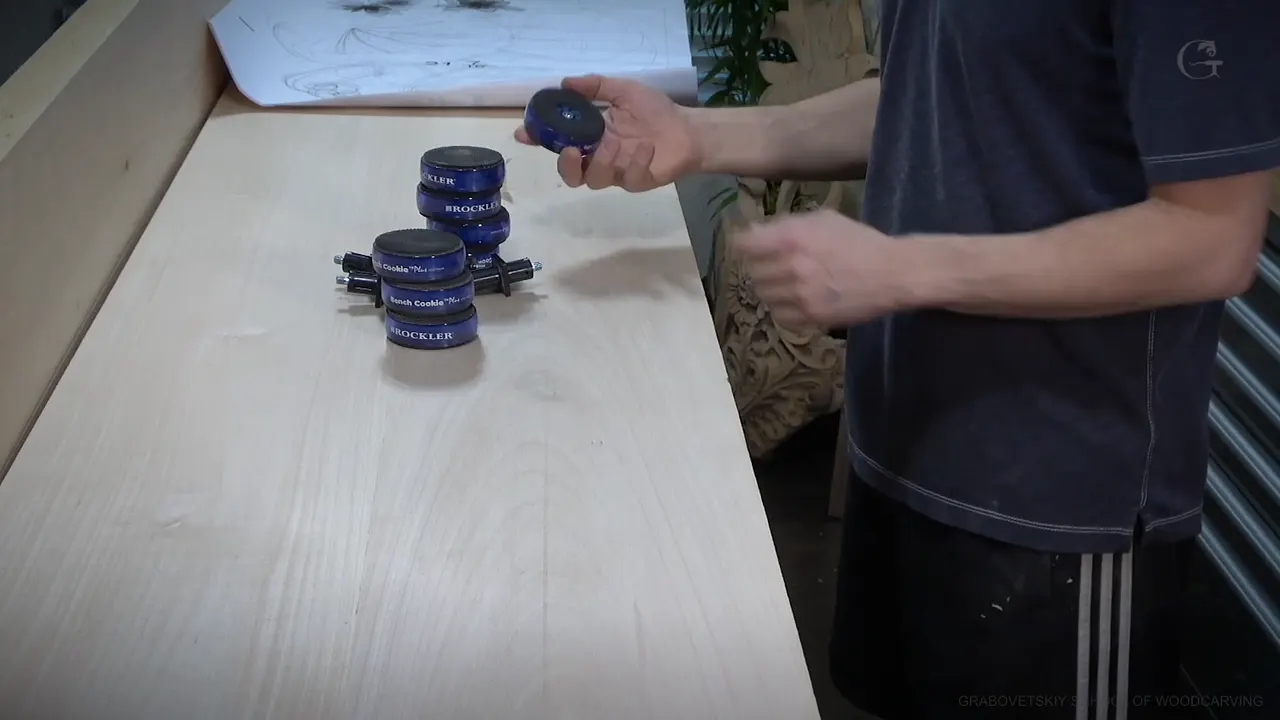

Cookies came up in video 2 of Venice Room 1, where a set of four rubber pads went under a long board for my jigsaw. I called them a lifesaver sometimes. In other lessons the same pads hold a corbel I called super heavy, and one lesson has a job where a cookie would not do for me.
Ever had a heavy board slide away from your gouge? Did you ever need a board high enough for a blade to pass under it? Then you know the job. Below are the lessons I read for this page.
What this page holds
- The long board in lesson 1, and the pads under it.
- One piece in lesson 3, held with no clamp.
- My rolling bench in lesson 49.
- A jigsaw job in lesson 75 and a corbel in lesson 79.
- A line about a cookie from lesson 66.
- Fragile petals, from a Techniques lesson.
What was the board lying on before the cookies came out?
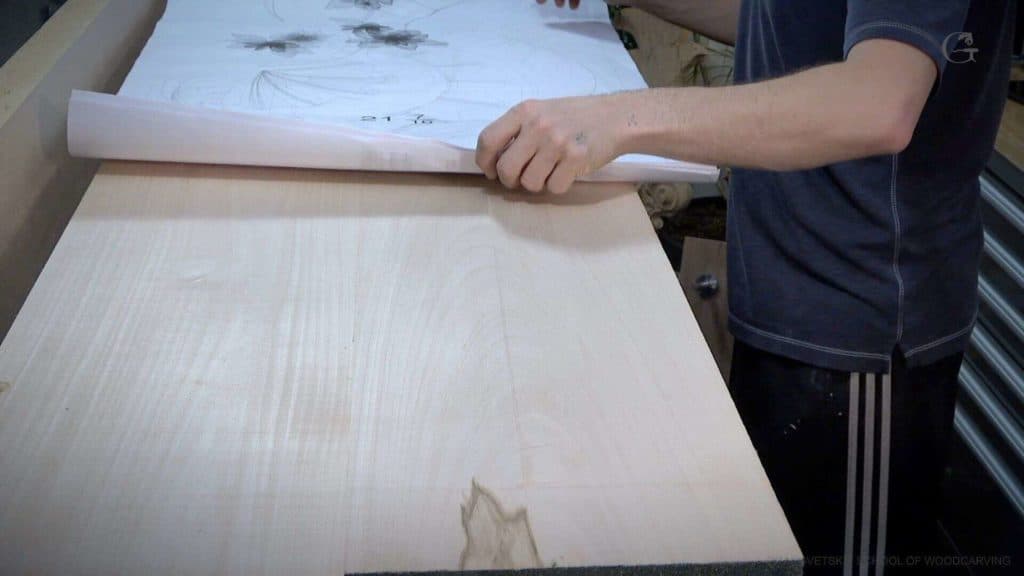
My workbench, and nothing supported it. The day begins on the outline: "I want to work on my design. Not the design, but I want to cut outline." I had printed some paper to follow. For the main outlines I used a CAD program, plus some hand drawing, but with the CAD it was much quicker for me.

Next came my tape, to double-check how wide it would go. Approximately 20 and a half inches (52 cm). "I want to make sure I do have enough property right here. And yes, I do." Overall it will be really, really good, though I don't have too much, which means my line has to sit pretty much on the edge.
That board comes from video 1 of the same lesson. The middle piece would be 10 foot long (about 300 cm), with a first layer about two inches (51 mm) thick.
Here is how it sat that day. "Right now, the board is laying on my workbench. And nothing supports. I did not clamp it. I can move it easily, and that is not the right way to work, I guess."
How did I name the pads that fixed it?
"So-called cookies." Then: "those cookies are really a lifesaver sometimes." Put one down and it is just rubber on both sides.

I showed you one, and I said there are different brands of those cookies. "I have extension legs, and I have cookies itself." And then: "it's actually called cookie."

"Check them out, by the way." If you don't know about them, I said you can look them up, and other places also sell them. There are a couple of other brands, I think.
How do cookies help a jigsaw?
I can use them with my jigsaw. One cookie goes right underneath my board, and it gives me enough height for my blade to travel. "That's why I like those."

They are not an everyday tool for me. Sometimes, once in a while, I think it's a smart idea. Four of them were the plan. Other ways exist, of course: I could just pull my board over myself to the edge and work that way. With the cookies, I think it's smarter or wiser.
In video 1 of the same lesson I said it is all hand carved, of course, but "if I can incorporate a jigsaw or a scroll saw, sometimes I will."
I wanted to place them where they would stay out of the blade's way. Once they were in, "Okay, wonderful. Now it's higher, and I can work with my paper."

What else happened on that bench in video 2?
The bench itself is just a tool chest with a wood top and wheels, and I can move it if I need to.
The project would probably take a long time. "When I'm saying long, I'm not saying years. Of course not." Then: "at least three months, I would say." I don't have a big printer, and I'm not planning to get one. I thought about a big plotter before, but then I would have to find the extra space to keep it, and I don't see the big advantage of it.

The paper would get no glue, since I would reuse my papers. Push pins would hold it at first, and I would outline with the knife to see exactly where my cut would be. Then comes the jigsaw. Any jigsaw will do. Mine is a Festool, which gives me a really nice 90 degree cut. The blade in it was not the proper one, so it needed changing.
About the shell: "This part right here. So that is going to be a big, huge shell." After that: "Okay, let me find the next one." What I needed for the day was "this side right here" and the "opposite side also."
What did I do when one side got heavier?
I moved the pads. This line is from video 8 of the same lesson: "Let me reposition my cookies, because right now, this side is much heavier, and I want to make sure I have a good support." Then, "That is good. And I can just continue to work."

One more line comes from video 6. I was checking my cut with a square, and then: "let me see if anything in the way. I'm talking about cookies I have." Right after it: "And I can just do this side first, right?"

Do I clamp a piece that sits on cookies?
Venice Room 3, video 12, has this line: "You probably have a question how I fastened my piece on a work table, and I actually did not clamp anything. It's actually staying on my cookies."

Rubber prevents the piece from slipping. If the piece is heavy, I said, it's a good idea. Later on the piece would become less heavy, and then I would probably have to fasten it, from the backside. "But as of now, it works just fine."
Venice Room 49, video 6, has the clamping question as well. "You're going to laugh maybe, but there is no clamping system at all on this particular piece." A solid block of wood, multiple pieces glued together, really heavy.

Cookies sat under it. I explained the name this way: "It's called like a cookie. It's just like whatever you eat." I said I own different brands of them, more than one kind. Rubber on both sides. It just prevents slipping.

Why does my bench move while the carving stays?
The piece is so heavy that it is not moving anywhere. "My bench is moving, but not this piece." There is a reason for the bench: I have so many tools, and I organize them in drawers.
Half a thousand tools live in those drawers, which I can open and reach on both sides of me. This bench runs about eight foot (2.4 m) in one direction. Behind me stands another, with all my sharpening systems and more drawers, also about eight feet (2.4 m) long. The bench I use is a tool chest with drawers, on wheels, and it is working really good. My tool layout has its own page, work bench organization.
"So hope it answers your question. So that's what I'm using to hold my piece."
Can cookies lift a piece for the jigsaw in lesson 75?
In Venice Room 75, video 1, they did, and one line there was "I think I can just do a jigsaw." Sawing it roughly was the plan. I did not need to be right on the outline. It was approximate, and that was the boundary to cut out.

"Let me raise a little bit, because if I'm not going to raise it, my blade going to hit the workbench." Not too much, only "a little bit, and I'll just use the cookies. Bench cookies." Then came the line "Get three of them underneath." And a remark: "this is heavy."

"I think it's good enough." Then a correction: "High enough, I should say." After that came "let me make that quickly" and then "There you go. So it took me literally just about 30 seconds."

I would keep that piece, just for repairs and so on. The only downside to this operation: I don't really like to have any dust, and I hate it in my shop. "There's always a solution for that." "Just vacuum it."
Which cookies held the corbel in lesson 79?
The same kind of pad turns up in Venice Room 79, video 1, which opens on a huge corbel: super heavy, about 42 inches (107 cm) long and about nine inches (23 cm) thick. I needed to place my piece right on the bench. "I'm using those cookies to hold it, and that's super heavy."

Next I wanted it flush with my workbench, positioned the right way, with the right support on this end. And I don't want to knock my lights. "I've done it before, so it's not a good idea."
Then came the plywood. "I also get a piece of plywood with the supporting shelf, which I use just small pins, so really easy to remove and reuse it."
A speed square shows up in video 2, a really, really easy-to-do process. "Maybe I can just clamp that also. Somehow, I don't have anything to grab." Even so: "it's okay. That's fine." Next: "Maybe I'll just support it with the cookie. It's going to hold it in place."

A smaller clamp was one more thought, and I really don't have to use those. A couple of screws, right here, was what I probably should use.
Which cookies did I use in lesson 79?
In lesson 79, video 3, the work is just removal of material. "Nothing exciting." Then: "I'm going to place it on the cookies again." I said that is what I like.

I could not recall the maker of the orange ones, and I let it go. And about the piece itself, I asked and answered: "That's stable?" "That's stable." And one more plan: "Let me place it the way I want to carve it, and I'm going to carve across."
When did I say a cookie would not work?
In Venice Room 66, video 10. "Now I need to use a spoon veiner, to be exact." Maybe seven millimeters (0.28 in) will work. I do have leverage on that point, and it's a big chunk yet, so I'm safe pretty much to crank it against.

But: "it's always better to protect with the other piece of wood if you do have it, or something. Not to damage it." Then the cookie line: "Even if you would use something like that, like a cookie, if it's going to be possible for you to crank against, that's always better." And my own case: "In my case, cookie is not going to work, but it's a good idea."

Another idea was short. "Otherwise, you can just use your finger as a leverage point." Pushing too hard on this edge is what I don't want, even if it's not developed yet. And once the detail is done, "you really don't want to mess up."
Are cookies safe for a fragile carving?
Cookies did not suit one job. The Techniques lesson on back cutting has step number two, flipping the piece, and "it's not safe to flip it on the bench. You create the pressure, or you're going to break those petals, and they're really tiny petals."
Some people use bench dogs. I corrected myself with "I'm sorry," and I said my cookies come from more than one maker. It doesn't have to be one brand. "But those are just the cookies. You place them right on your bench and place your piece on it, but still, you can't create pressure." Break it 100%, I said, and it's not safe for the fragile pieces.

The solution was soft foam made for the audio studio. It's really safe and really soft, and "I can create the pressure without the breaking." The lesson sits in a simple tip for back cutting, in the Techniques course.
Which lessons put cookies under the work?
The table puts each lesson beside what the cookies did there and what came next.
| Where | What the cookies did there | Next |
|---|---|---|
| Room 1-2 | Four gave the blade enough height | The paper |
| Lesson 1-8 | I repositioned them, one side was much heavier | More work |
| Venice 3-12 | One heavy piece stayed on them, no clamp | Fasten later |
| Workshop 49-6 | A glued block lay on them, my bench moved | My bench |
| Class 66-10 | A cookie was ruled out for that job | A finger |
| Part 75-1 | I used them to raise a board for the jigsaw | A vacuum |
| Session 79-1 | They held a super heavy corbel in place | Right support |
| Lesson 79-3 | A plan to place the corbel on them | Carve across |
| Back cutting | Not safe for tiny petals, I said | Soft foam |
The Part 1 course page holds all twelve workshops of the room, and the tools course has more pages on tools. Wikipedia has short pages on Venice, the gouge and the workbench. Each video named here sits inside tuition to the school, paid monthly or yearly and renewed automatically until you stop it.
How it's done
- Raise the board. In video 2 four cookies went under the board, and one right underneath gives my blade enough height to travel.
- Place them clear of the blade. I made sure the cookies were not in the way of the blade.
- Reposition for the heavy side. When one side was much heavier, I repositioned my cookies to have a good support.
- Skip the clamp on a heavy piece. A heavy piece sat on cookies in lesson 3, and the rubber prevents it from slipping.
- Keep fragile work off them. For tiny petals I said cookies are not safe, and I used soft foam instead.
Frequently asked questions
How many cookies went under the board in video 2?
A set of four, I said. A cookie placed right underneath my board gives me enough height for my blade to travel.
Are bench cookies safe for a fragile carving?
No. Cookies do not suit that job, I said: you cannot create pressure, or the tiny petals break. Break it 100%, I said, and flipping the piece on the bench is not safe.
Did I clamp the piece that sat on cookies?
Clamps stayed out of lesson 3, video 12, I said. That piece was staying on my cookies, and later on I would probably fasten it from the backside.
Did I say a cookie can protect the carving when I crank a tool against it?
What to carve next