
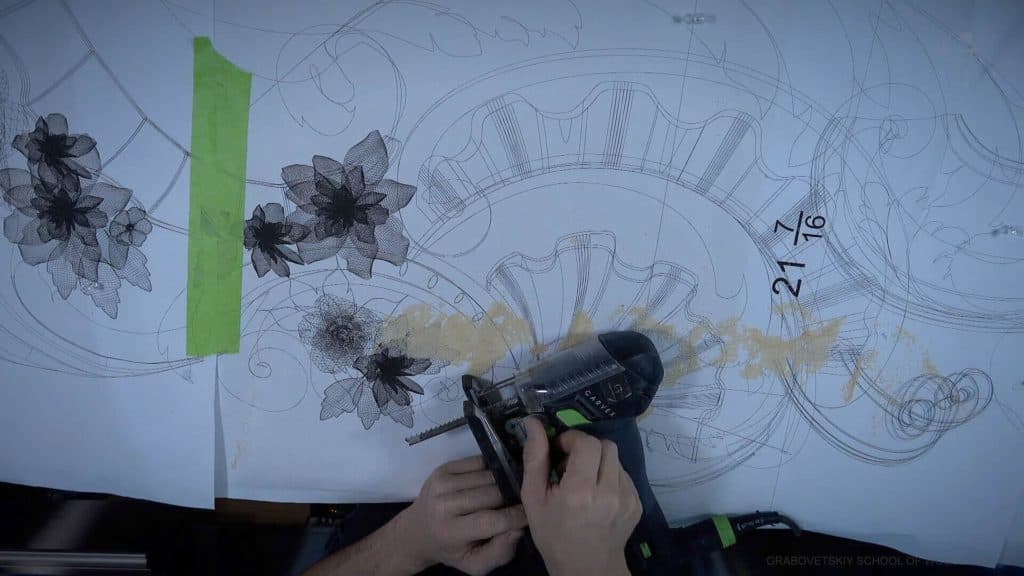
Alexander Grabovetskiy, woodcarver, School of Woodcarving · Published 2023
What does a wood carver mean by "adds up"?
Quick answer: Before my first jigsaw cut, in video 6 of Venice Room 1, I said a mistake of 1 mm (0.04 in) or 2 mm (0.08 in) in the first measurements adds up later. Other videos of mine say it about small details, and some say the opposite.
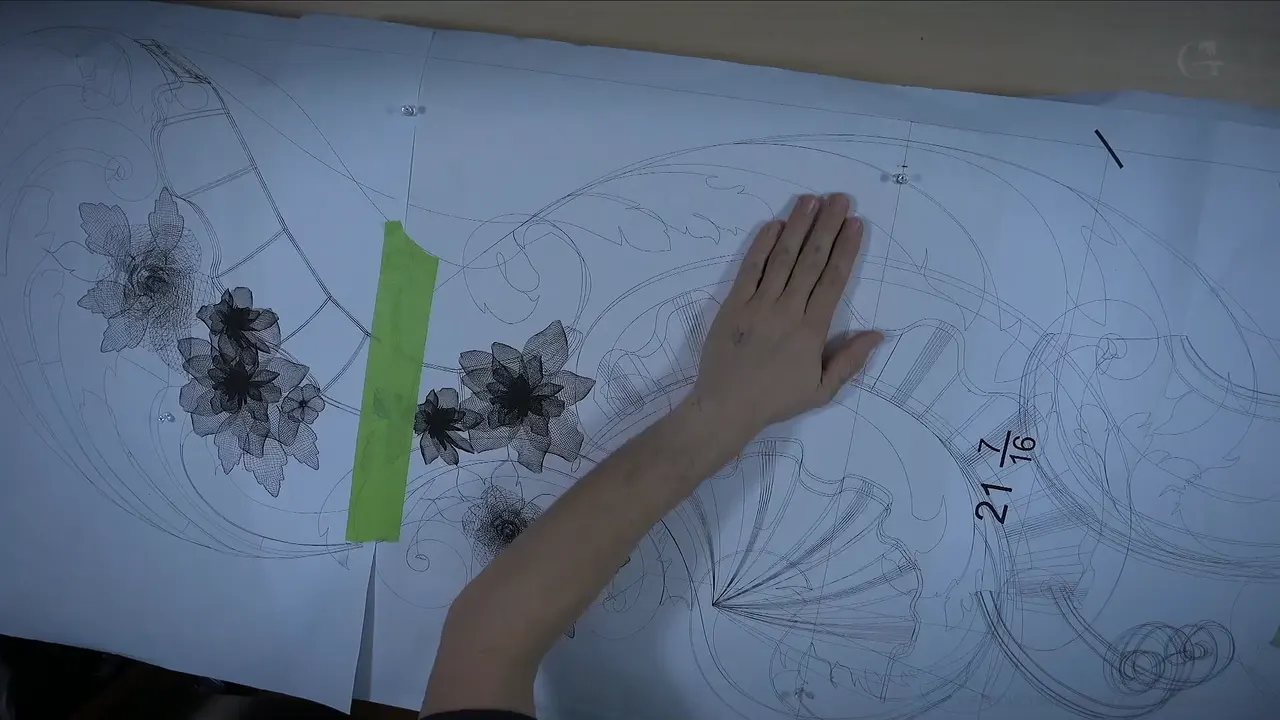

A mistake in the first measurements, I said in Venice Room 1, adds up later. That line is where this page starts. Other videos of mine use the same two words for small details, and some go the other way. Each lesson I name is linked.
Ever measured twice and still wondered if a millimeter matters? Did you start a jigsaw cut and hope the blade was square? Then this video is for you. I check, I check again, and I say sorry for the time it takes.
What this page holds
- My words in video 6 about the edge, the first measurements and my grandpa's rule.
- The jigsaw, with its blade, a square and the settings.
- The videos on each side of it, in lessons 1.5 and 1.7.
- More videos with the same words, in lessons 17, 20, 23 and 30 and in a Gibbons class.
- A table of every video.
What did I check before the first cut?
The video opens with a check: "Double check. I need double check." I want to be sure "everywhere, because it's really important, like I said." Pointing at a spot, I say it "is going to be the edge." Then a pause, "Hold on."
Next comes "I checked everything and looks like I am ready to carve... I mean, make my cut."

Why do I take so long on the measurements?
The wait needs an apology, I say. "I apologize if it takes little long, but from the first measurements, it's always really important." The reason follows. "If you make mistake right now, even just the one millimeter, two millimeters, later on, it all adds up." One millimeter is 0.04 in, and two millimeters is 0.08 in.
My own list is long. "It's why I'm measuring, remeasuring, checking, double-checking, triple checking, seven times checking, okay?" Then my grandpa joins in. "Like my grandpa said many times, 'Measure seven times, cut once.'" My comment on his rule is that it's "a really good wisdom."
Knife first, or the jigsaw?
Two ways in are open. "I could actually cut by knife all the outline and just outline with the pencil, or I could actually cut right away pretty much to the line with my jigsaw." About that saw, the word I use is preference. It is "really a preference of mine just because, first of all, it just gives me absolutely the best cut, I would say, as far as the 90 degrees cut."

How do I know the blade is square?
The blade gets a look first, with "Let me check the blade" and then I say it "is absolutely 90 degrees." I call that "one of the advantages of it."
I plan to start the saw at a weak point on the middle line. "Because it's kind of weak point, and once it spreads, it becomes really thick, and I can always separate on this line." I point at the spot and say "I'm talking about right there, the middle line."
Two branches are in the plan. If the cut is on 90 degrees, "then I can go right to the line." If it is not, "then I'll stay away maybe about eighth of an inch," which is about 3 mm, and make "a preliminary cut somewhere, in some area right there."

Which blade is in the saw, and what is wrong with it?
"I probably have to mention what blade I'm using." It is the progressive one, "really fast, but disadvantage of this blade, it's cutting upward, and that's not the best practice." My verdict on it is "So that is not the best." Of other blades, "I really like more nicer blades, but it is what it is."
Two blades go side by side for a look. "If you look close, so you will see this one cuts downhill and that one cuts uphill, so it just pulls out the fibers and this pushes down, and this one gives me a much cleaner cut."

And on the progressive blade: "This one is actually gives me quicker cut, so that's why I like this one also."
How do I check a cut with a square?
The plan for checking is "just a square" and the verdict is "just perfect, right on the money." You cannot see it, and I tell you so. Moving the camera just to show you is not something I want to do.
A look around the bench comes next, for anything in the way, and the cookies I have are what I mean. The side to start on is this one: "I can just do this side first."

Why a preliminary cut before the line?
On the noise I say "Apologize for that noise, but this is the way to do it anyway." My preliminary cut is done, right in the middle, and my next move is to attack from one side. Then "it looks like I am right at 90 degrees" and "I can just go ahead and cut that right to the line."
Afterward, "let me double-check. And that's just absolutely perfect." The cut went over the middle "because I have preliminary cut." I do not want a burnt blade or too many turns, and my verdict is "this is the best way, I think, anyway."
What do the settings on a jigsaw do?
"I probably have to tell you about the setting of the cut." The jigsaw has "three different positions" and I count them "zero, one, two, and three."
On three, I say, the saw will be vibrating and cutting "a lot more progressive" and giving "a lot rougher cut." On zero, where I am "as of now," the saw "gives me a really, really, really nice cut." I call it "almost perfect cut."

What came before and after this video in lesson 1?
In video 5 I left "approximately three millimeters" at the edge of my paper, about 0.12 in, and the board is "exactly inch and seven-eighths right here," which is 1 7/8 in, about 48 mm. I say "I need to make sure I do have a right dimension."
Video 5 has a doubt in it too. "I think I'm making a mistake," I say, and "I might have to move it slightly down." The answer comes right after, "No, I don't think so" and "So we are on the right track."

In video 7 the saw gets picked up. "I am right on the line, and it's 90 degrees. That is good." A tiny detail stops me. "A really small, tiny detail, and I don't remember what's that detail right there. So I need to work around that really carefully."

Further on I have "the perfect outline right there" and the rest works "exactly the same when you're working on those details." My method is "You just cut to it, go back, cut back, and so on."
A blade comes up again later in that video. "I just killed my blade. Okay? That is not appropriate blade for that thick of a wood, so I shouldn't do that." "Get rid of it," I say, and then "I'm going to use progressive." The course page holds all twelve workshops of this first Venice Room course.
A small plug in lesson 23
The 23rd lesson, Venice Room 23, has me wanting one more cut in video 6. The video begins with a tool choice, "Maybe this tool is a little too small. I need to use a little bigger tool." "And now there is a separation, but I think I should create an extra separation, extra moment right here." Deeper is the idea: "I think even deeper." The plan is one-eighth of an inch, number eight, to "excavate a little plug out" and that is 1/8 in, roughly 3 mm.
Earlier in the video the plan is a tool of "16th of an inch, one and a half millimeters," number eight, to "carefully go in," "Just enough for the shadow." Depth has a limit, and the reason I give is seeing tool marks. Then I look at it: "But look at that." Of it I say "Just a small detail" and "Just adds up" and "that's not the end yet."


A subdivision in lesson 30
A concave sits ready in Venice Room 30, video 10. "Now I do have a beautiful, beautiful concave on this side, and I can actually give a subdivision right there, too." More is possible: "And I can give a really nice movement on this side." Earlier in that video I say "I'm not taking too much right now from this piece because I can carry that piece inside even more if I need to."
Then the line: "I know those are really small, tiny details I'm doing, but they add up." And once more, "They really add up."

A shadow in lesson 20
Out loud, in Venice Room 20, video 11, I choose a gouge size. "Should I use a quarter-inch? Or I could use just 3/16 of an inch or one-eighth of an inch. I'm sorry, three millimeters." Those are 1/4 in (about 6 mm), 3/16 in (about 5 mm) and 1/8 in (3 mm).
Tools get tried for size first: "number seven would be too big for this area" and "number five is perfect right here."
My reasons come in order, and the first is "I really like how this part raises up." Of the part: it "creates beautiful movement." Deep is out: "I don't want to excavate too deep because I don't want to create a too-weak spot." Of the shadow: "I think it's going to add up really nice, interesting detail."
Smaller tools get a thought, "maybe 3/32 of an inch gouge," or about 2.4 mm, and then my plan is "just probably two millimeters, number 11," which is about 5/64 in.

A simple flower in the Gibbons class
Video 2 of workshop 18 in my Grinling Gibbons class in Maine opens with a reach for "number 16" and a few words later come "those small tiny things they add up." The first cut is next: "Let me create the first cut."
Of that cut I say "don't worry about cleaning up yet" and "that is just preliminary cut." On the small flower: "which means you really have to bring that cut to the center." Later comes "Exactly the same idea" and then "Just on a smaller scale."

Where did it not add up?
Lesson 17 goes the other way, in Venice Room 17, video 10. "It's one of those days when something bugs me, and I'm still not too happy with the overall result." Of what I see I say "still something doesn't add up."
For the next cuts: "Let me think which I should use, maybe number seven and four millimeters and create a couple more lines, and maybe that's going to help." Four millimeters equal 0.16 in. Soon after, "One and two, and yes, I think it helps actually. It does help." A separation gets a look too: "my separation is not so good after all, and maybe I should just use three millimeters and create semi-round separation." Three millimeters work out to 0.12 in.

My Furniture Panel course, workshop 19, video 8, opens with "I'm still not too happy what I see. Okay. It just doesn't add up." "I'm going to spend just a little more time with that" and not do too much as of now.
"Sometimes it's a good practice, actually, just to walk away from the area which bugs you." After that, "let me just get rid of this convex. Maybe I'll just create a concave. And I'm using number seven, and that's six millimeters." Six millimeters are 0.24 in. "Let me just kind of make it softer transition," I say, and "I just really don't like really sharp edges."

Which videos use the words?
This table lists each video beside what I was working on.
| Video | What I was working on when I said it |
|---|---|
| Venice 1.6 | The very first measurements, before any cut with the jigsaw |
| Venice 23.6 | An extra separation and a small plug excavated |
| Venice 30.10 | A subdivision and a movement on one side |
| Venice 20.11 | A gouge size for a shadow |
| Gibbons Maine 18.2 | A first cut with number 16 on a small flower |
| Venice 17.10 | The overall result and a separation |
| Furniture Panel 19.8 | A look on the panel that bugged me |
Venice Room 2 follows lesson 1, and the second part of the Venice room holds lessons 17, 20 and 23. Each video named here sits inside tuition to the school, paid monthly or yearly and renewed automatically until you stop it.
Never held a gouge? Start with first cuts for beginners. My tools have their own course, All About Tools for Wood Carving, and Carving Tool Sharpening is the course for edges. Wikipedia has short pages on the saw, wood carving, woodworking, workbench, Venice, pencil, mallet, Grinling Gibbons and inch.
How it's done
- Check the edge. I want to make sure everywhere, because it's really important.
- Look at the blade. "Let me check the blade" comes first, and the blade is absolutely 90 degrees.
- A preliminary cut. Mine was made right in the middle, and then my plan was to attack from one side.
- Check with a square. A square does the check, and the cut is perfect.
- Go to the line. With the cut square at 90 degrees, I can go ahead and cut on the line.
Frequently asked questions
Which mistake adds up in lesson 1, video 6?
A mistake right at the first measurements, even 1 mm (about 1/25 in) or 2 mm (about 5/64 in). I said it before my first cut with the jigsaw.
How did my grandpa put measuring?
My grandpa said it many times, I said, and the rule is "Measure seven times, cut once." I called it "a really good wisdom."
How did I check my jigsaw before the line?
The blade got a look, and a square was named for the cut. A right cut means the line is next, while a wrong one means staying away maybe an eighth of an inch (about 3 mm).
Why did I make a preliminary cut in the middle?
What to carve next