

Alexander Grabovetskiy, woodcarver, School of Woodcarving · Published 2020
What does a wood carver mean by "I would like to see"?
Quick answer: In Venice Room 10, part 10, I said it about a little more convexing, and my next words were about trying a number six. In other lessons the same words came before a raised ridge, a deeper concave, a water drop shape and a shadow.
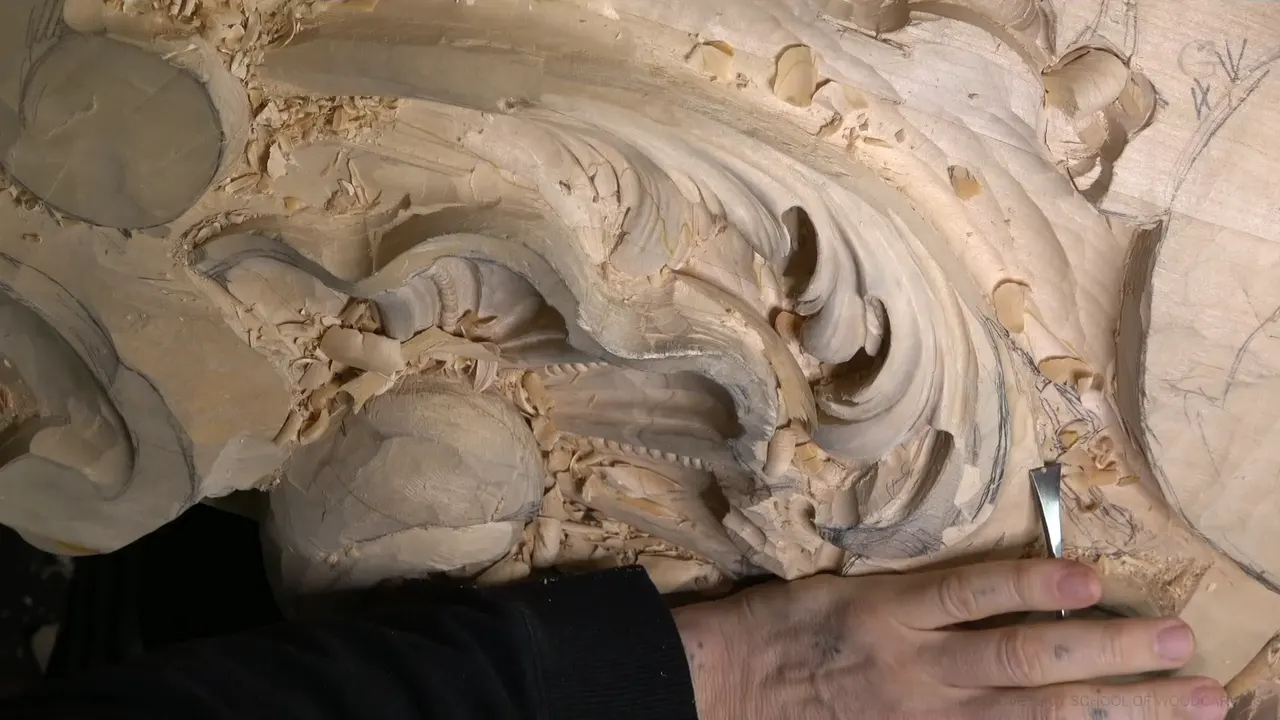

Part 10 of Venice Room workshop 10 is where I say "I would like to see that a little more convexing." Other lessons carry the same wish. A raised ridge, a concave, a shape like a water drop or a shadow follows it there.
This page walks through part 10 first. Then it goes to the lessons where I said it, and each stop gives the thing I named plus the words that came next.
What happened around that wish in part 10?
A small job is in my plan, "Going to clean it a little bit first." A need comes with it, "And yes, I need to probably go a little more like that because it's going to be visible from below" and "So I can probably go just a little bit more inside."
For a tool I name a small nine, "I'm going to use probably just a small number nine to create even a little more separation right here." It is all plan.

Then comes "And this one needs to be more--", and the wish finishes the sentence. In my next words I name a tool, "So let me try to use number six", and after it "And going this way a little bit."
Roundness is another wish. "So I really want to see that roundness on this part." A tool stays a maybe. I even say "And maybe I should even use number seven, not number six."

The nine returns in my plan, "And going to follow with that number nine", then "go and clean that side." I also say "And again, go inward." One more thought is "And what I could make go all the way, actually."
What was my plan for the shadow?
Shadow gets its own plan. "Now, again, I want to create extra shadow underneath. So which means I'm actually able to create that really deep concave on inside." For that I name "a smaller number nine, like 10 millimeters or so, and I'll go in" (10 millimeters is about 0.39 inch), and I add "And I'll go in maybe even more."

Sizes stay open. "And maybe I could actually use number 11" is one way, and I call it "a good idea". After that I stop with "Let me think." Another way is "Or I could use just the smaller number nine and go in even deeper." The reason is plain, in my own words, "Again, for the sake of the shadow, okay? So that's the only reason."
"So that is good," I say, and "now I need to create also concave right here." A smaller tool is the plan for that, "just to clean that line a little bit."
Which choices stayed open at the end?
One line lists them, "couple ways I could develop this part." One is "I could leave it like that." Another is "Or I could actually try to flip somehow inside". Then "But anyway, I can start lowering down this part anyway."

A size comes in plain words, "Number nine, and that one is 5/8 of an inch, 16 millimeters." After it I plan to tidy, "let me clean the upper part, because right now it just looks a little too messy, and it's hard to make the decision."
"And yes, I can actually go a little bit inward like that," I say, and the separations get another name, "or I should say subdivisions." The part ends on "I really want to develop something really interesting."

When the wish was a raised part, what came next?
The Byzantine Acanthus 3 lesson, part 3, names "convex going uphill but not going backward." A maybe sits in my plan, "maybe even to excavate much deeper concave on that side," and then "I'll take the same tool, and I excavate much deeper."

In my own words, "I can reestablish it," and "I still have to have some space." The shape I want is "raised part like this, okay?" With a knife or another tool, "it's exactly the same idea," and I say "You still blending, but it's going uphill."
Modern Acanthus 6, part 1, begins with "Okay, you have to create your concaves." For a tool I plan "the spoon one", the one I used before. The ridge is "this Ridge also raised up," and I add "in this style raised up".

A question comes up there, "Why is that important?" "Concave gives you a shadow," I say. A book is in it too, "the concave gives you the best shadow." The ridge sits in Modern Acanthus 5, part 3, as "this Ridge raised up," next to "I'm after Shadows." A limit in that part starts "Closer to the background, but don't go".
Over in Hashemi Flowers 15, part 5, I mention the camera, "I know it's almost impossible to see on a camera, but I'll try to explain." My object is "this as my high point", and that means "I kind of have to bring that to the high point and remove this triangle."

A tool plan follows, "Let me see if I can fit number seven." Its size is "about half an inch" (about 13 millimeters), the cut is "carefully make my cut on inside," and a note on the shape reads "It's still going to have an inner flow line."
In Furniture Panel 29, part 2, a dark shadow shows, "how dark the shadow it casts." "And that is what I'm after," I say. My wish ends a line that starts with "both regions are raised".
Which tool came up for a concave or a convex?
Over in Venice Room 59, part 9, I name the object, "a lot more pronounced concave." My direction is "going this direction." Then "And yes, I can always recreate my divisions. I have no problem with that." The plan is "And let me relieve that area."

Two wishes sit in Venice Room 140, part 1. One is "some kind of convex" in the middle, and for it I name "let me take actually right away a number five sweep." A back bend joins it, "13 millimeters back bend" (about 0.51 inch), with the task "get rid of some of the ridges."

The other wish is for "concave", and that line starts with "But still,". My next job is "I need to excavate a little deeper." Then "Somewhat deeper right here at this point."
I stop on "That's beautiful" in Venice Room 30, part 11. From there I name "number eight", with the job "just excavate deeper".
Hazelnuts 3, part 2, gives me "five separations on the thing", and I plan "a lot more movements on this side." That wish comes with "on the main separation", then "convex and concave." Then "That is good." My note is "I don't see enough blending", and I add "need a smaller tool."

Which shapes did I name with that wish?
A channel starts it in Furniture Panel 28, part 1, "I don't wanna see the channel going all the way through." What I name there is "one part overlaps another part, but sometimes it just creates a problem of it overall design." Then, in my words, "I have to make the decision if this is gonna be on top of that part or the vice versus that could overlap this part".
Bringing this one in has an upside in my words, "I have a lot more possibility to create more beautiful shape than this side." Next, "I have to lower down slightly" and "bring everything underneath of this line."

Deeper into that part I name "the highest spot right underneath of here", with "Even if I gonna sacrifice somewhat of my convex I created previously." "But that's the idea," I say, and "I can always blend that in." Then the shape, "a shape of the water drop, almost like a water drop right there." Next in my words comes "let me with the same tool, somewhat create the undercut," and after it "number 11 and half a millimeter tool" (half a millimeter is about 0.02 inch).
At the end of that stretch the verdict is "but I lost overall detail." Then "There should be a separation, which is absolutely no problem. Let me grab my pencil and draw it right here."
Floral and Molding 13, part 3, turns to a drawing, "I drew actually what I'm working on," I say, with the object as "a lot of waviness on all of them." The petals get "a couple concave on the side, on both sides, on every petal." My pattern is "Concave in the middle, another concave in the middle, and then those sides, they do have a convex. And then go little bit concave at the ends like that." The rest is a plan, "I'm going to do off-camera rest of them," and "it's not really clean yet. I need to clean it".

Maine class 15, part 2, turns the wish into a count, "about five," and the size is "they don't have to be the same size". Next I name "the openings really dark spots."

In Grape Onlay 5, part 3, I say "to make it looking like the real vine". Next come "those facets," and "on the vine itself, but not on the tendrils." A caution follows, "Every cut I do from now on have to be really careful, especially in the weak spots."
A ridge is the object in Furniture Panel 31, part 2, "this ridge," and I say it "gives me an idea of the center line." And "I can actually exaggerate this movement with the, a little more sweep, like maybe number seven or even number eight."
Roman Acanthus 7, part 5, has "it's not really symmetrical yet" and, as the object, "close to originally designed." Then "Just clean that little bit." The lesson sits at Roman Acanthus 7.
How does the wish sound when a cut falls short?
Take Venice Room 14, part 3. I say the wish about "that concave," and my cut runs against the grain, "I am cutting against the grain." "It doesn't give me a crisp cut," I say, and that line ends on the wish. A switch is possible, "for me, to cut from this side, I have to switch to a spoon gouge or so."
A depth gets held back in Venice Room 34, part 7, "I do not want to lose the height of it." Then "It's going to be visible, but not as", and the same wish closes it. Then a cleanup, "clean up little bit, because right now those black marks, they're just throwing me off visually."
Eyes are the trouble in Venice Room 65, part 8, "bigger eyes because it's just too chunky in this area." The same wish follows. I plan two eyes, with "2 millimeters" (about 0.08 inch) and "number 11", and I add "You could use number nine, by the way."

Where does a shadow come into it?
Butterflies 7, part 1, ties the wish to a spot, "the spot where the meeting like this triangle spot I try to excavate as deep as possible because", and the wish after it is "that shadow dark spot". The depth is "1/8 of an inch three millimeters", and I add "be mindful what you have another side."
The Lily Box second layer, part 2, is short, "that shadow everywhere." Then "Okay, that is deep enough for now."
Dark wood comes up in Furniture Panel 20, part 8, "dark wood that's really hard to see sometimes." My object is "a really nice transition from this point", and "as clean as possible."

The shadow line goes on both sides, "I create that shadow line from this side also." A lamp is next, "Okay, let me get my magnifier lamp." Careful undercut is my plan, "undercut around," and I say "That's already casting some shadow."
Acanthus over Moldings 7, part 3, adds "raise it up like convex". In lesson 6 of that course, part 1, I say "So but that is approximately", and the wish finishes there too. The tool is "about a quarter inch number 11" (about six millimeters, as I said it) for "the outlining cut".
| Course and part | Named in the part, and the words after it |
|---|---|
| Venice Room 10, part 10 | More convexing. The next words named a number six, with maybe a number seven instead. |
| Byzantine Acanthus 3, part 3 | Convex going uphill, not going backward. A much deeper concave on that side was my maybe. |
| Modern Acanthus 6, part 1 | This ridge also raised up, with the spoon one as my plan. |
| Hashemi Flowers 15, part 5 | A high point, then a number seven, about half an inch (about 13 mm), if it fits. |
| Hazelnuts 3, part 2 | Convex and concave on the main separation. I did not see enough blending, and I noted a smaller tool. |
| Venice Room 140, part 1 | Some kind of convex in the middle, then a concave, with a number five sweep and a 13 millimeters back bend (about 0.51 in). |
| Furniture Panel 28, part 1 | The highest spot and a shape of the water drop, with an undercut and then a number 11 in my plan. |
| Maine class 15, part 2 | About five of them, and the openings as really dark spots. |
| Butterflies 7, part 1 | That shadow dark spot, with a depth I gave as three millimeters (about 1/8 in). |
| Furniture Panel 20, part 8 | A really nice transition, as clean as possible, with a magnifier lamp and a careful undercut. |
Where can you hear it yourself?
Workshop 10 of the Venice Room course holds part 10. Listen there for the number nine, its width and the shadow. The wood carving goes on part by part.
How it's done
- Name the look. In part 10 I wanted a rounder form, and I said it in plain words about roundness.
- Try a tool. My plan was to try number six, and I said maybe number seven.
- Dig for the shadow. For extra shadow underneath I planned a smaller nine, about 10 millimeters (0.39 inch), with number 11 as a maybe.
- Leave options open. I named two ways to develop one part, then said I needed to think about how to do it.
- Tidy up. I planned to clean the upper part, since it looked messy and I found it hard to decide.
Frequently asked questions
For the rounder form in part 10, which tool was my plan?
A number six, as a plan, and maybe a number seven in its place.
How wide was that nine?
I gave the width as 5/8 in, and also as 16 millimeters.
In the Byzantine lesson, which way did I not want the convex to go?
I did not want it going backward.
What did I say I lost in Furniture Panel lesson 28?
What to carve next