

Alexander Grabovetskiy, woodcarver, School of Woodcarving · Published 2020
What does a wood carver mean by "create an eye"?
Quick answer: In Venice Room 10, part 11, one sentence of mine called a separation good and said an eye was still needed. In other lessons I put the same words beside a tool number, a position or a worry, and sometimes beside a reason to skip the eye.
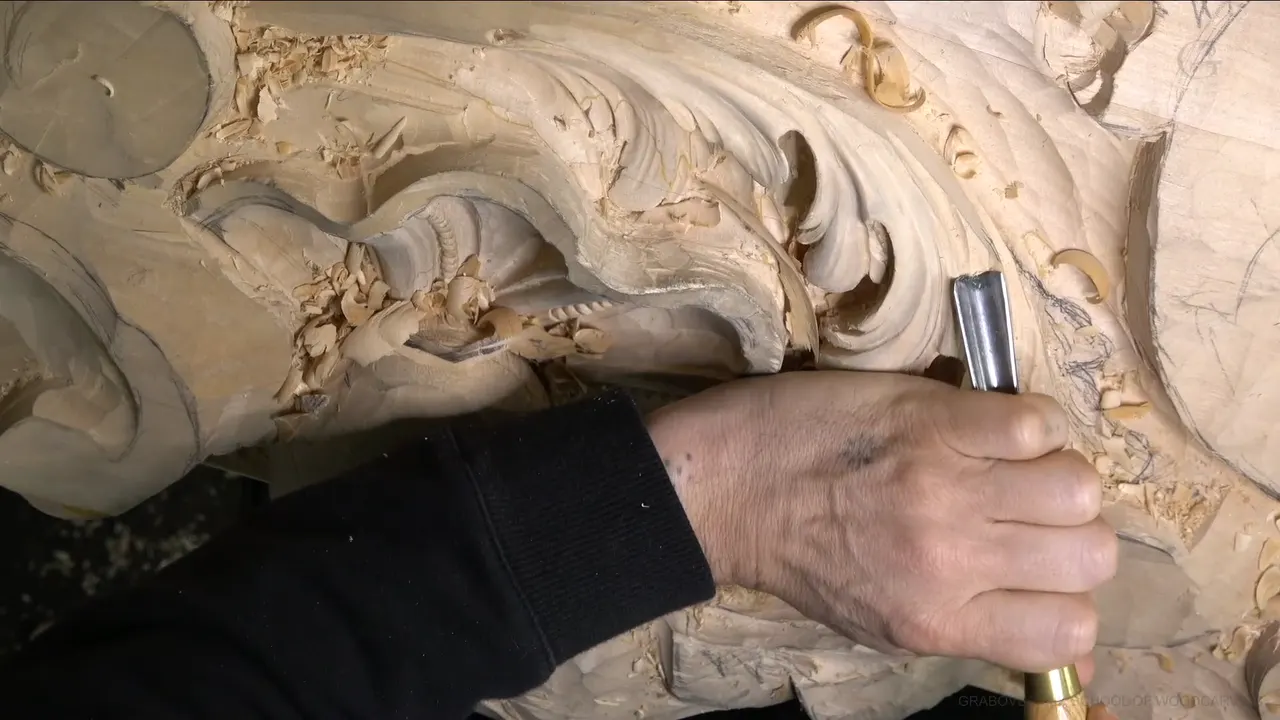

In part 11 of Venice Room workshop 10, I said: "That is a good separation, but I need to create an eye." It is a need, said while I worked on an acanthus leaf. Lessons from other workshops use the same words beside tools, positions and worries, and sometimes beside a reason to leave the eye out.
This page follows part 11 first, with the two parts beside it. After that it visits the lessons where I talked about giving a leaf its eye.
What was I carving when I said it?
Part 11 opens with the concave right here as a plan, "a preliminary concave," and "the same number nine." On how far: "And I'll go all the way."

A ridge comes next. "I do have an extra ridge, and I kind of like how it looks, but I'm not sure if I'm going to keep it or not, okay? Because logically, it should not be there."
The old work gets a mention too. "When you look at the original work, the pipe not always convex." Then: "I'm not joking. You can check yourself." And last, "Sometimes those pipes, they don't make sense, but for some reason, they look really good when they do that way."

Separations follow. I planned to "start actually creating really good separations," and I added a limit, "I don't want to make it too parallel." Also: "I think this separation will work really well in this case."

Here the line from the top of this page sits in its place, a little after "Let me start to do that separation." The next words are about the pipe: "Logically it's supposed to be a pipe, which supposedly is to be a raised part." A plan follows, "that old trick." I said I would get that pipe reverse, "Just opposite direction, like a concave."
Digging comes after it. "Let me dig a little deeper and inside." And what that gives: "That way, we can reveal this part a lot more, the lower part."

A tool is named for later: "attack that with number 11." Of its stage I said: "But that is preliminary." A pencil gets a verdict too: "I don't like the idea that I used a pencil, and it just leaves dirt, which is not a good idea."
A flip comes up as well, "flipping this part." I said, "I think it's going to give me a really interesting movement." And then: "Not sure I should do that or not."
Near the end of the part: "I do have to think on the way, okay, while I'm carving." And: "I'm making some improvements of the original design."

What did the parts on either side of it say about an eye?
Part 12 has an idea of its own. "I could make it a nicer movement right here. Either I can create the appearance of the eye, which I think is going to be really good." A line later: "if I give some kind of eye."

Then comes a plan to dig. "I do have plenty of the material, so I freely can go in if I wish to." Later came a plan for "a little bigger number nine" to "excavate even deeper right here," with a cause of my own: "I want to make sure those details are visible so people can see them."
Before part 11, part 10 held a hollow for a shadow: "I want to create extra shadow underneath." For it I planned a smaller number nine, "like 10 millimeters or so" (about 0.39 inch). On going even deeper I said, "for the sake of the shadow, okay? So that's the only reason."

Which tool did I plan for an eye?
Over in workshop 7, I weighed the choice in part 11. Big or small? "Should I do the big eye or small one?" My plan was "a quarter-inch eye" (6.35 millimeters). Then, in a new thought: "And I really like, actually, big acanthus eyes." And: "I think they look really good. But it's my opinion, okay?" For the cut itself I planned "a 3 millimeters number 11" (0.12 inch).

Next comes a smaller tool in workshop 121, part 2: "a smaller number 11, maybe about three millimeters" (0.12 inch). Also: "I'm going to create that eye, and also going to get this piece rolling underneath." And of the leaf: "Not my eye, but the eye of Acanthus."

A section left me happy in workshop 128, and still I had one more idea: "an eye in this section and kind of pipe it." For it, "Number 11 and 4 millimeters" (0.16 inch).
Another need comes in part 2 of workshop 144, "an eye again to make it look lighter," with "1 millimeter again. Number 11, of course" (0.04 inch).

The words in workshop 17, part 10, are about showing more: "Use number 3 to create that eye a little more pronounced." Then a check: "I got to check the backside."
The Furniture Panel course has its own take in lesson 22, part 4: "Let me establish the eye first." In that part the tool is "number 11, one millimeter" (0.04 inch), then "follow with the half a millimeter and exaggerate that eye even deeper" (0.02 inch).
In the Lily Box course, lesson 4, part 13, the tool is a gouge with a number: "the same small gouge, number eight and 1/16 of an inch" (about 1.6 millimeters).

How big, how deep, and where does it go?
Size comes up in part 10 of workshop 13: "I kind of like the big eyes because it's what they did back then." On depth: "let me excavate a little deeper right away because those eyes are really important."

What they do, in my words: "They give a really good shadow that will go around that detail." A limit follows. "I know you don't see that yet, but that is going to flip on top of that."
Two eyes are a plan in part 2 of the same workshop: "create the eye or even both eyes." My tool plan was "the same quarter-inch number nine" (6.35 millimeters). Afterward: "Right, two eyes right there."
Waiting shows in workshop 14, part 12: "I could create eye or I could take it all the way down if I need to. So we'll see."

My first spot was wrong in workshop 26, part 1: "that is not the right position of the eye." The fix I wanted was the eyes "closer."
Extra material is the topic in part 3 of workshop 25: "I need some extra material for subdivisions." Beside it: "There could be another eye." My words on it: "It will make sense." In part 4 of the same workshop: "I have to create the eye somewhere right here."

A second eye has its reason in workshop 34, part 8: "I can create another eye, which going to give me space to divide this one later on."

Logic starts part 10 of workshop 44: "I need to make it logical." A little later: "I do have one of the eyes right here, and it's one of the divisions," and "secondary eye and go like that on inside."

Words I called funny are in part 5 of the same workshop: "I think I should give an eye." And then: "I know it sounds funny, give an eye."

What I wanted in workshop 49, part 8, was a shape: "an eye shape like this, okay, on both sides. Okay? So it has to go underneath."

A side I was not happy with opens workshop 63, part 8: "I'm not too happy about this side." The plan: "a small eye with the number 11." And: "let me think which is supposed to flip what."
A pair shows in part 12 of workshop 61: "So I can do an eye like this. Okay? But I also have to do exactly the same eye on the opposite side." It gives the "ability to widen a little bit this section," and "later I have to figure out what I want to see in this section."
What if I put the eye in the wrong place?
Placement is the question in workshop 84, part 6: "And where do I now do it? Probably somewhere right here." Later in the part, the tool in my plan: "7 millimeters, number 11" (0.28 inch).

A fear comes in the same part: "I usually am kind of afraid of doing deeper right away." The fear has a cause in my words: "I'm afraid because if the eye position in the wrong place, it's always a chance."
A way back is the point in part 5 of workshop 37. After "double-check from below how it looks" I said, "I can always recreate the eye. It's not a big deal at all. So I still have the position for it, no problem."
A slip came in workshop 144, along with a small tool: "by using small tool." Then: "I just made the mistake, just too early, I guess. But it's okay, I'll fix it."
Development is the open question in workshop 75, part 8: "But how I going to develop it?" For a start I named "indication of the eye," at "7 millimeters" (0.28 inch).

Many ways to do it, I said in workshop 64, part 4: "There's multiple ways to do the eye." First in my plan: "a small 16th of an inch number 11" (about 1.6 millimeters).

The goal is one movement in workshop 84, part 2: "I need to make an eye somewhere underneath." Then: "a part of one movement." Of the spot, "I really don't want to lose that detail."
A last part gets the same idea in part 11 of workshop 93: "I could create some kind of eye." Then the tools in my plan: "same tool, like number eight, and then I'll switch to one millimeter, number 11" (one millimeter is about 0.04 in).

A better eye is the plan in workshop 55, part 2: "a little better, or nicer." And the state of it: "it's not the finished product, of course. There is a lot of work yet needs to be done."
When did I leave the eye out?
A case for leaving it out is workshop 112, part 1: "eye and pipe, but there is no need because it's never going to be in the eye of any human person." And: "So don't need that extra detail in this case."

A question and a maybe sit in part 7 of workshop 34: "Do I need to do the eye or not? Maybe not." A few words on: "But I still have to make it readable." Next in my plan: "number 11, but the small one, like one-eighth of an inch" (3.2 millimeters).
Out of sight is the eye in workshop 56, part 2: "an eye, which you don't see." Then: "visible from the bottom, which is really important for me to show."

Doubt shows in lesson 9 of the Lily Box, part 3, about adding an eye at all: "Maybe I should, maybe I shouldn't. I don't know."
I apologized in the same breath in workshop 162, part 2: "I apologize if you don't see it." Soon after: "nobody's going to look inside." The closing thought was "safer for me."

| Source | What I named there |
|---|---|
| Here, in part 11 | A good separation is done, and an eye is still needed. |
| Next to it, part 12 | The look of an eye, or the eye itself, with room to dig inside. |
| Lesson 7, part 11 | A quarter-inch eye (6.35 mm) or a small one, with a number 11 at 3 mm (0.12 in) in the plan. |
| Lesson 13, part 2 | Two eyes, started with a quarter-inch number nine (6.35 mm). |
| Video 13.10 | A liking for big eyes, with a reason given. |
| Video 14.12 | A pipe first, with the eye still to come. |
| The 17.10 video | Number 3 for an eye a little more pronounced. |
| The 25.3 video | Extra material needed for subdivisions, with another eye beside it. |
| From workshop 34, part 7 | Whether the eye is needed at all, put as a question. |
| From workshop 44, part 5 | Words I said sound funny, about giving an eye. |
| Workshop 44, part 10 | Another eye, a secondary one, going like that on inside. |
| Workshop 56, part 2 | Nobody sees this one from the side, but it shows from the bottom. |
| At 84, part 6 | A number 11 at 7 mm (0.28 in) in the plan, and a fear about the position. |
| At 112, part 1 | No eye and no pipe, and the line goes underneath. |
| On workshop 128, part 1 | One section could get an eye plus a kind of pipe. |
| On Lily Box 9, part 3 | Maybe I should, maybe I shouldn't. |
Watch the videos
Everything above comes from my video lessons. Start with workshop 10 of the Venice Room, where part 11 holds the line, and listen for the number nine and the number 11. The wider Venice Room course sits around it, and the wood carving goes on part by part.
How it's done
- Call the separation good. The separation was good, and an eye was still needed.
- Pick a small tool. A smaller number 11 was my plan for the eye in workshop 121.
- Check the position. The position was not right in workshop 26, and I wanted the eyes closer.
- Think about the shadow. A really good shadow comes from the eyes (workshop 13).
- Decide whether it shows. Neither an eye nor a pipe was needed in workshop 112, and the line goes just underneath.
- Keep a way back. The eye can be recreated, and I still have its position (workshop 37).
Frequently asked questions
Which tool did I plan for an eye?
A number 11 in the workshops I cite: about three millimeters (0.12 in) in workshop 121, 4 millimeters (0.16 in) in workshop 128, 1 millimeter (0.04 in) in workshop 144 and 7 millimeters (0.28 in) in workshop 84.
Did part 12 mention the eye too?
Yes, as a plan: a nicer movement, either by creating the appearance of the eye or by giving it an eye of some sort.
Which workshops mention big eyes?
The two are workshop 7, part 11, and workshop 13, part 10. The first has me saying I really like big acanthus eyes, and that it is my opinion. The second has me saying I somewhat like the big eyes because it is what they did back then.
What to carve next