

Alexander Grabovetskiy, woodcarver, School of Woodcarving · Published 2020
What does a wood carver mean by a "bigger number"?
Quick answer: "Bigger number" is my way of asking for the same gouge number in more millimeters. The Hazelnuts course shows it with a number 11 that grows in size, and Venice Room 10.12 has a little bigger nine with no size said. Part 12's bigger sweep led to a plan for a seven.
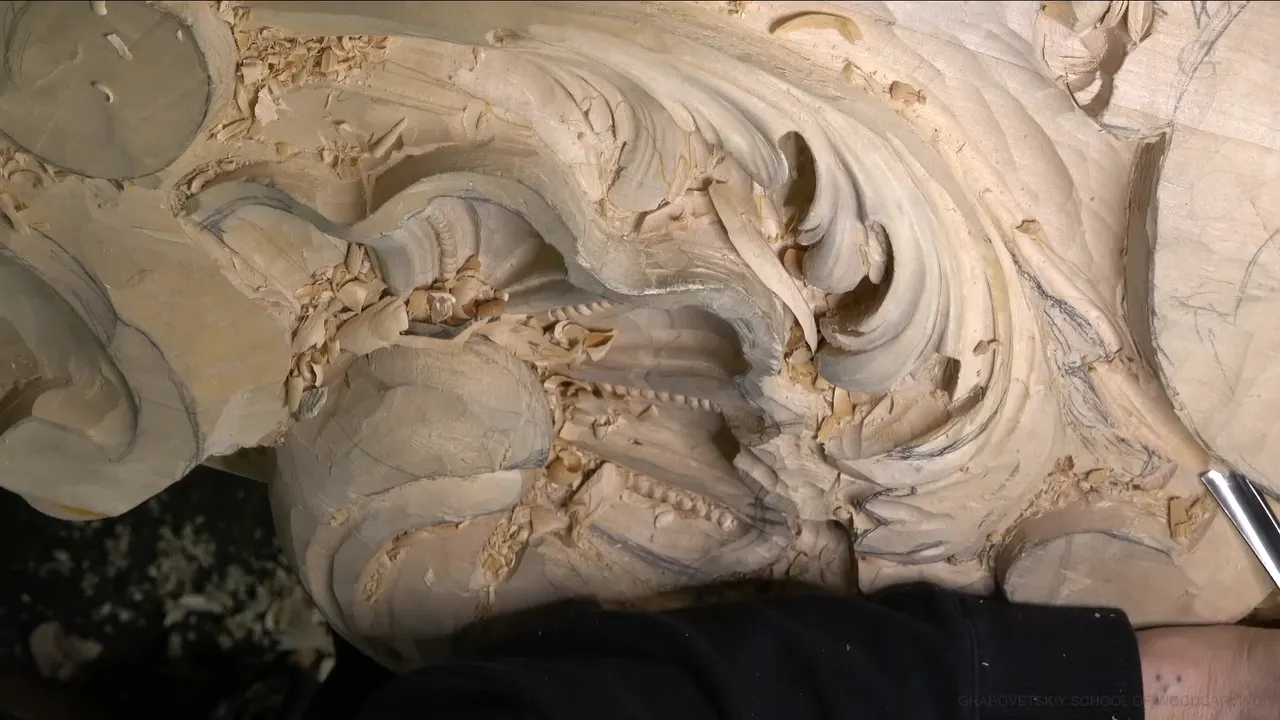

A "bigger number" is how I ask for the same gouge number in more millimeters. In the Hazelnuts course I said it with one size attached: "Still number 11, but 12 millimeters" (0.47 inch). The number holds. The size grows.
Venice Room workshop 10, part 12, holds a call for a bigger nine, and no size is given there. This page follows that part and its two neighbors, then goes through other lessons where I called for a bigger one, and ends on the times it did not fit.
What was I carving when I said it?
Part 12 opens with a few options on an acanthus leaf. I could make a nicer movement, either with "the appearance of the eye" or with some kind of eye. A plan to dig inside follows, and the wood allowed it, I said: "I do have plenty of the material, so I freely can go in if I wish to."

Outlines come next. My plan was to outline the idea, to relieve the future triangle, and a little later to outline one more side.
Then the line you came for: "And I'm going to use a little bigger number nine. And excavate even deeper right here." My cause followed it: "Because I want to make sure those details are visible so people can see them."
A limit shows up soon after. "I don't want to remove too much material because there's going to be a shell, which I still have to take some of the material out later." A second one, said plainly: "I don't want to remove what I don't need to remove right now."
The opposite direction came too: "With the smaller number nine, just go in more." A wall was off limits to that dig, and I said so.

Which sizes of number nine does workshop 10 hold?
The part before it has two. For a deep hollow, my plan in part 10 was a smaller nine, "like 10 millimeters or so" (0.39 inch). Later in that part I named another one: "5/8 of an inch, 16 millimeters."

Between them sits part 11. There I said "the same number nine," and near its end I planned "a small number nine to outline it." One workshop, then, holds the same nine, a small one and a smaller one, plus one at 16 millimeters (0.63 inch) and the little bigger one that part 12 names. The number holds. The size moves.
What does "bigger" change, and what stays the same?
Look at the Hazelnuts course first, lesson 3, part 1. I called for something "much bigger" and gave a size: "a 12 millimeters number 11, okay?"

The Roman Acanthus course gives a size too. Lesson 16.1 has a tool I called "a little too small," and then the words "Get a bigger number nine, 20 millimeters, twice bigger" (0.79 inch).

I corrected myself in mid-sentence in Lily Box 2, part 7. "Maybe I should use a bigger one for now to make a bigger sweep. A bigger cut, I should say." Next came a plan: "Let me get a bigger number seven, and then I'll work on details." Then a size: "This one is about three-quarter of an inch" (19 mm).

Lily Box 7, part 3, makes the same step. "It's a little too small. I need a bigger one." The pick: "maybe about 10 millimeters will do" (about 3/8 in). And a verdict: "10 millimeters is good."
Part 10 of workshop 2 shows the same step inside this course. I was using the same nine and said "I can go really deep if I need to." A little later: "I should use probably" a bigger one, and "Let me see."
Even a number one gets it. Workshop 38, part 10, has me saying I needed "somehow to reach the bottom of it," and then: "I need to get little bigger number one, like 10 millimeters number one. So don't pay attention to zero, okay?"
The Butterflies course has a line about owning one: "If you have a bigger number seven, that's always gonna help." A way around it appears too: "You can get by with the smaller number seven. Let's say seven and fourteen millimeters" (0.55 inch).
Why did I reach for the bigger one?
A few came with causes. In part 12 of workshop 58 I reached for a bigger five and explained that it would "eliminate the lots of carving marks, tool marks, facets." What the tool gave me was "really long, consistent cut."

Speed and a clean cut came up in the Hashemi Flowers course, lesson 8, part 2. One option was a bigger seven, and then I reached for the one-inch (25 mm) and named what it gives: "a lot quicker move, a lot cleaner cut in a single pass." That line closes with praise for bigger tools.

Other Hashemi lessons carry the same pick. In lesson 22, part 5, I planned an eight and gave it a size: "Bigger number eight. This one is a 10 millimeters" (just under 0.4 in). For a downward curl in lesson 44, part 5, I planned a bigger seven, "About half an inch, I would say" (13 mm).
The Roman Acanthus course, lesson 2, part 3, has it in its own words. "I'm always on the side of bigger tools myself." A cause follows: "with the bigger tools, you can use just the edge of a tool," and "you can take much more material with a bigger tool than a smaller one." A smaller tool stays on the table: "you can get the same results probably, or almost the same results." The cost I named was "too many chisel marks."
The Greek Acanthus course comes at it from the other side, in lesson 2, part 2. "Even slightly bigger will help you a lot, actually." I said "Let me get just a bigger" seven, and went on to praise bigger gouges. Their gift, in my words, is that you can use "just the one corner of a tool if you need it."

Venice Room 134, part 1 gives a rule after I said I could probably use a bigger 11: "Logic is the same. The bigger tool I have, the quicker it goes."
And the Furniture Panel course, lesson 22, part 12: "bigger tools like a bigger number five or number six or number seven would help a lot, actually, just to give a quick result."
Does it have to be the biggest? Not in Hazelnuts 2.3, where I said of a seven: "It doesn't have to be that big number seven, I just like how fast I can do it." Smaller tools, I added, can do the job too.
Which jobs did a bigger one take?
Concaves are a big part of that list, and the next two paragraphs are about them. Part 7 of workshop 9 has me saying I could probably go with a bigger nine, "like 16 millimeters" (about 5/8 in), and then my plan: "start creating my concave."
A really big concave was the job in workshop 41, part 5, and I started "with the bigger number 11." Its size: "18 millimeters, almost three-quarter of an inch" (0.71 in).

A roll came up in workshop 44, part 4. The plan was a bigger 11 at 20 millimeters (a hair under 0.8 in), taken to roll one part "a little bit, but not much."
A movement had its turn in workshop 54, part 10, with a thought of a bigger nine and a plan to "create an escape movement." I gave it a name, too: "It's what I call it, how it escapes out like that."
More movement shows up in workshop 69, part 9: "I can take a bigger number 11. In my case, it would be 20 millimeters" (about 4/5 in). My cause was "to raise one of the parts of that movement up."
Cleaning takes a bigger tool as well. Workshop 75 (part 3) has "bigger number two, like 50 millimeters" (about 2 in), then "I'll just kind of ride on top of those ridges." A cause came with it: "I really like to create the design on a clean canvas, okay?"
The same canvas returns in workshop 37, part 9, with a seven at "like one inch" (25 mm): "give even better shape, even if it's not the final shape. But still, I like to work with a clean canvas."
One more cause comes from the Corinthian Acanthus course, lesson 4, part 2. Long cuts "create a really nice movement," and I said I took "a little bigger" nine for it, "because this lobe is a little bigger."
When does a bigger number not fit?
One bigger tool went back on the rack at times. The Floral and Molding course, lesson 3.1, has a seven at 28 and a half millimeters (1.12 in). My answer to myself was "No, I'm not, because it's going to be too dangerous," and the fear behind it was a plain one: "make a big mistake if I continue my cut."

Workshop 66, part 6: a nine ran into the board. I was not sure it would fit, and the next word was "Nope." A medium bend was the new need, and a number eight came next, with the words "Let me see if number eight will work," and then "And yes, it does."

Workshop 69, part 11, had a different problem. A seven at 14 millimeters (0.55 in) was in my hand, and I said: "That's what I'm using. But it's not working out." The plan after it was the bigger nine. Lines after it move on to number 11 and a long bend, so the nine stays a plan on this page.

A size can also be a notch too big. In workshop 33 (part 7) I started with a plan for a slightly bigger 11 "because I really want to create that depth." Then: "This is a little too big." And: "This is okay. Ten millimeters, three-eighths of an inch."
Space sets a limit too, and I hit it in workshop 16, part 2, where I wanted an even bigger nine for a deep inside cut and then checked. "I don't have too much space right there." And: "I can't go more than three quarter of an inch" (19 mm).
Is a bigger sweep the same as a bigger number?
Part 12 answers it. First I weighed "number six or so for this operation." I needed "a unified concave right here because I want to make sure that looks like it's part of a same movement," and I planned to start with six.

A sharper edge was part of that plan. Cutting against the grain meant I would "need to sharpen that little more." And a goal: "I really want to see a nice and smooth movement."
Then the jump. "I think I'm going to need a bigger sweep than number six." Next came a try, "Let me try number seven," with a doubt about it, and then: "So let me try and see if I have to switch to number eight."

That is a jump in the number, a different move from the Hazelnuts one, where the number stayed and the millimeters grew. The other direction exists too. An S shape was not right in workshop 18, part 9: "Not too happy how that S looks. Maybe I should use a lesser sweep, like number five." Then came a maybe, a five and a bigger five. Right after it: "Yeah, much better."

So across these lessons the word "bigger" sits beside two kinds of jump. One keeps the number and adds millimeters. The second asks for a bigger sweep and names a new number. What comes after the word tells you which one: millimeters or a number.
Back in part 12, the plan after the six reads "Let me start with the number eight." And the last line of the part: "And I need to sharpen this one, too."

Where did I use it? A short list
| Where | What I said about the size |
|---|---|
| Workshop 10.10 | Smaller nine near 10 millimeters (0.39 in), another at 5/8 in (16 mm). |
| Workshop 10.12 | Bigger nine, with the size not said. |
| Lily Box 2.7 | Seven, about 3/4 in (19 mm). |
| Hazelnuts 3.1 | Number 11 at 12 millimeters (0.47 in), much bigger. |
| Roman Acanthus 16.1 | Nine at 20 mm (0.79 in), twice bigger. |
| Hashemi Flowers 8.2 | One-inch seven (25 mm), quicker and cleaner. |
| Workshop 41.5 | Eleven at 18 mm (0.71 in), for a big concave. |
| Floral course, lesson 3 | Seven at 28 and a half mm (1.12 in), put back. |
| Workshop 66.6 | Nine at maybe 20 mm (about 4/5 in), then an eight. |
| Workshop 69.11 | A 14 mm seven (0.55 in), not working out. |
Watch the videos
Everything above comes from my lessons. Start with workshop 10 of the Venice Room, where part 12 holds the line, and listen for the nine in each part. The wider Venice Room course sits around it. Each lesson adds another cut to the wood carving, and the hazelnuts lessons use these same words on a much smaller piece.
How it's done
- Keep the number, change the millimeters. Hazelnuts, lesson 3: number 11 stayed, and the size went up to 12 millimeters, just under half an inch.
- Say what the bigger one is for. Furniture Panel 22 names a quick result, and workshop 58 names fewer carving marks, tool marks and facets.
- Check that it fits the spot. Workshop 66: the first nine got a nope, and an eight worked.
- Change the number when the size is not the problem. Part 12 of workshop 10 moved up from six, with a seven and maybe an eight in mind.
- Watch the edge. Part 12 also names the grain as the cause for sharpening a little more.
Frequently asked questions
Is a bigger number the same as a bigger sweep?
Not quite. The Lily Box course has me correcting myself, from sweep to cut, before a seven was picked. In workshop 10 I called for a bigger sweep than six, and that led to a plan to try seven, with an eight in mind.
What size was the bigger nine in part 12?
The video gives no size. The closest figures sit one part earlier, where I planned a smaller nine near 10 millimeters and named another at 5/8 of an inch, 16 millimeters.
Does a bigger number fit every spot?
My lessons say no. The seven in the Floral course, at 28.5 millimeters (about 1.1 in), went back because it looked too dangerous. The nine in workshop 66 got a flat nope, and an eight took the job.
What to carve next