
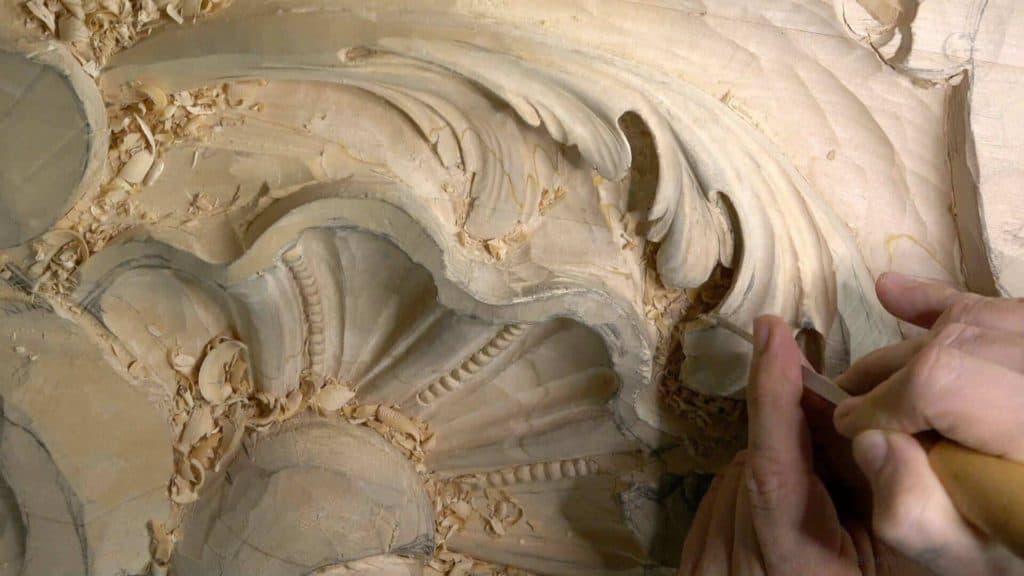
Alexander Grabovetskiy, woodcarver, School of Woodcarving · Published 2020
What does a wood carver mean by "the right direction"?
Quick answer: In Venice Room 10, part 4, I planned a rasp to smooth out movements, then said "I don't like this one." Lessons from other workshops and courses use "the right direction" for pipes, ridges, flips, petals, husks, my own eye and the side a tool comes from.
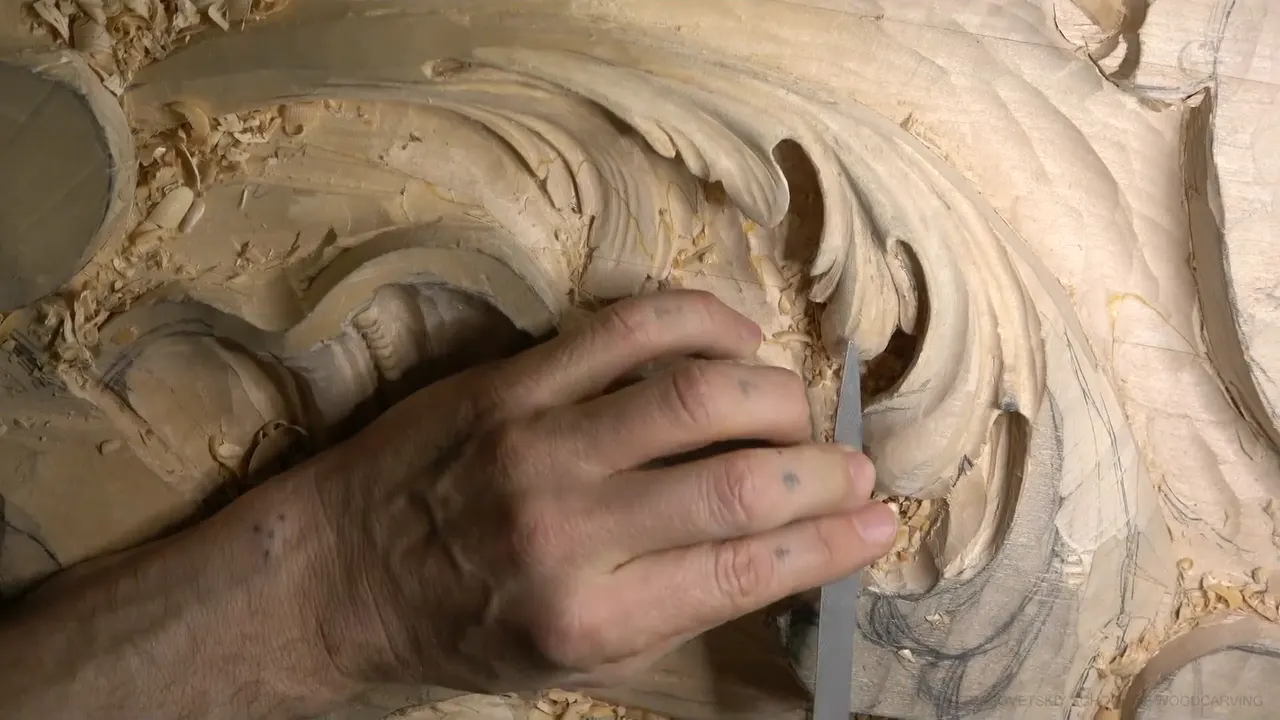

In part 4 of Venice Room workshop 10, I planned a rasp to smooth out movements and said "I don't like this one." Other lessons use "the right direction" about pipes, ridges, flips, petals and husks.
This page starts with that part. After it come the places where I said "the right direction" about a movement, and a few where I said it about a tool. Every stop has my own lines, and nothing else is added to them.
How did part 4 start?
It began with a plan. "I will use a rasp," I said, and "Kind of smooth out those movements." A verdict came a moment later: "So it doesn't move the right direction, I think."
The light came up: "Let me change the position of the light where I can see much better." One more plan: "And go a little bit this direction."

"And yes," I said, and the next plan was about separations: "I probably should do extra separations closer to the end." I tied it to the originals: "So that is also on original ones, you can see a lot, like a couple notches." "It's going to give even nicer look."
How do I check a movement before I carve it again?
Two lessons show a check before the next pass. The light mattered in part 4, and my plan was to move it. In Venice Room 29.2 the cue is a check too: "Again, I'm just thinking out loud. And I'm checking from different points of view how it's looking." A skew was the plan for the next step. "I'm going to kind of refine a little bit this movement and see if I'm on the right direction, if I'm doing the right way."

A look from below sits in Venice Room 16.11. A ridge needed work, and I said "I need to fix overall movement of this one." I gave a cause: "because I chopped, so now it's not consistent." Later in that part came a plan to look from the bottom: "Let me see from the bottom how it looks. And it does look good." "Except just one spot kind of still bugs me a little," came after that.
Which cuts came after "extra separations"?
Notches. The line was "Couple more notches," and more like it followed. "I like that, and maybe the same idea right here." Smaller ones were next, as a plan: "Going to do a couple more really micro ones."

For those I named two choices. In my words: "use probably just either knife or, in this case, I'll just use a skew chisel, which would be number 2 in London pattern." Next I said "But if it's European, it's marked absolutely differently." Then "And maybe just make them more popping." Another line followed: "I need maybe just exaggerate them little, but just like that." About the amount I said "One and two, not much, just slightly." I named that chisel.
I judged a spot, saying "I still don't like right here how it looks." "And this side concave is not as pronounced." Then came "Not bad, okay, so I shouldn't complain and all."

What does the reed brush add to the movement?
A sanding pass came next in the plan: "Let me use a reed brush again and give little more of original sanding." It was an offer, not a finished cut. "And yes, I could go this direction and create extra lines, which is almost invisible, but still."
Then "But again, there is some stopping point. I have to stop because you always find some stuff which you don't like." A tool plan sat right behind that line. "But right here, I could probably use number 11 and 3 millimeters and can exaggerate that pipe underneath. Give an extra shadow." In inches, 3 millimeters is about 0.12 inch. That was a could.

I praised it in a few words: "And that's good. And that is good." "Yes, I still probably going to find some stuff to do with that," I said next. One spot got named, and it was an eye. "For example, I already found one of the spots again. I'm not too happy about this eye, but that's already more to the end of a project."
For the end of a project I planned a full check, "I have to just recheck everything." The next plan was to do those separations: "But let me do those separations."

A goal followed: "But what I want to do, I want to create something interesting." My idea was a cut, put this way: "I want to create a cut and get this part inside." The tool stayed open. "And for that, I have to use, I'm not sure, maybe just number 11 and 1 millimeter right away." One millimeter is about 0.04 inch.

Where else does a pipe have to go the right way?
One pipe gets two lines in Venice Room 45.2. The first reads "That pipe, it's not the right direction, so the pipe's supposed to go that way." I followed it with "But I need to probably just blend a little better," then "Number three, that's what I'm using." Further down the same part came the second line. "But now I can give that pipe the right direction. The pipe's supposed to go from the eye, and I can give the right movement to the pipe." My last line there: "And honestly, I love that development I just created. Overall development."

A pipe turns up in Venice Room 9.8, with a concave. "I have to bring my concave closer to that direction, just give that movement the right direction." A big tool came next. "I need to use a big one right now."
Does the right direction work for an eye too?
Yes, and I said which eye. The words in 12.2 were "And I will give a small concave to give the right direction for the eye. For the human eye, okay? I'm not talking about the eye of the acanthus. Just give the direction of this movement like that." A result followed. "All right, so you can see it just going that direction." And "Okay, I think it's better."

The third part of that workshop 12 has a smaller version: "But I also don't like to see right here some of the ridges, so I need to move that to the right direction, and I can see that this one could go in."
The Floral and Molding course says it too. In its lesson 9, part 1, I said "And now I can just establish the right direction, how that leaf's supposed to be." Right after: "I would just keep that same flow, okay, same flow with this line." Later in the part came "And I can feel there's that ridge, it actually moves my eye to the right direction."
Can a flip or a petal have a right direction?
Venice Room 16.9 has me saying so about a flip, with a warning in front: "So which means I have to get rid of this ridge and make the whole movement just like that. Otherwise, it just doesn't look right." The flip came next. "I really want to flip something above this one, but it has to move the right direction."

A warning about danger followed: "And it's kind of dangerous the way I'm doing right now, because if I'll mess up, which I don't want to mess up. I can't glue it back because that's one of those areas that is better not to make mistakes." And then "That's why I'm taking my time and think every cut."
The Furniture Panel course has a petal. In its lesson 29, part 3, I said "I kept overall movement" and a few lines on, "moves to the right direction." After that: "So now I've got, I've got this big petal, which means, again, everything goes to the hole approximately to that center." A center line came next. "So my center line going to be somewhere right there."
Lesson 23 of that course, part 11, had a bigger concave and two reasons for it. "I could use bigger tool," I said, and the reasons were "a lot more waviness" and "a lot more interest." Right after them I said "it just goes to the right direction." I named a number eight at 7 mm (about 0.28 inch), saying "And yeah, I know it's kind of big concave, but that gives me a really interesting move." See lesson 23.

A leaf comes up in lesson 19, part 11. "I want to take care of this leaf, and I need to make sure it just develops the right direction. What I mean by that, so let me think how I should curl it." My next words were "Let me make this side slightly lower." A number seven at 14 mm (about 0.55 inch) was the plan, and I judged it: "Maybe a little too big of a tool for that operation." See lesson 19.
A husk of a hazelnut has one too. Hazelnuts lesson 4, part 1, reads "this one is much lower and husk going right underneath of the stem. And that is important because I want to make sure it's all flowing in the right direction." How would I look at it? "I think I need to just redraw on this side." See Hazelnuts lesson 4.

| Course and part | What had to go the right direction |
|---|---|
| Workshop 9, part 8 | The concave, to bring closer to that direction. |
| Workshop 12, part 2 | A small concave for the human eye. |
| Sixteenth workshop, part 9 | A flip I wanted above one spot, with a ridge to remove first. |
| Venice 25, part 1 | The sections going inward, to keep about the same distance. |
| From workshop 29, part 2 | A skew planned for the movement, after a check from different points of view. |
| Venice 45, part 2 | One pipe, off at first, and later one I could give the movement from the eye. |
| Furniture Panel, lesson 23 | A bigger concave, for waviness and interest. |
| Carving Hazelnuts 4 | The husk going under the stem, to be redrawn on its side. |
Does a section going inward have a right direction?
Yes, in Venice Room 25.1, beside a wall I did not want to go through. "I've got maybe about eighth of an inch wall right there, so I don't want to go through." An eighth of an inch is about 3 mm. The next line was "Now, I'm ready to just get my sections, those sections which is going inward, and I need to make sure they are going to the right direction." What I wanted to keep was a distance: "So approximately the same distance. That's what I want to keep." See workshop 25.

Venice Room 31.10 has this line: "I want to make sure I'm just doing the right direction." My comment was "it's easy to make mistake with those." My pick was a number one.
Is the right direction ever about the tool?
Yes, and in one place the cue names the grain right beside it. Hashemi Flowers lesson 25, part 3, has "just make sure you attack that from the right direction. So I do have a grain running this way, which means if I want to work with the grain, so I have to attack from this side, going downhill that way, this direction." See Hashemi lesson 25.
In that course, lesson 45, part 6, I said "just make sure your tools are sharp and you're going the right direction with the tool, especially when you're blending cuts." Over in the Furniture Panel course, lesson 18, part 10, I said "I'm working the right direction, from inside out."

A tool and a side show up in Venice Room 9.10. "I probably should use a backbend for that operation right here, and attack it from the right direction." Next came "Yes, much better." From 14.6 comes "of course, it would help if I were just to do the right direction, which I should from the beginning."
In workshop 21, part 7, no side is named: "Of course, the right direction would help too. But carefully, carefully just get that movement clean." The right direction sits beside "against the grain" in 23.1, and in my words "because for me, it's not convenient to attack from opposite side." Which of the two meanings I used there, the cue does not say.
Where does part 4 leave off?
In the middle of a job, with a tool plan. "Let me take my tools out and let me try." One more option came with it: "I do have plenty of the material, so I could use 3 millimeters right away, pretty much. But let me try with 1 millimeter first."

A flatter gouge closed the plan: "And let me use a flatter gouge a little bit, like number 5. Bring that down, this part." I closed on the wood that was left. "I already don't have too much material right here because I was cleaning the side, but it's okay since we have to go underneath anyway. So we still have plenty, I would say."
Part 5 ends with a rasp again. "I kind of don't like that convex," I said, and then "Let me do something else." The rasp was the something else: "Let me clean it with the rasp." Next, "I can see much better now." The words match what I said about the light near the start of part 4.
Where can you watch it yourself?
Every line above comes from my lessons. Start with Venice Room workshop 10, where part 4 sits, and look for the rasp, the light and the notches. The Venice Room course holds the rest of the Venice carving, one lesson after another. The wood carving goes on part by part.
How it's done
- Name the tool. My opening plan used a rasp on the movements.
- Judge one spot. I said I did not like one of the spots.
- Change the light. A plan came to move the light.
- Plan the notches. Extra separations were planned for closer to the end, with a couple more notches.
- Plan the cleanup. A reed brush was planned for a little more original sanding.
- Close on a gouge. The part closes on a flatter gouge, maybe a number 5, with plenty of material left.
Frequently asked questions
What did I plan first in part 4?
My first plan was a rasp for those movements, to smooth them out. Then I said I did not like one of them. Moving the light came next, also as a plan, so I could see better.
Which pipe got two lines about direction?
Workshop 45, part 2. The first line was "That pipe, it's not the right direction," then a need to blend it a little better. Further on I said I could give that pipe the right direction.
Did I say this about an eye?
Yes, in workshop 12, part 2, with a small concave for the human eye, and not the eye of the acanthus. That concave was for the movement in hand.
What to carve next