

Alexander Grabovetskiy, woodcarver, School of Woodcarving · Published 2020
What does a wood carver mean by "a couple strokes"?
Quick answer: In Venice Room 10, part 6, I planned a couple of strokes from a really shallow gouge, maybe number five. In other lessons I said "couple strokes" or "few strokes" about a number seven, a V tool and a back bent, and on a strop and a stone.
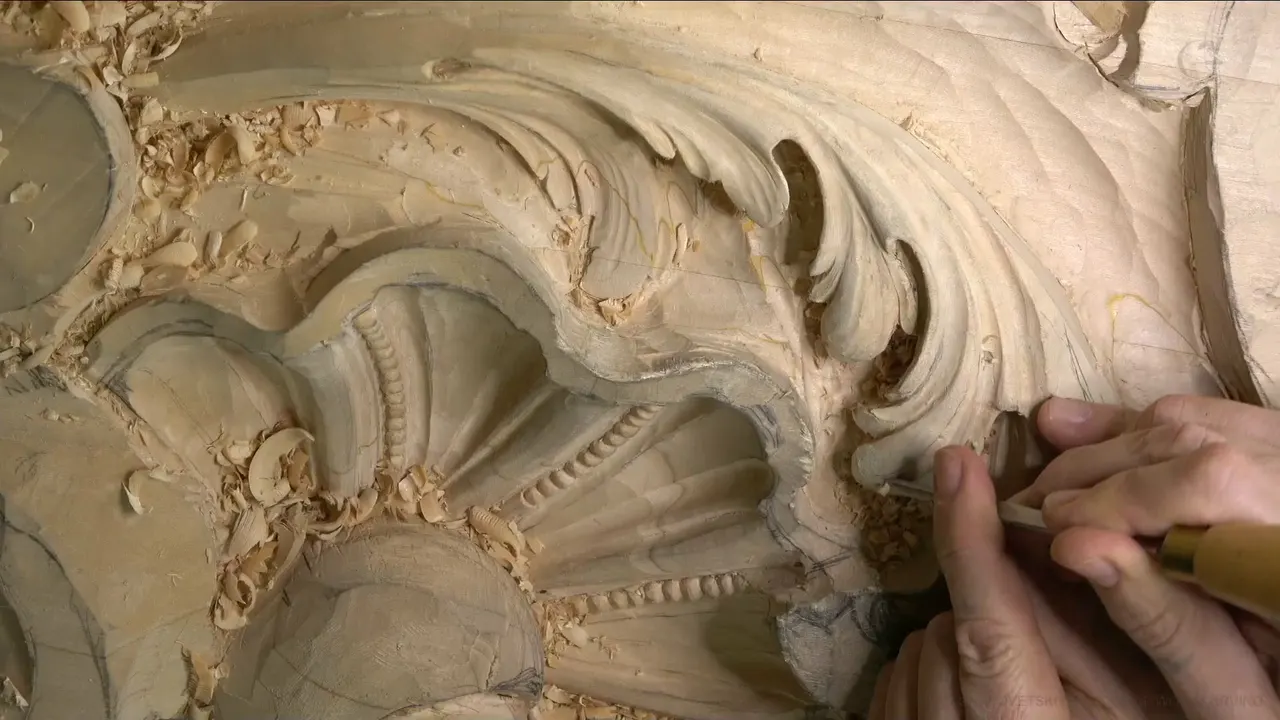

Part 6 of Venice Room workshop 10 is where I talk about couple strokes plus a gouge that cuts shallow. Those plain words come back in other lessons, with a number seven, a back bent, a V tool, a strop and a stone.
This page follows the line through part 6, then through the lessons where I said "couple strokes" or "few strokes". Each stop says what the strokes were for.
What surrounds the couple strokes in part 6?
In part 6 a plan comes early, "I'm also going to hit with the rasp, this middle part". Later I tell you "I like it, actually" and "let me hit also this pipe". A change of mind follows: "I kind of don't like what the pipe does, and I could probably clean it with the number nine".

The rasp comes up again in that stretch. "The beautiful thing about this rasp," I say, "it doesn't leave any abrasive on inside". The explanation comes in the next breath, "I can always go back with the tool, and I know it's not going to dull my tool". Roughness comes next: I can "just shave some roughness out and recreate the cut, and it's just beautiful again".
Reed rush is a plan, "I can probably just hit with some reed rush". Sanding stays a choice. I could use sandpaper because it is going to be "paint grade" and because "I have to sand my first coat, the base coat".

Notches get a look after that. I put it this way: "I can probably just make those notches look more unified, because right now, it just doesn't look too good". One more notch is on the table: "I could create an extra one if I wanted to" and "I don't need to, but I could". I weigh it with "maybe I should, actually" and "right there, just small". The next cue is "let me make this one nicer".

Which gouge was meant for the strokes?
The rasp is back: "again, with the rasp, take care of this roughness". My verdict on the spot: "it's not ideal, but it's not that bad at all, I should say".

Next comes the plan for the strokes, "I'm going to give a couple strokes with a really shallow gouge". It runs on to more movement, which I name in that same sentence. Some lines later, "just like that, just a couple strokes". Size comes as a maybe: "maybe with number five".

The part ends on a question to myself, "should I do another one?" The answer is "yeah, I'll do another one", and its place is "right on the side".
How do parts 5 and 7 sit beside it?
In part 5 I plan a small tool, "I could use a 1 millimeter again" (about 0.04 inch). At its end comes "let me do something else", with a rasp plan next. The final words are "I can see much better now".
One more small cut is planned in part 7, "an extra cut with the 1 millimeter" (0.04 in), and I leave the place open: "I need to make the decision". The result is in my own words as well, "it's just 1 millimeter cut, but it makes a big difference". Further on I name a tool, "let me use a spoon, maybe about number seven". All three parts sit in workshop 10.
Which tools took a couple strokes elsewhere?
Corinthian Acanthus lesson 2, part 3, has a check on a number seven, "let me check number seven, if it's going to fit". The answer comes in the same breath: "it will, but I need a smaller number seven". Then, "it fits absolutely perfectly".

The result, in my words, is "couple strokes and my curve already done". My plan after that is "number five again, clean it". A tool tip comes after: "you could do just with number five, actually". A knife is named too. "If you would have just a cheap carving knife," I say, "you could also do exactly the same idea".
Roman Acanthus lesson 8, part 1, has a big chisel, "I used the big chisel, number one chisel". Then "let me do that again". The reason sits right beside it: "that way, I can protect from undercutting this section".

The spot is "the central part", because "the central part shouldn't be undercut". The cut is "just straight down". I say "couple strokes", then "don't have to do too much". A V tool follows in my plan, "number 15, 3 millimeters" (0.12 in), "which is 45 degrees". Any V tool will work, I add.
In Butterflies lesson 10, part 2, a depth comes first, "only about one millimeter deep", which is 0.04 in. Next, a tool: "let me get a small gouge" and "a really tiny small one". A doubt about its edge follows. "I need to probably make it a little sharper," I tell you, and then "a couple of strokes".

Right after, the cue is "before we forget that detail, so let's do it". Later in the part I say "same idea", and, further on, "with the same tool, I'm going to create the same holes".
Floral and Molding lesson 12, part 2, has an undercut ahead of it, "I have to undercut it right there". The cue after it is "couple strokes and it's going to be done". A line earlier, "I could go even more, but it should be okay". Cleaning is planned afterward with "number nine, four millimeters" (about 0.16 in) and "I'll clean it little bit".

The Lily Box first layer has a small leaf in part 9. "I could add some details to it, and I think I should," I tell you. For the tool I name "eighth of an inch, three millimeters, number eight", and the plan is "let me put a few strokes, just the details like this". That spot closes on "I'm happy with this leaf" and "I'm not going to do too much to it".

Butterflies lesson 2, part 1, starts on a number seven at seven-eighths of an inch (about 22 mm), with "I hope it's Sharp". A tip about the paste follows, "you can use any types of paste". "A few strokes and then outside" is next, and the cue "you really don't want to roll that edge inward" explains the order.
What did I plan for a Hashemi leaf?
Hashemi Flowers lesson 6, part 4, has a spoon gouge, "number nine spoon gouge and about 3/8 of an inch" (about 9.5 mm). A smaller idea follows: "just the 3/16 of an inch, five millimeters, just to make exaggeration cuts, how I call them".

Then the strokes, "a few strokes, actually, you could do it with a smaller even", at "let's say, 1/8 of an inch number nine" (about 3.2 mm). About the grooves I say "some spots you could actually get even deeper grooves".
A limit rides along with it, "just don't overdo it", because small cuts "everywhere, they're going to distract".
Where else did a few strokes appear?
Maine 11, part 3, looks at the inside of a movement. It is "really important, you know, to hit the movement on inside and clean it", because "it's a really ragged". My next words are "it's not good". A back bent comes up, "for that I could use probably backbend", and a size note comes with it, "the backbend got to be small".

The verdict on that spot is "it should be good". Later in that part comes "I'm not going all the way because I'm gonna change my tool", and I add "just can't rush it".
In lesson 10 of the Maine class, part 1, the tool number is a choice. I ask "which number 11 I should get". Room opens up with "it could be number nine". The depth gets care: "I have to be really careful how much material I am removing", and "it's almost almost nothing".
Lesson 12 of that class, part 1, names a number 16, "let me actually use a number 16". The size follows, "that would be three millimeters" (about 0.12 inch). Then "couple Strokes" is the cue, and later comes "I'm gonna start undercutting".
Another use sits in workshop 4 of this room, part 1: "I'm just cutting a few strokes in, then I raise it". A reason follows: "I just break those particles because I don't want to break on the inside".

The grain comes into my next words, "I'm working right now against the grain". I add "that's not the best idea to work that way, so you're supposed to attack from that side", and then "sometimes you're limited".
A spoon gouge shares one plan with the strokes in workshop 23 of the second Venice Room course, part 2: "few strokes that direction" and "I can probably try to use a spoon gouge, and bigger one", "get rid of small tool marks". Earlier in that part I say "you probably already able to see some shadow casting".

Flower Rosette lesson 1, part 2, names a plane, "I usually like to use my block plane and just take those plane marks". Inside that part comes "couple strokes", followed by "just kind of angle it, that's the way I do".
The Furniture Panel lesson 29, part 2, has a size remark, "I don't have to have a big gouge". Another cue is "couple strokes". A paste line follows, "the paste does the job and it works really, really good".
Can a couple strokes happen on a strop or a stone?
The sharpening lessons use the words, and so do a few carving ones, where a strop comes in. Acanthus over Moldings lesson 3, part 1, names a number 17, "6 millimeters in this case" (about 0.24 in). It goes on with "the most complicated stropper piece of leather and little bit of paste", and "really doesn't have to be super complicated stuff".

A cue with the same words follows, "couple Strokes". My next line is "maybe more than couple". After it I say "I am pulling" and "I'm just doing my stropping".
A tool needs sharpening in workshop 146, part 2: "my tool needs to be sharpened, but it's okay". Planned: "couple strokes with just the leather and maybe just inside".

Sharpening Large Gouge, part 4, uses a stone, "a soft Arkansas". I note "some burr on outside", and the cue is "just a few strokes". After that, "it's nice", and a move to "a little finer stone".

How to Sharpen a Skew Bent Gouge, part 3, has it too: "a few strokes until I can feel burr on another side". Later comes a paste. "The blue paste," I say, is "not necessarily real necessary step", but "a much finer paste than a green paste", and the cue is "a few strokes with the blue paste".
| Course and part | What the strokes were for in that lesson |
|---|---|
| Venice Room 10, part 6 | The strokes go to a shallow gouge, on the Venice panel, number five being a maybe. |
| Corinthian Acanthus, lesson 2 | A smaller number seven fits the curve, with a number five next in the plan. |
| Roman Acanthus, lesson 8 | Number one chisel straight down, with a 3 mm V tool planned next. |
| Floral and Molding, lesson 12 | One spot to undercut, and a nine planned to clean it a little. |
| Lily Box, first layer, part 9 | Details planned on a small leaf, with an eight. |
| Hashemi Flowers, lesson 6 | A nine for a few strokes, with deeper grooves possible in some spots. |
| Maine class, lesson 10 | Number eleven or nine, and a depth of almost nothing. |
| Workshop 4, part 1 | A few strokes go in, the tool is raised, and the cut runs against the grain. |
| Maine class, lesson 11 | A small back bent is the option for a ragged inside. |
| Moldings course, lesson 3 | A strop, leather and a little paste. |
| Sharpening Large Gouge, part 4 | A soft stone, after a burr is felt on the outside. |
| Room 101, part 6 | Small strokes on a drawing, as older pictures show. |
Can strokes be lines on a drawing?
Drawing is the subject of workshop 101, part 6, and I explain it in my own words. "I have a lot more control if I'm doing a lot shorter strokes when I'm drawing like this," I explain.

Old pictures come up: "on the older pictures, they would just use a bunch of small strokes like that and then they would connect that". I add "that's exactly what I'm doing, just much quicker".
A bit later come "they just create few strokes and then they would connect them" and "that's visible if you're going to study those works". I close that thought with "I'm not making this stuff up".
In Design Principles lesson 4, part 4, the words show up too: "you can't call Harmony just couple strokes". Talk of "the 15th century pieces, 16th century pieces, 17th century pieces," follows, and then "they're still beautiful".
Where can you watch the couple strokes yourself?
Part 6 sits in workshop 10 of the Venice Room course. Listen there for the rasp and for numbers nine and five. The wood carving goes on part by part.
How it's done
- Name the rasp job. I planned to use the rasp on "this middle part", and I did not like what the pipe did.
- Weigh the sandpaper. Sandpaper was an option, with paint grade as the plan and a first coat I have to sand.
- Fix the notches. The notches did not look too good right then, and I said I could probably make them look more unified.
- Plan the strokes. My plan was a few strokes, from a gouge that goes shallow, and number five is the maybe.
- Ask about another. The part ends with a question to myself and a yes: one more, right on the side.
Frequently asked questions
Which size did I name for the strokes in part 6?
Number five was the size I named, and it came as a maybe, in the cue right after the strokes.
Did the rasp leave anything in the wood in part 6?
I said it leaves no abrasive inside, so I can go back with the tool and it will not dull.
How big was the spoon number nine in the Hashemi lesson?
Three-eighths of an inch (about 9.5 mm) at first, then three-sixteenths (five millimeters, as I said it), and then an eighth (about 3.2 mm) for the few strokes.
Did strokes happen on a strop in my lessons?
What to carve next