
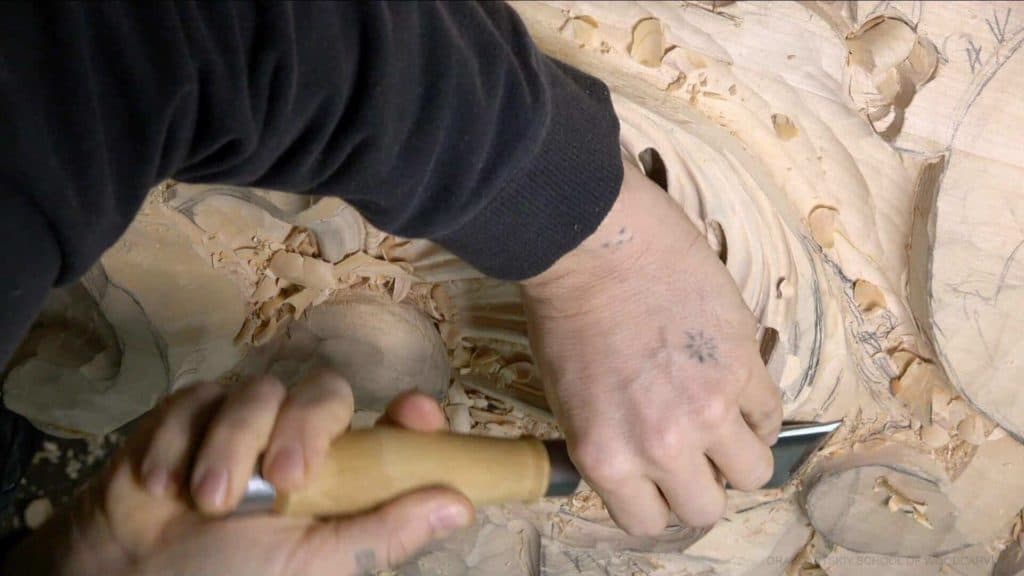
Alexander Grabovetskiy, woodcarver, School of Woodcarving · Published 2020
What does a wood carver mean by "raising up"?
Quick answer: I said "raising up" in Venice Room 10, part 9, after a number nine and the words "Clean that". The same words come back in a Byzantine pipe, a Modern Acanthus middle part, a Floral and Molding curl, a hidden part under a leaf in Venice Room 33, and a small Lily Box flower.
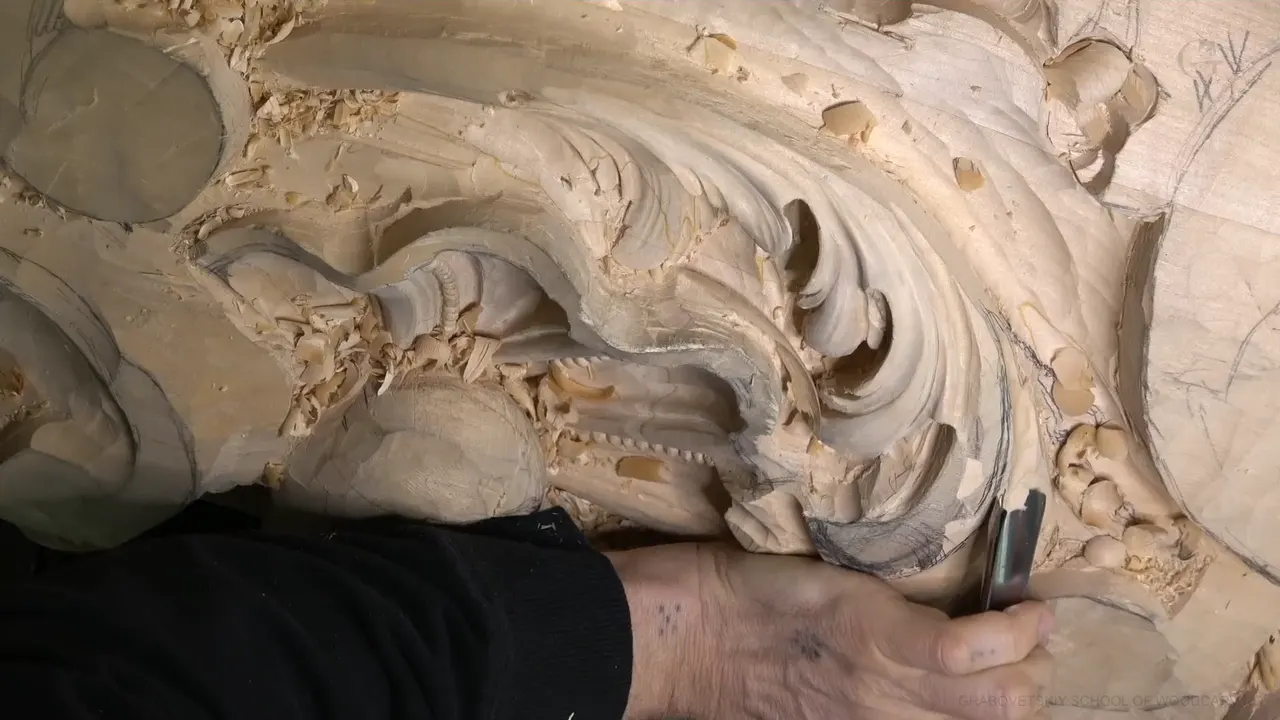

In Venice Room 10, part 9, I said one part probably needed to go a little lower, and "raising up" came in that same sentence. Those two words come back in my acanthus lessons, on ridges, pipes and curls.
Is one part of your carving sitting where you do not want it? Would you like to see it climb? I think so. Here are the lessons where I said the words out loud, with the tool I held and the cue beside it.
What did I say about raising up in part 9 of workshop 10?
Two cues come first: "Going to use again number nine" and "Clean that". The line itself follows, "Okay, and now I need to probably make this one a little lower too, because otherwise it's not going to make sense raising up."

Next I say "So now I can start developing." Then comes what I want to keep: "I don't want to go too much in. So I want to still reveal this bottom part." One idea for the direction stays open, "I could probably change here a little bit the direction."
What came before that line in part 9?
The part opens with the order "Make a separation cut", and the cut sits "below that part". A little later I say "So now I can start probably just removing a little deeper." I say "approximate development, how I want to see it", add "A bit smaller", and say "And that is good."
A plan for the shape comes next. "Let me create a really nice shape," I say, and "It has to go more convex." And "I need to actually create a lot deeper cut on this side." The tool comes in the next breath, "Here's a 20 millimeters. Number nine." That makes a number nine of 20 millimeters, about 0.8 inch.

"It has to go down too a little bit," I say. The shape comes next, "I need to give a really good shape to this one." A maybe comes for the tool, "I probably could use a big number seven. Let me see if I'll be able to or not." After more work in the part, number nine comes in again.
What else does part 9 hold?
I step down in size, and I say so aloud: "Maybe even smaller," and "let me use a smaller now." My pick is "Number 11 is what I'm going to use." A second pick follows, "or number nine will work also actually, just not as big". The separation comes next: "let me get that separation, and go around now."

Near the end I say "I've got my preliminary canvas." My plan after it is "Get rid of this because I'm not going to go all the way, because I could use that part as a development below." Then a doubt: "Now, I still don't like how it feels right here," and then "got to gradually..." Then "Not all the way." The last words are "Okay, and that is good."
How do parts 8 and 10 of workshop 10 sit beside it?
Next door in part 8, I weigh two ways. One is "a single movement" to "connect it to the upper part". The other is a movement "going from underneath" that connects "that part to the bottom part". I pick the second, and I say it will give me "a lot more interesting idea." "I am going to create this one as a lower part," I say. I call it "a double layering".

Part 10 turns to the convex. "I would like to see that a little more convexing," I say, and "let me try to use number six". Later I say "maybe I should even use number seven, not number six." A deep concave inside gets "a smaller number nine, like 10 millimeters or so" (0.39 in) in my plan, and going deeper is "for the sake of the shadow". Another number nine is "5/8 of an inch, 16 millimeters".
Does a ridge go up on its own, or because of the cut beside it?
Byzantine Acanthus lesson 4, part 1, has a ridge. The ridge comes first: "I want to make sure this part, this ridge, is also going up. Same like on that side." Then a convex: "It's still not what I want to see." I want "convex, but raising up."

I go on with "let me get little deeper concave", and soon "I'm creating deeper concave without going too crazy on the bottom." The goal, in my words, is "to make sure this part, right here, is raised up." It should look like "this one is overlapping, really". And "it goes up from that side toward the middle, and it goes up from that point toward that ridge."
Over in Modern Acanthus lesson 4, part 1, a middle part is the subject. I say the middle part is "going to be bulged little higher", and "it's gonna be convex movement." Then "we're gonna work on this and see this part is raising up." My tool is "a spoon gouge", and "in my case, that would be number 11. I use 7 millimeters" (0.28 in). "What I'm after this part, this part has to be raised up," I say.

Dropping gets its own words there. "See what we did on another side. We dropped slightly." Right here, "this part we're gonna slightly drop down." The thought ends with "You want to raise it. If you want to go a little farther, you can create the feel like it's rolling backward."
How does raising up look on a pipe?
Byzantine Acanthus lesson 9, part 1, has the pipe. "Between those eyes is a leaf and each leaf has a convex. Not really high, like a huge ridge, but kind of smooth." The pipes come next: "And the pipes in those sections, they are raising up."
Next comes the eye. Every one "is supposed to look like a water drop." From each side of that drop it is supposed to go "this way downhill, and that way downhill. So it creates the illusion of the pipe." "Again, it's pretty much convex," I say. Even with a ridge "a lot higher", it has to "overall look like a convex".
Modern Acanthus lesson 3, part 3, has a curl. "Yes, it will curl up," I say, "but also don't take too much material out of that little thing because we still have to dig an inside." Then "See that is the raising up? Then it's going down. Can you see?" A number seven is my plan to "knock down one of the sides", going "almost to the background" and "really far".

The next one gets "the bigger tool", "the number 9 and 20 millimeters" (just under 0.8 in). "I'm gonna drop pretty much. Only one of the sides," I say, and that side is "my high spot".
How does a curl climb?
In Floral and Molding lesson 3, part 2, the effect I'm after is "almost laying flat and just raising up, and then curls." A little before it I say "So it cannot be just a straight line." The plan is "a concave cut", with "probably just the number seven". After it I say "Hope it makes sense."

For the cut I name "number three, and that would be 12 millimeters" (0.47 in), and "a spoon." "Little by little we're going to create that concave," I say. Then "It's still concave, not as deep."
The Maine class has it too, in lesson 15, part 1. It "cannot go just straight in", and I want "some kind of movement like arching". Then "when I start it's almost laying parallel and then when I finish it's raising up like this, okay?" And "I'm gonna take my time." Those "tool marks they're going to serve for purpose also."
Workshop 77, part 4, has a smaller lift. "That piece can go up maybe," I say, "raising up a little bit". A plan follows, "I'm going to curl it up." Later, "I got that up about quarter inch" (6.4 millimeters).

The same part holds a second option. "I could actually go and attack that from the backside, and create some excavation that way."
Which way does the tool go when a part is raising up?
The words are plain in workshop 81, part 10: "In this section, I do have to work sometimes against the grain and going uphill, which you're not supposed to do. But if the tools are sharp, sometimes it's okay." I ask what is uphill and downhill in that spot, and I answer "So I start downhill cut, but then raising up uphill. So it's not really downhill, uphill."

A size plan sits in the same part, "smaller one, like maybe even two millimeters" (0.08 in). I also say "Create that undercut." I plan to "get rid of some of the material right here with the spoon gouge or spoon veiner, I should say. Veiner. Maybe use five millimeters again" (0.2 in). Then I say "And attack that from two sides."
Workshop 84, part 9, runs a part up with a gouge turned over. "Little deeper I can do," I say, and "I want to raise this part going up." "I really want to do the right movement," I add. Nothing stands in my way: "nothing prevents me of raising up this part." For this one: "I'm using number three upside down." I follow with "So it is going up," and add "Maybe deeper cut" and "make it even more pronounced."

A check follows: "So it's smoothly going from this point." Then "Right now it's not so good. Maybe I can hit that again with the rasp a little bit, this section, just to get really smooth transition."
Can a part that nobody sees still be raised?
Over in workshop 33, part 8, I say "I'm actually raising up this part. I hope you understand. It's invisible underneath of this leaf, but because it's going to be raised, it's going to give me a really beautiful movement."

The tool is "number 11 again", "20 millimeters" (a little under 0.8 in). "Yes, I am wiggling because I am working upward," I say. "It's not that easy," I say. "I need to find the right position how to do that excavation." A size remark follows: "that is probably a little too big of a tool to continue with my cut." And "I don't have to use a bigger tool, by the way. It's not the only way. I could get exactly the same result with the much smaller tools. But if you have a bigger tool, it's always advantage."
Room 59, part 7, treats a small raised part as worth keeping: "I still kind of like of this small part raising up", and "I don't want to lose it." The plan there is to "just go around that carefully, and go different direction", with "number 11 and one millimeter spoon gouge" (0.04 in). The lesson is Venice Room 59.

Lily Box lesson 12, part 4, has one I did not plan. After "make it more round here", I say "what happened, this part is just raising up little bit." I ask "Did I plan for it?" My own answer comes straight away: "No, but it's naturally happened." Then "Okay, and I kind of like that movement."

A dislike follows: "What I don't like, really sharp shadow on this side, and I need to take care of it."
When does a raising up look wrong?
Venice Room 25, part 6, gives the other side, with one part I was not happy about. "I'm also not too happy about how this one's raising up. So it doesn't look too good. Just sticking too much. And let me also just knock down that ridge." Then "And here you go. That is the main shape of this one."

Another comes from workshop 56, part 7, a part that is weak. "Here I have to be careful how I do that because it's raising up right now, and it's already became weak, or weaker I should say." Then "The way I'm doing it is a little too dangerous, by the way. I shouldn't do it. I should use a really long bevel like this tool, okay? Create a lot less stress on the fibers." I name "a number four long bent, and about 10 millimeters" (0.39 in) for the tool.
Where it stops shows in workshop 100, part 11. Now it "doesn't go up anymore", I say. It is "not raising up again", and it goes "underneath like this". It's "still concave".
Where else did I use the words?
Furniture Panel lesson 21, part 7, has "Just a little bit raising up. Okay? Wonderful." right after "One more cut." Before it I say "Later on, I can actually get really close with the router plane and go right underneath of it." Then "Let's see how crisp it gives me the result." Next comes "number seven. This one has a 16 millimeters number seven" (0.63 in).

Acanthus over Moldings lesson 5, part 2, has "see this part what I was talking about before it is raised up. Just really nice the raising up exactly the same goes right here." I also say "the left hand side will be laying right at the side of my future volute." Then "I'll take number 11", "15 millimeters" (0.59 in), and "I'm gonna attack carefully".
| Lesson | What was raising up there, and what I held |
|---|---|
| This part, 10.9 | One part I needed to probably make a little lower. |
| Room 84, part 9 | Going up, a number three turned upside down. |
| Byzantine 4-1 | A ridge that goes up, and a deeper concave. |
| Modern 4-1 | A middle part set to bulge a little higher, with a spoon gouge. |
| Floral 3-2 | A line almost laying flat, raising up, then curling; a number three planned for the cut. |
| Lesson 77.4 | A piece that can go up a little bit. |
| Lesson 81.10 | A cut that starts downhill and then goes uphill, with a smaller tool as my plan. |
| Venice 33.8 | A hidden part under a leaf, raised using a number 11. |
| Venice 56.7 | Already weaker, and a long bent was the plan. |
| Lily Box 12.4 | A part that came up without a plan, and I liked it. |
| Furniture Panel 21.7 | One more cut, then a little bit raising up. |
| Maine 15-1 | A cut laying parallel at the start and raising up at the finish. |
Where can you watch it yourself?
You can hear part 9 in the Venice Room course, in workshop 10. Listen for number nine, then number seven. The wood carving goes on part by part, in Venice and everywhere else I carve.
How it's done
- Set the cut below the part. In part 9 I said to make a separation cut "below that part", and that I could start probably just removing a little deeper.
- Name the deeper cut and the tool. The cut on that side got a number nine of 20 millimeters (0.79 in).
- Say what lower has to do. One part probably needed to be a little lower, and my reason came in the next words.
- Keep the bottom part in view. I wanted to still reveal this bottom part, and not go too much in.
- Use the part below. I said I could use that part as a development below.
Frequently asked questions
What tool did you name for the deeper cut in part 9?
A number nine, 20 millimeters (0.79 in), was named right after "a lot deeper cut on this side". A big number seven was only a maybe. Number 11 was my pick later, when I said "let me use a smaller now".
Which tools went with the words in other lessons?
Workshop 84 used a number three upside down. In lesson 3 of Modern Acanthus, a number seven was my plan, to knock down one side. Workshop 33 had a number 11, and workshop 56 had a long bent, number four, as the plan.
Did you plan every part that rose?
In Lily Box 12, I asked "Did I plan for it?" and answered "No, but it's naturally happened." I kind of liked that movement. In workshop 25 one part displeased me, and my plan was to knock down that ridge.
What to carve next