

Alexander Grabovetskiy, woodcarver, School of Woodcarving · Published 2020
What does a wood carver mean by "not enough"?
Quick answer: In Venice Room 11, part 10, I called two blended cuts a nice movement and said it was not enough. I then named number nine to raise that edge. In other lessons I said it about shadow, a concave and a tool size, and I named what to try next.
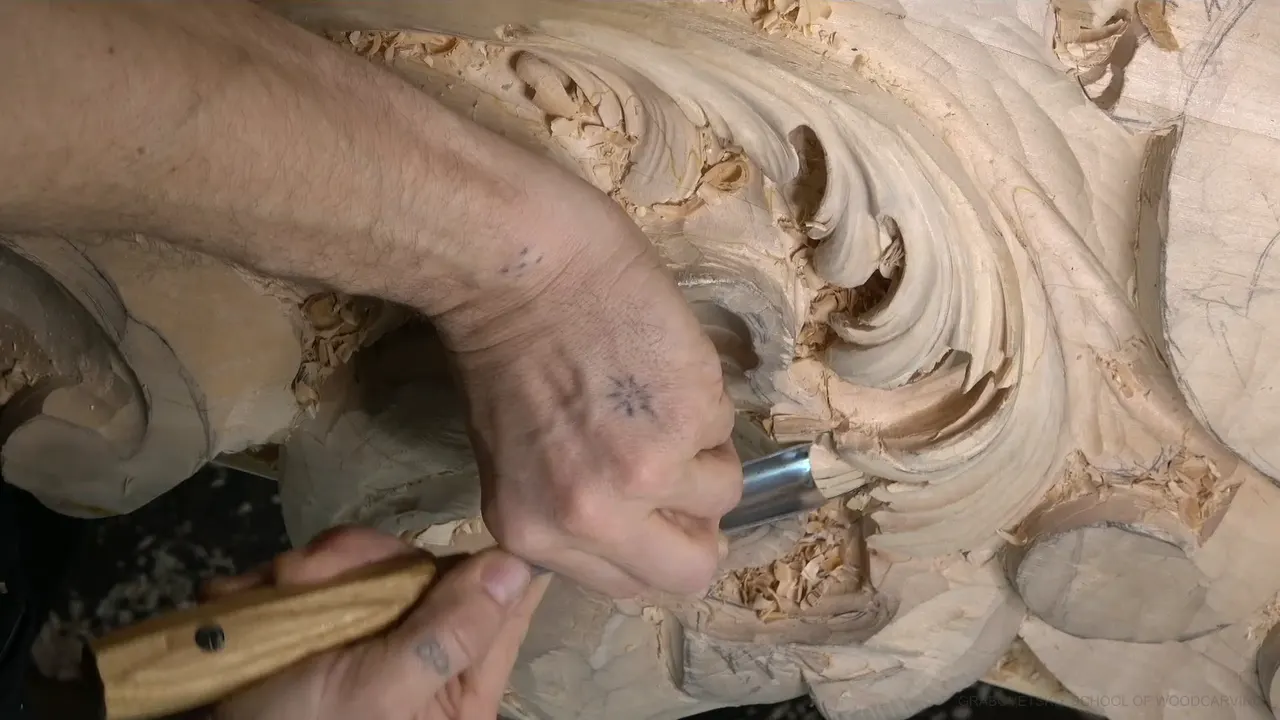

In Venice Room 11, part 10, I said two blended cuts create "a nice movement right there, but it's not enough for me." Next came "I think I need to go even more extreme." I say a line like it in other lessons too, beside shadow, a concave or a tool size.
Does a pass in your wood carving ever look fine and still leave you wanting more? Do you reach for another tool? Or do you turn the piece around? Stay a few minutes. Below are the lessons where I said it, what was missing, and the words that sit right next to the line.
The short list of what I wanted more of
- Part 10 of workshop 11 has a blend of two cuts and a plan for number nine.
- Workshop 119 has shadow, and my plan to excavate much deeper in one section.
- Workshop 53 has three divisions.
- Hashemi 17 has a number seven with too little concave.
- Workshop 143 has concave underneath, and a wish to go deeper.
What did I say in part 10?
At 00:10 came "Let me make relief cuts in those sub-divisions." At 00:22 came "Let me double-check. I don't want to mess up and chop what I don't need to chop." Then my tool: "number nine and a quarter inch," about 6 millimeters, and "carefully going to relieve it" (00:34, 00:40).

"Okay, wonderful," I said at 00:51. Soon, at 01:03: "This is a little too big. I need to probably use a bigger tool and create this movement." A little later, at 01:22, I said, "it's a really interesting detail, and I want to create something really nice."
Next came a plan for the shape: "Let me start actually first with creating concaves" (01:31). And this: "I want to see this edge really raised almost like that. Okay? So maybe I can just do a big concave on this side" (01:46, 01:50). By 02:02 it was "Preliminary, just create that movement."

At 02:26 I said, "I want to carry that concave a little more inward like that." After that, at 03:02: "And now I can probably start blending those two cuts."
Where did "not enough" come in, and what came next?
At 03:11 I said, "And that creates a nice movement right there, but it's not enough for me." Then, at 03:18: "Again, I am thinking about how it's going to be looked from below, and I really want to cast some shadow right there."

At 03:30: "And I think I need to go even more extreme." And then, at 03:38: "In this case, use number nine and raise that edge even more."
At 04:10 came "And let me think what I can do. I can actually exaggerate those concaves. Let me use number eight and create a concave on that side." At 04:43 I said, "So that's going to go on the side of the pipe." Then: "I can go actually really deep right here, too" (04:46). A few lines on came "But now I don't like how this part looks" (05:00), and then "Let me use number seven and make a little more roundness right there" (05:12).

At 05:50: "I'm using number seven upside down because I want to see that convex in the middle of this movement." Soon after: "I need to make sure it's a smooth transition downhill" (06:19).

"I can probably clean it now. Blend two sides together" (06:33). Next, at 06:53: "And I know it's hard to see from a camera position, but I'm not going to move my camera now. Just wait until I'm done, and you'll see exactly what I'm doing."
At 07:26: "What I mean by that, when you just cut and pull back, it creates small ridges like that. So I need to clean them to make it really smooth and nice" (07:26, 07:40).

What do parts 9 and 11 say around it?
Part 9, at 00:51: "So now, I'm happy because this ridge is raised, and it gives me really good movement." At 03:33 I said, "I'm going to create a deep shadow, but like I said before, it's flipping above my future shell, which is still not developed yet." Next, at 03:47: "I need to create a really good round eye." At 05:13 came "I'm not going to go deeper than about a quarter inch, maybe," and a quarter inch works out to about 6 millimeters. Then: "Maybe actually more because I do have a concave side like this, so I'm actually able to go deeper right here." At 07:09 I said "if you divide that in 10, I move it six parts out of 10," and I called it "like a golden ratio."
At 00:09 in part 11 I said, "Except now I need to fix this side." Next: "a more pronounced concave on that side" (00:19). At 01:29 I said, "Wonderful. So now I see how it's supposed to look, and I hope you see that too."
Soon, at 01:54: "I need to excavate underneath of that upper part. Otherwise, I don't see clearly what is going on." My next words were "Maybe 5 millimeters" (about 0.2 in) and "Number 11 will help me in this case" (02:04, 02:07). At 07:10, "I have to fix this eye," and at 07:18, "I need to actually bring that eye a little closer to that direction."

Which other lessons call for more shadow?
Workshop 119, in the Part 10 course, part 2, has "I really like to create a dark spot" (00:05) and then "Shadow" (00:12). At 00:34: "I need to actually excavate much deeper in this section." Right after came "Not enough shadow" (00:46). A size follows, "number 11 and 5 millimeters" (close to 0.2 in), and then "switch to 3 millimeters" (roughly 0.12 in) at 01:03.

Furniture Panel, lesson 34, part 3, has me at 02:43 with "six millimeters about quarter inch." Then: "'cause there is not enough shadow as of now. Gotta do a much, much deeper cut right here on this side, maybe number 11" (02:57, 03:00).
Part 3 of workshop 8 has "Maybe I can just create extra cut, extra long" (06:46), and the same sentence ends with "not enough shadows right there." At 07:01: "So I'm going to just create the cut around the number 11."

The Grinling Gibbons class in Maine has lesson 13. Of a dark spot: "That's what I'm after" (11:47), and "an extra shadow" (11:53). At 11:55 I said the same thing as in part 10 of workshop 11, and then "Okay later on. I will separate." Later still: "I'm gonna create another darker spot" (12:12).

How much concave is enough?
Workshop 143, in the Part 12 course, part 1, at 04:02: "Smooth and nice. I already got some concave underneath, but" and then "not enough, so I want to create even deeper." Next: "So let me switch to 18 millimeters" (near 0.7 in), and "Number 11, of course" (04:12, 04:18). Another line, "Maybe 5/8 of an inch, like 15 millimeters or so" (04:28).
Then: "And yes, that is probably enough" (04:43). At 05:00 I said, "I could excavate with a smaller one in this section, with maybe, let's say, 12 millimeters or so" (a bit under 0.5 in).

Workshop 14 of the second Venice Room course, part 11, at 07:02: "I'm using number seven and one inch right now, and maybe it is not enough yet concave. It's just preliminary." One inch is about 25 millimeters.
Next, Carving Hashemi Flowers, lesson 17, part 4. At 02:59: "Now it looks really clean, but number seven is not enough concave." Then "I need to take number eight" (03:06) and "This is too big" (03:13). The pick was "Number eight and about 10 millimeters" (0.39 in) at 03:18, and "10 millimeters works fine" (about 0.4 in) at 03:27.

When is a count short?
Workshop 8, part 6, at 01:45: "Maybe I should look at one, two, three and four. That is not enough." I said I need another subdivision, and at 02:01, "Maybe just right there."
Workshop 53, in the Part 5 course, part 3: "that is a good development. But three divisions is not enough" (05:07). Right after: "I really need to make more divisions" (05:13), and "let me think how I can do that" (05:19). I added, "I think I can get one of the middle lines right here."

Then the Furniture Panel design course, lesson 14, part 4. My words were "We've got those five and those small leaves" (09:21), and "And I think it is not enough" (09:29). Then: "So if we follow Fibonacci numbers, so it's got to be either five or eight" (09:32), and "I think we should do eight" (09:39).
What happened when a tool was too small?
Workshop 7, part 3, at 07:04: "And maybe number seven is not enough." At 07:16 I said "It is kind of enough at the top, but I kind of don't like what I see." Then: "And I think I'm probably going to use number eight" (07:24), and "I'll use a half an inch number eight. I need to sharpen it first" (07:44). A half inch comes to about 13 millimeters.
In part 9 of workshop 16 in the Part 2 course, at 02:55: "All right, but it's still not enough, so I still have to probably take a little more from the side and create a little thicker chunk." My reason came next: "Again, why I'm doing the way I'm doing, because it's going to be visible from the bottom" (03:12).

What about relief, curliness and depth?
Part 12 of workshop 7, at 03:06: "Let me do number seven." At 03:10: "create my first notch." A moment later came "Oops, that's not enough relief I did, but that's okay" (03:16), and "So I've got to relieve it much better" (03:25).
Part 2 of workshop 2 has "how deep did I go?" and then "three quarter of an inch, about 20 millimeters deep from this point in" (01:26), and "that's not enough" (01:31). My next words were "go back to number seven" (01:36) and "get rid of what I don't need" (01:39).
Then workshop 5, part 6, at 01:53: "This is not enough. This one needs to be a little more." At 02:10 I said, "I know maybe it doesn't make sense why I'm doing it for now, but you'll see that in the overall picture."

In part 8 of workshop 22 in the Part 2 course, at 05:55: "believe me, it's a beautiful movement." The next words are the ones I said in workshop 11. At 06:07: "I still want to do probably extra notch right here just to give an extra curliness." At 06:17: "going to use probably just number 11 and 1 millimeter" (close to 0.04 in).

Workshop 73, in the Part 6 course, part 5, at 06:58: "I needed to do something because it's a little too long." Then came "not enough curliness, I would say" (07:02). I added, "But I got to be really careful how I do it" (07:06).
In the Hazelnuts course, lesson 2, part 2, at 06:51 I said the same thing as in part 10, and then "I need to get lower this part" (06:55). At 07:18 I said, "I don't want to remove too much on the sides," and next, "number 9 and 20 millimeters" (07:26), about 0.8 in.

One more, from the Furniture Panel course, lesson 15, part 12. At 15:41, "Let me clean that." At 15:48, "This is not enough," and right after, "I need to get a little deeper right here" (15:50).

Where can you see them side by side?
| Lesson | What I wanted more of |
|---|---|
| Venice 11.10 | A nice movement, and a wish to cast shadow. |
| Venice 22.8 | A beautiful movement, and an extra notch still wanted. |
| Hazelnuts 2.2 | A part I said has to come lower. |
| Maine 13.1 | An extra shadow, with a darker spot planned for later. |
| Venice 119.2 | Shadow, and a much deeper dig in one section. |
| Venice 143.1 | Concave underneath, and a wish for deeper. |
| Venice 14.11 | Concave, called preliminary, with number seven at one inch. |
| Venice 8.3 | Shadow, with an extra long cut as the idea. |
| Venice 8.6 | A count of four, and a need for another subdivision. |
| Venice 53.3 | Three divisions, and a need for more of them. |
| Venice 7.3 | Number seven, then a probable number eight. |
| Venice 7.12 | The relief of a first notch. |
| Venice 73.5 | Curliness, and a need to be careful. |
| Panel 34.3 | Shadow, and a much deeper cut, maybe number 11. |
| Hashemi 17.4 | Concave, with a plan for number eight after number seven. |
| Venice 16.9 | A chunk that needs to be a little thicker. |
| Panel 15.12 | Depth, and a need for a little deeper right there. |
| Panel 14.4 | A count of five, and the Fibonacci numbers. |

Where can you hear it yourself?
Part 10 sits in the Venice Room course, workshops 1 to 12, in workshop 11, and the other lines sit in the lessons I named.
How it's done
- Blend the two cuts. At 03:02 I said I can probably start blending those two cuts.
- Say what is missing. At 03:11 I called the movement nice and said it was not enough.
- Think about the look from below. Soon after, I said I was thinking about the view from below.
- Plan the next move. At 03:38 I said to use number nine.
- Clean the marks. At 07:26 I said that a cut and a pull back create small ridges, and that I need to clean them.
Frequently asked questions
Which tool did I name first?
At 00:32 I named a number nine at a quarter inch (about 6 mm), and at 00:34 I said "carefully going to relieve it." Later came "This is a little too big" (01:03), with a need for a bigger tool.
Where was my mind after the nice movement?
I was thinking about the view from below, and I added "I really want to cast some shadow right there." Before that, I had called the movement nice.
How big was the number eight I took in Hashemi 17?
At 02:59 a number seven gave not enough concave, I said. Then came "I need to take number eight" (03:06), and my pick was "about 10 millimeters" (0.39 in). At 03:27 I said that size works fine.
What to carve next