

Alexander Grabovetskiy, woodcarver, School of Woodcarving · Published 2020
What does a wood carver mean by "see clearly"?
Quick answer: My line in Venice Room 11, part 11, was that I need to excavate underneath of that upper part, and that otherwise I don't see clearly. Number 11 was my tool for the excavation. In other lessons I said it about a line, a pipe, a separation and a movement.
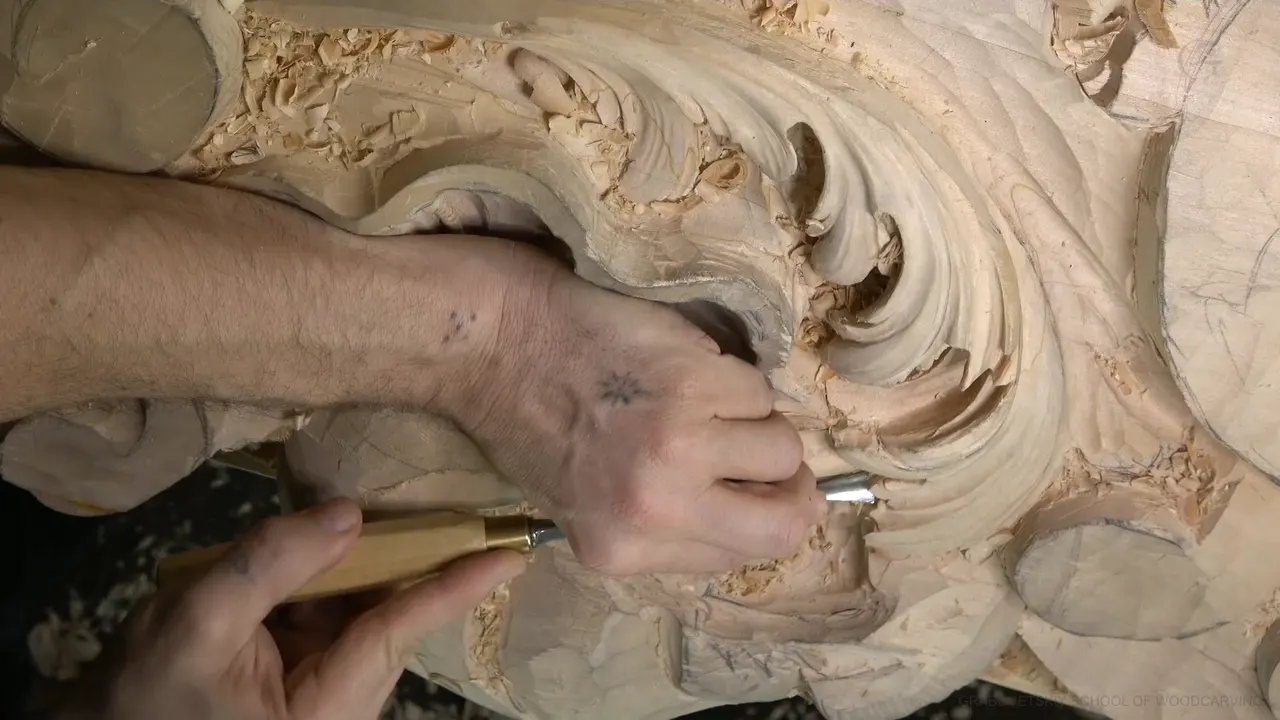

In Venice Room 11, part 11, I said, "I need to excavate underneath of that upper part. Otherwise, I don't see clearly what is going on" (01:54, 01:59). I say a line like it in other lessons too, about a line, a pipe, a separation or a movement.
Have you ever looked at your wood carving and felt you could not read it? Do you take wood off, pick up a pencil, or turn the piece? Stay a few minutes. Below are the words around that line in part 11, and the lessons where I said I could see clearly, or could not.
The short list of what I could see
- Part 11 of workshop 11 has an excavation, and a small separation.
- Workshop 38 has a pipe, and a spot where I did not see clearly.
- Workshop 44 has sunshine on the carving, and a separation.
- Lesson 19 of Furniture Panel has a line.
- Roman Acanthus lesson 5 has a pipe I lost on one side.
What came before the excavation in part 11?
It began with a need: "Except now I need to fix this side" (00:09). Soon after came "maybe I can actually give a more pronounced concave on that side" (00:19), and "Let me use number eight" (00:27).

Next: "this edge is also kind of going a little bit up" (00:37). A direction followed: "Turn that direction and clean from this point of view" (00:59). Next: "Maybe just more strokes like that" (01:13).
At 01:29 came a line for you: "So now I see how it's supposed to look, and I hope you see that too." My next words were "So I got that. But I also got this" (01:46, 01:52), and the cue after them is the line I opened with.

Where did "see clearly" come in?
The first half of the line came at 01:54, and the second at 01:59. Sizes followed. "Maybe 5 millimeters" (about 0.2 in) came first, and "Number 11 will help me in this case" came after it (02:04, 02:07). Also, "Carefully. Just excavate like that" (02:13).

"I'm using 2 millimeters" (near 0.08 in), I said at 02:28, and "Number 11" at 02:31. At 02:33 I said spoon gouge, and then I fixed the name: "Not spoon gouge, I'm sorry" (02:37). Next, "That would be mistake to call it the gouge" (02:41). And "It is not the gouge" (02:47).

Work went on. "And this direction, too" (02:54). "And maybe cleaning a little bit underneath" (03:20). One need came up: "Okay, I need to sharpen that again" (03:33). After that, "That's good" (03:53) and "Clean underneath of here" (03:55). By 04:09 I could say, "And that is approximately what I want to see."

Which plan came once I could see it?
"Now I can put some more details on that, okay?" I said at 04:19, and "I want to create an extra movements" at 04:25. Then came "Let me think" (04:44), and my plan: "What I want to do, probably, just create an extra cut underneath and separate little bit right here, okay?" (04:51).

Following that, "Just use number 11 and start doing stuff like that. And go underneath" (05:02). Soon: "And now I just created a small separation" (05:28), and "So I need to create that notch nicely, just like that" (05:44).
"And again, I'm going to clean little bit underneath of this" (05:53). Then: "That way I can see exactly what is going on" (06:01), and later "And I can create a little deeper cut" (06:19).

A size came with the next line: "The 1 millimeter. Okay. And number 11" (06:31), and one millimeter is about 0.04 in. Then, "Going to go and create that cut even deeper right there" (06:34), and "And maybe I can continue this cut a little farther" (06:51).
The eye came after that. "That doesn't look too good, too. I have to fix this eye" (07:05, 07:10), and "I need to actually bring that eye a little closer to that direction" (07:18). Next: "Oops, that's not good" (07:33), and "That's not what I wanted to do" (07:37). Next, "I need to bring that down a little bit downhill, and use the right tool" (07:41, 07:45), and I named number nine (07:50). The last line: "And bring that eye closer to this direction" (07:56).

What do parts 10 and 12 say around it?
In part 10, "And I know it's hard to see from a camera position, but I'm not going to move my camera now. Just wait until I'm done, and you'll see exactly what I'm doing" (06:53, 07:08). Earlier came "I am thinking about how it's going to be looked from below, and I really want to cast some shadow right there" (03:18, 03:22, 03:26). A detail of it, "it's a really interesting detail" (01:22, 01:25), came before that.
Part 12 opens with "The number 11, and excavate little deeper this way" (00:06). Later: "let me dig underneath, and I can see how big chunk of wood I will need" (01:06), and "I'm able actually to dig deep and create a really nice shadow there" (01:17).
At 00:29 I said, "I know it's tiny detail, but every tiny detail makes big difference." Then: "And that is also the movement of acanthus" (00:36, 00:39), and my size was 7 millimeters (roughly 0.28 in) at 01:26. Soon it "looks a little too big maybe for this separation. We'll see" (01:58), and the answer came at 02:17: "I can switch to a smaller one." Paint comes up at 04:41: "But again, I don't want to go too deep for the same sake I said too many times about paint, because I have to paint that later" (04:41, 04:45, 04:50). Near the end, "I still have to keep chunk of wood right here, because I still have to develop other parts" (05:09).

Which lessons have me seeing a line?
Workshop 3 of the first Venice Room course, part 9, has a pencil. "You could use any pencil. You could use 2B, you can use harder ones or soft ones, so it doesn't really matter" (04:23). Next: "But I really like this one because it's soft, it gives me good results" (04:32). Then: "So now I can clearly see my lines" (04:41). And "It's just preliminary" (05:07).
A few lines on, I said, "I probably should cut a little deeper right here because I can't really see the line" (05:21). My fix: "Unless if I can use some light" (05:33). Then: "Try to figure out how to... Yeah, that's better now" (05:38).
Lesson 19 of the Furniture Panel course, second part, part 5, has "I want to make sure my outline is perfectly matching my design" (14:43, 14:48). At 15:16 I could clearly see my line. Next: "So I'll just go around first, straight down, okay, at the beginning" (15:21).
Then a warning: "be careful not to dig inside the background" (15:37). My tool was "number three again and six millimeters" (15:56, 16:00), or about 0.24 in, and I planned to "carefully attack my edge, okay, and kind of make it a little round" (16:05, 16:13).
Where did I see a pipe?
Carving Roman Acanthus Leaf, lesson 5, part 1, starts from a problem. "on the left-hand side, I can clearly see where my pipe is going to be" (00:26). Then: "Pipe right here and pipe right there. But I completely lost this pipe on that side, and I need to recreate that" (00:36).
About a fix, I said, "There are actually different approaches you can take" (00:48). One answer: "You can see some sections of my carving. I did not remove paper" (00:59, 01:04). Soon: "to print two drawings" (01:16), and "one of them you can lay right beside, and another one you can just glue on the top of wood and work and remove the paper" (01:20, 01:25). I added, "Always you can reference those lines" (01:29), and "You have to be really creative" (01:42). My tool: "I'll take my small gouge, same gouge I used" (01:54, 01:57). I also said, "to solve the problem to recreate those eyes and the pipe movement" (01:46, 01:49, 01:54).
Now workshop 38, in the fourth course, part 9. "Just goes really nicely, and that just flows all the way" (00:09, 00:13). Before that: "And I can take this concave all the way this way" (00:21). Soon: "I can see clearly my pipe, which is established right here at the eye point" (00:39).
After it came "I need something flatter" (00:52), and "to get rid of those extra marks I don't need right here" (00:55). Later: "I don't need really deep excavation at this detail" (01:00).
Lesson 20 of the same Furniture Panel course, part 7, begins with the paper: "Okay, to remove the paper, I'll use again reed brush" (24:42, 24:44), and "scrape that out or sand that out" (24:50, 24:52). Then: "That way I'll see much better" (24:57). At 25:18 I said I could see clearly that I really need to exaggerate, and "What I need to exaggerate, it's my pipe" (25:23).

Then: "Because right now I don't really see the really good shadow" (25:27). So the need was "a smaller concaves on both sides" (25:37). The tool was "16th of an inch number eight" (25:46), a 16th of an inch being about 1.6 millimeters. Then a plan: "Need to attack that from a right position" (25:55, 25:57).
When do I clean first so I can see?
In workshop 38, part 2: "I need to use an even smaller tool, like five millimeters" (01:18), close to 0.2 in. Soon: "just because it's too many marks" (01:26). At 01:32 I said I do not see clearly, and "I need to fix my canvas. Just clean it first" (01:39). Next: "Otherwise, it just doesn't make too much sense for me" (01:42), and "I have to just match the depth on both sides" (01:52, 01:56).

What did light and a view from below show me?
Workshop 44, in that same course, part 11, has "And now I have to blend this ridge, and sunshine helps me a lot, actually" (04:48, 04:52). After that: "I can see how the light hits, and I can see clearly what I have to do" (04:59, 05:04). Near that: "It's almost sunset" (05:20), and "Okay, let me get rid of those chips" (05:23).

"That could go underneath right there" (04:23) comes first. A small eye comes up as well. Soon after: "And I could create a small eye" (04:29, 04:31). "Not big, but still an eye. Just like that" (04:41, 04:45). Later: "And I clearly see that separation now" (06:48).
Part 11 of workshop 17, in the second course, has "my goal is to see from the bottom, from this position" (00:21). Next: "now I clearly see what I don't like about it" (00:37). Next, "I could just chop and just create beautiful movement right there" (00:50). A line: "it's almost straight line, so that's not good. Of course, I didn't finish it yet" (00:44). Also: "I explored couple options" (00:59), and "That would be nice" (01:03).

Workshop 33, in the third course, part 2, has "That way I see the direction much better" (06:16). Then: "on some of the projects, I actually use a marker a lot" (06:26, 06:30). "It makes sense" (06:34). My words were "even to put the separations" (06:38), and "You see, the marker sometimes helps" (07:10).
Which movements did I check?
Workshop 39, in the fourth course, part 5, has a ball pen. "you can just push in and draw whatever you need to draw" (00:39, 00:43). Then: "At least it's going to give you an idea where the stuff's supposed to be" (00:48). It is "one of the methods" (01:00). At 01:05 I could clearly see that I was way off. Then: "Not really way off, but because I sloped that, now I just have to move this direction a little more" (01:13). Last: "I have to excavate inside little deeper" (01:43).

Part 4 of workshop 22, in that second course, has "I need to clean inside" (01:13). "I could actually get four millimeters first, number eight, and get in" (01:13, 01:21), and four millimeters is roughly 0.16 in. Following that, "And even I can get an inside of this eye" (01:25), and "although I need to establish really nice shape of this eye" (01:30, 01:33). Later, "I will spend a little more time later to get deeper" (01:55). After "but as far as now," came "clearly see the movement of my acanthus and this eye" (02:00, 02:03).

Where can you see them side by side?
| Lesson | Seen clearly |
|---|---|
| Venice 11.11 | Not clearly yet, and an excavation I need underneath. |
| Venice 3.9 | My lines, after a word about a soft pencil. |
| Panel 19.5 | My line, then a plan to go straight down around it. |
| Roman 5.1 | My pipe on the left-hand side, and a pipe I completely lost. |
| Venice 38.9 | My pipe, set at the eye point. |
| Panel 20.7 | That the pipe is what needs more, and why. |
| Venice 38.2 | Not clearly, because of too many marks. |
| Venice 44.11 | What I have to do, with sunshine on the carving. |
| Venice 17.11 | What I don't like about it, from the bottom. |
| Venice 39.5 | That I am way off, because I sloped it. |
| Venice 22.4 | The movement of my acanthus, and this eye. |
| Venice 33.2 | How I can work my way in, after a marker. |

Where can you hear it yourself?
Part 11 sits in the Venice Room course, workshops 1 to 12, in workshop 11, and the other lines sit in the lessons I named.
How it's done
- Turn and clean. At 00:59 I said, "Turn that direction and clean from this point of view."
- Pick the tool. At 02:07 I said number 11 will help me in this case.
- Clean underneath. At 03:55 I said, "Clean underneath of here."
- Check what you have. At 04:09 I said that was approximately what I wanted to see.
- Shape the notch. At 05:44 I said that notch should come out nicely.
Frequently asked questions
Which size did I use for the excavation in part 11?
At 02:28 I said, "I'm using 2 millimeters" (about 0.08 in), and at 02:31, "Number 11."
How did I talk about the tool name at 02:33?
I said spoon gouge, and then "Not spoon gouge, I'm sorry" (02:37). At 02:47 I said, "It is not the gouge."
Which pencil did I like in workshop 3?
During part 9, at 04:23, I said any pencil works, and 2B is one. At 04:32 I said I like the soft one because it gives me good results.
Which pipe did I lose in Roman Acanthus 5?
What to carve next