
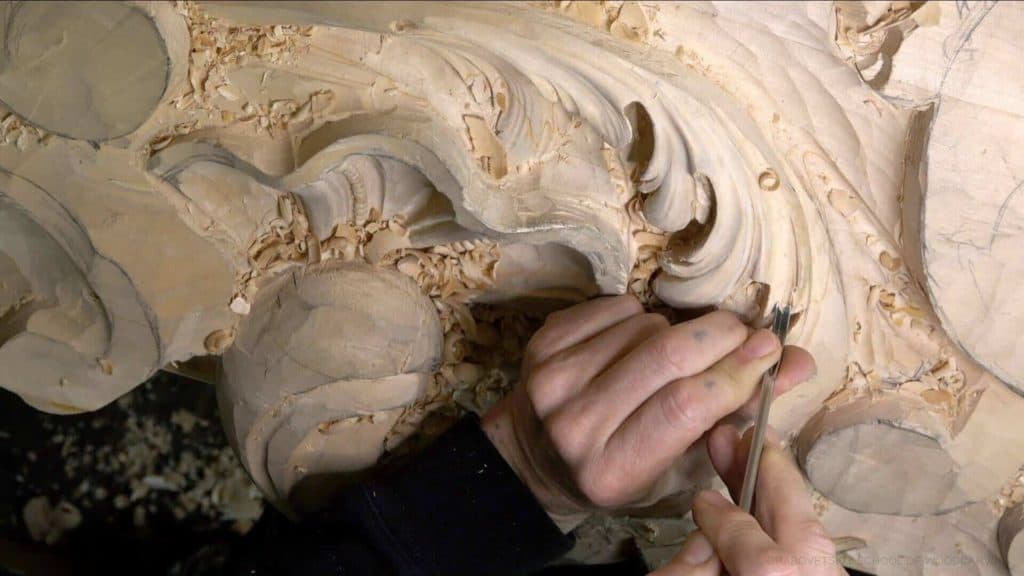
Alexander Grabovetskiy, woodcarver, School of Woodcarving · Published 2020
What does a wood carver mean by "work out"?
Quick answer: In Venice Room 11.2, I said that a double flip would work out before I made the cut. In other lessons I put those words beside a tool I was trying, a hope with a stop line, and a part I wanted to check first.
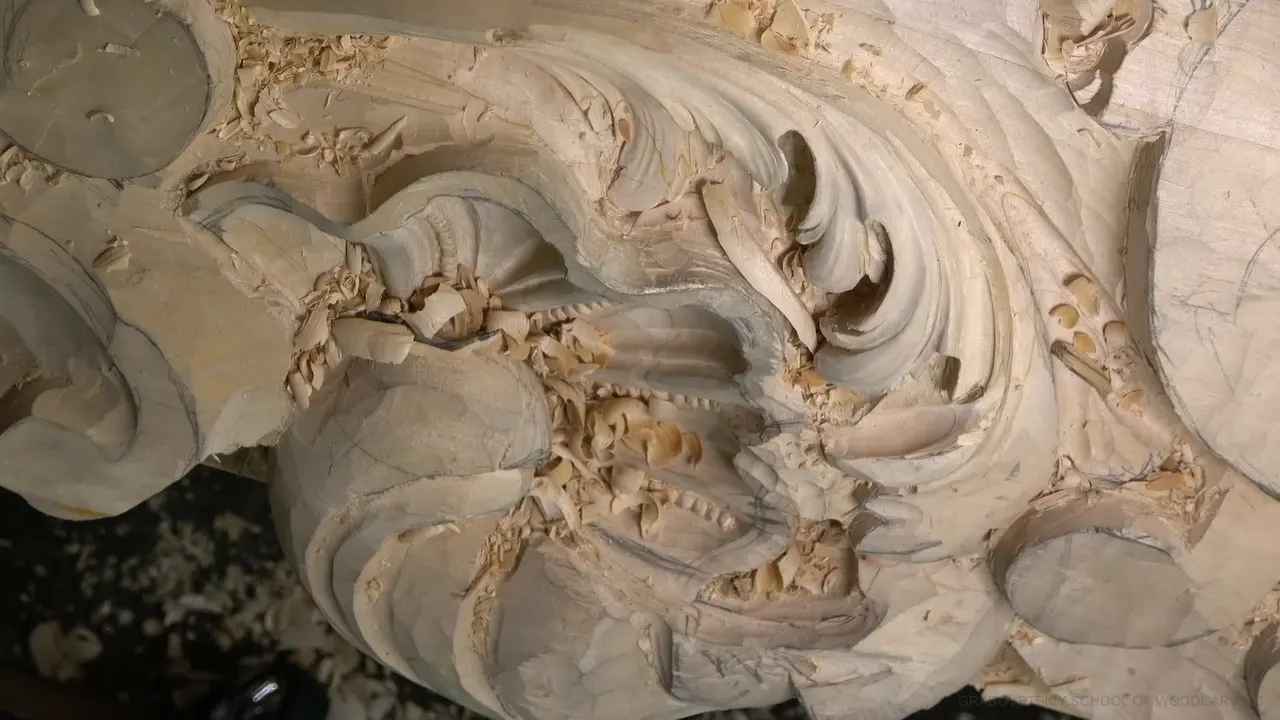

In Venice Room 11.2, I said a double flip was "actually going to work out really good." The cut was not made yet. I had just said that I was not happy with the spot, and the flip was still ahead of me. Lessons from other courses use the same two words beside a gouge I was trying, a hope with a stop line, or a part I wanted to check first.
This page follows part 2 first, with the two parts that come after it. Then it visits the workshops and courses where I said it again, and what each time had in it.
What was I carving when I said it?
Part 2 opens with the details. "And now I probably start putting the details on this one." Then a worry: "I'm still not too happy about how this one developed right here." My plan: "So maybe I should do a flipping. Double flipping."
The price came next, and I said it out loud. "Okay? Let me try. If I don't like it, it's too late." After that, a need: "I need to create a concave." The words from the top of this page came next, said twice in a row.

Where the flip goes: "So my flip going to start somewhere right there." A limit followed, "Yes, but it cannot be below. It has to go in just like that." About one spot: "that part is going to be the lower part," so I needed a cut "right here." I thought the result would make me "much more happier."
Two tools were named, one as a back-up. Number nine came first, and if that was not sufficient, "I'll use number 11." The back-up would be "a spoon gouge, maybe five millimeters" (0.20 inch), and I would "excavate right below it." I also wanted some space, because "I still have to go that flip on inside."

Next, a start. "This has got to start from almost nothing," I said, and maybe a "little deeper concave right here." Then a test. Keeping "this small raised part" was the idea, with some kind of separation "if I'll be able to." The reason I gave: "it looks like I am breaking some stuff."
The captions then go quiet for about 48 seconds. When the words come back, the verdict is a mixed one, with an answer already attached to it. "And I think I love that idea. Although I've got two separations too close, and that's not too appealing, but it's not unfixable." My answer: "I can actually create an extra separation right here."

More plans filled the rest of part 2. One was to "lower down a little bit this section later on." One cleanup, as a plan: "Get rid of that mess I just created." One check: "I am double-checking. I want to make sure I'm doing the right thing."
A choice about a line came late in part 2. The line stays: I would not "destroy this line," although it would be "a part of different movement." It would give "extra movement on the side." I meant to keep it. Last, a plan for a cut "a little lower," and "At least give some concave." Near the end: "Give that feel like this is flipping little bit above that one."

How did it go in the parts after it?
A plain look came in part 3. "It looks not bad and all, except this separation needs to be kind of fixed. Otherwise, it doesn't make sense." A minute later: "But now I like it a lot more." And: "Now for me at least, it looks more movement." A doubt sat beside it. "I'm not sure. Did I do enough of it? But I like it."

Later in the same part: "I know it doesn't make sense as of now," and I said it would, with the shape going "just like that." Then: "I'm not too happy how it looks. Maybe I should use a little bigger tool and less sweep. Let me try to use number six." As for the ridge, I said that I would keep it, and added that I kind of liked it.
A rasp turns up in part 4. "Now, I'm kind of happy with the overall feel, but I think I missed something right here. So I need to probably take a rasp and just to find the high spots." Next: "There is a couple of spots that kind of bugged me. They're not flowing okay in my opinion."

Near the end of part 4, a line about a tool: "I didn't think I was going to like that tool at all. But the more I use it, I like it more." Then: "I actually like it a lot now." The caption does not name the tool, so I will not either.
How did I try a tool I could not judge yet?
I tried it and said so first. In workshop 67, part 12, the first size did not hold up, so I asked myself which one else. "Maybe number three." We would see, I said, if it worked out or not. That was "number three and one inch" (25.4 millimeters), and the result came right after: "And that works really good, actually."

The same pattern shows in workshop 74, part 2. "That one doesn't work." Then number six, to try in the quarter inch. A quarter inch is 6.35 millimeters, and I called it "about six millimeters or so." My verdict: "number six is actually excellent."
Bigger was my idea in workshop 66, part 8. I thought a bigger tool "will work much better," maybe 20 millimeters, and we would see. The tool was "20 millimeters, number 11," and a second figure came with it, "Three-quarter of an inch." (20 mm is about 0.79 in, and three-quarters of an inch is 19 mm.) Of the cut: "right away, it gives me clean cut."

Again in workshop 67, part 11, number three was the plan, this time to go "that direction." "It will do the trick." Then: "It actually does." I was able to hit some high spots, which I said did not make a big difference, but "I like to work on a clean surface."
Small sizes got the same test in workshop 64, part 3: "Two millimeters, four millimeters, maybe. Maybe four millimeters." Four millimeters is 0.16 inch. My try in workshop 15, part 12, was 7 millimeters (0.28 inch) on a number 11, and I added "And it should."
Sometimes the test was a direction. I tried to get across the grain in workshop 78, part 5. "I'm placing my fingers right underneath to support, and it's still kind of moving around. But just because it's along grain, and I have that handle, I'm still pretty stable."

When did I only hope for a good result?
Hope has its own sound. Here it is in workshop 84, part 10: I said "Try 7 first," and then "7 is much better than what it was before." Next came "Also go opposite direction." The word "Hopefully" came next. A cheer followed, "Okay, wonderful," and then a snag: "But it's still not pronounced pipe. So pipe has to be more pronounced."
The Floral and Molding course has a hope that came with a condition. In lesson 5, part 1, I was trying out a look from above in the corner, and I hoped it would work out. If not, I would skip it, so I would not "overcomplicate my setup."

A ridge is the subject in workshop 60, part 4. "I really don't need this ridge, so I need to take care of it." I planned to try a tool, and could always try another. A bit later: "It looks like" the tool "is working really good." Then: "It's just like using knife pretty much."
A hope for a middle line is in workshop 74, part 6, "so you can see that line." About where the next one goes, I said: "Again, maybe it's wrong."
A slip with a good ending is in the Plate with Butterflies course, lesson 1, part 2. "I've got little too deep. But that's okay." Then, in plain words, I said: "It's gonna work out. It's not gonna be any problem."

When did I say it with confidence?
The plainest case, in my own telling, is workshop 7, part 2. "Maybe let me use a number seven and a half an inch" (12.7 mm). What I expected: "really uniform look."
A leaf over a leaf is the plan in workshop 43, part 12. "Just to get leaf above the leaf." Calling it a good bet, I planned "huge eye. Big eye," and the plan was to excavate "before I forget the idea what I have in mind."
Small details on a big shell got the same trust in workshop 73, part 6: "that shell is huge, which is this area, so those are small details. It will work out really good."

The rasp gets a good word in workshop 82, part 10, although I am "not the biggest fan of rasps." My reason: "in this case, like I said previously, I think it makes sense." And: "I can create and refine the shapes really quickly."
Care comes first in lesson 8. "I could start with just the straight tools, like number seven. Just do it upside down." I expected it to go well, "but I have to be careful," so the full cut would wait.
A good plan, in my words, is in lesson 9 of that course. And a knife idea is in the Furniture Panel course, lesson 20, part 10: "for that, I probably should use a knife."

A second tool would do too, I told students. Over in the Greek Acanthus Leaf course, lesson 4, part 2, I told students that a number nine in your hand could work out also. "And you should see also result like that, and I like what I see."
A choice of direction is in the Vase with Grape Leaves course, lesson 1, part 3. "I could grow from a bottom of the vase up." And: "Or I could grow from up, down. Okay? Which is also legit."

Not every try fit cleanly. In lesson 12, part 1 of that course, I said one tool would not work in that section, so I took number seven. Afterward: "It doesn't fit, actually, all the way. Barely. It did fit, but barely."
What did I check before I trusted a plan?
A check on a part is in workshop 78, part 6, where I wanted "to make sure everything" would be fine "with this part." What that meant: "I need to actually excavate a little more right here."
A division was a decision in workshop 61, part 10: "I have to make the decision how my division" would come out. My test for it: "this makes sense if I can make main middle line going this way and going down."
A flower in the Lily Box course, lesson 10, part 8, needed a decision. "I have to make the decision how it's going to curl, because I don't have too much space on the backside. It has to flip."

The Hashemi Flowers course, lesson 8, part 1, has a check of the whole piece: how it would sit "with the overall composition, if you wish." And an invitation: "You don't have to repeat exactly the movements I do. The idea is actually to learn how to do it on your own, to make your own designs."
What did I hold back in case it did not work out?
Workshop 150, part 2, shows me holding back on a volute: "I'm not going to finish it right away, this volute, because I still have to establish the final look from above." My reason: "in that way, I'm going to be safe if something not going to work out. So I can always have extra material left."

The Lily Box flower has a way out too. I would see how it worked out, "and if I don't like it, I can always remove it." A marker was next on my list: "Let me get my marker, and I'll try to figure out what I can do."
The opposite case is the part this page follows. There the price was named: too late. No reserve was named in that line, and the two parts after it show me fixing, keeping and cleaning, with a rasp in part 4.
Where else did I say these words?
In a talk about how I started to teach, the words belong to someone else, and I passed them on. Around five years before that recording, I agreed to come and try, at a woodworking school in Indianapolis. The man whose school it was told me, "Don't be afraid." He said it might work out and it might not, and either way I should not be afraid. My own summary was "nothing to lose."
I came and I tried, and about what followed I said, "I fell in love." In the years after, "my class was sold out pretty quickly." Before all that, in my words, "it took me a couple of years to think." The whole story is in Let Me Introduce Myself.
| Where | What I said or did |
|---|---|
| This video | A double flip, with the cut still to come. |
| Next door, part 4 | A rasp planned for the high spots, and a tool I came to like. |
| In 67, part 12 | A first size that did not hold up, then number three. |
| From 74, part 2 | Number six at a quarter inch (6.35 mm), called excellent. |
| At 84, part 10 | A hope, and a pipe that was still not pronounced. |
| Over in 78, part 6 | A check before I trusted a part, and a need to dig more. |
| Over at 150 | A volute I would not finish right away in part 2, with extra wood in reserve. |
| Panel course, lesson 12 | A number seven that fit, but barely. |
| Lily Box 10, part 8 | A curl I could always remove, and a marker to plan it. |
| The talk about my start | A phone call, a couple of years to think, then a try. |
Watch the videos
Everything above comes from my video lessons. Start with workshop 11 of the Venice Room, where part 2 holds the line, and listen for the nines, the 11s and the word flip. The wider Venice Room course sits around it, in Venice style, and the acanthus wood carving goes on part by part.
How it's done
- Say how you feel. I was unhappy about how the spot had developed.
- Name a plan. Maybe a double flipping, I said.
- Say the price. Too late, if I disliked it: that was the price.
- Pick two tools. Nine first, then 11 if nine was not enough.
- Say it before the cut. I said the flip would go well before I made it.
- Check as you go. Double-checking, to be sure of the right thing, was part of it.
Frequently asked questions
Was the cut better by part 3?
A lot better to me, and more like movement. I also asked whether I had done enough of it, and said I liked it.
Which tools did I name in part 2?
Nine came first, and 11 was the back-up if the first one did not do. The 11 was a spoon gouge, maybe five millimeters (0.20 in).
Did I plan a rasp in part 4?
Yes: I needed to probably take one to check for high spots. Later I said I had not thought I would like a tool, and liked it more as I used it.
What came after the size that failed?
What to carve next