

Alexander Grabovetskiy, woodcarver, School of Woodcarving · Published 2020
What does a wood carver mean by "I like this tool"?
Quick answer: Venice Room 11, part 4, is where I said I did not think I would like a tool, and then liked it more with use. In other lessons I said I like tools for a bend in the blade, for a fit sideways and for a smooth finish, and I said I kind of like a rasp.

In Venice Room 11, part 4, I said I did not think I would like a tool at all, and then "the more I use it, I like it more." I say a line like it in other lessons too. It sits next to the grain in one, an undercut in another and the heel of a tool in a third.
Is there a tool in your set that you did not want at first? Has it ended up in your hand anyway? Then stay for a few minutes. Below are the lessons where I said I liked a tool, the tool I held, and the words that sit right next to the line.
The short list of tools I liked
- In part 4 of workshop 11, I liked a tool more as I used it.
- In Hazelnuts, a tool let me work against the grain if I wanted to, and I had no problem breaking that rule.
- My number 17 gave me a softer look in an undercut.
- A bent grounding tool helped when a piece was on my way, in Greek acanthus.
- In Venice Room 50, my short number nine got me deep without hitting the sides, and I could fit it sideways to rotate.
- In the Lily Box course, a rasp got a "Wow" from me.
What did I say about that tool in part 4 of workshop 11?
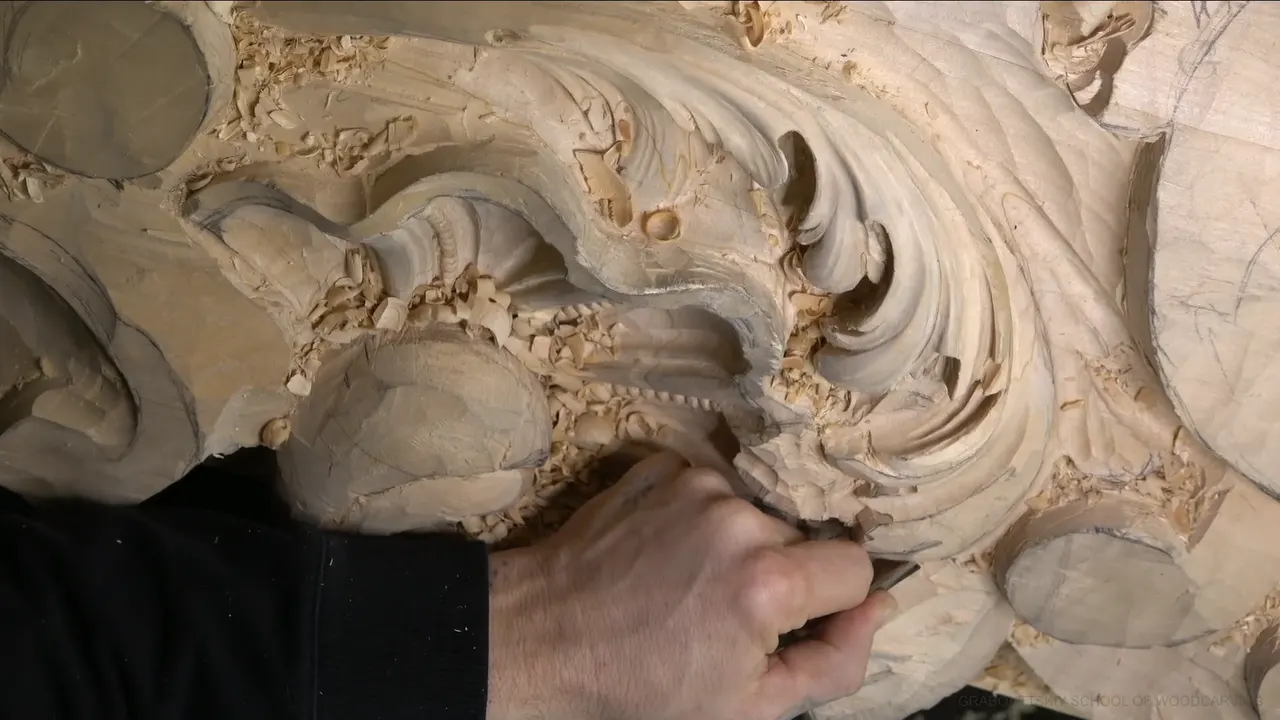
The line comes at 07:56. Before it, at 06:37, I said, "Now, I'm kind of happy with the overall feel, but I think I missed something right here." After that came my plan: "I need to probably take a rasp and just to find the high spots, because I kind of don't like how it feels right here." The frame below, from 07:00, shows a long flat rasp in my hand.

Next I said, "See, that's what I'm talking about. There is a couple of spots that kind of bugged me. They're not flowing okay, in my opinion" (07:12). Then came "Now, it's better, but this..." (07:41).
And then the line: "Let me tell you, I didn't think I was going to like that tool at all. But the more I use it, I like it more" (07:56). Right after, I said "Let me just clean that concave," and at 08:16, "I actually like it a lot now."

How did part 4 start, before the rasp?
In its first lines I said "we can do whatever," then "Actually, you know what? If I want to be authentic, so I still have to create some kind of..." (00:13). Next: "It's not really eye, but still, it is an eye, okay? Because they really didn't have too many sharp triangles on inside back then" (00:22). A little further on I added, "And of course, not just the Venetian style, it's actually to the 15th century" (01:08).

Then: "There is going to be some separations, and let me clean now whatever the shape I have to clean right here" (01:24). "Sometimes what they did, there was flipping everywhere. Flipping and overlapping and so on, and I'm going to do that somewhere. Some unique overlapping movements" (01:54).
By 02:18 I was saying, "As of now, it looks good. But let me create a long concave right here." "Not long, but just the starting concave this side, and I'm going to do exactly the same on this side. But I need to move opposite direction like that." Then, at 03:15: "I need to also kind of create for the eye, the movement where I can draw my attention to the middle line. Maybe I can just create an extra ridge." Later, "to create that extra ridge, I can probably use the same technique. Just concave on one of the sides. Actually, I could do both sides if I need to" (03:34).

At 04:23 came "that does not look too appealing right here," and a little later "So we've got the main idea right here" (04:45). And then: "I can probably go on right now and just try to develop even more if I want to. And I think I should" (04:57). I added, "I kind of want to see another concave on this side, a little deeper, at least at the beginning" (05:11), and "Just give that detail extra pop, extra shadow" (05:30).
One more line before the rasp plan: "I think it looks good, except I can actually go from all the way here. It goes all the way down, and I could do a little more concave on this side" (05:48).

Which tools did parts 3 and 5 name?
Part 3 comes before it. "I'm pushing it, so I don't want to create a mess. So it's better just to go number 11, and I just go upside down and start removing little by little on inside" (00:21). Later: "So with the number nine, no, number 11, I'm sorry. Number 11 veiner" (02:54). Later still: "I'm not too happy how it looks. Maybe I should use a little bigger tool and less sweep. Let me try to use number six" (04:42). Next came "Number six, maybe number eight, even" (06:10), and "And three-quarter of an inch" (06:22), about 19 millimeters.
Part 5 comes after it. "I can always hit with the gouge and take care of all those tool marks," I said, and I added that this will be "paint grade" (00:33), and "I really don't have to if I don't have to." Further on: "Here's number five. I got to be careful how I do that" (02:26). "Just because I use rasp, you can see the new concaves a lot more clearer, I'd say. But it's not necessarily the good thing" (04:47). "I can always hit that with some type of sandpaper or just with the reed brush" (05:11). At 07:28, "I'm using number two and 50 millimeters," close to 2 inches.

Why did I pick one tool in the Hazelnuts course?
Lesson 4 of Carving Hazelnuts, part 2: "So now it's just the blocking-in stage, and let me do it with the same tool pretty much." I like the tool, I said, because "I can work even against the grain if I wanted to." A little later: "I am breaking right now the rule of working with the grain, which I don't have a problem with breaking, I mean." Also: "I know it looks messy, but that's all right."

Then I said I needed a different gouge for another part, "like number nine or so. Or even 11." Eleven was my plan (02:15).
What is a number 17 good for in the Roman Acanthus course?
Part 2 of Carving Roman Acanthus, lesson 16, has me saying "on all of my carvings, I really like deep... Well, deep undercutting, but extreme undercutting, okay?" (21:03). For that I could use number 16, "but since I explained to you today about number 17, and that is number 17 right here. It's also like a V tool, but it has a bigger gouge at the edge."
At 22:16: "What I like about this tool, it doesn't give me a really sharp point." With a V tool, "this point would look kind of sharp. But with the number 17... it's actually kind of round a little bit on the inside. It just gives me a little softer look, okay?" I added "So that's why I like this tool, probably" at 23:00, and then talked about number 16.
On the two tools I said: "I shouldn't say I like this one is better than number 16. Number 16 is actually also my favorite." About number 17: "just because of that, I like it, okay? In this case, at least" (23:17). Its finish: "it actually really gives me a smooth finish on the inside" (23:28). Later, "please don't force it. Let the tool do the work" (24:25).
Does a bend in the blade change which tool I like?
In Carving Greek Acanthus, lesson 5, part 3, I said I would take "just about 1/8th of an inch grounding tool," which is about 3 millimeters (00:35). "I do have different grounding tools, but I like this one just because it has a slight bend in it. Okay, just a slight bend. And I think that helps me a lot sometimes in areas like that, for example, when I have a piece on my way and a straight would not reach as deep" (01:37). Then: "But even a straight, certainly, you can get to the point really close to that."

A whole video of mine is about back bent tools, in the All About Tools course. "Let's say I've got the high spot right here," I said, and "if I wanna attack that with the right angle, with the straight tool, it's gonna dig in." Of the back bend I said, "it's raised above and I can safely attack this part." And "obviously that is one of the reasons why I love that tool." I also like to use it for undercutting, I said.

What does my number nine let me do?
Workshop 50 of the Venice Room, part 8, at 06:02: "I'm actually going to excavate a little deeper, but not too deep because I don't want to create a problem for myself." Someone had asked me about the number nine I was using a lot in that project. "You can see this is a really short part, just the cutting part," I said.
My reason for loving it came next. "If I've got a spot like this, if you can see, and I can fit only sideways, I would not going to be able to fit like this, but sideways, I could fit and make my rotation and continue my carving right on the side."
"With this tool, I can get really deep without hitting the sides. You can see I can't pull it out like this, so I still have to rotate and move out. So that's why I love this tool. Flexibility."

Who asked about my chisel in workshop 89?
In workshop 89, part 9, I said, "It is almost like if I would use a small number three, but if I have the tool in my hands, why not use it?" (00:35). At 00:44 I said I needed to clean the wall of my volute. A question came up at 01:14. One of you asked me why I like it, and why I'm not using number three or just a knife. The answer: "Absolutely no problem with that," and "I can use knife," and "I love knives, as you know," and "I really love knives" (01:14).
And about the chisel: "It's a really handy chisel," "it has whatever the angle I want to use," and "that's the same pretty much like multi-tool in one" (01:31). "With the same tool, I can get a lots of operations. It's good for cleaning areas like that and for general purpose even."

From workshop 90, part 7: "If you are a furniture maker, that is a really good tool to have." I said I could attack the wall too, and "create a really nice and beautiful transition." Then: "If you would ask me, why don't I use a 90 degrees V-tool? Oh, absolutely you could" (00:27), and "Absolutely, no problem. You could do that" (00:37). At 00:41, "I just like that tool, okay," followed by "I just really like that."
How big was the tool I liked in workshop 105?
Part 3 of workshop 105 has me at 03:13 with "I think that is deep enough. So now I need to make sure it's really gradual." The next tool for me, I said, would be a number two, 50 millimeters (04:22). "Two inches or so," I said, and 50 millimeters is about 2 inches.
I could use something different, I said, but "I really like what I can accomplish with this big tool." Then: "Maybe get rid of this mallet. And I'm carefully going to smooth this out" (05:01). And "number two is almost flat, it's not really flat, but almost flat."

Did I like a rasp from the start?
Part 11 of workshop 5 has "lately, I really like the idea of using rasps" (03:41). I was honest about it: "I really didn't use them before too much. I kind of thought it would be like a fake to the wood carving, but not really. To establish the main form, I could probably do that. And especially in production, I got to save time also."
Part 13 of the Lily Box course, lesson 4 has "Let me use a rasp again, and I'll just try to blend this side" (24:54). "That looks good, in my opinion" (25:21) came next, and then "Wow, I kind of like that rasp."

What about a skew, a macaroni tool and a flat tool?
Part 6 of Carving Hashemi Flowers, lesson 43, at 02:34: "if you would ask me why I really like that skew gouge, I told before about slicing cuts." Then: "On a skew, to create that slicing, you don't even have to move it like that. So you can just push it, and just because it's already skewed, it actually creates that slicing on its own. And especially it helps on the end grain."

In the Furniture Panel course, lesson 18, I could clean around the edge "a couple different ways," I said in part 2 (01:05). One was a macaroni tool to "carefully shave out all those wastes." Then: "like I said before, I really love that tool just because it leaves me a 90 degrees wall. Beautiful" (01:27).

Carving Floral and Molding, lesson 4, part 2, at 05:38: I said I was going to need a flatter tool for that. Of the tool in my hand: "It's such a wonderful tool," and "what I like about it, you can use just the heel part" (05:56). At 06:25 came "Obviously, it's not the only tool you could use," and then number two or number three, "and just placing that 90 degrees down and use a mallet. That also going to work."

Where did I say it, and what did I hold?
| Lesson | What I liked, and what it does |
|---|---|
| This part, 11.4 | Liked more as I used it. |
| Hazelnuts 4.2 | Breaks the rule of working with the grain. |
| Roman Acanthus 16.2 | Seventeen, with a softer look in an undercut. |
| Greek Acanthus 5.3 | A grounding tool of 1/8 in (about 3 mm) with a bend. |
| Back bent tools | A back bend, raised above a high spot. |
| Number nine, workshop 50 | Short, and it fits sideways to rotate. |
| Chisel, workshop 89 | Handy, with whatever angle I want. |
| Workshop 90 | One I just like, beside a wall and a transition. |
| Big tool, workshop 105 | Two, at 50 millimeters (about 2 in), almost flat. |
| Rasps, workshop 5 | Rasps that I did not use much before. |
| Lily Box 4.13 | A rasp I kind of liked, with a plan to blend a side. |
| Hashemi 43.6 | A skew gouge that slices on its own. |
| Furniture Panel 18.2 | A macaroni tool with a wall at 90 degrees. |
| Floral and Molding 4.2 | A flatter tool, and its heel part. |

Where can you hear it yourself?
Part 4 sits in the Venice Room course, in workshop 11, and the other lines sit in the lessons I named.
How it's done
- Name the spot that bugs you. At 07:12 I told you the spots that bugged me were not flowing okay.
- Check for high spots. My plan at 06:46 was a rasp, because that spot did not feel right to me.
- Say what is better. At 07:41 I said, "Now, it's better, but this..."
- Clean the concave. At 08:11 I said I would clean that concave.
- Say how it feels now. At 08:16 I said I actually like it a lot now.
Frequently asked questions
Is number 17 better than number 16?
Carving Roman Acanthus, lesson 16, part 2, has me using both tools, and I shouldn't say number 17 is better. Number 16 is also my favorite. For number 17 I named a smooth finish on the inside.
How big was the tool in Venice Room 105?
Workshop 105, part 3, has a number two at 50 millimeters (1.97 in), and my words were "two inches or so." It would give me really smooth cuts, and I really like what I can accomplish with this big tool.
What was my plan with the rasp in workshop 11?
At 06:46 I planned a rasp, just to find the high spots. Just before that, at 06:41, I said "I think I missed something right here," and by 07:41 it was better.
What to carve next