

Alexander Grabovetskiy, woodcarver, School of Woodcarving · Published 2020
What does a wood carver mean by "this moment"?
Quick answer: In the sixth video of workshop 11, I used "this moment" for one spot, saying I needed to dig underneath, maybe a number 11. In other lessons the same two words came beside a tool, a size and a job such as clean, fix or refine.
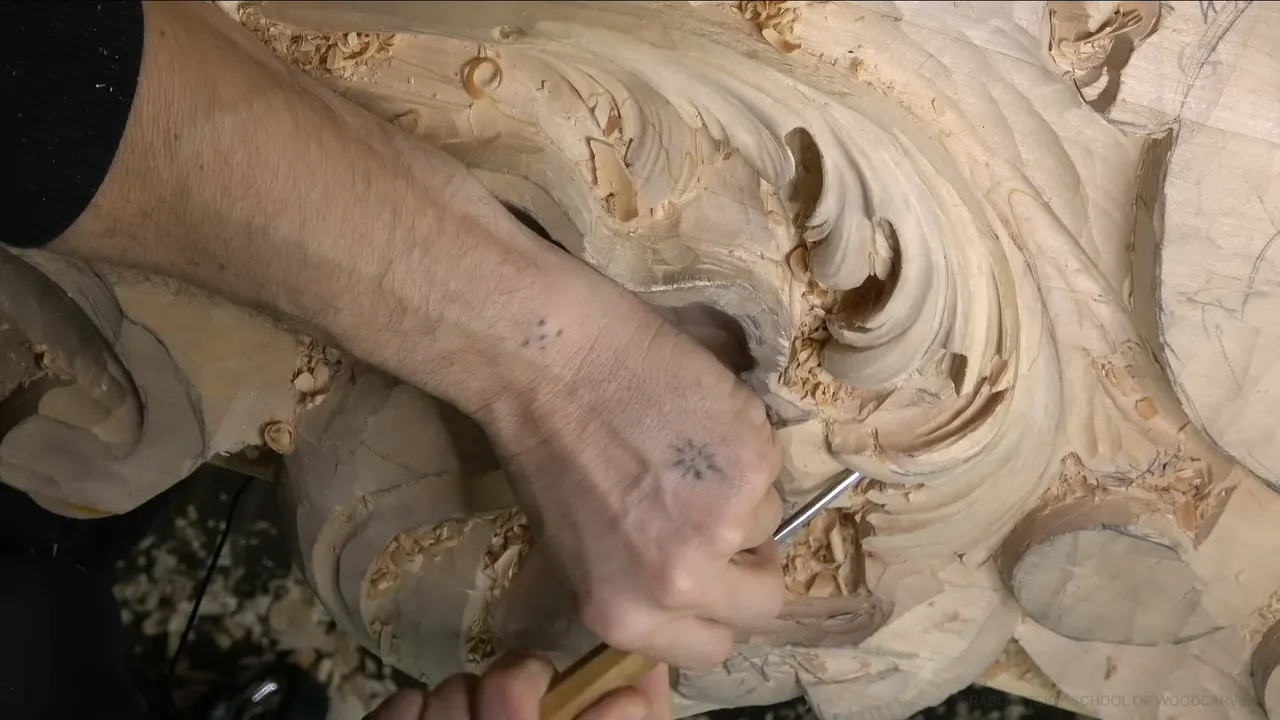

In Venice Room 11, part 6, I said "This moment right here" while I worked on one spot of the carving. This page follows that word into other lessons of mine. Each passage says where it comes from.
Have you ever stood over a carving, pointed at one spot, and not had a good name for it? Do you say "this part" and hope your hand shows the rest? Then you know the spot I mean, and you know it from your own bench.
What did I say in workshop 11?
The video opens with "And I need to use probably number 11, start cleaning, and get closer to the second layer." I fixed my own words. "Not the second layer, but that part which is going above." Then "Overlapping part."

Then came a mistake. "And I just destroyed edge of this moment, which I need to take care of."
A plan followed: "So now I need to dig underneath." I added "Maybe just to use number 11 would be a really good idea" and "Because like I said before, I really need that smooth transition."
Size was the question. "At which number 11 should I use?" My answer, "Maybe five millimeters" (0.2 in), came with "Let me see if it's going to fit good." One worry: "I don't want to use too small." Then "Looks like this is going to be a little too big." My next words were that I was going to use "probably just the two millimeters" (0.08 in).

Areas like that get a comment: "It's tricky to clean because it's almost impossible to see what is going on inside." And "But I really need to see it."
A smaller tool was next in my plan: "let me use a flatter gouge, smaller flatter gouge, and get a little bit on the side right there and try not to break it." And then "Because right now it is fragile."

Painting came up. "How I'm going to paint that?" I said, about a cut that might be too big. "That's the goal, to paint it, and I have to keep in mind."
Shadow came next. "And now I can actually excavate a little more right here." "I think it's enough shadow I got." Still, "I need to go underneath a little bit right here, but not much" and "Maybe I should actually create a deeper shadow right there." Next, a question to you: "See how nice shadow it gives?"

The shell came up too. "But I also can't forget that this element going to flip above my shell." So "I want to keep in mind, so I'm not going to go too low."
Then the lower part. "So now I can develop the lower part. This moment right here." I wanted "to make sure it looks really nice." For the tool I named "number nine and quarter inch" (6.35 mm), and I said I would start outlining.

Then "Oh, by the way, let me think. Let me think." "Maybe I'm not doing the right thing." Then "Well, actually, I do." One more idea: "Maybe I could actually just do this part as a big separation going downhill like that."

How did I use it in the Lily Box lessons?

From Lily Box 5, part 3: "let's give an overall shape to this moment." My tool was "number seven and 14 millimeters" (0.55 in). You got a quiz: guess which tool cleans it. The answer was "number 11."
The thirteenth video has "let me take care of this moment." Close by: "See those voids inside the grain, cracks."
Over in Lily Box 6, the fourth video has "clean little bit again this moment." After that, "I can see clearly what I'm doing."

Lily Box 7, part 2, offers "a straight down cut this moment." One option was a 6 mm number 9 (0.24 in), I said. In the same video I said "I do see there is a crack inside of the wood, so I have to be even more careful now."
Another line sits in part 4: "give a nicer shape at this moment." Same video: "a really interesting area for me. It's hard to work with."
The eighth video has a longer line, and it ends with an apology. "It's going to be absolutely different moment. I apologize for confusion."
Next comes part 9, with "Let me try to use a number seven." "I'm still not too happy about this moment."
In part 5 of Lily Box 8 I said "And fix that moment." Next: "I do like what I see."
The knife shows up in Lily Box 11, part 5. "I'm using just a knife," I said, and "Just trying to connect those two moments." Next, "please don't overdo it, which is really easy."

A happy note closes Lily Box 9, part 3: "But overall, I'm really happy with this moment." Afterward, "Let me get a bigger number seven again."
Which words came with it in Hashemi, Moldings and Grape Onlay?

Hashemi 32, part 2, names a tool and a job: "Let me use number 4 in 10 millimeters, and refine this moment." That size is 0.39 in.
Lighter work sits in Hashemi 22, part 2: "This moment, just to make it more smooth."

Acanthus over Moldings 7, part 3, names a tool first. "Probably number seven or number 8 and 1/8 of an inch" (3.2 millimeters). "Exaggerate that moment." A caution followed: "gonna be careful how I do it."
Same video: "I really love it how it looks." Then "let me also attack slightly gonna undercut underneath of this moment." Added to it, "I'm gonna get beautiful shadow."
Grape Onlay 9, part 3, has "I'm gonna create a repetition of this moment with this guy, okay?"
When did the moment need fixing?
The word opens Venice Room 16, part 9: "This moment." Then "Right now, it's a little too messy." And "Maybe actually get a little longer cut to create a beautiful movement."

Back in Venice Room 17, part 3, I said "I need to fix this moment," giving a reason in my next words: "it has to look like a leaf, not like something else." Its fourth video has "I lost a moment" and I said I would deal with it a little later. Earlier in that video I said "Just use a rasp and create that really nice curvature."

Over in Venice Room 18, part 11, I said "That is probably the end of this moment." Also "I broke this edge" and "It doesn't look right."
"I really need to get this moment underneath because right now, I moved that direction, but I lost some of the material right there," I said in part 4 of Venice Room 13. The ninth video has "right away clean that moment, which you don't see."

At Venice Room 19, part 10, I said "I want to go at least a quarter inch in" (about 6 mm), "otherwise it's not going to look as nice as it should look." Then "chop a little bit this moment." My reason came with "right now it doesn't have a nice curvature."
Workshop 8, part 2: "I need to create some kind of notch. Otherwise, it just doesn't look right." Straight after, "let me fix this moment."
For Venice Room 9, part 9, the words were "just the side of this moment."

Venice Room 23 comes next, part 3: "what I need to fix is this moment." Plus "it's already cut." The job was "get rid of that from inside." I planned "a spoon and 1 millimeter" (0.04 in), "Number 11."
Its part 6 adds a plan. "I think I should create an extra separation, extra moment." Then "I think even deeper." My planned size: "one-eighth of an inch" (about 3 mm).
Edge work shows in Venice Room 43, part 4: "I need to clean the edge." Following that, "Otherwise, it doesn't look too good."
Part 5 of Venice Room 83 has "Let me clean little bit this moment." Also "Now I need to make the decision."
What size went with it in later Venice Room lessons?

Small sizes show in Venice Room 35, part 4: "I'm going to need the number 11 to clean up around this moment, and I don't want to lose it." The size was "7 millimeters, little bigger than a quarter inch" (0.28 in).
From Venice Room 30, part 8: "use number three right now and kind of refine this moment and go underneath." Also "But for now, just to give the right shape."

A limit sits in Venice Room 27, part 6. I wanted to keep the high point, I said, and "it still has to go below this moment."

A warning is in Venice Room 37, part 8: "let me also excavate on this side, but I have to be careful not to touch this moment. Otherwise, everything was in vain."

The goal in Venice Room 45, part 11, was "to do really low in this moment." Before choosing, "Maybe that chunk is a little too big, so we'll see." Number 11 came with "three-quarter of an inch" (19 mm).
Something bigger comes up in Venice Room 47, part 12: "I need to get something bigger for this moment." Tool choices appear in Venice Room 66, part 12: "number five or maybe number six" with "give a nicer shape to this moment."
Size shows in Venice Room 67, part 10: "Middle line of this moment." Next to it, "quarter inch" (about 6.4 mm). And in Venice Room 70, part 3: "I need to make sure I'm happy with this moment. It looks like I am."
A plan sits in Venice Room 48, part 4: "I also need to establish what I want to see on this moment." Soon after, "there's multiple ways I can establish it." Another plan is in Venice Room 46, part 8: "After I establish that moment, I can do the rest of it."
A short one is in Venice Room 41, part 4: "the chance to create beautiful moment."

Undercutting comes up in Venice Room 59, part 8: "start undercutting underneath of this moment because let's finalize it, and I can then develop rest of the moment." I named "number 11, 4 millimeters" (0.16 in), "and see if I'll be able to get little by little inside."
Is the word ever about time?

At Venice Room 21, part 5, I said "I don't worry about how it looks at this moment because it's not the final look." The tool there: "number seven, 14 millimeters" (about 9/16 in).
The same lesson, part 11, has "I'm not doing the final form until the last moment." I went on with "when almost everything is done, I'm spending a few days, actually, just to clean everything and just refine everything and get to the edge, and so on."
A depth gets the same words in Venice Room 32, part 9: "how deep I want to go as of this moment."
Rough work waits in Venice Room 37, part 4, with "I left rough, really rough, this part until the last point. Last moment, I would say. It's not the last moment yet, but in this area."
Pauses use the word too. Part 7 of Lily Box 8 has "Take a moment and think how I want to see it." In part 12 of Venice Room 23 I said "Just give me a moment, and you will know exactly why I'm doing what I'm doing." One more sits at part 1 of Venice Room 17: "I know I repeat myself in moments like that."
The sizes in the next table sit in millimeters and inches, as I named them.
A short table of the tools, sizes and jobs I named
| Lesson | Tool and size, as I named them | What I said to do with it |
|---|---|---|
| Lily Box 5-3 | Number seven at 14 mm (0.55 in) | Give it an overall shape |
| Hashemi 32-2 | No. 4 at 10 mm (0.39 in) | Refine it |
| Room 35-4 | A number 11 at 7 mm (0.28 in) | Clean up around it |
| Room 59-8 | The number 11 at 4 mm (0.16 in) | Undercut underneath it |
| Venice 21-5 | Another number seven, 14 mm (about 9/16 in) | Clean it a little |
| Venice 23-6 | One-eighth of an inch (3.2 mm) | Plan an extra separation, even deeper |
| Workshop 11-6 | Number nine, quarter inch (6.35 mm) | Start outlining |
Which spot of your own piece do you keep pointing at, with a gouge, a chisel or a mallet in your hand? The full set of videos for this Venice panel sits inside one tuition plan. The course page for Part 1 holds workshops 1 to 12, and lesson 11 has all of its parts. More wood carving waits there, down to the last tool mark in the wood.
How it's done
- Point at the spot. In workshop 11, I said I wanted "to make sure it looks really nice," then named "number nine and quarter inch" (about 6 mm).
- Name the tool and size. Venice Room 59 pairs it with "number 11, 4 millimeters" (about 5/32 in).
- Say the job. Hashemi 32 has "refine," and Venice Room 19 has "chop a little bit."
- Hold back where the wood is still needed. The limit in Venice Room 27 is "it still has to go below this moment."
Frequently asked questions
How did I plan to fix the edge I destroyed?
Digging underneath was the plan, maybe a number 11, which I called a really good idea. The size stayed open: maybe five millimeters (0.2 in), then probably just two millimeters (0.08 in). My worry was a tool too small or too big.
Which sizes sat beside the words in other lessons?
Fourteen millimeters (0.551 in) went to a number seven in a Lily Box lesson and in a Venice Room lesson. A number 4 took 10 mm (0.394 in) in Hashemi 32, and a number 11 took 7 mm (0.276 in) in Venice Room 35.
Did a spot ever bother me?
A spot bothered me in Lily Box 7, part 9: "still not too happy about this moment." The line in Venice Room 18 is "I broke this edge." Then Venice Room 16 adds "Right now, it's a little too messy."
What to carve next