

Alexander Grabovetskiy, woodcarver, School of Woodcarving · Published 2020
What does a wood carver mean by "at some point"?
Quick answer: In Venice Room 11, part 7, I said "I have to start creating more movement," after I named a number nine. In other lessons the same words sat beside a tool I would switch to, a place to stop, a limit I could feel, and a job I was keeping for later.
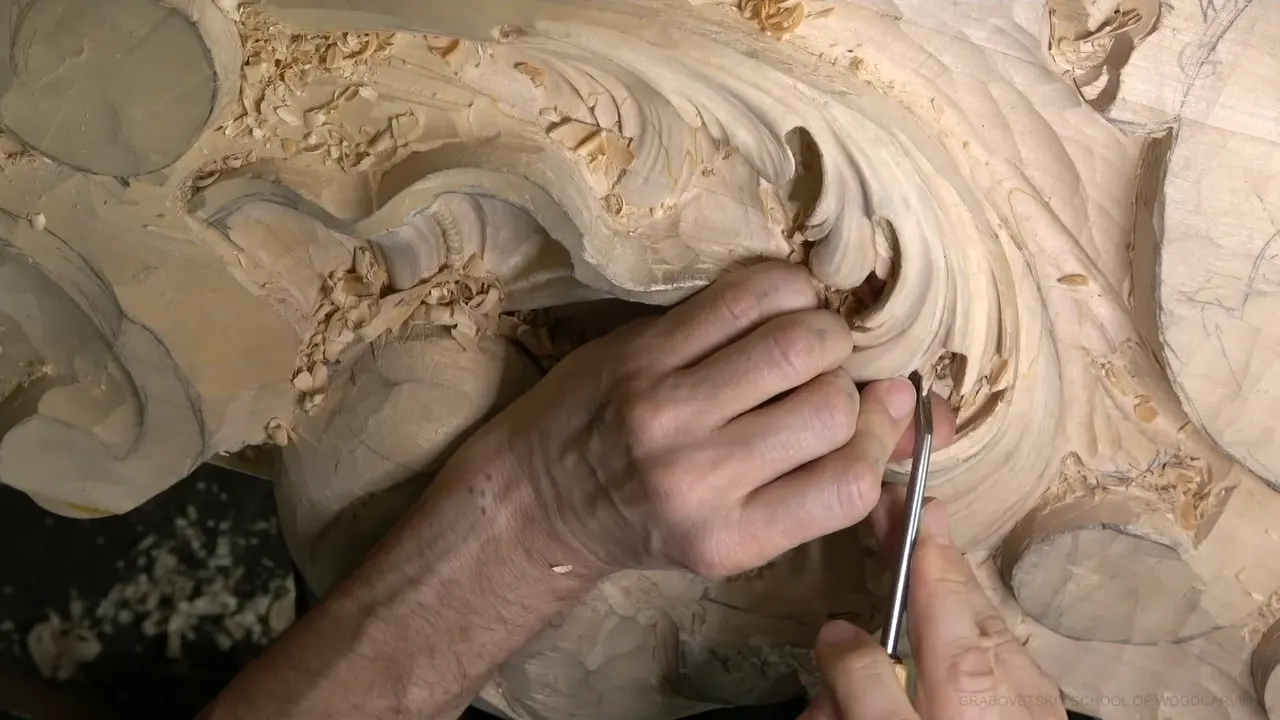

The acanthus needed more movement, I said in part 7 of Venice Room 11, while I was naming one tool after another. I say the same words in other wood carving lessons too, and what follows them changes from one lesson to the next.
Have you ever put a tool down because you knew it would not reach any further? Did you ever stop on a carving you could still have cleaned? Then stay a few minutes. Below are the lessons where I said it, and the words that sit beside it.
What I said right after those words
- Part 7 of workshop 11 names a movement I wanted to show, an original idea on the acanthus.
- Workshops 8, 87 and 143 name a spoon or another tool.
- The finish comes from Hashemi Flowers 49, and the stop from workshops 78 and 64.
- A roadblock and a limitation come from the Tray course.
- Hashemi 5 names a mallet I could not use at one point.
- The Onlay lesson names a flip, and the Vase lesson names a brush and a color to mix.
What did I name in workshop 11?
"I can probably chip a little at the edges of it" (01:41), I said, and I did not want to lose that detail. My first tool came at 02:04: "Let me get with the number 11 and 2 millimeters," and "kind of remove some of the waste." Two millimeters is about 0.08 in. I could use "a bigger number 11," I added, and "maybe four millimeters" (02:15 to 02:27), about 0.16 in. Then, at 02:36: "And carefully go in, taking my time, from both sides."

Underneath was on my mind. I did not want to create "too much mess and trouble underneath here," and I said it would be "visible from the bottom" (02:58 to 03:06). I wanted to make sure "that transition is nice and smooth" (03:07). Next: "Let me use number nine," and a try to "fit in a quarter inch" (03:17 to 03:23). A quarter inch is about 6 mm.

The phrase itself comes at 03:47, on the acanthus: "And at some point, I have to start creating more movement." It sits between two tool names, a number nine first and a number 11 later. "Used to do really interesting movements, and I really need to show that," I said of those leaves (03:53 to 04:03). And "I really want to show that original idea" (04:09).

"Again, I'm going to get number 11" came at 04:42. "But you should be able to see by now some of that development already, what I'm working on" (04:46 to 04:55).
"But now I need to take that one a little more down" followed at 05:26. A "concave look right here" was my wish, with the ridge "a little raised up" (05:32 to 05:40). "So let me use number seven and start creating that" (05:56). Then, "But I also need to undercut. Underneath of this main detail" (06:32). At 06:43: "Let me try to do first with the number 7," to "dig deep enough with that."

"But I really want to make it look like that outer ridge edge is raised up" (06:58). "So really important for me" (07:09). A little later: "And maybe I can start removing some of that material I don't need right here." "But got to be careful" (07:26). One more tool name came at 07:35: "Maybe it's a good idea to use a number 11." Then, "Wiggle a little bit" (07:40).
The part closes on the same worry about a weak element. "I don't want to make this element too weak," I said, "but I also don't want to look at it and see how thick it is" (08:15). Next I fixed my own words: "I should say, I'll try to do the concave on inside, and that is going to give me that extra shadow underneath of this element" (08:32).
In that part I named a number 11 at 2 millimeters (0.079 in), a bigger number 11, a number nine, number 11 again, a number seven, and a number 11 one more time. Every name came as a plan, a try or a maybe.
When did a tool switch wait?
"I'm using number nine and a quarter inch and the help of a mallet" (07:04 to 07:11), I said in Venice Room 8, part 10, which is 6.35 mm for the quarter inch. "So far, little by little, I'm able to dig in" (07:16). Then, at 08:05: "I have to switch to a spoon."
Depth was the question in Venice Room 6, part 2: "Because it is challenging because it's becoming deeper, and sometimes it's almost impossible to use a straight tool" (04:41 to 04:49). Next, "I probably will just switch" (04:51). "Maybe about 3 millimeters deep," I said, and "About one-eighth of an inch deep" (05:05 to 05:15). "That's still going to cast a shadow and gives me an extra line" (05:17).
"My straight tool is not going to be sufficient anymore" (06:17 to 06:22) is from Venice Room 87, part 2. I "need to use a spoon," and "Let me try number six" (06:33 to 06:41). The verdict came at 06:57: "And yes, number six is really good."

"I'm going to try to create a dome on inside" (00:39) opens Venice Room 135, part 1. "I am somewhat limited now how much I can reach" (01:31). And at 01:46, "So now for me, it's time to take a back bend."

A line "has to be a lot deeper shadow" (01:32) starts off Venice Room 143, part 1. Excavating "a little more with the 30 millimeters" (about 1.2 in) was one option, and a time would come to "switch to another tool" (01:48 to 01:54). "But so far, my 30 millimeters number 11 works fine. Just gives me plenty of control" (02:03).
"And that is probably the moment of truth, I need to switch to another tool" (02:24). Then: "let's see, maybe 25 first" (about 1 in). After that, "gradually move to a smaller tool" (02:31 to 02:37).

In Lily Box, lesson 11, part 8, I said "Maybe I have to switch and use the micro tools" (14:13 to 14:17). Then, "But so far, just because that back bend, I can reach really in those hidden spots" (14:20 to 14:32).

Where did I say a stop was coming?
"Like I said before, I can take it to extreme" (00:07) comes from Venice Room 78, part 9. "It's all about the time I want to invest. And that's a big question, how much time do I have?" (00:11 to 00:16). I still had "a lot of stuff to do ahead of me for this project," and "I just have to stop" (00:20 to 00:29). I asked myself, "What should I do? Should I take it more?" (00:46).

"And yes, again, I could spend much longer and clean it even better. But the question is, should I?" (04:00 to 04:08) is Venice Room 64, part 5. Then: "See? There is a nonstop process" (04:14), and "I really have to stop" (04:21 to 04:23).

In Hashemi Flowers, lesson 49 I said "probably, for me, the most challenging part, to what point I want to take it" (09:21 to 09:25), in part 2. "Just the business side of me just kicks in," I said, and "That's enough, I have to feed my family, I got to buy food" (09:30 to 09:41). "So I can't go on and on and on" (09:47). After that: "I have to just finish. That's it, and just let it go" (09:49 to 09:53).

Lily Box, lesson 12, part 5, opens with "there's really no limit to what you're able to do" (00:33). Of work "for history, let's say," I said "I would spend a lot more time on some of those projects" (00:51 to 00:59). "But when I'm doing that for a client, sometimes I'm limited with the time, and I have to compromise and just stop" (01:07 to 01:19). And in Lily Box 11, part 13: "got to stop because just like I said, it takes a long time, and sometimes you really don't really have to do that" (08:49 to 09:04).
"I don't like how the line is not really flowing right here" (04:47) comes from Greek Acanthus, lesson 15, part 1. "And I'll just take my number 12 knife and kind of fix that line" (04:53 to 05:01). "Now it's much better" (05:01). I had to stop, I said, because "you always can find imperfections in your carving" (05:09 to 05:12).

How did I describe a limit?
The Tray of Blessing course, lesson 2, part 3, starts with "just the part by part by part, just the one chunk at a time that makes it a lot easier" (02:25 to 02:28). Next: "you're gonna hit the roadblock, like I've, I've done right now" (02:44 to 02:50). "The time for me to stop probably" followed, and "I'm gonna grab number two and 10 millimeters" (02:50 to 03:00), about 0.4 in.
"You are gonna hit some limitation," I said in lesson 3 of the same course, "you know how much, how deep you can go" (03:21 to 03:25). Number two can go "even deeper," and "number seven also gonna work" (03:28 to 03:34). And: "if it does not fly, don't force it just to get your previous tool" (04:00 to 04:03).

In lesson 6 of that course, part 3: "I can feel the limitation" (11:44). "I'm gonna stop, I'm gonna grab my number two," I said, and "see I'm catching the grain so that means I can't force it" (11:49 to 12:00). "I have to change the position and attack that from opposite side" (12:02 to 12:09). The grain is what I named.
In Hashemi Flowers, lesson 5, part 2: "You can control a lot nicer with the mallet, but the more material you take out, the weaker it becomes, and it's easier to break" (00:41 to 00:52). "I'm not going to be able to use any mallet" (01:01). I probably could use one now, I said: "that's actually going to save me some time" (01:12 to 01:14).

"Number 11. Two millimeters" (01:08 to 01:12), about 0.08 in, opens Venice Room 18, part 10. Then: "even two millimeters will be little too big" (01:26 to 01:30), and "it's already breaking, so that's not good" (01:32 to 01:36). "So got to stop." A micro tool followed: "like a number three and one-eighth of an inch" (01:57 to 02:03), about 3 mm, to "create multiple cuts, like that, inward." It "does not create a lot of stress because that's a really thin tool" (02:07 to 02:13).

Which jobs did I keep for later?
I wanted "some kind of curly motion of that husk" (01:50 to 01:56) in part 1 of Carving Hazelnuts, lesson 3. "So I'll place some kind of wavy line right here" (01:56 to 02:00), and "connect that line" was a job I named (02:06). The first tool I named was "number 11 veiner" (02:27 to 02:34).
Later, in part 3 of that lesson: "I can probably undercut somewhat" (17:10). "And yes, I will completely make the separation between this part of the husk and the nut itself" (17:15 to 17:22). "But not at this point yet because it's too early in the carving process" (17:26 to 17:31). V tools came next, "especially, I like number 16" (17:41 to 17:45), at "35 degrees," and "or three millimeters if you wish" (17:54 to 18:05).

The same Tray part carries one more: "a little later, we're gonna start undercutting" (00:36 to 00:41), I said of "this foot." "Don't go too low" (00:50). "Later on we're gonna add some more details" (01:11 to 01:15). "Nothing prevents me from undercutting right now" (01:18).
Carving Grape Onlay, lesson 12, part 1, has some high spots left alone: "I need to keep those high spots because I have to remember," and "I will have to flip it and it's gonna rest on those spots" (07:17 to 07:29). "So once I'm gonna find those spots, it's gonna serve me like legs" (07:31 to 07:35).

Carving Vase with Grape Leaves, lesson 3, part 9, was about color. "I probably have to change the brush I'm using" (02:13 to 02:17), and "I do have to mix two colors together" (06:08 to 06:12). "I want to do my lavender color right in the middle somewhere" (06:12 to 06:17). Then "lavender to nothing" (06:23 to 06:27). And "It's a golden ratio again, but my six parts out of 10 are going to fall right here" (06:41 to 06:46).
"I will have to give roundness to that stem" (02:21 to 02:25) was my line in Venice Room 98, part 9. "And I can probably do it with the back bend" (02:32). Then: "This one is number eight, by the way, back bend, and six millimeters quarter inch" (02:51 to 02:57).

Where did I say it, and what came next?
| Kind of moment | Where I said it in the lessons | What came next |
|---|---|---|
| A tool switch | Lily Box 11 and Venice Room 6, 8, 87, 135 and 143 | Spoon, back bend, micro tools, another tool. |
| A stop | Greek Acanthus 15, Venice Room 64 and 78, Lily Box 12 and 11 | Time, a client, a nonstop process, imperfections. |
| A finish | Hashemi Flowers 49 | The business side kicks in, and I let it go. |
| A limit | Tray of Blessing 2, 3 and 6, Hashemi Flowers 5, Venice Room 18 | Roadblock, number seven, no force, no mallet, micro tool. |
| A job for later | Hazelnuts 3, Tray 3, Grape Onlay 12, Vase 3, Venice Room 98 | Wavy line, undercut, flip, brush, stem. |
| More movement | Workshop 11, part 7, 03:47 | Number 11 named, then number seven, then number 11 once more. |
Where can you hear it yourself?
The video sits in the Venice Room course, in workshop 11, beside Venice and its acanthus. The other lines sit in the lessons I linked above.
How it's done
- Name the later job. At 03:47 of workshop 11 I named more movement on the acanthus as a job for later.
- Name the tool you reach for. At 04:42 I named number 11, and at 05:56 I named number seven.
- Be careful at the weak spot. At 07:26 I said, "But got to be careful," with a worry that the element would be too weak.
- Hollow the inside. At 08:32 I said a concave on inside is going to give me extra shadow underneath.
- Say when you stop. At 00:20 of Venice Room 78, part 9, I said I still had a lot of stuff to do ahead of me for this project, and so I just had to stop.
- Say when the tool must change. In workshop 87, at 06:17, I said my straight tool would not be sufficient anymore.
Frequently asked questions
Which tool did I name after a number nine in Venice Room 8?
Part 10 has me at number nine, a quarter inch (about 6 mm), with a mallet. At 08:05 I said I had to move to a spoon. In Venice Room 87, part 2, I tried number six for the spoon and called it really good.
What was my plan for the number 11 at 30 millimeters?
At 30 mm (about 1.2 in), the number 11 works fine and gives me plenty of control, I said in Venice Room 143. I added that I would need another tool, maybe 25 mm (about 1 in) first, and then smaller ones, gradually.
Why did I mention a client in Lily Box 12?
For some work for history, I would spend a lot more time, I said. For a client, I said, "sometimes I'm limited with the time, and I have to compromise and just stop." I also said "there's really no limit to what you're able to do."
What to carve next