

Alexander Grabovetskiy, woodcarver, School of Woodcarving · Published 2020
What does a wood carver mean by "enough depth"?
Quick answer: Enough depth is the question I asked about one hollow in workshop 11, part 8. There I said I did not think I had enough depth in that spot, and I planned to dig much deeper. After that I decided to stop at that depth, because the spot shows from below.
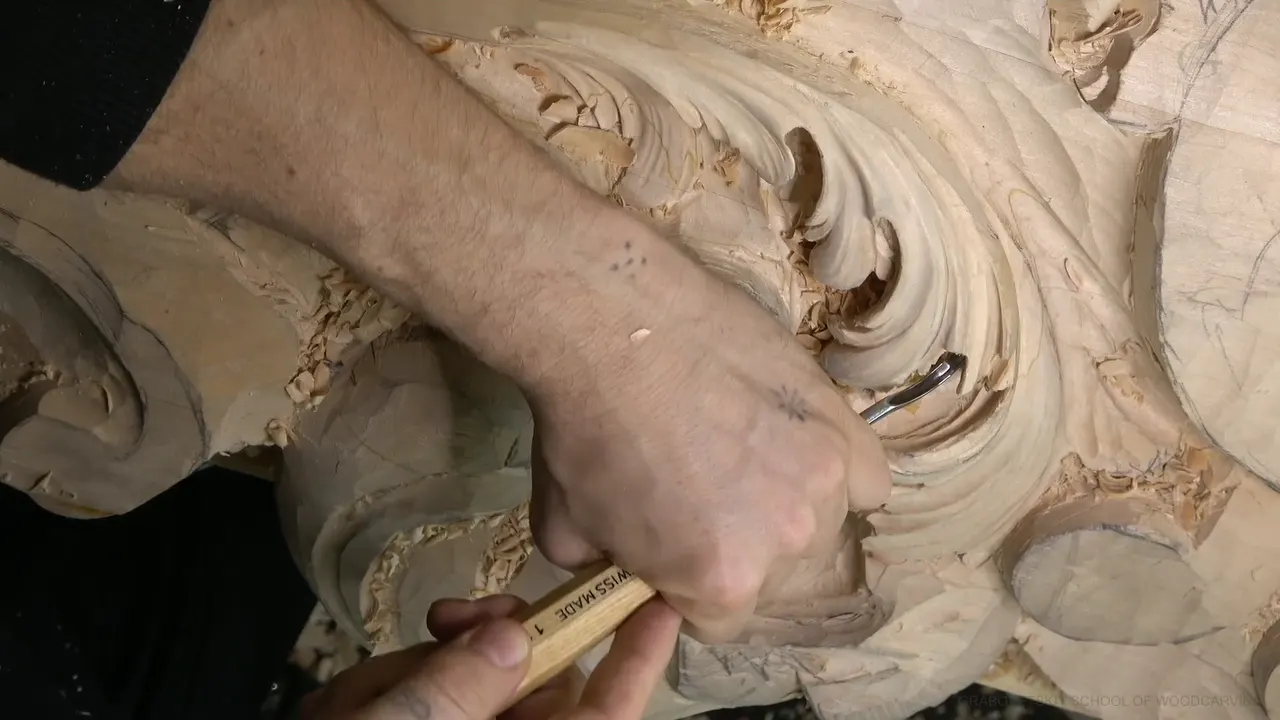

Enough depth is a question I asked in the middle of one hollow, and in Venice Room 11, part 8, I asked it out loud. My words were that I did not think I had enough depth under one element, so I needed to dig much deeper. Other lessons carry the same two words, and some say "deep enough" instead, so I put those here too.
Ever wondered if a hollow in wood was deep yet? Does a part you cannot see from the front still need shadow? You get part 8 first, then the two parts beside it, and after that the lessons where I said it again.
What did I say about enough depth in part 8 of workshop 11?
The part starts on "And it's still strong." Then "now I can actually access even deeper with the number 11 spoon gouge and excavate even deeper right there underneath, but still keep that one really strong."

Next is a stop for the inside, with "That is good, except I need to clean a little bit on inside," and then "Stuff you don't see, but I need to make it smooth." A short one comes later. "Could go even deeper."
How did one weak element change what I did?
One element needed care, and two ways in were open to me. I could "just chop from the side," I said, and I did not want it "too weak." Instead I planned to "round that little bit this way."
An option I named was to recreate "that little by little." Further on I said "maybe I can actually go a little deeper right here," and then "Create extra shadow." One need followed, for "something small to hook this out."

Then I said "it's still not what I want to see." Cleaning came next, "Clean that transition right here. Okay. And now it looks better."
A tool gets named too. My line was "Again, I'm going to take number 11 and 4 millimeters" (0.16 in), and I would "excavate a little bit underneath right here." Close to it sits "Make a little nicer transition inside and this way."
"All about shadows. Okay. It's all about shadows." That line comes twice, with an Okay between.
When did the worry about depth come up?
Before it, I said I was able to get in "at the number seven" and "I create that concave." Right after came the line this page is named for, "But I don't think I have enough depth right here, so I need to excavate much deeper underneath of this element."

A plan follows the worry, to start, probably, on a number nine, and "Let me try." What came after that? "And now I need to use a number 11. It's a better idea."
Bigger was the next thought, "maybe even bigger number 11, because I want to create a deep shadow. Use 7 millimeters" (0.28 in). Hope sat beside it. I said we would see if it worked, and "I think it's going to give me real depth." A mallet was on my list too, "if I need to."
Why did the grain come up in part 8?
At one point came "Yes, I am carving against the grain," and sharpening was my first thought, "Maybe I should sharpen this one." Then a second idea, "Or maybe I can just attack that from the right position, but I don't want to crank against those. That's why I'm trying to use that tool from opposite direction. Maybe mallet will work."

Why did I stop going deeper in part 8?
I did not "really need to go too deep right here," I said, "because, again, it's not going to be visible straight like that." Then "visible from below, and that's already giving me a lot of shadow."
The upper part, I said, would stay "still really strong and nice." My call was "So I probably should be happy with that depth and not go deeper." Another concave was still ahead, "let me create a little bigger concave."

Near the end I said "Now, when I look from below, it gives me a really good shadow. And I am happy with that."

How do parts 7 and 9 of workshop 11 treat going deeper?
In part 7 comes a worry about the view from the bottom, "visible from the bottom. So I want to make sure that transition is nice and smooth."
A size question came next in that part. I asked if I would "be able to fit in a quarter inch" (about 6 mm) with a number nine. Past that point I said I also needed to undercut underneath of the main detail, and "Let me try to do first with the number 7, if I'll be able to dig deep enough with that." The same part says "I also don't want to look at it and see how thick it is," and ends on a plan for "the concave on inside."
Part 9 has me planning to "create a deep shadow, but like I said before, it's flipping above my future shell, which is still not developed yet." Later it gives a number, "I'm not going to go deeper than about a quarter inch, maybe," and then "Maybe actually more because I do have a concave side like this, so I'm actually able to go deeper right here." It goes on with "extra space to work."

Where else does the same worry show up in my lessons?
That is one workshop. Six other lessons carry the same words.
Furniture Panel lesson 23, part 2, opens on "So it's enough depth, I would say." A choice follows, "should I go around this flower right away, or just should I develop those?" Step one in my plan, "probably start undercut a little bit on inside, okay, with the one millimeter number 11" (0.04 in).
Waiting was an option, "I could wait until later, but it's okay. I can probably do it right now." A little further came "let me dig in with the one millimeter and go right underneath. Not much, but a little bit." The reason was "Just to give that extra shadow." Another tool was possible too, "number five or number four will work exactly the same way and just dig in using just one of the sides of the tool."

The Venice Room has it in workshop 59, part 3, with a check of my work, "And check if I've got that deep enough or if it's not deep enough." Right after, "I have to just make sure that there's enough depth right here to create that movement below, okay?"
Explaining it is hard, I said, and "It's probably better just to show." Next came "So the feel like it's going down and then it goes up." A boundary line was not my worry, "I can always reestablish it with no problem," because "All I need is just right now the main movement."
Later in that part, "So now I need to excavate this section, and that's going to be deep excavation just to give that feel like it is flipping." Later still, of a hole, "but deep enough, okay? Deep, but not too deep."

Part 6 of Lily Box workshop 11 treats depth as something two pieces share. "I don't need to go too deep, but still, I need to make sure I have enough space for the upper part and for this piece," I said, then "So I need to estimate approximately enough depth for both of them."
Sometimes my explaining makes no sense, I said, and tried again with "because we undercut this one, we still need to create some space for the upper piece also right here. So this can go even deeper, this side."
Next, a knife, "Let me remove from this side also some of the material. Carefully. I'm using just a knife for now." Toward the end of that stretch came "I can prove to you it does look like it's going from everywhere, from all the directions."

Carving Grape Onlay, lesson 4, part 1, has the same worry, "And again, on this side, I don't have enough depth. I need to get little deeper. I'll use my previous tool number 11 and I'll get little deeper."
The tool was "four millimeters" (0.16 in). With it I could "probably start excavating right underneath," keeping "about a quarter of an inch wide" (about 6 mm). Soon after I said "maybe a little less," and "maybe five millimeters, five and a half millimeters, something like that" (0.2 in, 0.22 in).

The space got a size too, "a little bigger than a quarter of an inch" (a little over 6 mm). Why? The part would "float above that tendril," so "I have to excavate a little deeper."

That same part comes back to "enough depth on this side," and then "approximate 10 millimeters left on this side" (0.39 in). With it came "I can probably chop a little more, just get some excavation."

Then comes workshop 142, part 1, which has a big tool in mind, "I could actually attack the table with the bigger tool right away, like 30 millimeters" (1.18 in). The trouble was named as "the only problem I have."
Looking from the side, I said there was not "enough depth to work around." After that I thought out loud, "let me think what I can do," and then "more shallower movements," as a maybe.
After the thinking came a plan, "I want to just round that side. Just create a dome." A smaller tool was on my mind too, "smaller number 11 now" at "maybe about seven millimeters" (0.28 in). Later I wished for more wood, "I wish I have a lot more material to the surface." On lowering the middle part, "I really don't think it's a good idea."

In Venice Room workshop 140, part 1, it comes in two moods. First a doubt, "I thought to do something different with those acanthuses," then "I'm not sure" about doing it. The next sentence is about "enough depth."
Still, it would be a "double acanthus." My first step, in my plan, was "lower down section between those two elements," with "maybe even just the 30 millimeters and number 11, of course" (1.18 in).
Why so big? "see how quickly I can get to the final depth." Then "It's not always possible because, for example, right here," with a part "on my way." And "bigger tool you have, a lot more resistance you're going to experience, and you have to be strong to push it. Or just use a mallet."

The number came later. "So I've got maybe about eighth of an inch from the upper point to lower part to this part. That's about three millimeters or so, and I think it is enough. I hope it's enough. I don't know yet, so I just have to see if I need to lower that down or not."
What do other lessons say about a hollow that came up short?
The other side of the check is in workshop 62, part 7, "It's visible, but it's not deep enough for my taste." A little deeper was my plan, "because like I said, it's really important for me to cast some shadows, and right now, it still doesn't."
Next, a way to find depth, "Maybe I'll just establish my depth with the back bend." Then "now I've got the preliminary depth," with a back bend that was "number eight, three-eighths of an inch, 10 millimeters" (0.39 in).
Depth is a hope in workshop 65, part 11, "I think it's deep enough. I hope it's deep enough. If it's not, I'll just do something deeper." Next I said "let me use bigger now, like 12 millimeters" (0.47 in), "of course, number 11."
Unsure comes next, in workshop 72, part 11, "I'm not sure if I've got that deep enough on this side." My thought was "Maybe I should do much deeper because I still don't see that overall movement yet." Next, "I just personally want to get more three-dimensional, if you wish."
The shorter case is workshop 4, part 5, with "Okay, that is deep enough." It goes on with a plan to remove the waste and "attack that with a flatter gouge."
| Lesson | What the check led to |
|---|---|
| Venice Room 11.8 | A plan to dig deeper, then a stop. |
| Furniture Panel 23.2 | It was enough depth, and a number 11 came next in my plan. |
| Venice Room 59.3 | Checking for room to create the movement below. |
| Lily Box 11.6 | Depth to share between the upper part and this piece. |
| Grape Onlay 4.1 | Short on depth, so I planned my previous number 11. |
| Workshop 142.1 (Venice Room) | Too little to work around, so I planned to round a side. |
| Workshop 140.1 (Venice Room) | A measured gap, and I hoped it was enough. |
| Part 7, Venice Room 62 | Short of it for my taste, so a little deeper was the plan. |
| Part 5, Venice Room 4 | Deep enough, and no wish to go deeper than that. |
Where can you watch part 8 yourself?
You will find part 8 in workshop 11 of the Venice Room course. Listen for the number 11 spoon gouge. It comes back in Venice and in the rest of my wood carving.
How it's done
- Ask whether the hollow is deep yet. In my own words, one spot is short of depth.
- Plan the dig beneath the part. My plan was to dig deeper beneath that element, starting probably on a number nine and then a bigger number 11.
- Come at the grain from the other way. Carving against the grain, I try the tool from the opposite direction.
- Look at the part from below. The view from below is already giving me shadow, I say.
- Call it where the shadow shows. I say I probably should stop at that depth rather than dig deeper.
Frequently asked questions
Is there a number for enough depth?
Some lessons here name one, and the numbers differ. In part 9 of workshop 11 I put the limit at roughly a quarter inch (roughly 6 mm), maybe more. In workshop 140 I measured about an eighth of an inch (about 3 mm) and hoped it was enough.
What do you do when a hollow is short of depth?
Grape Onlay lesson 4 reached for my previous number 11 to go deeper. Workshop 142 thought of shallower movements and planned a dome. Workshop 62 planned to establish depth with a back bend.
Can a hollow be too deep?
Part 8 has me saying the spot would show from below and already gave a lot of shadow, so I probably should stop there. Workshop 59, part 3, put it as "Deep, but not too deep."
What to carve next