

Alexander Grabovetskiy, woodcarver, School of Woodcarving · Published 2020
Can you combine different acanthus styles in one carving?
Quick answer: Combining acanthus styles is something I said you can probably do and be okay with, because most people miss it. Smart people, I added in video 11 of workshop 12, sometimes understand the difference, and then trouble can follow. For me, I said, it has to be accurate.
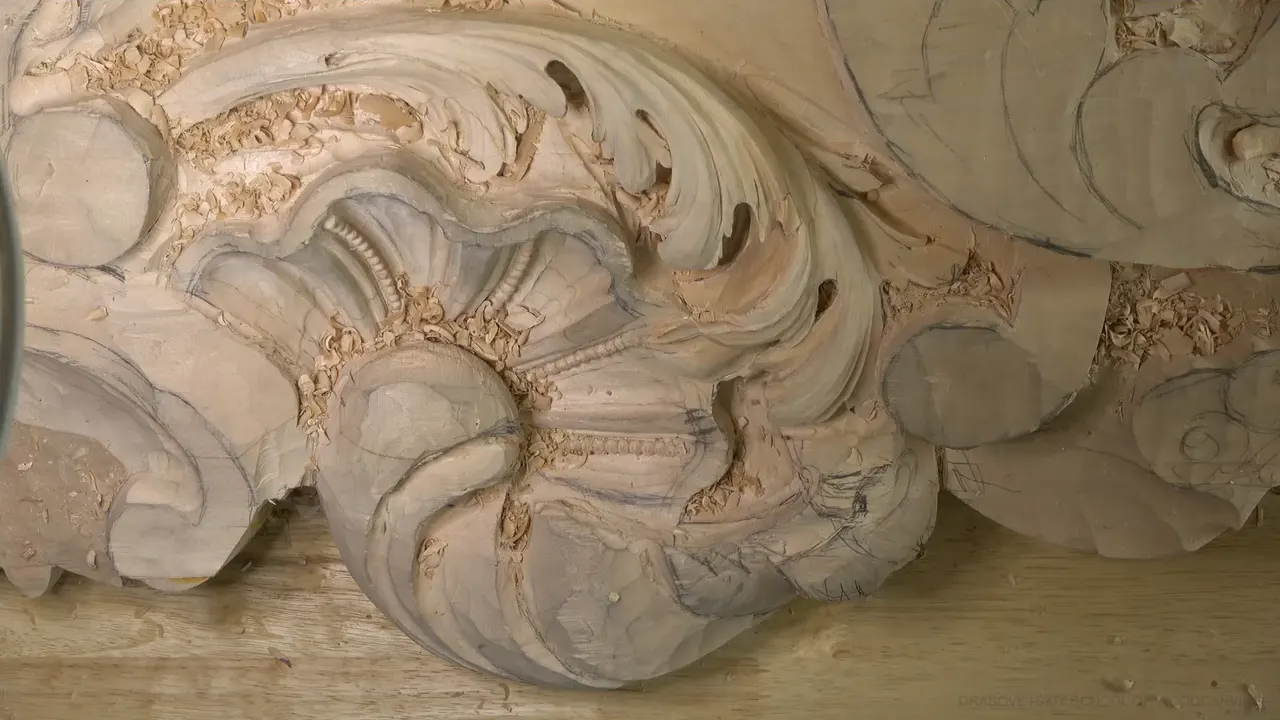

In Venice Room 12, video 11, I say "I like to combine different styles" and I mean acanthus styles. Below, that line sits beside what I say about acanthus in other lessons. Each passage names its lesson.
Ever copied a leaf from one place and a curl from another, then wondered who would see the join? Ever had a person lean in and look for a long time? Both worries meet in one short video.
What did I say about acanthus styles in video 11?
The video opens on a tool. "Use a nine." "Maybe even a bigger one." Then "Maybe a quarter-inch number nine," a quarter inch being about 6.4 mm, and "Number nine quarter-inch." After that I start to talk about the leaf.

"And I know I mentioned before, there is so many different types of acanthus leaves." I also say "a lot of people even don't know what acanthus leaf is." For anyone who knows a little furniture making and wood carving, I call it "the most common detail for embellishment, furniture, and so on, acanthus." Even professional furniture makers, I say, do not know how many kinds there are.
"It's not like it's a really big deal." The next sentence answers the question: "You can probably combine a lot of different types of acanthuses, and you're going to be okay because most of the people anyway don't get it."
A warning follows. "But sometimes you get across some smart people, and they really do understand difference, and then you can get in trouble."

When I work with "designers and big architects," I say, "they have no idea, and I don't even have to tell them that they don't get it." "And we're talking about big names." "We're talking about big architects, famous ones, and they still don't know what the difference is." Then "And let's keep it that way."
Next I turn to myself. "But for me, I am really picky about it has to be accurate." "Although, I like to combine different styles." And "Every style has some beauty in it."
Who notices when two acanthus styles end up in one design?
Many do. I say so in Dining Table Apron, workshop 5. There I love the original design: "It has acanthus leaf." I talk about "limitless different styles" from different places, and I list Moroccan, Greek and Roman leaves.

"You can actually incorporate different styles of acanthus leaf in just one design." I correct myself. "Nobody's going to know if it's Roman plus Greek." "Well, I shouldn't say nobody's." "There is plenty of people who do understand the big difference." I also name "some German Gothic acanthus leaf style."
Over in Venice Room 52, video 7, I say "People sometimes just really confused about the designs." "Acanthus is not just acanthus." For the leaf on that board I name "acanthus Venetian style, Italian style, authentic to 15th, 16th century." On the piece I was carving the divisions are "really, really short," while "if you go to France" the same part is "really long."

Who sees that? "People who do understand design and do understand the development of acanthus and studied that, actually, the history of development of acanthus, they can see."
Small concaves and convexes come up in Venice Room 28, video 4: "sometimes you don't notice that at the beginning, especially if you've never done any acanthus leaves work in different styles, I'm talking about." "The more you do those acanthus leaves, the more you see them, the more you see those movements."
Do the styles carve differently?
A short list sits in Byzantine Acanthus 3, video 3. "Different acanthus leaves have a different structure of the leaf." "For example, Greek acanthus leaf, it has a sharp V cut on inside." "Roman acanthus leaf has a concave on inside." "Byzantine acanthus leaf has a raised up convex, and we are working with Byzantine style." "So, the middle part will become convex."

We want, I say, to be "authentic to the true Byzantine." Doing that acanthus "in a style of Roman with that twist," I say, would not look as nice. It would look "really weird" with "Too many lines," not as soft, and not good for the gold leafing.
That is about one course and one leaf. The other thing, about a mix, comes in video 11 of workshop 12. Both lines are mine.
The Greek Acanthus course, lesson 8, says "we are just trying to be authentic." "This is just one of the types of acanthus leaf," I say, and it will be beautiful too. It "later on was used actually in the history" and "Even in the Byzantine style, there was some more development." Greek Acanthus 5 adds "we have to be accurate to the history" and that the Greek leaf has "that V cut on inside."

Roman Acanthus 1 says the Roman leaf is "exactly the same like Greek acanthus, just more beautified." I say the leaves we carve later will be "even more elaborated." And "The plant is still the same." In Roman Acanthus 15 I say "there's absolutely different styles" in the leaves that follow, and "they all have different characteristics." I name "Different cultural input" and a Moroccan leaf that will look absolutely different.
The first lesson of the Corinthian course sets out types of the leaf. My list there names Greek, Corinthian ("the most ancient"), Roman, Moroccan, Gothic, Renaissance, Belgium and French leaves. After it I say "those all Acanthus leaf still represent one leaf, which is the Acanthus plant." The plan for the course is "a historical progression of Acanthus leaf."
One more pointer is to the acanthus course. The eye of the leaf comes up in Venice Room 19, video 10: "please watch the course on acanthus." "We started actually developing different acanthuses" and "we're actually explaining the difference and different designs."
Do I say which style I am carving?
More Venice Room lessons name the style. Look at Venice Room 22, video 7, where I say I looked at the original: "on original, you often see also like a micro eye in just that case." "Just in Venetian style." "Sometimes when you're working with the different styles," I say, they "look a little differently." Later in that video I say "there is absolutely no rule to all because they're all different styles of acanthus." "Particular one we work in, just in Venetian style."

Video 3 of Venice Room 65 has the same thought. "That's why I'm bringing my concave in this case, not always, but in this case, all the way there." "Not every acanthus is the same." Video 5 of Venice Room 94 adds "it does not apply to all of acanthus in history." "This is just more like Italian Venetian style."
I concentrate on a detail in Venice Room 49, video 4: "It is acanthus, even if it doesn't look like acanthus, but it is." "There's a lot of different styles, different periods when people worked on those acanthus."

Where do I place a different style inside a design?
The Furniture Panel design course talks about a leaf of another style inside the panel. In Furniture Panel 8, video 3, I say I could develop "what's called the Louis XVI acanthus leaf." "That would be really good place to place something like that." "That's a more French-looking one."
Later, in Furniture Panel 21, video 5, I say furniture carving has many styles. "This particular style is more North European, more, I would say, French late 18th century style." "But I want to be authentic to what I designed."
The Corinthian Acanthus course, lesson 4, has this line about a mix: "It's a good idea to just practice different types." "You can incorporate lots of different acanthus leaves in just one design, and it's going to look beautiful."
In Acanthus over Moldings 1 the acanthus is "just one of many different styles." It "just happens to be Italian, I shouldn't say Italian, Venetian style acanthus" and it has a "raised part right in the middle of a leaf."
The word combine turns up for movements, too. I want every one in Venice Room 75, video 4, to have "a motion like returning backward like this." "So that way, I can just combine really nicely, the design wise." "It's going to just flow together with the overall design."
When am I picky about a leaf?
Picky turns up on other subjects too. In Furniture Panel 22, video 6, I say I am going to use a reed brush for sanding, and that we want it "really authentic to the original." I mention that some people in school are "picky about authenticity."

Furniture Panel 19, video 1, is about the depth of one area against the middle part. "If you have a people who's really going to look, and they are really picky about it, so they will see that." My probable plan there is a router plane, "because I know some of you are really picky."
The word names a spot, too. In Roman Acanthus 14, video 4, I say "this area is kind of a picky area, but it doesn't mean it's impossible to remove the material out." "Just be really careful how you do that." In Lily Box 10, video 12, I say "Again, this area is kind of picky."
What else happens in video 11?
Besides the talk about the styles, the video carves, too. "All right. That is good." "Now what I want to do, I want to clean little bit outside of that detail." Then "the back bend probably again going to be my biggest friend." My reason for the back bend: "Because everything is on my way, and there is no way I can use a straight tool." "And I really love back bends."

A tool story comes next. "I remember the time when in United States, you almost couldn't get any back bends." "I had to order those back bends from Europe and pay extra because for the shipping." "Nowadays, you can get some of them here, too, in USA." "But not all. You're still limited." "But for everyday carving, you really can get by without them."
Lines come next. "Now I can put few lines." "Maybe I can use probably number five, small number five." "A spoon gouge and create few long cuts, just like that." "Maybe it's not enough." One thing I name is a pencil mark: "And also got that pencil mark I don't really want to see." "Which is okay." It will still be painted over, I say, "but anyway."

"Let me clean little bit that concave on inside I just hit." "Don't remember which tool I used." Then "Let me use number five and create a little better separation right here." "A little better one." "And we should be good."
"But I still would love to put some kind of line work." "I know on a camera you probably can't." "It's almost impossible to see it." "But when you look at the different lighting condition, you'll see it."

Next, "Let me use number 11 and 2 millimeters and clean a little bit." Two millimeters is about 0.08 in. "But at least I know exactly how that ends up." Then one more idea: "maybe I can actually put an extra, maybe deeper concave 5 millimeters right here on the side of the pipe." Five millimeters is about 0.2 in. "Just give extra movement for the eye." "I think it's good." "But it's enough." "It is enough for this area."

Two neighbors in lesson 12 add a few lines. In video 10 I say "I don't want to keep that crack," about a crack I made earlier. The next video in lesson 12 opens with "Let's move right here" and I say "I got to be smart," "I'm going to save some more material" and "I'm not going to use a big tool right now because I don't have to."
Where did each line come from?
The table lists each line with its lesson.
| Lesson | What I said about styles |
|---|---|
| Venice Room 12, video 11 | Most people do not get a mix, but smart people do. |
| Table Apron, workshop 5 | Roman plus Greek in one design, and plenty of people can tell. |
| Venice Room 52, video 7 | Anyone who studied how acanthus developed can see the difference. |
| Byzantine course, lesson 3 | A Roman style with that twist would look really weird. |
| Corinthian Acanthus 4 | Lots of leaf types in a single design look beautiful. |
| Venice 22, video 7 | No rule covers all of them, since each one is a different style. |

Which leaf in your next design would you carve beside a different one? Every video here sits inside one tuition plan. The Venice Room part 1 course page holds workshops 1 to 12, and lesson 12 has all of its videos. More gouge work and relief carving waits there.
How it's done
- Name the first tool. I named a nine, maybe a bigger one, maybe a quarter-inch (about 6.4 mm) number nine.
- What I said of the styles. There are many kinds of acanthus, I said, and combining styles is something I like.
- The outside of the detail. I wanted to clean a little bit outside of it, and I planned a back bend, number five.
- Lines with a spoon gouge. A small number five spoon gouge and a few long passes were my plan for the lines.
- Look in a different light. The line work shows in a different lighting condition, I said, even where a camera probably cannot show it.
- Last details. I planned a number 11, 2 millimeters (0.08 in), to clean, and maybe a deeper concave of 5 millimeters (0.2 in), then said it is enough for this area.
Frequently asked questions
Can two acanthus styles share one design?
In video 11 I said you can probably mix many acanthus kinds and be okay. The Dining Table Apron course puts it the same way, with a Roman and a Greek leaf as the example. Many people, I added there, do see the big difference.
Who can tell when styles are mixed?
Smart people, as I put it in video 11, understand the difference. Most of the time, designers and big architects, I said, have no idea. People who studied the history of acanthus can see it, I said in video 7 of workshop 52.
Does one acanthus style carve like another?
In the Byzantine course I said the Greek leaf shows a sharp V inside, the Roman one a concave, and the Byzantine one a raised convex. My wave technique, I said in Venice Room 22, does not necessarily apply to all of the styles.
What to carve next
- Venice Room part 1 course page
- Venice Room 12
- Dining Table Apron 5
- Venice Room 52
- Byzantine Acanthus 3
- Greek Acanthus 8
- Roman Acanthus 15
- Corinthian Acanthus 1
- Venice Room 22
- Venice Room 65
- Venice Room 94
- Venice Room 49
- Furniture Panel 8
- Furniture Panel 21
- Corinthian Acanthus 4
- Acanthus over Moldings 1
- Furniture Panel 22