

Alexander Grabovetskiy, woodcarver, School of Woodcarving · Published 2020
What does a wood carver mean by "try to show you"?
Quick answer: In video 12 of workshop 12 I say I could show you, though I doubt you would see it anyway. Other lessons put the same offer beside undercuts, concaves, small walls and one very heavy block of wood that I marked first.
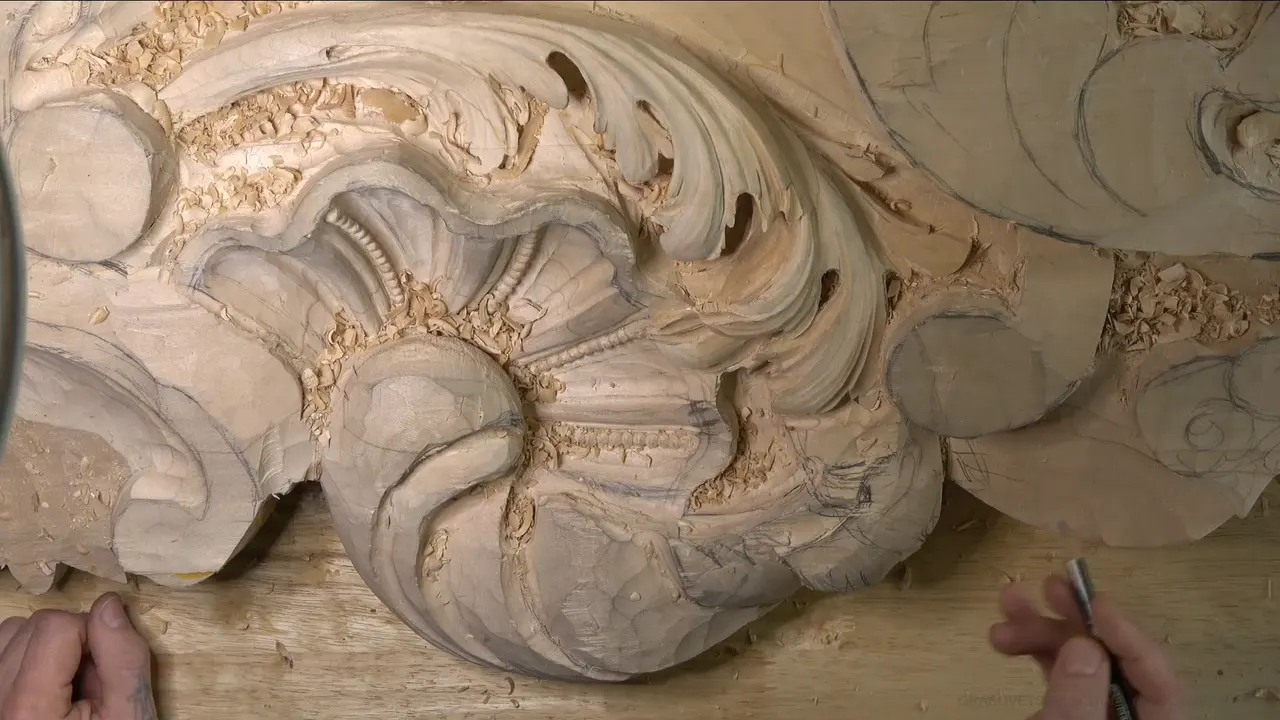

In Venice Room 12, video 12, I say "I can try to show to you, but I don't think it's going to be visible anyway." Each passage below names its lesson, so you can open that video and hear me say it.
Ever watched a carving video and wondered what the tool was doing where you could not see? Ever tried to follow a cut that goes underneath an acanthus leaf? The last video of workshop 12 has a few spots like that. So do many other videos of mine.
What did I do in video 12 before I said it?
It starts with "Let's move right here." I "really want to end this point" and I plan to "save some more material" and to "excavate this side." I tell you "I do know that is a little confusing" and "Just wait a little."
"Let me outline this way," I say. A bigger one will probably do. Then comes an apology: you will not see "the bottom of it." The idea is "approximately a leaf like that" and it goes on the side. I need to "excavate a little bit underneath."

To get the mallet, I say, and I'm going to use "number nine and quarter inch" (6.35 mm). I will not use a big tool right now, "because I don't have to." One line has to stay, so I make sure I do not lose that line right here. That line goes underneath too. I'll be "really careful how I approach."
Beautiful, it will be, I say, "but I still have to be really careful." The surface needs rounding next. A flatter gouge would do, "like number three" and then "round little more." I call the surface "my canvas." It will be visible from the bottom, and I want "a really nice transition."

For cleanup I plan "maybe number three and the bigger one" and I say "Use upside down." It looks "too messy," I say, and when it is, "you can't actually see what is going on." Cleaning "once in a while" matters, and I "clean my next area." That way it is "a lot easier to even draw, and figure out what's going on."
A deep line shows up. After "That cut is really deep," I am "not sure" I can do anything with it. I call it "probably a mistake that I placed that line too deep." Let me see how deep it is, I say. "It's okay. It's not that deep." The line has to "gradually just go upward" and I do not want "any too big of a bumps." I will "move this one down a little bit." Then "Now I can see."

Which part of video 12 would not be visible?
Before I place my central line, I say "you not going to see exactly what I'm going to do." The next sentence is the line of this page. Showing it would be confusing, I add. My central line goes "somewhere right here," I say, after "Let me think."

Then "that doesn't look too good." I say "Again, I got to think." One idea is "Maybe I should just take it down like that." That will be my center, I say, and "Maybe even more down like that." I tell you I am afraid of how it will look with the overall movement, and I "don't want to be too much off." The last words are "So I got that."

How do videos 10 and 11 handle a spot I cannot show?
Video 11 comes just before. In it I say "I can see it now. I know on a camera you probably can't." My next words are "But when you look at the different lighting condition, you'll see it."
That video also has "Let me use number 11 and 2 millimeters" (0.08 in), and I call it "just preliminary," because I have that side left to develop. Back in video 10, I say "I know it's almost invisible, but you'll feel it." Even a small detail will still be "detectable." Later in that video I say "It is visible, but it's almost undetectable."

Where else in Venice Room did I make the offer?
Video 5 of workshop 5 holds an undercut plan. I say "I need to undercut first" with a number 11 of "probably three-eighths of an inch, 10 millimeters." Next I say I am not sure you will see it, and make the offer. A tool change follows: "maybe I need to use long bent" at "half an inch" (about 13 mm).

In workshop 7, I give a size in video 3, "14 millimeters approximately" (0.55 in), and I plan to start that concave. Then "Sorry if you can't see what I'm doing." Later: "maybe number seven is not enough" and "I kind of don't like what I see." My next plan is number eight. "It is scary to use number eight," I say.

Next comes Venice Room 13, video 9. It opens with "I know it's almost impossible to see from the side." Once the offer is out I say "that is the camera right now pointing. So that is the element I'm working." The element is "just repeating the previous one. It just goes downhill." "When you look from the side, it doesn't really make sense," I say. After that I plan to "turn back the camera I used" and to "clean little bit more" with a flatter gouge. And "Going to clean this because it doesn't look too good."

Venice Room 32, video 8, sets "the right position for the camera." Next I say "that is from a different perspective." The panel has "lots of junk inside," but "I like the movement itself, how it looks." I am "still not too happy about this one" and "I'll take care of it a little later."

Over in Venice Room 64, video 8, I plan a smaller tool "to get all that mess out" at "four millimeters" (0.16 in). I have more work on that chunk later, and you won't see it. I offer to show what is possible to see. "On a camera, you see that part, upper part." The stem on the side is "nothing special," just "a stem coming from that detail" and "you really don't see what's going on on the side." "Maybe I can clean little bit, create deeper shadow," I say. "But can you see that?" And "It casts shadow now."

The offer shows up again in video 6 of workshop 97: "I want to create movements like this. Sorry if you can't see that." Then "I also don't want to block the camera." The plan is "five total divisions on the side of each of three parts." "You'll see it just in a second." For tools I name "number 11, 5 millimeters" (0.2 in), and "They don't have to be deep, by the way."

The same offer sits in video 6 of Venice Room 101, with "I'm sorry you didn't see." Four of those parts will go this direction, and it is "easier to divide." I plan to "get right in the center," keep "an eye on my right side line and left side line" and "eyeball the movement." The count ends at "four concaves and three convexes."

Which spots came with the offer in the acanthus and Furniture Panel lessons?
Roman Acanthus 16, video 5, has "10 millimeters" (0.39 in) and I plan to create my concave cut "carefully, on an angle." Then "Although it's impossible to see" and the offer. "Maybe it's almost impossible." The cut "leaves some really rough cuts," I say, "which means I have to buff it," or sharpen it.

In Greek Acanthus 11, video 2, I say "Now let's dig it out or hook it." Then comes "that's how deep I got" and I plan to clean later, and it will look clean underneath.

Furniture Panel 22, video 6, has my plan to undercut underneath this detail. "You probably don't see that," I say. Once the offer is out: "there is a small wall." "I need to remove it." With "the same tool, 1 millimeter" (0.04 in), I will undercut it and "create that shadow." Last, "I can take a half a millimeter" (0.02 in) "and exaggerate that cut." "But I'll use a mallet."

Over in Furniture Panel 21, video 10, an edge fails: "see this edge right here? And it goes this direction." The offer is followed by "not really nice curvature" and "I need to fix my curvature right here."
Furniture Panel 14, video 1, has "you probably don't see what I am trying to show." Then "really important to just follow the main movement." I "really want to replicate the overall movement" and "repeat the law of repetition."

In Floral and Molding 10, video 3, my words are "I know you don't really see what happens" and then the offer. "I do have a wall, this wall, and I will undercut that wall also." A really deep shadow will sit underneath, "but later, not at that point, not at this moment."

How did I show a hidden spot when I could?
Floral and Molding 3, video 2, is about reach. "There's no way I can get the camera in a area like that." I can grab my phone, and "I hope you will understand." Then "my apologies for how shaky that is." I also do not want my fingers covering it. Of the volute I say it is "the lowest point of that overall side."

In Chamomile and Bow Rosette 2, video 1, I say "Well, actually, you're not seeing it, because doesn't matter what side I show, it still doesn't show what I'm doing." Later the answer is my phone. "So hopefully you can see" it. And "I excavated on inside right here" and I want a twist "going like this."

Venice Room 79, video 3, brings the offer with weight. "I marked everything," I say, and "I marked from all of the sides, and now I'm ready to carve it." Then "it's super heavy." "But you can see on all the sides I got with the red marker." Then "I need to flip it upside down without breaking."

Hashemi Flowers 35, video 1, opens with "I'm not sure if you're able to see that on the camera." My petal of the flower can stop right there, I say, and the rest is "just a leafage underneath of it." "I think that's a good chunk of wood we can save and utilize." For that I'll "just undercut." Later I say "I am saving this chunk" and it will be "like a small leaf sticking from underneath."

Hazelnuts 3, video 1, has "I open this one, so it looks much better." Then "So it's opened up a little better." I still have "to work on that curl." "A little better version of that curl going to happen later, but at least I know what direction it will go preliminary." I use "number seven, 14 millimeters" (0.55 in).

In Lily Box 4, video 3, I say "And now I am leaving only about five millimeters from my surface to this ridge" (0.2 in), and then the offer. "But still I can't leave it too high." It would not be as stable either. For a second section I may leave "only about three millimeters" (0.12 in).

Lily Box 5, video 9, has the offer after "And almost all the way down." Then "It looks like I need to sharpen this one." "Of course, it's always important to have sharp tools." I leave "just maybe about one millimeter right here" (about 0.04 in) and plan to undercut it. "I'm not sure if it's on a camera visible, what I just did. I sure hope so."
Flower Rosette 6, video 2, puts the line on tools: "I'm trying to show you that it's possible to use just the minimum tools. You don't really have to have a thousand tools to get some really nice results." "knife is the main tool what you're going to need."
Where did each hard-to-see spot sit?
| Lesson | The spot that was hard to see on the video |
|---|---|
| Last video, workshop 12 | The bottom of a leaf that goes on one side |
| Fifth video, workshop 5 | An undercut with a number 11, and maybe a long bent |
| Third video, workshop 7 | A concave, where number 7 might not be enough and number 8 is scary |
| Ninth video, workshop 13 | One element on the side, repeating the previous one and going downhill |
| Venice 64, video 8 | A stem on the side, coming from a detail |
| Venice 97, video 6 | Five total divisions on the side of each of three parts |
| Workshop 101, video 6 | Four parts that go one direction, easier to divide |
| Furniture 22, video 6 | A small wall under a detail |
| Hashemi 35 | A leaf kept under a petal |
| Panel course 3 | The inside of a section that the camera could not reach |
| Panel course 10 | A wall to undercut later |
Which spot on your own panel does a camera miss? The full set of videos for this panel sits inside one tuition plan. The Venice Room part 1 course page holds workshops 1 to 12, and lesson 12 has all of its videos. More wood carving and relief waits there.
How it's done
- Save some material. My plan was to end at one point, keep some more material and excavate that side.
- Start the leaf. I wanted a leaf like that on the side, with a little excavation underneath. I named a number nine, a quarter inch (about 6 mm), and the mallet.
- Round the surface. The surface needed rounding. A flatter gouge such as number three would work.
- Clean up. It looked too messy to read, and a cleaner area is easier to draw on.
- Think about the line. The line through the center was somewhere right there, and maybe I should take it down.
Frequently asked questions
What could you not see in the last video of workshop 12?
The bottom of a leaf that sits on one side. I apologized for that, and a little later I told you that you would not see exactly what I was going to do.
Which tool did I plan for the first digging there?
A number nine, quarter inch (6.35 mm), and I said to get the mallet. A big tool was out for now, I said, and a flatter gouge such as number three would work for the rounding.
Why did I stop to clean?
The wood looked too messy, I said, and a messy spot hides what is happening. A clean area also makes it a lot easier to even draw.
What to carve next