
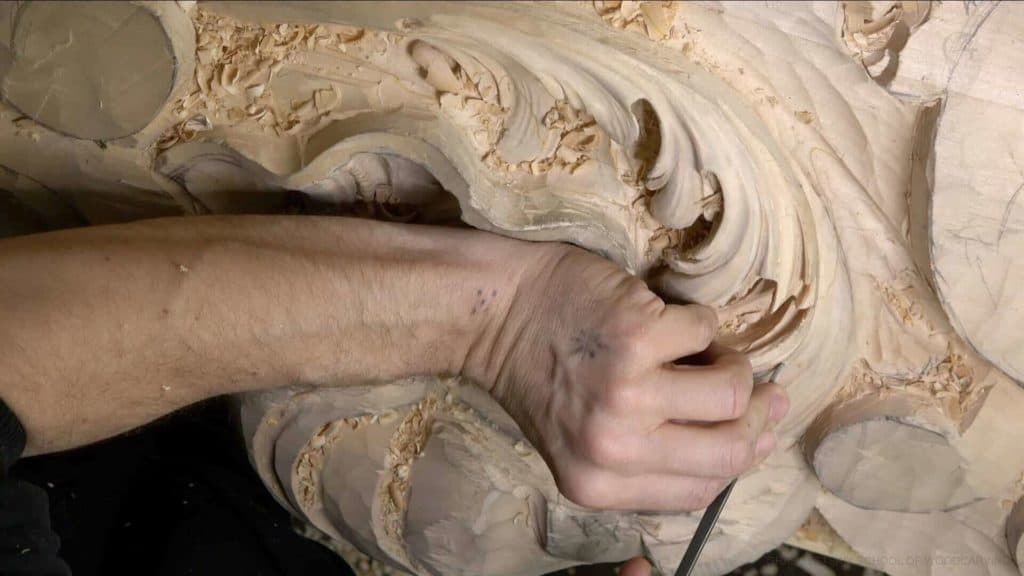
Alexander Grabovetskiy, woodcarver, School of Woodcarving · Published 2020
What does a wood carver mean by "an interesting detail"?
Quick answer: In part 2 of workshop 12 I planned a small flip, said "let me do that," and named "maybe number 11." The words "interesting detail" come with it. They return in part 1 of that workshop and in the Furniture Panel, Hashemi, Lily Box and Butterflies courses.
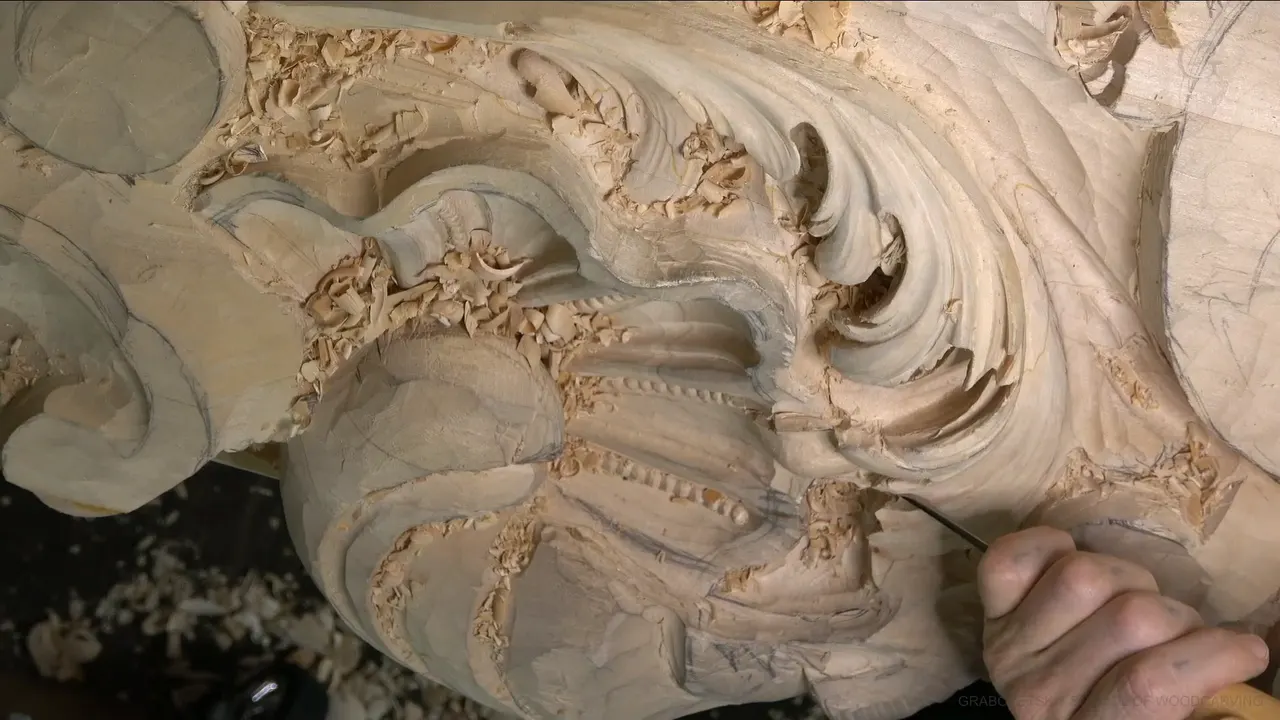

In Venice Room workshop 12, part 2, I said a small flip would "give a little more interesting detail." Those are my words from that part. The first part of the same workshop uses them too, and so do lessons in other courses, each over a different small spot.
Ever looked at one small spot on a carving and felt it needed a little more? Did you hold the tool over it and not know what the little more should be? Start with part 2. Then come the lessons where I said the same two words again.
What did I say about an interesting detail in part 2 of workshop 12?
The part opens on a small plan, "I will give a small concave to give the right direction for the eye." I add a note on the word, "For the human eye, okay? I'm not talking about the eye of the acanthus."
Next I look for a place to separate, "Let me separate right here." I planned a number 11 at "four millimeters" (0.16 in), then "just get underneath a little bit of this part," and later "two millimeters" (0.08 in). My words about the result were "that's looking better."

One spot would not settle, and I said so, "I should say it looks better. But still, this one doesn't." Then "Something about this one doesn't look good to me, okay?"
I named one move I could make. It was "some kind of flipping motion" to "flip that backward like that," with an undercut "a little bit on the inside with the concave." A worry came right after, "But then I'm going to lose the overall feel," and I ended with "Maybe I shouldn't do that."
What made me change my mind about the flip?
The turn came with "Well, actually, you know what? Actually, it's going to look good because if I'm going to create a little flipping this direction, it's going to pretty much repeat those shell movements and going to give a little more interesting detail, okay?"
My test was "if I don't like it, I can always redo it or something." I added that I was not sure I could redo it, but "let me try."

Next, "now I can start excavating underneath of this flip," and the tool is a plan, "Well, maybe number 11. And again, it's got to be from almost nothing and go really deep." Then, "See? It gives extra shadow," I said, and the next words were "Extra detail. Extra something."
A doubt sits beside it, "Still not sure if I like it or not, but it's too late anyway." Further on came a verdict. "In my opinion, it doesn't look too bad at all."
A need follows, "what I have to do now, I got to cut deeper underneath right here." Next comes "And now it looks much better." I wanted "a long, shallow concave" after that. The part ends on "that concave is going to die," then "let me clean it," then "maybe get a little closer to this ridge."

How did parts 1 and 3 of the same workshop go?
The first part starts with "And I want to give extra shadow," and next comes "That is really good." The pipe is after that. I needed "a small, two millimeters or so, number 11" (about 0.08 in), "and remove that waste," and also a tool "upside down" to "give some roundness to it."
I called the result "not clean yet, but it is exactly what I want to see." The next plan was "Let me chop the side right here." Then "Just create some distinguishable separation."

Later in that part the shape bothers me. "The overall shape, I'm not too happy with," I said, because "it's just too pointy in my opinion." I said I needed to "give some roundness." Then, "maybe I can give some kind of S movement right here." Once I had explained the S, I said "I think it gives really interesting detail."
Part 3 has a plan too. Extra movements were on my list, with "a really shallow number five or number seven," or "maybe a really small one, like three millimeters, one-eighth of an inch" (0.12 in). They were "just for the eye." I did not want deep ones, "that's my personal thing."
One more was a maybe, "just with the one millimeter" (0.04 in), and "Just one, okay? That's all I need." For another I had a question, "I need to decide where to put it, or even should I or not." And a line to go with it, "But maybe right there. Just for eye. Like eye candy. Just to draw that attention," and "Not much."

An edge came up too, "my edge is not appealing at all," in "kind of a tricky area." I said "Sometimes it's a good idea to give an extra detail to reinforce it." That detail would be a convex, "just like that," and "that's going to be sufficient to hold that thing." Further on, "I kind of like that small detail we created, or I should say I created."
Would I keep an interesting detail I was not sure about?
Workshop 15, part 3, carries the words and a fallback. Of a backward flip I said "I could actually use that as extra detail, like flip backward slightly," and "I don't have to do that." With "If I'm not going to like it," came "I'll just take it out."

A tool is named too, "3 millimeters" (0.118 in) in a "number 11," as my next tool. The work so far was "just preliminary," and "later on I really need to go deeper."
Part 4 of the same workshop points to the original work. "Sometimes I saw on some of the original work, they would give a concave cut on inside right here, and they stayed away little bit from the separation itself, and it just created interesting detail."
My test from workshop 12 comes back, "let me try it, okay? If I don't like it, I can always shave it." The shadow was my reason, "I think I really need that shadow right there." I meant to "exaggerate that shadow inside" with "3 millimeters" (0.12 in) of a "number 11," with "I think it's good, okay?" later.

How deep did an interesting detail go?
Workshop 20, part 11, sets a limit. I did not want to excavate too deep, and my reason was a "too-weak spot." Still, "I'm able to and give a really nice shadow," and the result would add up to a "nice, interesting detail."
The gouge changed with it. "Maybe I should use a smaller, even maybe 3/32 of an inch gouge" (about 2.4 mm), I said, and then "I'll use just probably two millimeters" (0.079 in) in a "number 11." My reason for the number 11 came with a because. "I can lean on one of the sides more, and it actually gives me beautiful movement."

In workshop 33, part 12, deeper was my thought. Of that spot I said "I could go much deeper right there, and I think I should probably." I would use "maybe five millimeters" (0.2 in), "Number 11 again," for an "interesting detail."
Next, "I think that is enough." One more thought sat after it, "I could go extreme and get even deeper underneath," maybe "three millimeters or maybe four millimeters."

What about a detail inside a detail?
Workshop 54, first part, sets the words beside a plan. "There is another really interesting detail I could create," I said, and "It's like a detail on inside of detail." Then "I could actually roll this in." I added "Same effect what I did on overall," and then "on a micro level."

"Almost undetectable but, for people who's looking for those details, they really will appreciate." I would take "four millimeters" (0.157 in), "number 11." Later in the part, "It's a really small detail, but that detail going to give extra level," and "Extra level, extra shadow, if you wish."
Part 11 of workshop 25 speaks of "interesting detail also." This one has "a unique movement, which is going all the way from that direction around this side." Later still, "Let me double-check how will I see that."
Which details did I leave to develop later?
Workshop 16, part 2, ties the words to a view, and the detail could come "on inside" because it would be "visible from the bottom." Next, "But I want to make sure I do have an eye somewhere."
At workshop 56, part 8, I said "what I need to develop right here, it's interesting detail for me, but doesn't really make too much sense." One question followed, "I need to make the decision, what am I going to do?"
Workshop 65, part 9, calls it "pretty much the final detail," and then says those words again, with "I have to develop" after them. Then, "originally, I had those two pieces kind of tiny," and "I'm not 100% like it."
Workshop 81, part 11, has "an eye and the pipe," and then the pair once more, "but it's authentic." I went on with "to create that pipe, I need to create the concaves."
Part 3 of workshop 90 has a gap, "I want to leave approximately an inch away from this wall" (25.4 mm). The words come next, with an inch left open.
In Carving Furniture Panel 20, part 9, I called one part a "Really interesting part," then a "flipping motion," then "a double flip." Next, "interesting detail, and I need to develop it the right way. Okay, so I need to make concave cuts." I named "number eight and three millimeters" (0.118 in), and the first one "can do kind of deep."

Panel lesson 22, in its first part, has "interesting detail, flipping over detail." A first one is named, "a concave cut, just all the way this way."
Panel lesson 27 has the words once more in part 2, with "I need to excavate some of that area right here." A tool followed, "four millimeters just in case" (0.16 in), in a "number 11."
Does it come up in other courses too?
It does. Over in Carving Hashemi Flowers 17, part 1, I wanted to develop "interesting detail, like around on inside, like a berry on inside, if you wish to call that way." Next, "I'm not sure where should I put it." A V tool was my plan, "number 16," at "six millimeters, quarter inch" (0.24 in), for a "preliminary cut."
Lesson 19 of that course makes the word plural, "I do have interesting details, which is, I don't know, could you call them berries?" I also said "those small details like those berries are inside those beads, they make world of a difference," and "It just looks much better than just the leaves."

Small mallet in hand, I said "I don't want to overdo it," and "That's why I barely hit the mallet." It was "only 12 ounces" (about 340 g). Lesson 40, part 1, goes "interesting details, more 3D look, I would say," and then "a couple leaves."

Part 8 of Lily Box lesson 8 has the words as well. Also "there is a wall on inside," and "I can actually take advantage of this and create really deep undercut and cast really good shadow." With it, "one and a half millimeters, number 11 at first" (0.06 in). Later, "Beautiful three-dimensional effect."

Over at workshop 148, part 1, the words aim at feathers. "I really didn't want to do too many details on the feathers," I said. "But the feathers itself, it's a really nice, interesting detail," and "They're going to paint that."
Then Carving Plate with Butterflies 9, part 3. The spot is the inside of small areas, and I told you what you "can create" there, an interesting detail. "Just place that straight down like this, 90 degrees," and "a small Plug-Cut by creating rotation motion just like that, but not really deep," at "about one millimeter deep" (0.039 in). A warning came with it, "Do not push too hard." Also "It is better just to create a lot more rotation than pushing down."

| Lesson | What came next |
|---|---|
| Workshop 12.2 | A small flip I said would repeat the shell. |
| Workshop 12.1 | Extra shadow, and a pipe to round. |
| Workshop 15.3 | A backward flip I could take out. |
| Workshop 15.4 | A hollow kept a little away from the separation. |
| Workshop 33.12 | A hollow I could take deeper, with a number 11. |
| Workshop 54.1 | A detail on the inside of a detail. |
| Carving Furniture Panel 20.9 | A double flip, and a plan for concave cuts. |
| Hashemi Flowers 17.1 | A berry inside, and no place chosen yet. |
| Lily Box 8.8 | A wall inside, and a deep undercut I could make. |
| Butterflies 9.3 | A plug cut, about one millimeter deep. |
Where can you watch part 2 yourself?
You will find part 2 in workshop 12 of the Venice Room course. Listen for the small flip, a number 11 in it, and the line "it's too late anyway." Venice comes back, along with the rest of my wood carving.
How it's done
- Say what the spot lacks. One spot did not look good to me, I said in part 2.
- Name the move and the worry. A flipping motion with an undercut was one move I named, and the overall feel was my worry.
- Point at what repeats. A little flipping would pretty much repeat the shell movements beside it, I said.
- Try it small. A redo was my fallback, I said, and I would do it.
- Say your verdict. It did not look too bad at all, then it looked much better.
Frequently asked questions
Is an interesting detail always a small flip?
A flip carried my words in workshop 12 and workshop 15. A detail on the inside of a detail carried them in workshop 54. In Butterflies 9, part 3, a small plug cut did.
Does an interesting detail have to be deep?
Workshop 20 has me wary of going too deep, because of a too-weak spot. Workshop 12, third part, has me ruling out "deep ones" and calling that "my personal thing." Deeper was an option in workshop 33.
What if you do not like the detail afterward?
Shaving it or taking it out was possible, I said in workshop 15. Workshop 12 had a redo in it, and then I was unsure I could manage one.
What to carve next