

Alexander Grabovetskiy, woodcarver, School of Woodcarving · Published 2020
What does a wood carver mean by "underdeveloped"?
Quick answer: In Venice Room 12, video 9, I call one spot underdeveloped and plan a couple of notches on it. Other lessons put the word on a movement, a side and a huge head, then on a part, a shell and an area. Each time I say what is still to do, from "develop it more" to "an extra separation."
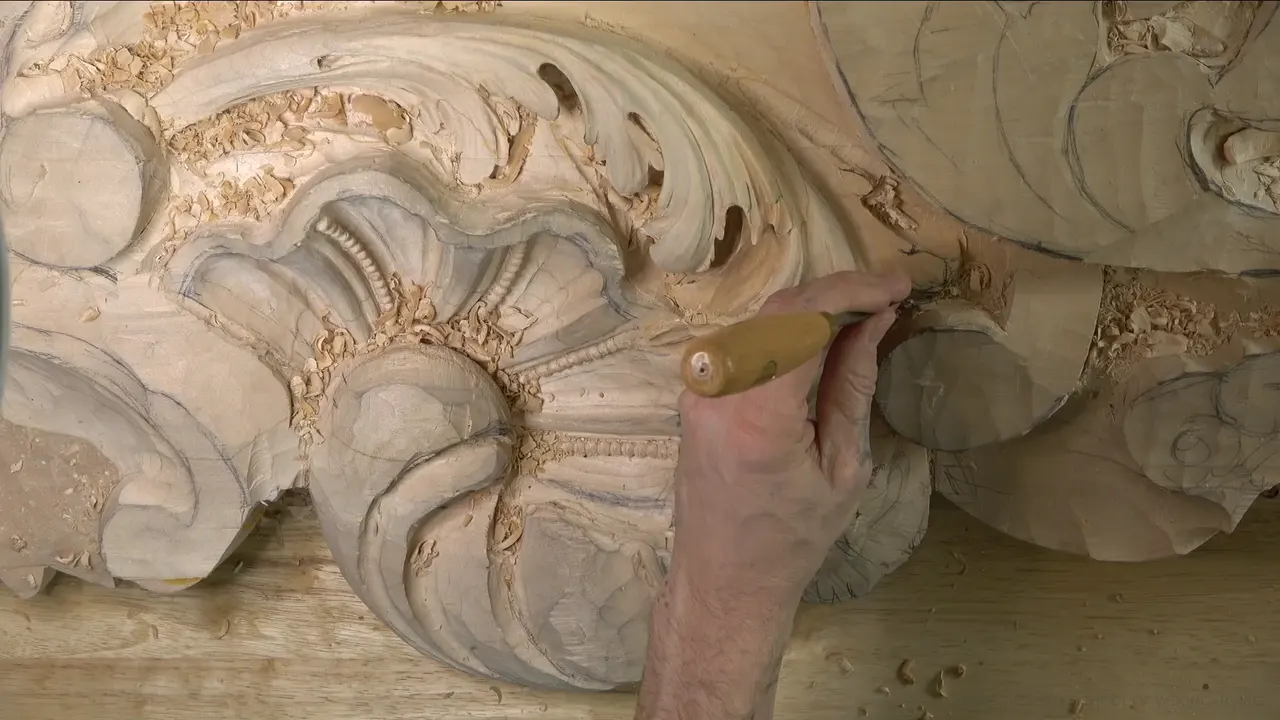

In Venice Room 12, video 9, I say "I can't leave this one underdeveloped" and plan a couple of notches on it. Other lessons use the word too, and each one shows what I said about the spot next.
Ever looked at one part of a carving and felt the rest had moved ahead of it? Ever wondered what a carver does next with that spot? This page follows one word through my videos, and it starts in the ninth video of workshop 12.
What did I plan before I said the word in video 9?
The video opens with a plan for one side: "Let me, before I forget, work on that side." On the other hand, I want to "indicate my future movements" and I plan to "keep that chunk" as "a part of this movement." The chunk "has to be divided in three main parts" and I want to keep "how this goes underneath." A separation will "go downhill like that."
Two small needs come next: "I have to make it a little more round" and "maybe I have to bring a little closer my separation." The eye needs a place too, and my words are "somewhere right there. We'll see." I also tell myself, "let me concentrate and finish that."
Here is the line the word sits in: "Again, I can't leave this one underdeveloped, and I'm going to create a couple notches on this one" and then "exactly the same on this one." I add "Not many, but still a couple of them I want to do" and once more, "A couple of them."

Which cut came right after the notches plan?
A cut came up as a plan: "Let me get a straight-down cut in the triangle area right here." Then "Just one and one and this one." A first gouge was only an idea: "I can probably use number six to give me that really good round movement. Let's see."
A verdict follows. "That was just spreading too much of material," I say. "I shouldn't use that big of a tool, which is okay." I have an option too, "I can lower down this part" and a cause: "Usually when I'm trying to rush, which I shouldn't." After that, "Okay, that is good."

How did I shape a line that looked straight?
Right now "it's a straight line," I note, and I want to "outline nicely this movement." My aim is "a really nice flow movement." The tool I name for it is "number five, I would say. The bigger one, number five, 35 millimeters. Let me try."
My sizes come in millimeters and in inch fractions, so I give both on this page. For the number 5 here, 35 millimeters is about 1.4 in.
That works, I add, and I plan to "hit a couple times, maybe a little inward slightly, and give that overall shape." Then "It's good." A second tool comes up: "the same tool" could clean it, "but for me, that is on the way," while "the good tool would be, again, number 11, I would say."

With the 11, I could "preliminarily excavate whatever I don't need" and "I don't want to damage that crisp line also." About depth: "I can always go deeper later on." Then "Really like that movement" and after the cleaning, "All that is junk, and I don't really need it."
What did I decide about the overlap?
A plan for "a couple more things" comes next. Then "I want to kind of overlap" and there is "lots of overlapping like that going on." One part will "go underneath," but I "still have to invisibly change" that line, because "right now it doesn't look too good."

Another cut gets its reason: "I have to make a straight down cut, relieve it in that section, because I don't want to create stress on the wood that I don't have to create." My tool is "the same number five" at "About an inch and three-eighths." Then "Okay. That's good."
The result, in my words: "it gave me really nice movement, although it's not necessarily completely what I want to see yet." Then "it gave me approximately what I want to see."

Which way did the two parts go in the end?
My next tool is "number 11, and I will take, let's say about four millimeters" (about 0.16 in). Then comes doubt: "a couple ways I could do, but I'm not sure." "Should I do it the way I just drew or not? Maybe not." I settle it by saying I will not "overlap this one above that one" and then "I don't know" and "Should I or not? Let me think."
Then comes the other idea: "I could continue that movement like that and get this one below, which would also be good." About the view I say: "we have to look from down, and you're not going to see that overlap anyway." And then "So let me do that," followed by "Just take this one down."
How does video 10 open?
With a leaf, and the word I use is "gradual." "I can take this leaf a little bit underneath of that one," I add. Its size: "the smaller number 11, two millimeters or so" (about 0.08 in). It will "create a deeper shadow right there." Then "exactly the same idea" and "just indication of separation."

What do videos 8 and 10 say about a spot I keep shallow?
The videos on each side of video 9 hold lines from the same workshop. Video 8 has me ready "to get rid of this junk on inside," because "when you paint, it sticks to that area." That stretch ends with "it's a really good, deep excavation. I like it."
A little later in video 8 I plan a concave around a pipe, "Not really deep," just "for the eye to draw attention." Video 10 has me say "I don't really want to create big concave" and "I could, but I don't need to." A shadow is already there: "it's already giving me that shadow."
Where else do I say underdeveloped?
In other lessons, with other spots and other next steps. Each passage below names its lesson, which lets you open that video and hear it. Video 9 lives in the first course of the Venice Room, and the rest come from courses on acanthus, panels and boxes.
Which movements still needed more development?
Video 9 of Venice Room 63 has me stop to "show you overall picture what I'm working on." Then: "I'm still not too happy about some of the movements. Okay. So it's little underdeveloped yet." I add "I still have to develop it more."
The plan follows: "just develop a little more those movements." One more fix waits: "I need to fix also this movement since I chopped much deeper" and "I need to work on it a little later." About the side, I say "kind of messy on the side, but it's okay."

Later in that video I say "Get that pipe done" and "I established one of the pipes." Then "that's good. It gave me really beautiful shadow" and I am "really happy." The Part 6 course holds this lesson, and shadow is what I name there.

Which side of a drawing looked under-developed in the panel design?
Furniture Panel design lesson 14, video 5, has me name where my second and third flower will sit. I tell myself "Let me develop this side" and next "it still looks a little under-developed." The fix I try is "maybe a separation like that."
A few lines later comes a warning about the drawing itself: "don't create too much mass, with those charcoals and pencils marks," to "see and detect the lines when you're going to carve it." Overdo it, I say, and it is "kind of hard to detect that." Both charcoal and pencil are named there.
In the same video I give a goal for the piece: I want to "make it look like a fully three-dimensional." The design course for the panel sits behind that lesson, next to furniture work.

Which separations went onto a huge head?
The first line of Byzantine Acanthus 10, video 1, is "But it's not the end yet." Then: "That is a huge head and it's under developed yet." The fix comes at once, "an extra separation right there" and then "an extra separation right here. We're going to make it curly."
The shape follows: "some concave-convexes on that big 3D movement." Someone asks whether I would put an eye where a black marker is, and I say "We can do a micro eye right there." "Right here, and we can do another one right here." And that adds "another pipe inside of that big movement."

Later in the same video I talk about more division, to "divide that even more" and "divide in three more." And a rule that uses a boat as one picture: "everything's supposed to have a boundary, like the shape of the boat or shape of the leaf." The Byzantine Acanthus course is the home of that lesson.

Where do notches come in the Lily Box?
Lily Box 7, video 11, has this line: "I can actually develop this part also because right now it's still underdeveloped." The next line is "And I need to make some notches." Then: "I need to find those notches, how they're supposed to look. One of them is here." And "then it has a smooth transition, okay?"
The tools come next: "Use a one and a half millimeter" (about 0.06 in) for the relief cuts. Then a clearing line: "let me clean a little bit my surface for those lines not distracting my view. And that way I can see exactly how I need to approach it." The Lily Box course has the whole run.

A few lines before the word, I call a hollow there "gradual" and "not a really deep concave, just indication of separation." The same phrase comes up in video 10 of the lesson I started with.

How does a big shell fit in part 2 of the Venice Room?
Over in video 10 of Venice Room 17, I say "develop rest of it, but at least you can see overall feel." The word comes in a line about the shell: "It's still the shell" and then "which is still underdeveloped."
Next: "I have to do a lot more stuff to it, okay? But this part is also part of same shell. That's huge shell right there." And on how it all comes out, I say "tie together, it should look beautiful." The Venice Room part 2 course holds workshops 13 to 25.

Which area did I leave undecided in the Maine class?
In the Grinling Gibbons class in Maine, lesson 17, video 1, I say "now there's one of the areas right here also kind of underdeveloped and I did not decide yet what I'm going to do in this section."
Then an idea: "Maybe I can just put something like that right there, which I don't have to show you how to do it because I already showed you how we've worked on that one." And to you: "So you can go ahead there's a plenty of thickness you can work on it. But let me do today this one." I also say "you can actually play with the different ideas."

Can a part be important and not underdeveloped?
Principles of Design in Wood Carving, lesson 2, has me talk about a design with a main figure and a second one. "It is a secondary hero," I say. "It's actually an antagonist." Then my word comes back in the negative about one part of that design: "It's not underdeveloped element" and I call it "really important element" and "also superpower." The Principles of Design course holds that lesson.
Where did I say it, and what came with it?
| Lesson | What I said about the spot |
|---|---|
| Workshop 12, ninth video | This one, with notches planned and a cut at the triangle |
| Venice Room 63, video 9 | Some movements, to develop a little more later |
| Furniture Panel 14, video 5 | One side of the drawing, with a separation in mind |
| Byzantine Acanthus 10, video 1 | A huge head, with more separations still to add |
| Lily Box 7, video 11 | A part to develop, with notches still to find |
| Venice Room 17, video 10 | A big shell, with a long list of work left on it |
| Maine class 17, video 1 | An area where I had not decided on a plan yet |
Which spot on your own board still feels unfinished? The full set of videos for this panel sits inside one tuition plan. The Venice Room part 1 course page holds workshops 1 to 12, and lesson 12 has all of its videos. More wood carving, relief and sculpture from old Venice waits there.
How it's done
- Plan the side and the chunk. A plan for that side comes first, and a chunk stays as part of the next movement.
- Divide it, keep the underneath. The chunk has to be divided in three main parts, and how it goes underneath matters to me.
- Name the spot. Notches go on two spots, and I call the first one underdeveloped.
- Plan the triangle cut. The triangle area gets my plan for a cut, and a number 6 is my first idea for the round movement.
- Pick tools for the line. A number 5 is my pick for the line, and a number 11 for the waste.
- Weigh the overlap. I ask whether to overlap, say maybe not, and plan to take one part down.
Frequently asked questions
How do I use the word underdeveloped in my lessons?
The word goes with a spot, and then I name the next job: separations, notches, more development, a lot of work on a shell. In one lesson I say I did not decide yet what to do in the area.
Which tool did I name after the notches in video 9?
A number 6 came first, as an idea, and I added "Let's see." After a number 5, my next pick was a number 11 at "let's say about four millimeters" (about 0.16 in). The number 5 comes back with its own figure in the same video.
Why relieve a section before an overlap?
The phrase was "relieve it in that section," and the reason I gave was stress that I did not have to create. The tool was the same number 5 as before, 35 millimeters (about 1.4 in), and I gave it in inch fractions too.
What to carve next
- Venice Room part 1 course page
- Venice Room 12
- Venice Room 63
- Venice Room part 6 course
- Furniture Panel design lesson 14
- Furniture Panel design course
- Byzantine Acanthus 10
- Byzantine Acanthus course
- Lily Box 7
- Lily Box course
- Venice Room 17
- Venice Room part 2 course
- Grinling Gibbons class in Maine
- Principles of Design lesson 2
- Principles of Design course