
Alexander Grabovetskiy, woodcarver, School of Woodcarving · Published 2023
What does a wood carver mean by "I don't know why"?
Quick answer: In part 1 of Venice Room 2, I said I would use a number nine, 20 mm (about 0.8 in), and that I could use a bigger one. I said I did not know why I was using it, and named number 11 at 25 mm (about 1 in). Other videos of mine say the same words.
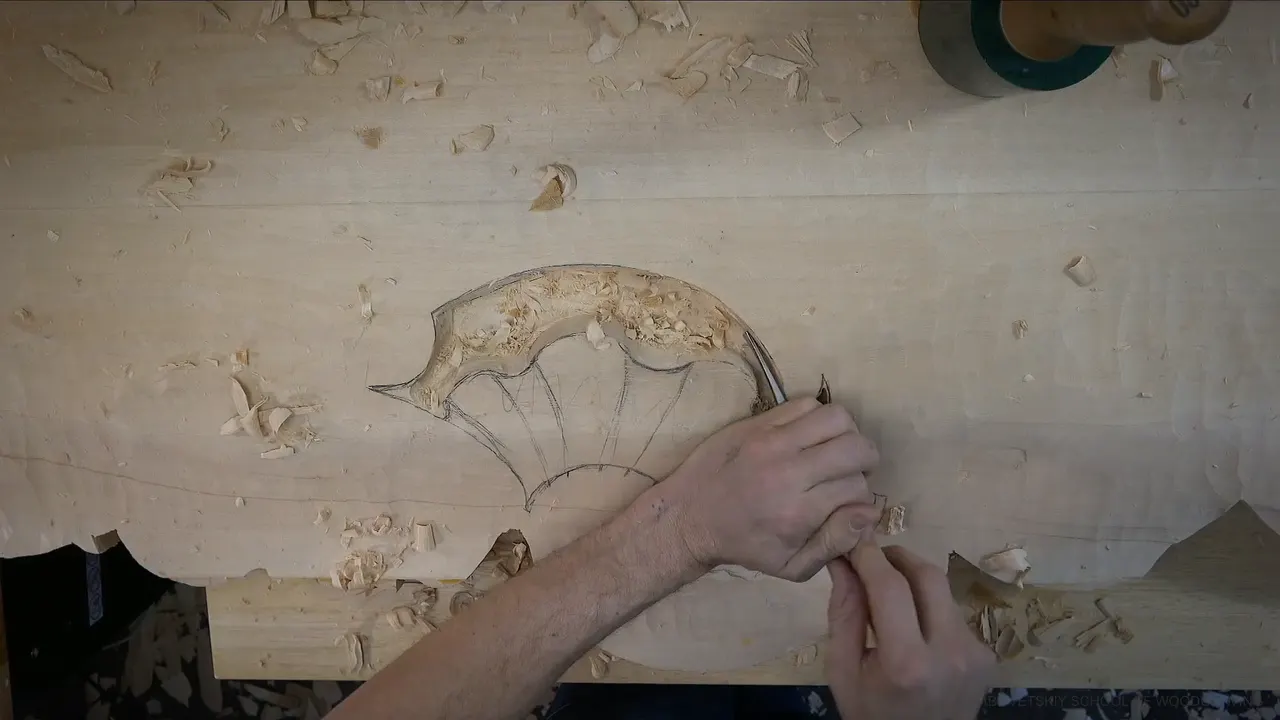

In part 1 of Venice Room 2, I said I planned to use number nine again, said a bigger one was possible, and told you I could not name a reason for using this one. Other videos of mine carry the same words, and each one has something different beside it. I link every lesson I name.
Ever picked up a gouge, looked at it, and wondered why that one? Did you carry on anyway? Then you have stood where I stand in these videos. I say it out loud, and then I show you what I do about it.
What this page holds
- The number nine, and my doubt about it, in the first video of lesson 2.
- Carving that would split the wood, and the spot I move to when it does.
- Tools I grabbed, and a number I keep saying.
- Mistakes I had no reason for, and what I did with each.
- Work that moves on the bench, gouge sizes and marks that make no sense to me, and a wood I love.
What happens in the first video of lesson 2?
The part begins on cleaning, and my words are "that is not the final destination yet." Next I say "Let me get number five and three-eighths of an inch" and about that size, "That's 10 millimeters, okay?" Three-eighths of an inch is about 9.5 mm.
Space is short, and I put it plainly: "it's not enough space for the straight tools, I'd say." After that, I plan to outline with "the same number nine," which I size at "20 millimeters, three-quarter of an inch."

How do I keep from splitting the wood?
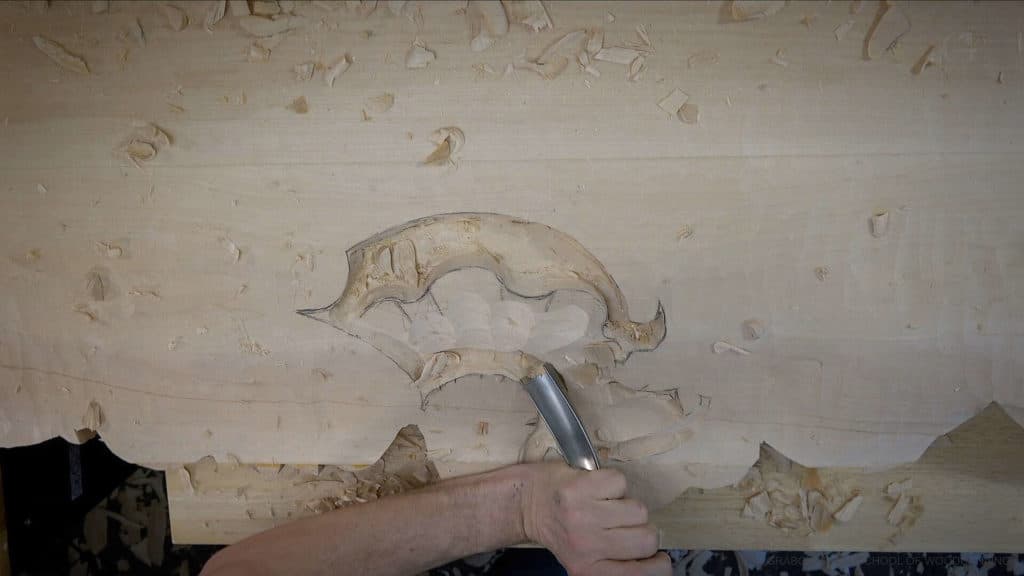
I explain it while my hands are working on the wood, and I ask you "And see what I'm doing?" The reason comes right behind that question: "if I'm going to continue my cut, it's going to split, and that's not going to be good." My fix, in my words, is to "remove it and jump to another location" and then to "attack from opposite direction." At the next spot, "that's exactly the same thing right here" and continuing there "would be a big mistake."

Out comes "Change the location" and I repeat it. The lines after that give my reason for working this way. I "don't like to switch my hands." I could swap hands and come from the opposite direction, and swapping would be okay with me. Still, "I don't want to swap the hands."
Depth is next: "a really deep cut" and "It has to be three-dimensional." Beside it: "later on, this part is going to be also rounded." Plans come next: "go all the way, exactly the same like right here, maybe even deeper."
Why did I reach for a bigger gouge?
"Now I need to get the big gouge because it's going to give me a much quicker job." I plan to get "my number seven" at "3 inches, 80 millimeters." On the details I drew, losing them does not scare me, and "That has to be also done." A fit check follows with "Let me see if this is going to fit" and I say "I still have to go deeper."

What did I say about the number nine?
My plan has the number nine again, and I give it a size. "Again, this is a 20 millimeters number nine." After that comes a stretch where I think out loud about the tool in my hand. "I could use a bigger actually. I don't know why I'm using this." A swap is on my mind: "Maybe I could use number 11 and 25 millimeters." Twenty millimeters comes to about 4/5 in, and 25 mm to about 1 in.

Buffing gets a word, "Maybe just a little bit of buffing" and then "Let me buff it" with "just a blue paste." I tell you "This is a new gouge."
Part 2 brings a number nine, and I say "It just gives me much better result because I do have a big bevel." Then in part 3 a spoon gouge "needs to be sharpened a little bit" and I use "just a blue paste, which is my favorite in this case." The green paste is another matter: "I don't really like the green paste because it gives a mess."

And when do I know why?
Part 2 of this lesson shows the other side of that doubt, in a stretch about depth. "Okay, how deep did I go?" My answer is "three quarter of an inch, about 20 millimeters deep from this point in, and that's not enough." Then comes "why would I go deeper" and a reason I give: "I think that is a focal point of overall design, and I need to draw attention to it." The wall is "about 25 millimeters" (about an inch), which I call "very good" with "Could go even deeper." My reason for more depth is "a big bowl, and I want to make it look really nice."
When do I say it about a tool I grabbed?
The knife comes up in Hashemi Flowers 46, part 3. I name a number out loud and take it back: "Okay, maybe I should use now number 12, or I'm sorry, number 11, and one millimeter." The habit puzzles me, and the cause I give is "probably number 12 knife is, as of now at least, my favorite knife, and I keep saying number 12." I call the work "nothing exciting" and "just excavating deep as much as I can until I can't even see." And my verdict is "I like it." A millimeter is about 0.04 in.

A small gouge is in my hand in Furniture Panel 27, part 1. I call it "one and a half millimeters number eight or number nine." The tool I could have taken is clear to me: "Obviously I could use just number 11 like I usually do." No reason comes to me for grabbing this one, and I add "this is so tiny." A millimeter and a half is about 0.06 in.

A curve comes up in part 7 of Venice Room 5. "Really important for me to have a really beautiful curvature and still create the illusion that that goes to the same point somewhere." I cannot say why I had not done it right away, and I add "because logically I should." The step after, in my plan, is "I would just take probably number 9 or number 11 even," maybe "3 millimeters, in this case, number 11," to "create the concave cuts on the side." A fallback is in mind too: "switch my tool." Three millimeters are about 0.12 in.

What comes out of my mouth when something goes wrong?
Hashemi Flowers 7 has it in part 5. "I can refine my edges, though I took too much, which is okay." Usually I'm "more careful." Why I'm rushing too much, I cannot tell you. I say "I could leave it like this" and the next line is "I'll just use a number one." Then, of the cuts, "Make a mistake after another mistake. Too many mistakes." Further on, a small knife helps, and I add "I can have much more control."

The doubt in Venice Room 99, part 6, is about wood. First comes "maybe use number 11, excavate around them" and I wonder why I did not leave enough wood. "But again, maybe there is enough." Then comes "number seven or number five will work," to "take care of this surrounding area." Later, "I am going against the grain."

A mistake gets the same words in the Maine class. In lesson 10, part 3, I say I'll use number 16 again, and then "I mean 35 degree angle." The angle is "really kind of interesting" and I add "I like it." Why I made it, I cannot say: "That mistake" and I call it okay. The mistake itself: "the mistake what I've done it was before I excavated too much from the backside." A plan follows, "let me take advantage of that mistake," along with "Maybe it's a good thing." Also, "see it's how fragile that is."

The first part of Venice Room 130 has "much lower" and "pretty much here's my edge." I can give no reason for the way I dug one spot, and I tell you "that's supposed to go from underneath." My plan is to "outline first" and "develop that detail."

How do I handle work that moves?
Venice Room 125 has "it's jumping so much" in its third part, and then "Maybe I should clamp it." A question to myself, "Why don't I?", is followed by a plan to "get the clamp" and "maybe clamp that somewhere right here."
Wheels come up in Venice Room 75, part 2. "I need to lock my wheels." The motion bothers me: "And I have to figure out what is going on. Why is it moving so much? It shouldn't." Then "I used to it."
Small misses I owned up to
In Lily Box 13, video 10, I am applying flakes. "I found the spot I missed" and "that is actually good time to check everywhere if I missed anything." The miss is a puzzle to me: "I thought I applied a lot." The plan is to "apply lots of flakes" and "not everything is going to stick, so that's why I don't worry about it." On the work: "it's better to do a lot more than you need." The wait is a plan too: "give about 72 hours, maybe more" and I may "just leave it over the weekend and only then clean it."

In Lily Box 12, video 6, the doubt is about facets. Big ones show up, and I cannot say why. My feeling is "I really don't like big facets" then "Not on small flowers." Then, "I have more wall to remove." And "Let me exaggerate that and just show that better."

Why do gouge sizes and marks confuse me?
Venice Room 60 has a "sweep number eight" in part 4, and I say "Don't pay attention to the number two at the beginning." Why all of those makers mark differently is beyond me. My summary is "essentially, it's just the sweep number eight, which is this part, and a six millimeters, one-quarter of an inch."

In its first part, Furniture Panel 33 has an antique fishtail with no mark. It is "seven and a half almost" and "there's no marking, by the way." Nobody marked it, and I can't say why. I settle it with "number seven will do" and "pretty much number seven or any number eight will work. Number nine will work. So don't overcomplicate."

The first part of Hazelnuts 4 has a tool: "Same 11 and 10 millimeters." I wonder why it is called 10 millimeters, and I say it is much wider. Ten millimeters are about 0.4 in.

Why does someone else's choice puzzle me?
Greek Acanthus Leaf 5 has lime wood in part 2. "You'd be surprised, actually, how nicely that wood keeps the detail if people don't damage it." And "Of course, you can damage any type of wood." Why anyone would do that is a mystery to me. "But I really love lime wood. I really do."

Which videos hold these words?
This table lists each video and the thing I had no answer for.
| Video | What I could not explain |
|---|---|
| Venice 2.1 | A number nine to use, and a bigger one I could use |
| Hashemi 46.3 | The number twelve I keep saying when I mean another |
| Panel 27.1 | One small gouge I grabbed instead of my usual number eleven |
| From Venice Room 5.7 | A curve I did not make right away, though logically I should |
| Hashemi 7.5 | Rushing too much, with one mistake after another mistake |
| Lesson 99.6 of the Venice Room | Not enough wood left around a spot I was excavating |
| Maine 10.3 | One mistake, made before I excavated too much from the backside |
| Venice workshop 130.1 | A spot I dug, though it is supposed to go from underneath |
| Lesson 125.3, Venice Room | Something jumping so much that I think about a clamp |
| Venice 75.2 | Something moving that way, and wheels I need to lock |
| Lily Box 13.10 | A missed spot, found while I checked everywhere for flakes |
| Lily Box 12.6 | Big facets I see on small flowers, and do not like |
| Workshop 60.4, Venice Room | Makers who mark sweeps differently, next to a number eight |
| Panel 33.1 | An antique fishtail, no marking, near a seven and a half |
| Hazelnuts 4.1 | A tool named 10 millimeters that is much wider than that |
| Greek Acanthus 5.2 | Anyone who would damage lime wood, a wood I really love |
This lesson has its own page, lesson 2 of this course, and Venice Room 3 picks up where it stops. The whole course sits on the Venice Room course page. Each video named here is inside tuition to the school, paid monthly or yearly and renewed automatically until you stop it.
Never held a gouge? Start with first cuts for beginners. My tools have their own course, All About Tools for Wood Carving, and Carving Tool Sharpening is the course for edges. Wikipedia has short pages on wood carving, sharpening, bevel, grain, Venice, hazelnut, millimeter and inch.
How it's done
- Pick the gouge. In lesson 2, video 1, I sized the number nine at 20 millimeters (0.8 in).
- Say a bigger one could work. Actually, a bigger one would do, I said.
- Name the doubt. You heard me say I can't tell why I'm using this.
- Name a replacement. Maybe a number 11, 25 millimeters (1 in).
- Buff the edge. Maybe a little bit of buffing, I said, with a blue paste.
Frequently asked questions
Which gouge was I using in lesson 2, video 1?
A number nine, 20 millimeters (about 4/5 in). A bigger gouge was an option, and I named number 11 at 25 millimeters (1 in). I also said it is a new gouge.
What did I say about swapping hands?
I said I could swap hands and go from the opposite direction, and that would be okay with me. Still, I don't like to switch my hands, and I said I don't want to swap the hands.
What happened when the wood was about to split?
Continuing would split it, I said, and that would not be good. I took the tool out and jumped to another location. I planned to attack from opposite direction.
What to carve next