
Alexander Grabovetskiy, woodcarver, School of Woodcarving · Published 2023
Does background music help when you carve wood?
Quick answer: Venice Room 2, part 10, has me asking you about the music, and I said a background that is too quiet is just boring. In other videos I carved with no talking and no music, while I listened to my tool when you could not see my hands.
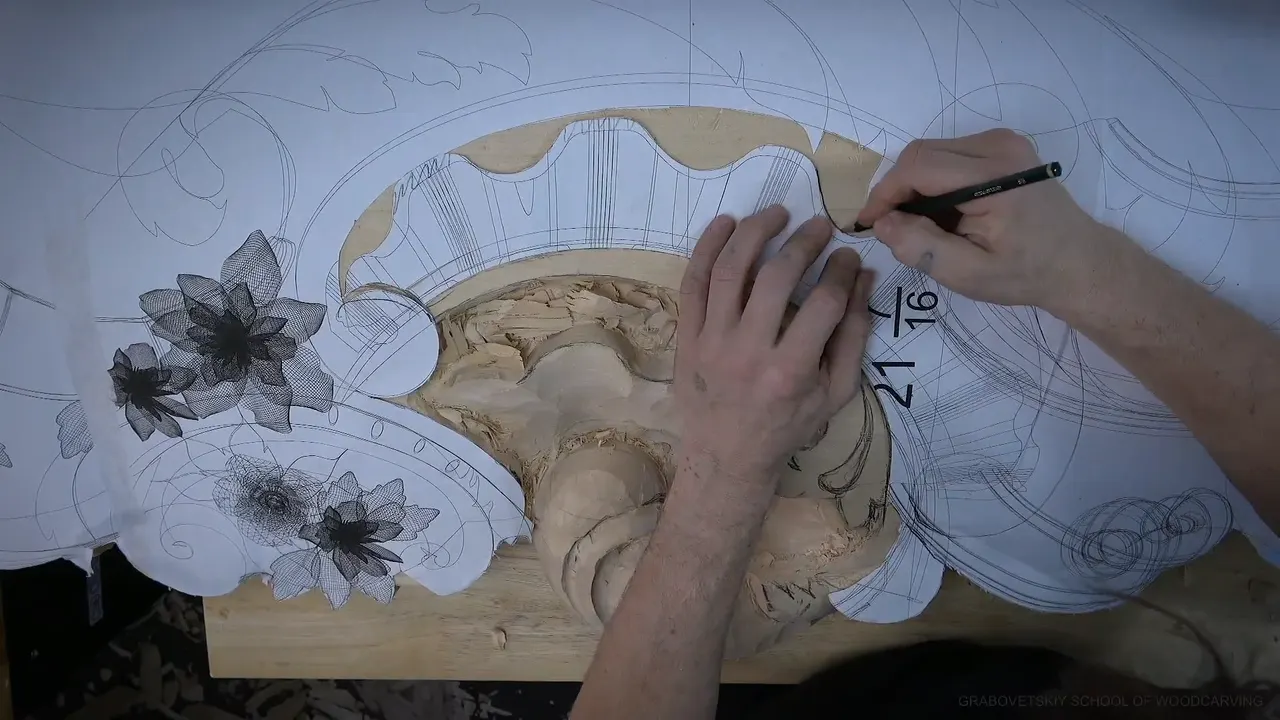

In part 10 of Venice Room 2, I asked you whether the music helps or not, and I said it is boring for me when it gets too quiet. Below, my words about music and sound from other videos sit beside that question. Each video I name is linked.
Ever worked at a bench so quiet that the hours dragged? Did you reach for a speaker? Then you know what I mean by boring.
What this page holds
- The question I put to you.
- What was on the board while I asked it, and which tools I named.
- Where I wanted room to work.
- What I said about music in my April 2020 livestreams, and what I listened to in my shop.
- One video of me carving with no talking and no sound but the tool.
- Two lessons where I listen to my tool.
- Design lessons that use music to explain repeating.
Which question did I ask about the music in part 10?
Right after "my shell," I say "Oh, by the way, I wanted to ask, when I put the music on the background, does that help or not?" My own view comes next: "I try to be as low volume as possible, but sometimes, I don't know about you, but when it's too quiet in the background, it's just boring. Okay?"
"So let me know if it distracts you or not." I add that I will "listen to multiple feedbacks, not just from one guy" and one more line closes it: "That would help a lot to improve."

What was on the board while I asked?
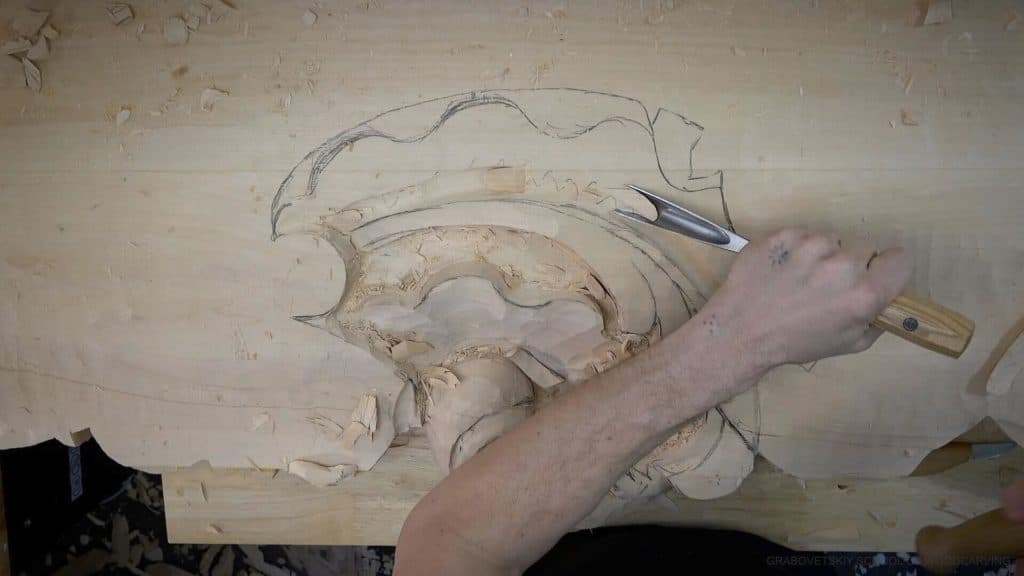
At the very start I say "And that needs to be also gone." Once the question is out, I say "Okay, let me line up. And now I can outline it." I call it "my future acanthus" and I add "Little bit right there." Then "Again, if it's not exactly how I planned, it is okay."
One spot gets a remark. "And anyway, I need to fix it right here because it doesn't look good." A check comes next, "Let's see if I missed anything" and my answer to it is "No, I did not."

The other side is next. "On that side, what I have is a mess, I should say. It's that line. Can you see that line? And that is going to go right there." About another line I say it is "part of a shell on inside."
About one more line I say "And what I can do, I can actually erase it like that." After it I say "actually, I can see my cut."
How much room did I want to work in?
I put it plainly. "But still, I need to make sure this has enough space for me to work. I need to probably move it a little closer. This space is too little." The size I name is "about half an inch space," which is 13 mm, with "maybe even more" in front of it.

Elsewhere in the part I say "Yes, I should change that position, but it's okay because I still have to make my overall three-dimensional movement of this, so I'm okay."
Which tools did I name in that part of the lesson?
The first tool comes with a plan. "So let's take the same tool." The size is "three-quarter of an inch," which is 19 mm, "and that's number nine" and I plan to start outlining. This claw "has to be higher anyway," I say.
About one side, "That's going to go from underneath of the claw, and I can go really low if I need to." A second tool is also a plan, "I'm going to use number seven and 3 inches to chop that down just like that." Three inches is 76 mm, and I add "this has to go all the way underneath."

Later I say "Now you probably know why I left so much material right in the middle. So it should make sense now." A job is waiting, "I still have to excavate much deeper right here for the future shell" with "going to use the same number nine, and I can go really deep if I need to."
Later in that part, "I should use probably bigger number nine. Let me see." Part 11 names "The 35 millimeters number nine," which I say will help me make "much quicker cuts." Thirty-five millimeters is 1.38 in.

What did I say about music in my livestreams?
Other videos bring it up too. In the April 2020 livestream from April 8, I say "Let me put some music on the background because I don't want to bore you." Next comes a plan for the stream: "I'm going to continue to carve only for school. Only for school."

The livestream about wood movement finds me shaping an acanthus movement when I say "Oh, I probably should give you some music." A story about a claim follows, "somebody else has claimed that, so the copyright." I had to prove it, and I say the music was "actually bought licensed by me, so I do have a license to use it" and I end the story with "I don't know why somebody's tried to claim music that I own."

In the clay modeling livestream I say "so as far as music, please, people." After it comes "One of the comments of that particular video was great carving, horrible music." "Don't judge, right?" And "Maybe I'm not going to like music you listen. Okay?"

What did I listen to in my shop?
In my livestream about making money from carving, I say "I had employees. They were working for me. I would send them to the job sites, and they did whatever they did. We built homes. And I would spend my time in my shop carving."
"And when you're carving, you're carving with your hands and your brains and your ears and your eyes. You concentrate on the carving, but it's like a turning off. It's just like automatic mode." Then a choice: "You can listen to music, or you can listen to audiobooks, but I chose to listen university courses, okay?" About the result, "I've got not just the one, multiple courses passed just because of wood carving."
What happened when I carved without talking or music?
During the livestream about mallets, I read a comment about a video I posted and ask which one is meant. Then the answer. "Yes, I posted yesterday night video when I was carving without any music, without any talking. It's just the sound of a gouge and the wood." And "also, let me know if you like those videos. I really appreciate. That way, I can make a little more."

About the gaps I say "Because there's a lot of gaps, actually, when I'm working on my piece, and I don't want to talk. I can't talk all day long even if I'm filming for hours every day for my school." And of the gap itself, "when I'm really quiet. Okay? Really quiet, and all I can hear is just the sound of my gouge."
About that sound, "I found out it's actually the sound it produces when you're carving with the gouge or chisel, the sound of that slicing through the fibers, it's really satisfactory to your brains."
Analytics come up as well. "And surprisingly, of course, I am checking analytics retention rate, what videos watched the longest." For a live, "everybody's pretty much sticking to the end, but my videos are also watched after live, and that is interesting."
"Without any talking and without any music, retention was absolutely tremendous. People just kept watching and watching. I think it's just like a hypnosis or something like this, okay?"
Do I listen to my tool?
In Venice Room 18, part 6, I tell you "you don't see" what I am doing, and "I apologize." The edge I make is "a full edge" and it is "Really nice and full edge on inside." Then comes "even I don't see what I'm doing, but I'm listening. I am listening the sound of my tool, okay, if I'm doing something wrong."

Later, "I created really sharp line, sharp edge, exactly the same edge like on outside, I created on inside." The tool, in my words, is "number seven, and I'm pretty much using only corner of the tool."
In Lily Box 4, part 4, I say "Let me try number seven. Number seven in about, I would say, maybe seven-eighths of an inch." Seven-eighths of an inch is 22 mm. "Maybe it's little too big," I say. I see it too: "I can see there's a void on inside of the wood." The line "Try to blend that in" comes next, and after it a question: "Can you hear that sound of the tool?" My next words are "Okay. It worked really good."

The void stays on my list, "I need to make sure I deal with that, okay?" My next tool is a plan too, "probably number 11," a concave one.
Where else do I mention music while I carve?
Venice Room 68, part 6, begins with "Some music for inspiration. Okay, good." Right after, I say "So now, I know it doesn't look like Acanthus. I know it doesn't, but it's okay. It's in progress."

In Carving Roman Acanthus 6, part 1, I tell you "I know I changed my intro music" and "I just said, 'Well, I'll change everything.'" Next is "So why change just the music? Let's change whatever I can." The carving comes after, "we're going to continue to work on that piece, on a Roman acanthus leaf."

What does music have to do with design?
In my design lessons the word has another job. Furniture Panel 2, part 3, has me saying "Rhythm in music when you just hear something just repeats itself like pam-pam-pam, pam-pam-pam, pam-pam-pam, pam-pam-pam." It goes on, "And it just repeats itself and that's a rule of repetition or rhythm." Lesson 2 itself has "that's exactly what I'm doing right here" and a size, "this is five millimeters and I repeat myself about five millimeters right here." Five millimeters is 0.2 in.
A second part of that lesson adds "Same principles which is going to apply to the art or creation of the form and creation of the sound. Still the same rules."

In Furniture Panel 3, part 4, "So if I've got one volute right here, if you remember, there's a rule of rhythm in music when you just repeat yourself, but you can't just do straight repetition." Then "What I mean, it should not be like pum, pum, pum, pum. It should have some music in it. Pum-pum-pum-pum-pum-pum-pum."
I go on, "So that's what we are getting also in art. So if I've got, for example, this one is a bigger one, and we can see this one can be much smaller one. Okay? But it still repeats. It's still a volute, but it's going to be a smaller volute."

In Design principles for wood carving 4, part 3, we call it the law of rhythm. "Do you know what it is? Like in music?" And "There's a second one, even if it goes to the same direction. There's another one, and there's another one." Then "it's like a music, pam pam pam" and figures come in part 4 of that lesson.
"We're talking about a 20 millimeter, three quarters of an inch flower." Twenty millimeters is 0.79 in. Three quarters of an inch is 19 mm. The next ones go down in size: "another one is going to be smaller, another one even smaller."

I say "It repeats same as in music" and "But they also play with the volume. The same part, but the volume changes." For the repeats I say they will "play with a different size." And "So, law of repetition, but we play with the size. That's the rhythm."
Which videos hold these words?
This table lists the videos and the words I used about music or sound.
| Video | What I said about music or sound |
|---|---|
| Lesson 2, video 10 | Does that help or not |
| April 8 | Let me put some music |
| Wood movement livestream | That music, somebody else has claimed that |
| Clay modeling livestream | Great carving, horrible music, and don't judge |
| Mallets livestream | Carving without music or talking |
| Money livestream | Music, audiobooks, or university courses |
| Video 6 of lesson 18, a full edge on the inside | Listening, if I'm doing something wrong |
| Lily box, video 4.4 | Can you hear that sound of the tool |
| Video 6 of lesson 68 | Some music for inspiration, okay, good |
| Roman Acanthus 6.1 | I know I changed my intro music |
| Panel design, lesson 2 | Rhythm, and music that repeats itself, pam-pam-pam |
| Panel design, lesson 3 | No straight repetition, and some music in it |
| Design principles 4.3 | A law of rhythm, like in music |
| Design principles 4.4 | The volume changes |
This lesson has its own page, lesson 2 of this course, and Venice Room 3 picks up after it. Before it sits Venice Room 1, and the whole course sits on the Venice Room course page. Each video named here is inside tuition to the school, paid monthly or yearly and renewed automatically until you stop it.
Never held a gouge? Start with first cuts for beginners. My tools have their own course, All About Tools for Wood Carving, and Carving Tool Sharpening is the course for edges. Wikipedia has short pages on wood carving, Venice, acanthus, millimeters and inch.
How it's done
- Ask your viewers. A plain question went out to you, and I said I would listen to many answers.
- Outline it. I said let me line up, and "now I can outline it," my future acanthus.
- Look at the room. I called the space too little and talked about moving it closer.
- Pick a number nine. Three-quarter of an inch (19 mm) was the size, number nine, with a plan to start outlining.
- Plan a second tool. Number seven, 3 inches (76 mm), came next as a plan, and I said this has to go all the way underneath.
Frequently asked questions
Do I keep the music loud when I film?
Low as possible, I said in part 10. I also said it is just boring when it is too quiet, and I asked you to tell me if it distracts you. I added that I would listen to many answers, not just one guy's.
Did I ever carve with no music at all?
A mallet livestream from April 2020 has me describing a video of carving with no music and no talking, only the gouge and the wood to hear. I said people just kept watching and watching, and that this sound is really satisfactory to your brains.
Can the sound of a tool tell you something?
In Venice Room 18, part 6, I told you that you could not see the work, and that I was listening to my tool for anything going wrong. In Lily Box 4, part 4, I asked you if you could hear it.
What to carve next