
Alexander Grabovetskiy, woodcarver, School of Woodcarving · Published 2023
What does a wood carver mean by "go back"?
Quick answer: Part 11 of Venice Room 2 has me saying a smaller size was needed, then that one area was still an option for a return. Other lessons of mine put those two words beside a smaller tool over the same spot, a spot left for later, a stuck chip, and a warning about depth.
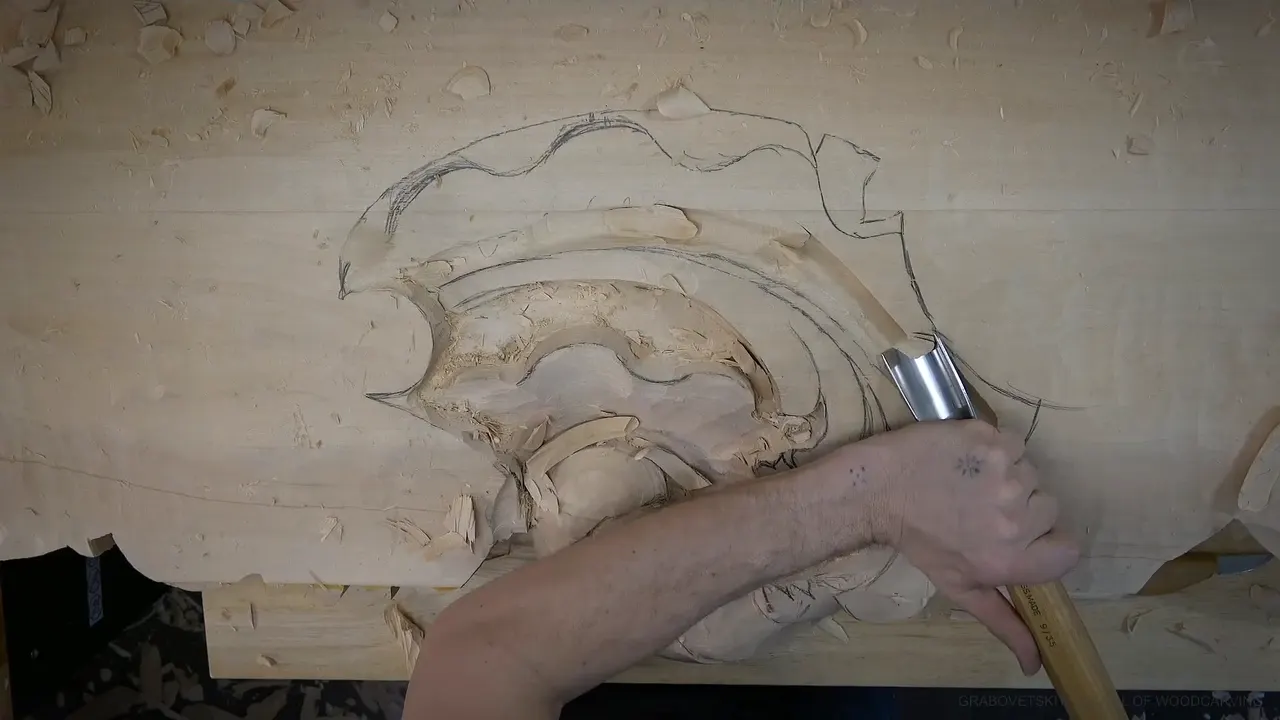

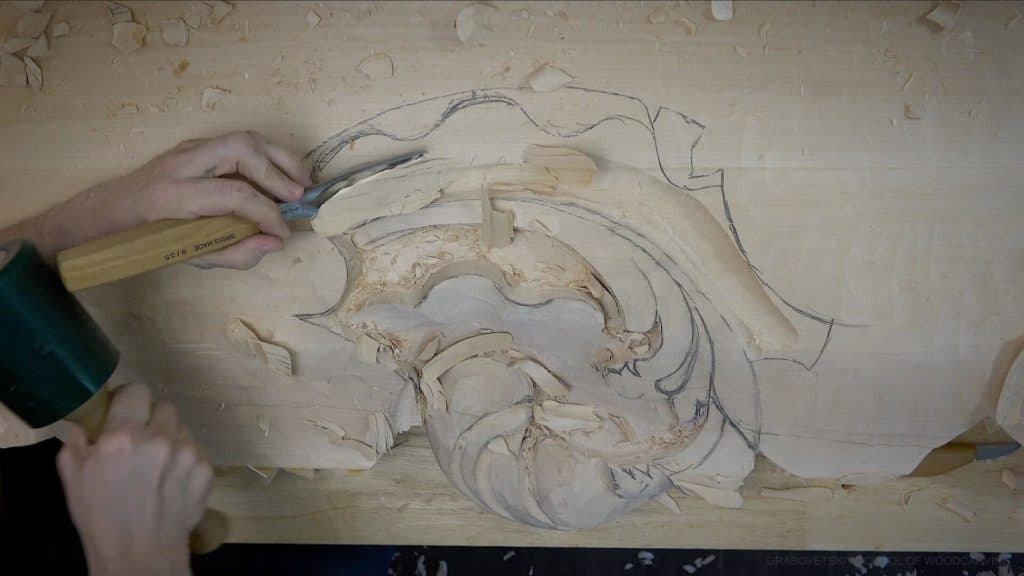
In part 11 of Venice Room 2, I said "Well, this area I could still go back with this one." Two seconds before it, I said "I guess I need to use a smaller number nine." Other videos of mine carry the same two words, and each one points at a different return. I link every lesson I name.
A gouge goes down on the bench, and the next spot calls for it again. This page shows what I do with a gouge I set down, and what I leave for later.
What this page holds
- This video, from a 35 millimeter number nine to a clean-up of the mess.
- Returns to a smaller tool.
- Spots I leave for a later day, and my reasons for leaving them.
- Chips that stick.
- A cut with no return, and a table of every course named on this page.
What do I do in this video before I say it?
The part opens on a tool. "The 35 millimeters number nine. That's going to help me make much quicker cuts." In inches, about 1 3/8. Next I say "So inch and a quarter" (about 32 mm), and ten seconds later I fix the figure. Then comes "Okay, carefully, got to change the position" and later "Yes, much quicker, much better."

Now I talk to you. "Hope you can see what I'm doing," I say, and a few cues on, "hope you can see." Next comes a depth: "And I'll go also inch and a half deep because I want to see those movements also kind of deep." The metric figure is 38 mm.

A size problem shows up in "I need to use a smaller number nine." Soon I stop: "That's enough." A warning follows, "That would be a mistake if I'm going to push it" and then "But here I can go deeper."

A hollow comes next, with "excavate this area right here" and "the same number nine as the first cut." I finish that stretch with "Two sides."

Where does the phrase sit in this part?
Near the end of the part the same size problem comes back. Next is the line of this page, and I say it with "could," so it is an option. My words do not say which tool "this one" is.

A little later I say "And I don't like how this one is too high, so I need to make sure I outline right here." My plan for the movement is "And I'll reestablish my movement later on."

The part closes on a plan and a tidy-up. "Now I'm going to need the number seven again and the three inches," I say. In metric, 76 mm. "fix overall shell movement." The last lines are "And that is good" and "Let me clean that mess."

Part 12 of this lesson is that clean-up, and I name its limit: "It's not the final cleaning, I should say." Then "It's just initial for not losing the details."
Which tool do I bring back?
The first meaning is a tool. I take a big one for the heavy work, and I come back over the spot with a smaller one.
Hashemi Flowers 12, part 1, starts with advice. I tell you "try to use the big tools all the time, as much as possible." My reasons are "much quicker, easier, and you can always go back and just clean with the smaller tools." It sits right beside the "much quicker cuts" of my Venice part. I start with "about number nine, maybe three-quarter of an inch" and call it 20 millimeters (three-quarters of an inch is 19 mm).
Furniture Panel 16 says it more than once. Part 3 puts a few passes with the gouge first, or a smaller blade. Later in that part I take a gouge to get "a little closer to the design." My final detail waits too, since I do not need to get really close to it yet, only roughly near.

Part 10 of that lesson begins with a relief cut. "I really need to create a relief cut first." Then "And then I can go back" next "with the smaller tool. And get my final shape." A few seconds on, "I just popped a little section, so I lost a little detail" and I said I should have made a bit more relief.
Workshop 26 of the Venice Room, part 2, has a previous gouge that can "clean it little deeper." Then comes "Which I really don't need to because we still have to work on details." My tool in hand is "a back bend, a sweep number five" at "13 millimeters, half an inch" (0.51 in).

In Venice Room 100, part 4, a skew gouge shaves a line, "which is about number three." I say "I don't worry about the fuzz when I'm getting it." The number 11 veiner is there to "clean it" later. The goal comes next, "to make it really nice movement for my beads."

Part 8 of the same lesson does it with one more pass, an "extra cut" to make it "much cleaner." My next words name "number three upside down."
The Chamomile and Bow Rosette course, lesson 1, part 2, has a chisel: "chisel number one" with a "straight down cut" to "clean all that mess." Afterward I say "And sometimes I have to go back to my previous tool and make sure I created the cut all the way to the center part." A calmer line follows: "If it's not really clean, I wouldn't worry about it right now."

When do I leave a spot for later?
Second comes a place. I leave it, and I say when I will return.
Floral and Molding for the Panel 11, part 2, gives my reason for waiting. "I don't want to clean this up right away, so there is absolutely no reason." The risk is changing my mind after "a lot of hours for cleaning" and in my words that is "really frustrating." I add "But again, it's just me, okay" and "You don't have to do it that way." The plan is "Once I establish the overall shape, then I'll just go back," followed by "clean it."

Venice Room 21 gives the reason from another side. Part 1 says "Probably now you know why I don't work on the details until the last point when I am actually ready for the details." Even "at the later point when everything is going to be done," I still plan to "spend more time checking, rechecking from different points of view." The test for done is "until I can find something else, I don't consider that as done."
Part 2 of the same lesson has a task, "clean again my concave." The figure I give is "sixteenth of an inch, one millimeter and a half" (1/16 in is about 1.6 mm).

In Furniture Panel 26, part 2, a section can wait, since "it's not the main concern as of now for me." What matters then is "I have to figure out what I designed." Part 3 of that lesson names a tool for later, a router plane to "clean it completely." And: "Well, I could use it now of course, but there's no reason."
Part 9 of Venice Room 102 is a pause, with "I'm still establishing the main form and clean up" and the clean-up can wait. Next is "Just preliminary, maybe clean up."
Workshop 15, part 7, hands a spot a later pass. I can "redevelop it if I need to," but "now I can concentrate on this one." Then "which is also a really nice movement, I think, in my opinion."

Hashemi Flowers 12, part 7, puts it as a plan. My line is "work on inside right now, and I'll go back later." My pick is "number eight and one inch" (25 mm).

Out in Venice Room 39, part 1, I give a reason too. "I know I still have to develop the shell and so on, but for me, I can probably jump to another section and then go back." My reason is "Otherwise, if I'm concentrating too long in one area, I'm losing interest." Then "Yes, I will clean it. I'm not going to leave it like that."

For a spot I do not like, see Venice Room 98, part 12. The words are "maybe" then "leave it for now and jump on this one, and then go back." After that, "work on that one." I correct my own word: "But I need to fix it first. Not fix it, but give somewhat logical shape to it."
For a fragile piece, Roman Acanthus 12, part 4, says "If you feel your piece is too fragile now, just stop it and work on something else." Just before it I take "1 millimeter, number 11" (0.04 in) to cut a channel, and I say "This is not the easiest area to work, believe me."

Floral and Molding for the Panel 12, part 3, sends a promise to the camera. "Let me work first off-camera on those ones and that middle one, and then I'll go back," a promise, followed by "show you how to get those because it's a little different."
What do I do when a chip sticks?
Third comes a recut. When a chip sticks, I come back to it, and I do not push it out by force.
Greek Acanthus 10, part 4: "It's a good idea not to rush anything." I point at "this piece right here, just kind of stuck." My fix is "it's better to just go back and recut, and then it's going to just fly out like this." And the other road: "But if I would force it, I could break the edges of my design."

The curly cutting board workshop 10, part 3, gives a second cut for a chip that sticks: "a second straight down 90 degrees cut until it just snaps out, just like that."
Plate with Butterflies 5, part 2, starts with "It's really important not to mess up and really also do not rush it." Then "If it doesn't go if the chip doesn't fly" I "re-cut that." In Plate with Butterflies 13, part 1, it is a clean-up: "If I need to clean up, I can go back, create secondary cut and remove it." My own note is "But that is the effect I'm after, leaning a little bit on inside."

Grape Onlay 5, part 2, repeats the cut. "If I can't remove it at one cut, I'll just" make "multiple cuts." After it, "Excavate like so."
Workshop 57 of the same course, part 11, sets a limit that matches my own part: "Although don't push too hard if it's not popping out, so you have to go back." Then "I can just recreate my cut just like that, and then boom, pop it." My own part gives the same warning.
Roman Acanthus 5, part 4, uses it for sides. I tell you to "concentrate on that side first" and "go back from opposite direction and clean another side."

When is there no return?
The warning sits in the dining table apron course, workshop 8. "Just make sure you don't go over eighth of an inch" (about 3 mm). Then "You can always go deeper, but you can't go back. So that is really important."

In Roman Acanthus 6, part 5, I give up a return on purpose. "I will try to make my cuts as long as possible, because some of the cuts are going to be almost finished." Those cuts stay "wherever they are right now."
Acanthus over Moldings 4, part 2, counts the cost of a return, with time as the money. A change in an area where you "invested so much time" costs more. "What you invested before became spending," I say, and "So it's a waste of time very much."
Where else does the phrase mean a view or a route?
At times the words only tell you where I stand. In Venice Room 29, part 7: "But I cannot leave camera in that position." Then, "let me go back," so we can "continue to develop that thing."
Lily Box 1, part 2, is a route. "I just passed this area." "Let me go back." Then "I'll just attack the way I usually work." The scroll saw comes next. My blade goes "like that" to "return and go back to the same position." The point it gives me is "really sharp."

Last is a word on the lesson itself. In Maine class 15, part 2, I name one advantage of online lessons: "you can rewatch." If you "missed something," I say, "just rewatch that."
Which course holds which return?
The table below lists them by course.
| Course | What I return to |
|---|---|
| Lesson 2 of this course | This area, with the number nine I already hold |
| Hashemi, workshop 12 | A clean-up with smaller tools, and the inside of a part, later |
| Lesson 16 of the furniture course | A smaller blade, a gouge to get closer, a final detail |
| Lesson 26 of the furniture course | A section to clean, and a router plane for the rest |
| Workshop 21 (Venice) | Details at the last point, and a concave to clean again |
| Workshop 26 (Venice) | The previous gouge, and an extra cut |
| Workshop 100 (Venice) | Fuzz that a number 11 veiner can clean |
| Floral panel course, lesson 11 | Cleaning, once the overall shape is set |
| Greek Acanthus 10 | A piece stuck underneath, to recut |
| Roman course, lesson 12 | A fragile area, after working on something else |
| Apron course, workshop 8 | No return: a depth, once cut |
| Lily Box 1 | A route for the blade, and the same position |
This lesson has its own page, lesson 2 of this course, and Venice Room 3 picks up where it stops. The whole course sits on the Venice Room course page. Each video named here is inside tuition to the school, paid monthly or yearly and renewed automatically until you stop it.
Haven't held a gouge yet? Start with first cuts for beginners. My tools have their own course, All About Tools for Wood Carving, and Carving Tool Sharpening is the course for edges. Wikipedia has short pages on wood carving, gouge, chisel, mallet, router plane, grain, acanthus, Venice, millimeters and inch.
How it's done
- Pick the tool. I took a number nine of 35 mm, which I said would speed up my cuts.
- Say what you will see. I told you I hoped you could see, and named a depth of 38 mm for some movements.
- Name what is too small. I said a smaller one was needed.
- Leave the door open. For one area I said this tool could still serve.
- Close the part. My plan was to outline a high spot, reestablish a movement later on, and use the number seven again. I ended on "Let me clean that mess."
Frequently asked questions
What did I say right before the line of this page?
That a smaller size was needed. Afterward I said one area was still an option for "this one."
Which size did this part start with?
The number nine at 35 millimeters (about 1 3/8 in), which I said would speed up my cuts. Ten seconds after another size, I fixed the figure.
How deep was I planning to go?
A depth of 38 mm, "because I want to see those movements also kind of deep."
What was my warning about pushing?
What to carve next