
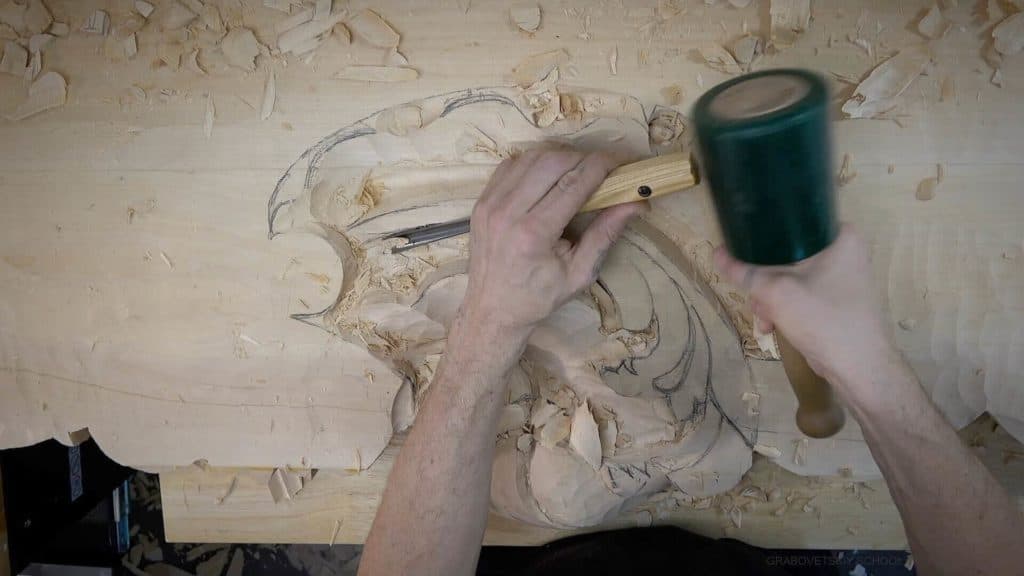
Alexander Grabovetskiy, woodcarver, School of Woodcarving · Published 2023
What does a wood carver mean by "something else"?
Quick answer: Part 12 of Venice Room 2 has me saying maybe I need something else for cleaning, with a spoon gouge named as the maybe. Further in the same part I say the words again, as a plan for that spot. Other lessons put them beside gouges, a rasp and a shape.
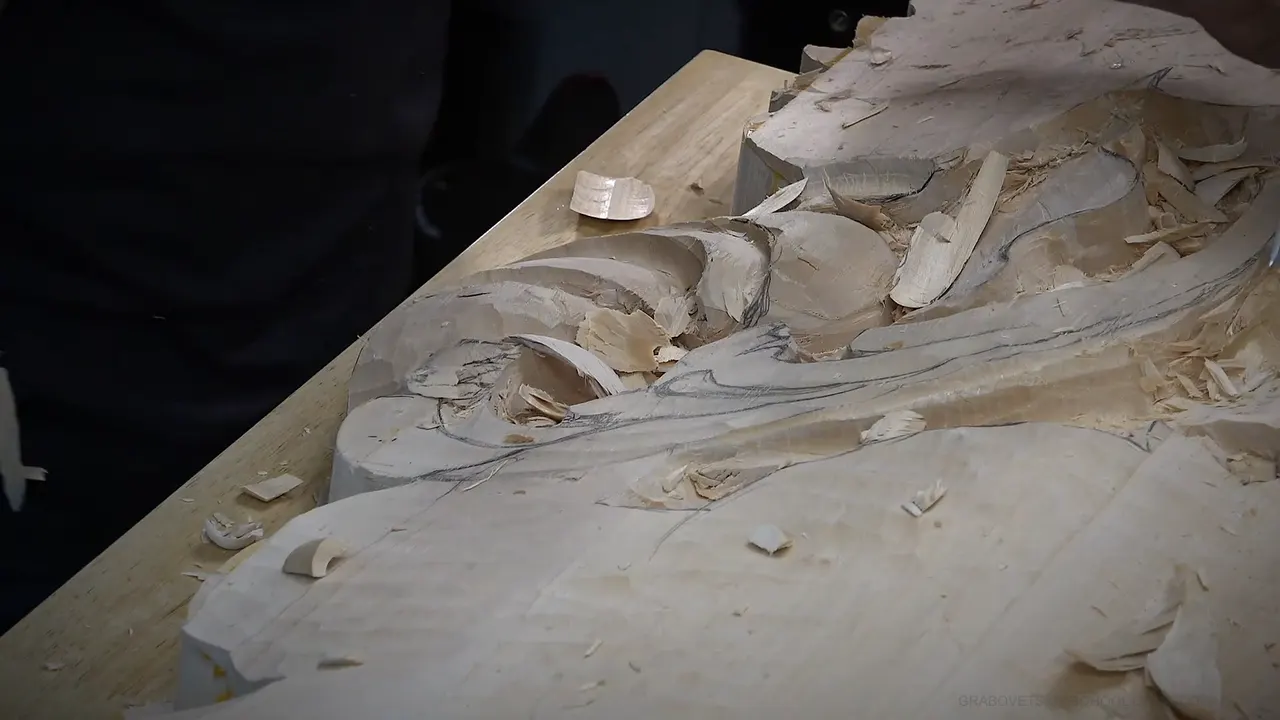

In part 12 of Venice Room 2, I said "maybe I need to use something else for cleaning" and the maybe that followed was "number three and a spoon gouge." Other lessons of mine carry the same two words beside gouges, a rasp, a ruler and a shape on the board. Each lesson I name is linked, and a table near the end sums up the words.
Ever held a gouge that felt wrong for the spot? In these videos you hear me think about another one.
What this page holds
- The cleaning lines of part 12, and the number of every gouge I name.
- The line where I stay with one tool.
- Tool lines from parts 11 and 13, the parts on each side.
- Lines from other lessons where I reach for a different gouge, a rasp, a ruler or a shape.
- A table of those videos at the end.
What did I say in part 12?
The part starts with a stop: "Okay, I'm going to stop because I need to attack from this side." Then comes "Except I need to outline it better. Straight down cuts." "I don't worry about if it's not that perfect yet," I say.
Numbers come next. "I need something smaller for this. Okay, number six fits perfectly." A need follows: "I need to also make sure I'm not losing my future movement right here. So I need to also make a straight down cut." A thought follows, "And let me think what I should use. I think number five will work." Then "And this side, exactly the same." After it come "And a corner" and "And again, number two."

Then, on cleaning, "Well, I could clean it actually with the number nine." Then "It's not the final cleaning, I should say" and "just initial for not losing the details." The maybe is "Maybe number three and a spoon gouge."

Once more the limit: "So it's not like a final cleaning of this project." The line at the top of this page comes after those, as a plan for this very spot.
One more plan is for number nine: "And maybe I can use again number nine and get rid of some of that mess, which is kind of a little bit distracting." Another line is "Sorry if you can't see that."
Did I keep the same tool?
A line in part 12 goes the other way. "Well, actually, I'm still going to be able to use the same tool right here." A size follows, "And the quarter inch number nine." A quarter inch is about 6 mm (0.25 in).
Height is another call. "So the idea is why I've got this one is much higher, because it's going to be above." I add "I want to make sure it's visible" and "it's still going to stick out," even if I am going to slope it slightly. On the grain I say "I know I shouldn't do that probably against the grain, but I still have plenty of the material." Then "I can probably safely do that yet. But it still has to go down anyway."

Which tools and sizes do the two parts on either side of this one name?
Part 11 gives a size: "The 35 millimeters number nine. That's going to help me make much quicker cuts." Thirty-five millimeters is about 1.4 in. Another line is "Okay, carefully, got to change the position." And "Hope you can see what I'm doing." Depth comes up as well: "And I'll go also inch and a half deep because I want to see those movements also kind of deep." An inch and a half is 38 mm.
A smaller gouge is on my list, "I need to use a smaller number nine." Then "That would be a mistake" if I push it, and "here I can go deeper." Also "Let me use the same number nine as the first cut." Of another spot, "Well, this area I could still go back with this one." A plan: "the number seven again and the three inches." Three inches is 76 mm.

Next door, part 13 starts on the idea: "And outline it because I don't want to lose the idea." I want "a much bigger opening" and "half an inch right there" (13 mm). It names a number seven, "the big one" with a plan, "start outlining my future shell." "I can't make a mistake," I say.
For the inside it says "I'm probably going to use just number eight and one inch for the beginning, 25 millimeters." And "That is going to go underneath anyway right here. So I should be good." The plan for the seven: "at one inch to get a nicer shape of that future shell." And "And repeat. That is number seven I'm using."
That part also has "I've got an idea. So now I can get big gouge and start digging in." There is "Let me get the number nine" with "35 millimeters," about 1.4 in.

What do I say when a tool will not do the job?
A fit check is in Venice Room 54, part 7, for "maybe 5/8 of an inch." The size is "16 millimeters." The verdict is "And no, it's not going to work." Those two words come right after it, and the next tool is "number seven, 14 millimeters" (0.55 in). Then "And number seven is actually much better." "I can make really clean cuts," I add.

Over in Venice Room 21, part 8, I ask for "a little nicer, cleaner cut right here." Of the approach, "I can probably approach using just the side of the tool." Then the plan: "number five or so" to "fix this movement."

The words "So got to be careful" sit in Venice Room 60, part 6, right before a tool that is "a little too big for me." The choice is "either two millimeters, or maybe let me try four millimeters first." Four millimeters comes to 0.16 in. The tool I name is "number 11." And "if it doesn't work, I'm going to do it with something else."
A number seven is the subject in Venice Room 95, part 2: "maybe that is not the proper tool." I say something else again, and "Number five, much better." The size is "about 10 mm," which is 0.39 in.
Over in Venice Room 58, part 11: "Well, let me attack little bit underneath of this piece because right now there's too much and it's on my way." And "I'll use the two millimeters, number 11, and carefully remove some of it." Between that and a number nine at "a quarter inch" sit the two words I follow on this page. Two millimeters is 0.08 in. A quarter inch is 6.4 mm.
"I really don't need deep concave, but I still need pronounced concave." It is Venice Room 70, part 2. Next, "Using number eight, but I could use any gouge or even number 11."
What do I say when the gouge is fine, but I only want to try a different one?
In Carving Furniture Panel 15, part 2, comes "I'll just eyeball it, approximately." Of my tool I say "Eighth of an inch, little smaller than that" (about 3 mm). A short order follows, "Get something else." After them I name a ruler: "I could measure it with just a ruler. Three thirty-seconds of an inch if I look from the side view, approximately." Call it 2.4 mm (0.09 in).

Before a pass, Furniture Panel 21 has a small detail in part 6: "So it's a small detail, but it creates a really nice movement." I tell you "And I use, by the way, number two. It doesn't have to be number two." The next sentence is the pair of words again. Its part 8 has "some different tool" and "Let me think which tool I should use. Maybe number five and three millimeters." Three millimeters is 0.12 in.


For a spot in Venice Room 66, part 1, I say "But at least I kept the overall slope." And "It's good." I name a number seven: "which I could use just probably number seven, I would say. Probably just the number seven. And let me do it."

A tool that is not a gouge comes in Venice Room 24, part 6: "I can use diamond rasps on this side right here." "That is good. But now, you know what?" I say that before it, and the rasp comes after those words.

In Furniture Panel 17, part 8, I say "It's not final yet." I check one area for another tool, and the answer is "Yep, number seven will work." And "That's a bigger number seven."

Hashemi Flowers 8 has the words with a need in front of them, in part 5: "And maybe I'll take a back bent #5 in 13 millimeters, which is half an inch." Those words come just before it.

Carving Roman Acanthus 7, part 4, is an acanthus lesson, and I talk about what a carver owns. "I know some carvers, they claim they're using only, some of them saying, 10, 12 tools on a regular basis. Maybe. It's not my case. I've got lots of tools, and I'm using most of them." Then "Even for the same task, sometimes I reach for different tools for the same task. You get bored with the same tools, and sometimes you want to challenge yourself. Would you use something different, something else?"

What else can something else stand for, besides a tool in my hand?
A few uses are far from a gouge. "Although, I could utilize different technique closer to the beads," I say in Venice Room 7, part 6. And "Okay. Let me finish this one, and I'll probably do something else underneath of those beads."
In Venice Room 10, part 7: "Well, happy, but I'm always finding something else. I'm always finding something else to do." And "a spoon, maybe about number seven."
A shadow is the wish in Venice Room 15, part 4: "I want to create something else because I really want to see some shadow right here. Casting shadow, I'm talking about, okay?"
A shell is the subject in Venice Room 19, part 2: "I did not develop that shell completely on this side." My reason is the two words again. Its part 8 says "Let me see if I should or not" and "visible from down below."
A chunk I may keep shows in Venice Room 39, part 12: "But I also could create something else right there, so I'm not going to take it down too much." My reason, in my words: "because there is a really good possibility for me to establish this chunk in and just develop something beautiful."
Which videos hold these words?
This table lists the videos and the words that sit next to "something else."
| Venice Room video, or the course named | The words beside something else |
|---|---|
| 2.12 | The spoon gouge, and the maybe for cleaning |
| 2.12 | The same tool |
| 54.7 | Nine does not fit, and seven is much better, with clean cuts |
| 21.8 | Probably number five |
| 60.6 | A 4 mm (0.16 in) number 11 to try first, with a fallback |
| 95.2 | Maybe not the proper tool, then number five |
| 58.11 | A 2 mm (0.08 in) number 11, or a number nine at a quarter inch (6.35 mm) |
| 70.2 | Number eight, or any gouge |
| Furniture Panel 15, video 2 | A tool of an eighth of an inch (about 3 mm), and a ruler |
| Panel course 21, video 6 | It does not have to be number two |
| Panel 21, video 8 | Number five at 3 mm (0.12 in), after some thought |
| 66.1 | Probably the number seven |
| 24.6 | Diamond rasps on this side |
| Lesson 17 of the panel course, video 8 | Seven, and it will work |
| Hashemi Flowers 8, video 5 | A back bent #5 in 13 mm (0.51 in), after the need |
| Roman Acanthus 7, video 4 | Different tools for the same task, and the question of whether you would |
| 7.6 | Something underneath of those beads |
| 10.7 | Something else to do, and I am happy |
| 15.4 | A shadow |
| 19.8 | Something visible from down below |
| 19.2 | A shell I did not develop completely on this side |
| 39.12 | A chunk I will not take down |
| Furniture Panel 4, video 1 | That corner, which I say I am going to break |
This lesson has its own page, lesson 2 of this course, and Venice Room 3 picks up after it. The whole course sits on the Venice Room course page. Each video named here is inside tuition to the school, paid monthly or yearly and renewed automatically until you stop it.
One more line about a corner is in Furniture Panel 4, part 1. Never held a gouge? Start with first cuts for beginners. My tools have their own course, All About Tools for Wood Carving, and Carving Tool Sharpening is the course for edges. Wikipedia has short pages on wood carving, Venice, millimeters and inch.
How it's done
- Start from the part 12 cleaning. Number nine, as an option for the first pass, which I called initial.
- Name a maybe. A spoon gouge plus a number three, named for cleaning.
- Say it again at the spot. Further in the part I said the line at the top of this page, looking ahead to the spot.
- Stay with one tool when it fits. I said I would be able to use the tool I had at that spot.
Frequently asked questions
Which tools did part 12 name for cleaning?
Number nine, to start: "I could clean it actually with the number nine." A spoon gouge, plus a number three, was the maybe. Nine came back as "maybe I can use again number nine."
Was the part 12 cleaning the final cleaning?
My words were "It's not the final cleaning, I should say," and then "it's not like a final cleaning of this project."
Do I change the tool every time?
Part 12 has me saying "the same tool right here." Part 13 has "number seven, the big one," and it also has "Let me get the number nine" with "35 millimeters." The first is a plan.
What to carve next