
Alexander Grabovetskiy, woodcarver, School of Woodcarving · Published 2023
What does a wood carver mean by a "bigger opening"?
Quick answer: In part 13 of Venice Room 2, I said I want the opening much bigger and gave its size as 1/2 in (13 mm) right there. Other lessons put the same words beside a shell and an eye, beside a dark spot, and beside a tool that needs room to turn.

The size I gave for the opening in part 13 of Venice Room 2 was "half an inch right there" (13 mm). Other lessons of mine carry the same two words, beside a shell or an eye, and beside a dark spot or a tool that needs room to turn. Each lesson I name is linked, and a table near the end sums up the words.
Ever stood over a board and wondered whether the hole you made was big enough? In these videos you hear me decide.
What this page holds
- The opening lines of part 13, with the size and the gouge numbers.
- Tool lines from parts 12 and 14.
- Size words.
- Maybe, and the lines where I stay on the fence.
- A shadow I want from an opening, and room for a tool to turn inside the hole.
- A table at the end.
What did I say in part 13 about the opening?
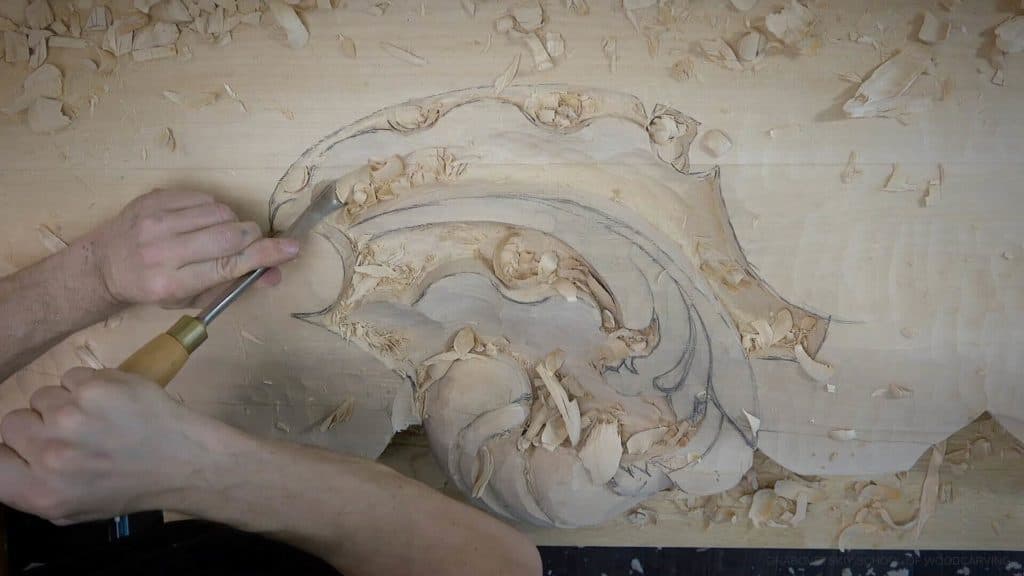
The part starts with an outline: "And outline it because I don't want to lose the idea." Next I say "And right here is exactly the same." The line that gives this page its name follows: "Although, like I said, I want to see a much bigger opening. It's going to be half an inch right there." Next comes "And let me see right here."
A tool comes in: "Okay, let me use number seven, the big one, and I'm going to start outlining my future shell." My next words are "Okay. I can't make a mistake."

For the inside, my plan names number eight: "I'm probably going to use just number eight and one inch for the beginning, 25 millimeters." Then "And that is going to go underneath anyway right here. So I should be good."
Number seven returns at a set size, one inch, which is 25 mm. "Okay, let me use number seven at one inch to get a nicer shape of that future shell." The line after it is "And repeat. That is number seven I'm using."

Planning comes next: "Let me figure out the next movement, and I'm going to continue to work on this side right now." A short line follows: "Need to find my paper."

Then I say "So, I do have a big opening right here. There's going to be a couple swirls you could call it." My plan for the swirls is "let me cut that" and I plan to cut "a little outside of the original line because as you see, it looks like it's really messy." Right after it comes "Okay, that is good. Make sure I see it."
Later I say "So overall movement has to be below that line." Then "I've got an idea. So now I can get big gouge and start digging in." My gouge is a plan too, "Let me get the number nine and 35 millimeters" and 35 mm is about 1.4 in.

Which tools do the parts on each side name?
Part 12 starts with a stop, "because I need to attack from this side." Then "Okay. That is wonderful. Except I need to outline it better. Straight down cuts." A light line follows, "And I don't worry about if it's not that perfect yet."
Gouge numbers go by fast: "And I need something smaller for this. Okay, number six fits perfectly." Two more follow, "I think number five will work" and "And again, number two" and for the cleaning I say "Well, I could clean it actually with the number nine."

My doubt about a gouge comes in part 14, "so I need to switch to smaller one." The gouge size I name is "three-quarter inch, 20 millimeters," about 0.8 in. Then comes "Straight down cut." Soon after, "Okay, and I think it is good." Then "But I'm not quite happy how it looks right here." Of a small gouge I say "And I'll use just a small gouge to get right there."
A low spot comes next: "And this one has to be really low. I can use number nine, bigger one, 35 millimeters." Thirty-five millimeters is about 1.4 in. A plan follows, "Number seven and three inches." Three inches is 76 mm, and later I say "Okay, wonderful. I need to clean right here."

How big is a bigger opening when I say it?
My size words change from video to video. One size shows in Venice Room 72, part 5: "Got to be careful and create a relief cut." Then "Slightly bigger opening." After it comes "Create a really good separation cut." A relief cut sits in my plan before the opening.

The small size shows in Carving Hazelnuts too, in video 1 of lesson 7: "I need to deviate slightly from my original design and excavate slightly bigger opening." The tool is "Five millimeters, about three-sixteenth of an inch veiner" and five millimeters comes to 0.2 in.
Over in Venice Room 143, part 2, I say "I can actually create a bigger opening in this section." Then "Not really big" and the line ends with "some kind of opening." Before it I say "logically if I have a division this side, so I have to match that division on the opposite side as well."

Grape Onlay 10, video 1: "I know it's not a big opening, but every little bit helps."

A larger size is in Carving Furniture Panel 19, video 13: "I can actually create a lot bigger opening right here. Okay? Because I want to make sure this part is not really thick, so I can take all that out." I add "I really don't need that much right there." Then "Straight-down cut. But carefully, because it's not much material."

When is a bigger opening only a maybe?
The maybe starts in Venice Room 78, part 9: "I want to probably create... I don't know if I want to do that or not. A little bigger opening, maybe." Next come "Maybe I'll just leave it like that" and "So I want to open up this section maybe." Then "Again, I really don't have to."

Part 1 of Venice Room 45 weighs it. "Just to create the opening. Do I have to?" Then "then I have to take care of the piece underneath. Should I?" And "Let me think about this one first, okay?"
The second part of that lesson has "Maybe I should give a bigger opening. Which sometimes you see actually in original work. Get the eye." After it, "I think it's not a bad movement at all" and "not everything is the same. Otherwise, it's just a little too boring."

The shell gets its words in Venice Room 56, part 2: "Going to create a little bigger opening for the shell." Next, "I don't know yet." "Or maybe shell." And "It's a lot of empty space."

The other side is in Venice Room 73, part 11: "I don't want to see that big opening. I don't know yet." Further on, "Or maybe I actually can bring this eye all the way this way, and that way create something really nice."
Lily Box 8, video 10, has the doubt: "if I need to." Then "I'm not sure I should or not."

Lesson 6 of that course, Lily Box 6, video 8, has "I know it looks really nice when you cut like this just to get all the way through."
When is the opening for a shadow?
A reason comes in Venice Room 54, part 10: "I probably really want to get really big opening, deep opening in this area. Okay. To give an extra shadow spot."

Venice 15th-century room 152, video 3, has a choice: "I could pretty much just chop this out and create a much bigger opening and make it lighter. Or, I don't know, create another division like this." "Probably going to just open up and make a shadow effect," I say next. Then "And there is a problem if I don't like it." Of that section I say "it is somewhat a focal point."

Maine class 14, video 1, has one part I talk about: "maybe even exposed like this and remove the whole thing. Just to create dark spot."

Maine class 16, video 2, goes on: "And with the number one, I'm gonna just do straight down cut carefully, of course." Then "it's gonna give me even darker spot" and, a bit later, "And I really like it. Actually I really love how it looks."

When does the opening give a tool room?
Room to rotate comes in Venice Room 111, part 3: "So that would be my opening, and that's going to create that airy look." "So that is my target," I say next. The tool part is "And just because I created a bigger hole, it gives me a lot more ability to rotate in the right direction." I add "And I can always attack also from this side."

Ten millimeters appears in Venice Room 35, part 9: "10 millimeters" and "get even bigger opening underneath." That size is 0.39 in. A reason follows: "that is why I did not undercut too high to that point, because some parts of my tool going to crank against or leverage against, and it would be a mistake if I would do it to the final form." Last comes "So that's why sometimes you see it looks rough until the end."

A scroll saw lesson has it as well, Lily Box 1, video 3: "I just went back and forth like a zigzag" and I made a bigger opening, "until I can rotate my blade easily without breaking the blade." To end it, "So I think sometimes in a smaller area like this, it works just fine."
What else do I say beside a hole?
A hole instead of an opening is in Venice Room 51, part 3: "Four millimeters, number 11. And now I can excavate a bigger hole on inside right here." Four millimeters is 0.16 in. Then "Well, hole or doesn't have to be hole. I can just probably start undercutting, and that's going to show me much better what I have to do right there."

A check on the size is in Maine class 11, video 1: "Let's see how big opening I created." Then "Now it's time to grab again." And "And just the switching between those two tools number 11 and number three."

Which videos hold these words?
This table lists the videos and the words that sit next to the opening.
| Venice Room video, or the course named | Words beside the opening |
|---|---|
| 2.13 | A half inch (13 mm) right there |
| 2.13 | A big opening, and a couple of swirls |
| 78.9 | Maybe, and maybe leave it |
| 45.1 | A question after it, and the piece underneath |
| 45.2 | Original work, and not everything the same, or it is a little too boring |
| 56.2 | The shell, and a lot of empty space |
| 73.11 | The eye I want, without that big opening, and I do not know yet |
| 72.5 | Slightly |
| 54.10 | Big and deep, for a shadow spot |
| Authentic Venice room 152, video 3 | Chop it out, and make it lighter, or add another division |
| Class in Maine 14, video 1 | Remove the whole thing, to create a dark spot |
| Maine 16, video 2 | Straight down, then a darker spot |
| 111.3 | A bigger hole, and a tool that can rotate |
| 35.9 | Underneath, with a 10 mm (0.39 in) gouge, and a rough look until the end |
| Scroll Saw Lily Box 1, video 3 | A zigzag back and forth, until the blade can rotate without breaking |
| Olive wood Lily Box 6, video 8 | It looks really nice |
| Second layer, Lily Box 8, video 10 | If I need to, and I am not sure I should or not |
| Furniture Panel 19, video 13 | A lot, where I want the part not really thick |
| Hazelnuts 7, video 1 | A small deviation from my original design, and a 5 mm (0.2 in) veiner |
| 143.2 | Not really big, but some kind of opening |
| Grape Onlay 10, video 1 | Not a big opening, but every little bit helps |
| 51.3 | A hole on the inside, or just an undercut |
| Gibbons class 11, video 1 | How big an opening I created |
This lesson has its own page, lesson 2 of this course, and Venice Room 3 picks up after it. The whole course sits on the Venice Room course page. Each video named here is inside tuition to the school, paid monthly or yearly and renewed automatically until you stop it.
Never held a gouge? Start with first cuts for beginners. My tools have their own course, All About Tools for Wood Carving, and Carving Tool Sharpening is the course for edges. Wikipedia has short pages on wood carving, Venice, millimeters and inch. A mallet and a pencil have pages too, and so does acanthus.
How it's done
- Say the size. Part 13 gives the opening 1/2 in (13 mm).
- Start the outline. The big gouge, a seven, was what I planned to use for outlining.
- Name the inside tool. Number eight, "probably," with one inch, 25 millimeters.
- Dig in. My plan was a number nine at 35 millimeters (1.4 inches), after "I've got an idea."
Frequently asked questions
What size did part 13 give the opening?
One half inch, 13 mm.
Which gouge did I plan for the outline in part 13?
Number seven, "the big one." For the inside I named number eight, "probably," with one inch, 25 millimeters.
Is a bigger opening ever only a maybe?
Yes. Lesson 78 has "Maybe I'll just leave it like that," and lesson 45 asks "Do I have to?"
What does a bigger hole do for the tool?
What to carve next