
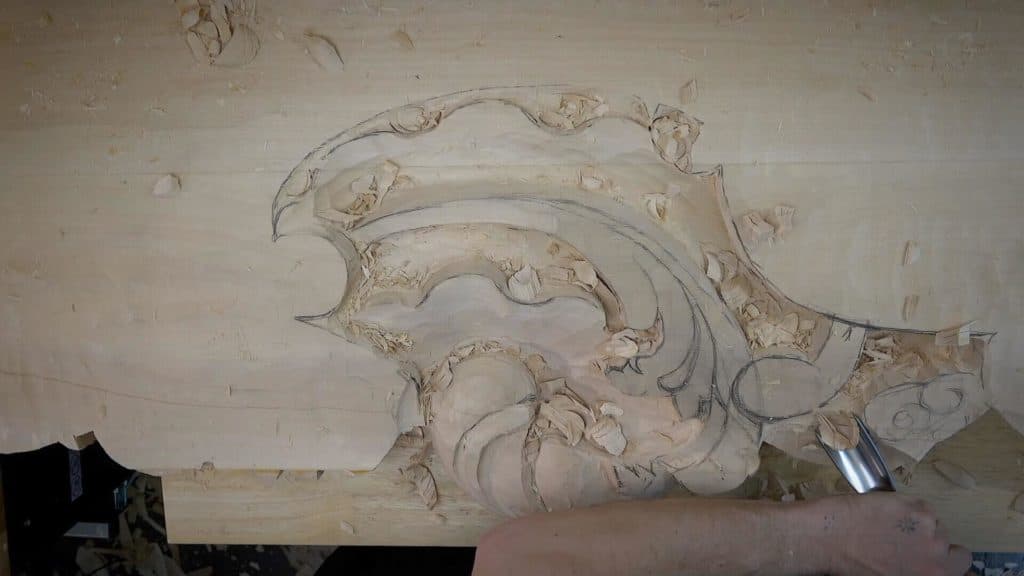
Alexander Grabovetskiy, woodcarver, School of Woodcarving · Published 2023
What does a wood carver mean by "really low"?
Quick answer: In Venice Room 2-14, I say I need a smaller gouge, and later the words come with a number nine I can use, a size I give in millimeters. Other lessons put them beside a carved shape, a low knife angle and a relief.
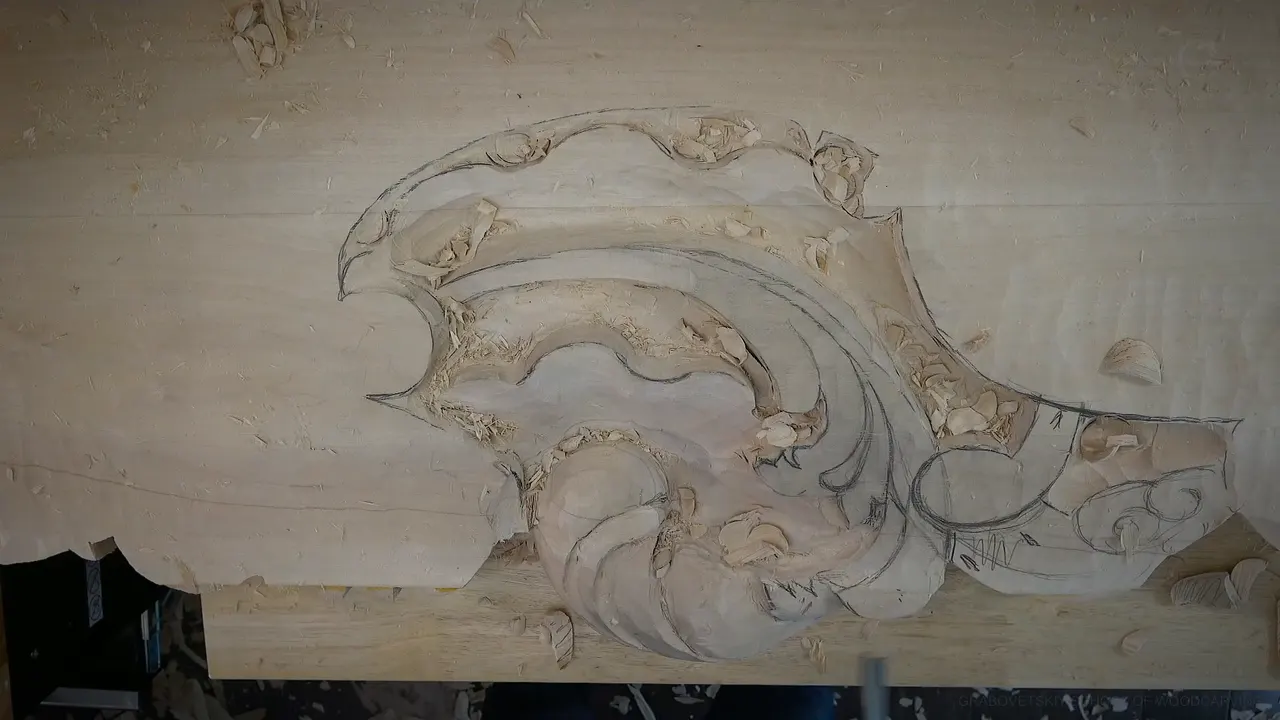

Part 14 of Venice Room 2 uses the words "really low" about one spot, and I say I can use a number nine, "bigger one, 35 millimeters" (1.4 in). Other lessons of mine put the same two words beside a carved shape, beside a low knife angle, and beside a relief. Each lesson I name is linked, and a table near the end sums them up.
Ever stood over a board and wondered how far down a spot should go? In these videos you hear me say it out loud.
What this page holds
- My part 14 lines, with the tool sizes I name.
- Lines from other lessons, each about a shape on a board and how far down it goes.
- Lines where the angle of a knife is low.
- Lines about a shallow relief.
- A table of those videos at the end.
What did I say in part 14?
The part opens on a tool that may not go in. "I don't think I'm going to be able to fit that gouge anymore, so I need to switch to smaller one." I name a size: "And let me use three-quarter inch, 20 millimeters." That is about 0.8 in, and a three-quarter inch comes to 19 mm. "Straight down cut" is the order that follows.
A warning comes next: "I don't want to undercut underneath of here, so I got to be really careful." After it, "Straight down. And clean it." Later in the same stretch I say "Okay, and I think it is good. But I'm not quite happy how it looks right here." And "But anyway, I still could just go outline it."

Next come lines about cleaning. "Okay, wonderful. I need to clean right here." And "I'll use just a small gouge to get right there." Then "I need to outline around this line." And "I have to do it the right way from this angle."
Here it is, from the same part: "And this one has to be really low. I can use number nine, bigger one, 35 millimeters." Thirty-five millimeters equals about 1.4 in. "Big movements" are the next words in the part.

A plan for a different tool follows: "Okay, let me use number seven. Number seven and three inches, and clean little that mess." Three inches is 76 mm.
One more line looks ahead. "Okay, it's still going to go even lower, but I want to leave some meat as of now." It will be much easier for me, I say, to "later on, clean everything and just get to the final destination."

Another spot goes "above that movement." Another line says "and I'll take 20 millimeters, and I'll just cut around" (0.8 in). Of the claw I say "which means I can actually lower down quite a bit. A lot."

Near the end I say "Let me take care of this. It's too bulky." After it, "And I could just use upside down number seven." The last words of the part are "establish my head of the acanthus a little better."

What do parts 12 and 13 say about tools?
Part 12 has "Okay, number six fits perfectly." Also "I need something smaller for this" and "It's not the final cleaning, I should say."
Part 12 also has "I know I shouldn't do that probably against the grain, but I still have plenty of the material. I can probably safely do that yet." "But it still has to go down anyway" is the next line.
Part 13 has "I can't make a mistake." A size comes with the number seven: "at one inch to get a nicer shape of that future shell" (25 mm).
How low is a shape on a board?
Venice Room 2, part 10, has the words beside a claw. "And this claw has to be higher anyway." Then "and I can go really low if I need to." I say I am going to use a number seven and "3 inches" (76 mm), "to chop that down just like that." I explain it this way: "what I mean by that, this has to go all the way underneath."

A big movement comes up in Venice Room 4, part 3. "Not acanthus, but this big movement, okay?" Next, "So I need to make that really low, and then I also have to slope, make my concave right here." On the method, "I could take care of overall first, make it a big concave, and then make a deeper area on inside."

Part 11 of Venice Room 45 has "I need to take this down quite a bit." Then "the goal is actually to do really low in this moment." Then "Maybe that chunk is a little too big, so we'll see." "Number 11, that's what I'm using." Then "that's a three-quarter of an inch," near 19 mm.

Venice Room 87, part 12, has a high spot, then a drop, then a rise. "But then it's going to go really low and up again." Before it, "I know the final depth, what I want to see right here." Next, "let me draw a line where I want to see it." The distance is "about an inch from this point to the line I just drawn" (25 mm).

Part 3 of Venice Room 61 has the words before a pass: "And I'm going to do kind of really low cut." Next, "maybe actually lower right here, too." The shape, I say, will be "wavy, really wavy, and curly."

The Lily Box course gives a number. In Lily Box 5, part 8, "So this part is going to be really low" is the line. Then "maybe about eighth of an inch, 3 millimeters from the main surface" (0.12 in). I follow it with "So now I can see exactly what's going on." In part 6, I say I will take it "all the way approximately to, right now, about 10 millimeters above the surface" (0.4 in).

Lily Box 4, part 3, has a plan: "I can take probably just a number five and quarter inch and make my straight down cut." That quarter inch comes to 6 mm. After that, "this side also really low, almost to the ground with the same tool. But be careful."
Floral and Molding for the Panel 5, part 2, has a volute: "this small volute should be somewhere really low." After that, "for that, I need to measure again."
From the tenth panel floral lesson, part 1: "let me see actually how low I can go. Oh, yeah, I can go actually really low." Beside that, "So absolutely no problem."
Part 1 of lesson 13 of the same course has a check on petals. "we really have to just lower down overall perimeter." And "I need to check what I did, how low did they go." The answer: "And yeah, it's actually really low." A measure follows: "a millimeter and a half," which is "about a 16th of an inch," or 0.06 in.
Roman Acanthus 2, part 1, is about acanthus leaves. "Edges of acanthus or acanthus leaves are going to create a concave look." It goes on: "really low on the outside and higher on the inside."

Video 1 of Chamomile and Bow Rosette 2 gives a measure for a low spot: "maybe about 5 millimeters, 3/16 of an inch." Next, "So which means I can remove really low some of the spots right here." I say I will take "big tool, like number 11."
In Venice Room 130, part 2: "I don't really have to blend that really low." Next comes what I can do: "I can lower down only one side of it."
Hashemi Flowers 19, video 1, has "you can see this is low." Of "this side," the line is "also really low." It goes on: "So I have to just gradually go upward and then downhill."
In the first video of Hazelnuts 2: "I still have to go low enough." Then "you have to understand the position of those nuts."
Which lines hold a knife low?
The same two words also sit beside an angle. Flower Rosette 4, part 2: "But right now, the angle is really low. It's what I'm maintaining, and I'm cutting away from myself. That way, I can control that much better." I also say "using my finger to push that" and "if I'm pushing too much, I can snap this side."

Part 3 of Flower Rosette 6 has "I'm just holding my knife at a really low angle and removing that paper." I go on with "with the knife, you can actually remove a lot of material really, really quickly."
Greek Acroterion 4, part 5, has "Let's work on inside and now remove those sections. I'll just use my knife." Then "You kind of have to feel in your hand where is your one-eighth of an inch" (3 mm).
A knife is the subject of Furniture Panel 16, part 2, a lesson on working on the background. "I'm holding my knife really, really low." Then "it's not going really deep."

From Furniture Panel 17, part 8: "I can hold it really low to the surface and that's not digging as deep. It doesn't give me as much resistance." And "it's all about maneuverability. So I can maneuver a lot easier with this knife."

A bevel gets the words in Venice Room 54, part 6: "That's my tool struggling because I've got a really low bevel, and that's not the best tool right now to use for this operation, but I'm still able to grab some of the material." And "But I have to be careful how I do that because I can break my tool."

One gouge gets a no. Sharpening Large Gouge 2 says "I don't want to do really low angle on this one because this tool, I use a lot with my mallet."
How shallow is a low relief?
The words come back in Furniture Panel 24, part 4, the lesson on the main flowers bouquet. "And remember, that is a really low relief. What you see on the camera, it's much bigger than in real life." The depth: "It's like 1 millimeter, I would say, like 1/32 of an inch maybe." One millimeter equals 0.04 in. "Really not much," I add.

Furniture Panel 14, part 2, has "I am actually drawing just for carving." And "as you remember, this one is a really, really low relief."
A Q and A on dotted background texture says "especially if it's a low relief or shallow carving, how I call it." And "so it actually pops, makes it look a lot deeper, nicer."

Lily Box 13, part 5, has thorns on olives. "the client, he actually asked me for those thorns would be really detectable." Then "that is a really low, I mean, low relief."
Video 6 of the same lesson is about color on wood: "this part is the lightest part of the wood." Then "this is really low, so we can do much darker right here."
One more use is in Lily Box 7, part 13, "somebody's going to look from the side really low." Then "they will see it."
Which videos hold these words?
This table lists the videos and what sits next to the words.
| Where | What sits next to the words |
|---|---|
| 2.14 | A spot, and a number nine I can use |
| 2.14 | A claw |
| 2.10 | The side of a claw, and a number seven |
| 4.3 | A slope and a concave |
| 45.11 | A goal for this moment, with a number 11 |
| 87.12 | A shape that falls and rises again, about an inch (25 mm) from a line |
| 61.3 | A pass with the tool |
| Lily 5.8 | A part about an eighth of an inch (3 mm) from the surface |
| Lily 4.3 | A side, almost to the ground |
| Floral 5.2 | A small volute, and a plan to measure again |
| Floral 10.1 | A leaf, and a check of how low to go |
| Floral 13.1 | Petals, with a millimeter and a half (0.06 in) measured |
| Roman 2.1 | The outside of a leaf edge, against the inside |
| Chamomile 2.1 | A low spot of about 5 mm (3/16 in), and a number 11 as the tool |
| Venice 130.2 | A leaf, with one side that I can lower down |
| Rosette 4.2 | The angle I maintain, and my direction away from myself |
| Rosette 6.3 | Paper that a knife removes |
| Panel 16.2 | My knife held low, in a lesson on the background |
| Panel 17.8 | Why that knife is a favorite |
| 54.6 | A bevel on a tool that struggles |
| Sharpening 2 | A gouge I use with a mallet |
| Panel 24.4 | A relief, and a depth given in millimeters |
| Q and A 12 | A relief that pops against a background |
| Lily 13.5 | Thorns the client asked to be detectable, on olives |
| Lily 13.6 | Color on the lightest part of the wood |
| Hashemi 19.1 | A side, then a gradual rise and a downhill |
| Panel 14.2 | A drawing made for carving, and a relief |
| Lily 7.13 | A look from the side |
This lesson has its own page, lesson 2 of this course, and Venice Room 3 picks up after it. The whole course sits on the Venice Room course page. Each video named here is inside tuition to the school, paid monthly or yearly and renewed automatically until you stop it.
Never held a gouge? Start with first cuts for beginners. My tools have their own course, All About Tools for Wood Carving. Wikipedia has short pages on wood carving, gouge, millimeters and inch.
How it's done
- Name the spot. The spot is "this one."
- Name a tool you can use for it. Part 14 names a number nine and gives its size in millimeters.
- Leave some wood for now. Part 14 has me planning to leave some meat as of now.
- Look ahead. I said it will go even lower.
Frequently asked questions
Which tool did part 14 name for the spot?
A number nine, which I said I can use. The size sits in the part.
Does part 14 give a depth in numbers?
No. The part has "even lower," and I give no depth figure in it.
Do the words always mean a depth?
The fifth lily box lesson has a figure beside them, "3 millimeters" (0.12 in). Panel lesson 16 has my knife held low.
Which lessons show a knife angled low?
What to carve next