
Alexander Grabovetskiy, woodcarver, School of Woodcarving · Published 2023
What does a wood carver mean by a claw?
Quick answer: Part 3 of lesson 2 in the Venice Room has my line that this claw should sit higher than the part beside it, and that the neighbor should sit under it, because I have some kind of movement right there. Other videos of mine say it about acanthus too.
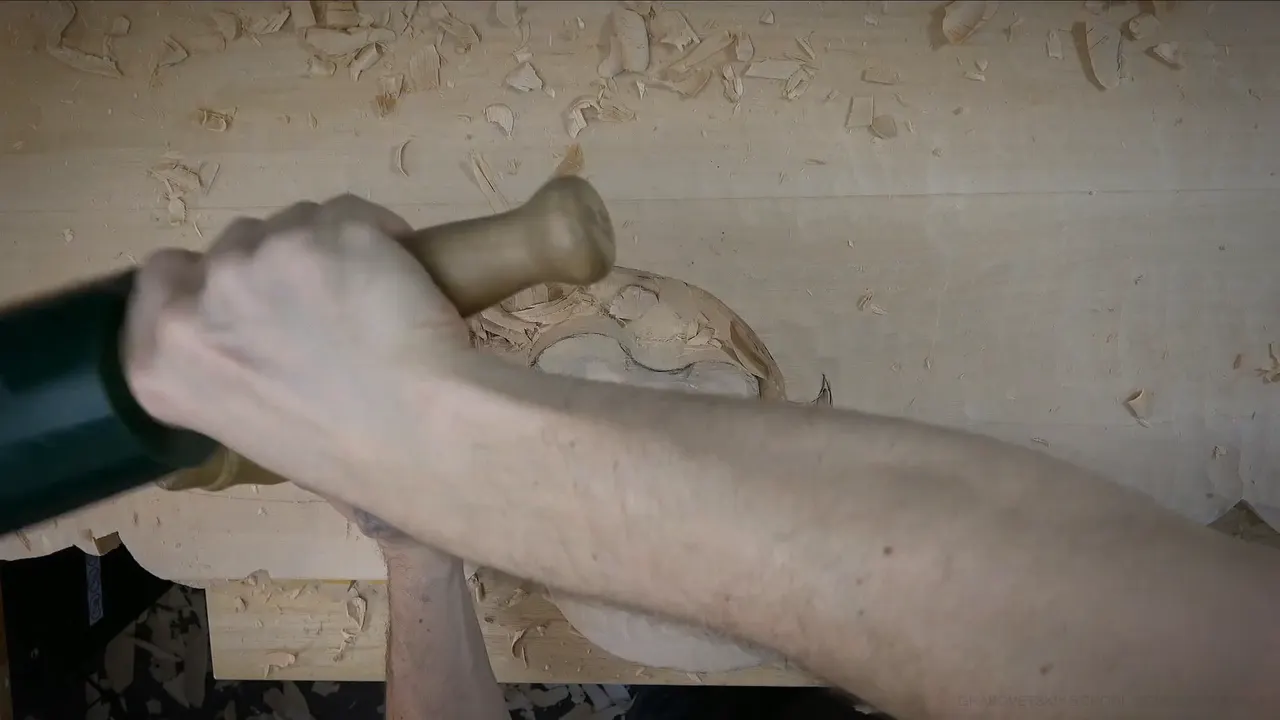

In part 3 of Venice Room 2 I called one shape "this claw," meant it to be higher than its neighbor, and said that neighbor goes under it. Other videos of mine carry the word too, on the Hashemi Flowers course and in the Lily Box. I link each lesson I name.
Ever heard me say claw and looked at an acanthus carving, trying to see one? Wondered if it is a real carving word, or only my habit? Here are the videos where I said it, with the lines around each one, and you can judge for yourself what I mean by it.
What do these videos say about a claw?
- How one claw rides higher while its neighbor goes under, at the close of part 3.
- The big shell of part 2 and the line that names its claw.
- Videos 6 to 14 of the same lesson.
- A claw that is also an acanthus head.
- The word in Hashemi Flowers, the Lily Box, Furniture Panel, Roman and Corinthian courses.
What did I say about the claw in part 3?
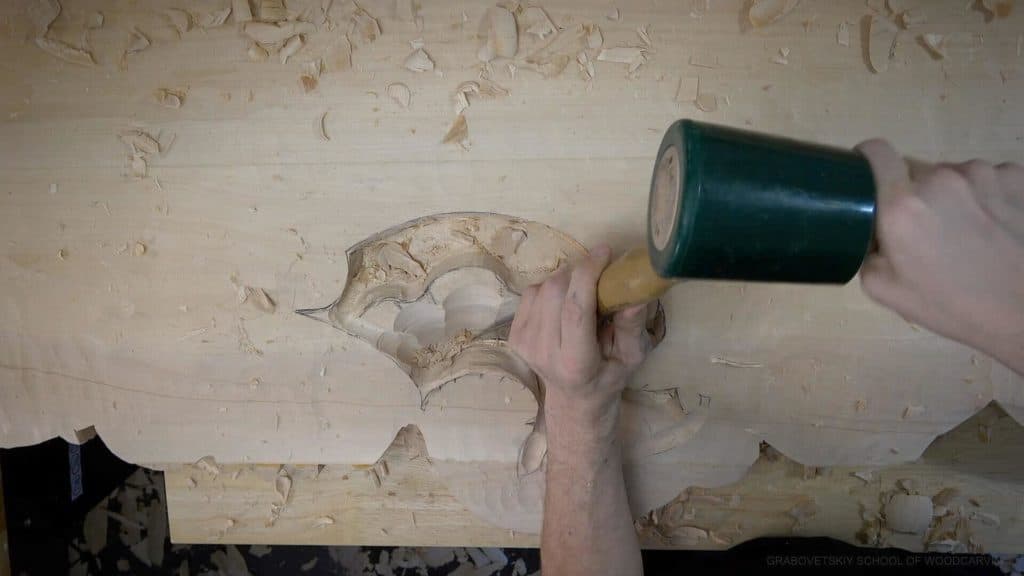
Near the end I say it plainly: "Now, this part, this claw, supposed to be higher than this part, okay?" The other side comes next. "But on the other hand, this part's supposed to go a little bit underneath." My reason sits right behind it. "Okay, because I have some kind of movement right there." Next comes a need, "So I need to make a separation cut." It is a need, not a finished cut.

How does part 3 get to that line?
It opens with a verdict. "Beautiful." Then, "Well, in my opinion, it is beautiful." My next need is to "outline right here and finish on this side because it doesn't look too good." Soon I say "I can actually go a little deeper right here, and outline like this" and later "Wonderful, except this. And I need to outline again."
My verdict on the cut is "I think that is enough." I put a number on it, about three-quarter of an inch, and say it is "about 20 millimeters" between "this point" and "that point." Twenty millimeters is about 0.8 in.

Cleaning comes first in my words, then I need to switch my tool. I plan to see which one is better. For the gouge I plan "a number nine and three-quarter of an inch spoon gouge" and that size is about 19 mm.
sharpening is next. "Okay, this one needs to be sharpened a little bit. That's exactly what I'm going to do." For the paste I say "just a blue paste, which is my favorite in this case." Then both faces of the bevel: "Outside bevel, and I'll do exactly the same on inside bevel." The inside gets another paste, in my plan. "But on inside bevel, I'm going to use a green paste." About that one I say "I don't really like the green paste because it gives a mess, produces a lot of mess." Then, "Okay, much better."

After that, "use again number seven 3 inches" (about 76 mm). Now the shape: "Now I need to fix the overall shape right here." It "should be a gradual movement overall." Then, "same right here, too." My verdict on the shape is "So it's not as it's supposed to look yet."

Next I say "Let me try to use straight down cut. And it is wonderful." That claw line arrives soon.

Why did I call a big shape a claw in part 2?
The video before this one is part 2, and it is where the word first shows up in this lesson. First comes a question, "how deep did I go?" The answer is approximately three quarter of an inch, about 20 millimeters, "and that's not enough." Later, "Now I've got about 25 millimeters wall, which is very good, I'd say." That wall is about 1 in.

Then comes the size of the shape. "Big shell. Huge shell." And a limit, in my words: "I have to make sure I'm not going too deep because I still have to have some meat, because even if I've got the six inches right here to the back, so I don't have that much right here." Six inches is about 152 mm. I also say "we did not establish the final look of this shell yet."
The line that names it follows. "That is going to be a big claw. That's how I call it. It's an acanthus movement." I say it will be unique, "Complicated, almost." A little after that, "And for this claw, for this acanthus movement, I really need the full depth, because I want to make it look really round." Both the limit and the full depth are mine, and both sit in this one video.

Which part rides above a claw, and which one goes under?
Video 6 of this lesson has the word on a movement. A part is "supposedly overlapping," so "I can actually get it deeper if I wish" and "I think it's a good idea to make it deeper." I name a part: "the main movement, the main claw. So which means this part can go underneath right there." A limit follows: "I'm not going to go all the way as of now" and "not on this side because I still need some meat right there, if you wish to call that way. Some material."

Video 9 has "another claw." Just before it, "Let me cut this part, and that way I'll know exactly the position of this future acanthus." Soon after it, "No idea what that line is, but anyway, let me cut the acanthus line." Those lines name an acanthus next to the claw, though I do not say the two are one shape.

The claw rides on top again in video 10. "And this claw has to be higher anyway, which means I could actually go ahead and just chop this side. That's going to go from underneath of the claw, and I can go really low if I need to." The tool I name for that is "number seven and 3 inches to chop that down just like that" and I add "what I mean by that, this has to go all the way underneath." That tool is 3 inches, or 76 mm.

Below lines is where video 13 puts the claw. I say I need to establish the claw, and that it will go underneath a line. My summary is that the overall movement must be below that line. An option follows, since I can "get big gouge and start digging in" with a number nine at "35 millimeters," which is about 1.4 in.

Is a claw really the head of an acanthus?
About my own word, video 14 has this. "And that has to be a claw, which means I can actually lower down quite a bit. A lot." Then I stop on the word itself: "By the way, I call it a claw, but it's not necessarily a claw. Okay? Not everyone calls it a claw. It's a head of the acanthus, to be more accurate."
Next comes the tool. "It's too bulky. And I could just use upside down number seven." I mean it as a plan. Before the claw line I said I would take 20 millimeters (4/5 in) and "just cut around."

Where else did I use the word in Venice Room?
In workshop 1, video 12, I say "I don't need to outline right now this notch." Then, "What I need, actually, just pretty much that big chunk. So it's going to be a claw. Okay? A claw, if you wish." Later in that video: "So that is a big shell."
How did I plan a claw in Hashemi Flowers?
In Hashemi Flowers 16, video 1, I start with a beak and then name it. "Let me work now on the beak. How I call it claw, because it look like a claw." I add that acanthus itself is called like a bear's claw. The divisions come next. "Let me refine the movements." The main divisions are three, and "Maybe I can place an eye and the pipe right here." Then, "This can go underneath."
A V tool comes next: "Number 16 and 6 millimeters, a quarter inch." A bigger idea comes next: "We can actually bring this one down underneath" and it is "going to just be underneath really deep." Further on I say "Let's make it deep" and "Let me attack from this side."

How big should the eye of a big claw be?
The eye is the job of video 2, "right here in this area." I name a number eight at "3/16 of an inch" (about 5 mm). Then, "Let's make it big." My comparison: "I usually use 1/8 of an inch for those eyes, but here is a big claw, and I think it's going to look good." One eighth of an inch is about 3 mm.
Concave cuts come next: "I need to make concave cuts right on the sides of this eye." Further on I say those concave cuts on acanthus leaves, "and especially on those claws," make beautiful shadow when the light hits.
What is a double-layered claw?
A plan for one is in video 3. "Now I need to take out that wall right here." The wall comes out so it "would look like full flip," but "on other hand, I want to create a movement on inside also." It will be "like a double-layered claw," I say. In my plan, wood comes out only from "this point down" and I will "keep this high reach up."

Hashemi Flowers 1, video 5, has a "return claw on inside," though, as I said there, it will not be visible. The space I left was "about eighth of an inch, but right here, I started to leave a little more, about maybe a quarter of an inch." That is about 3 mm, then about 6 mm.

Which claw did the Lily Box name?
In Lily Box 5, video 4, I give my reason for the word. "We call it claw." Then, "that part, I call it a claw because it has some subdivisions." Afterward I plan to "create that head of a claw" and add "Well, some people call it head, by the way. Head of an acanthus." Last comes a plan to "give a small undercut."

The work gets judged in video 5. "I'm kind of happy with this claw or this head." Later, "Maybe I started my claw or a head too far, and let me redo a little bit this section." Next line: "Okay, I think it's better."

Which other courses have the same word?
Furniture Panel 6, video 2, has it on a leaf. Next up is "work on details of this acanthus leaf" and then I name "my claw of the acanthus" as "the movement on inside."

In Roman Acanthus 1, video 2, the word comes with the plant. "Roman acanthus leaf is exactly the same like Greek acanthus, just more beautified." And "the idea is still the same. The plant is still the same. It's a bear claw or just the same plant, but development, it is just fascinating."

The Corinthian course says where the name points. In Corinthian Acanthus Leaf 1, video 1, I say "Acanthus itself, the name of it actually means a bear's claw." And right after that, "So it's a claw of a bear, of an animal. And it looks like that."
Which videos hold these lines?
This table lists each one and the claw line in it.
| Where | What I said about the claw |
|---|---|
| Venice Room 1, video 12 | Pretty much that big chunk, then a claw |
| Part 2 of this lesson | This big claw needs the full depth, for a round look |
| Here in part 3 | Claw meant to sit higher than its neighbor |
| Lesson 2, video 6 | The main claw, with its neighbor underneath |
| Venice 2.9 | Another claw, named near a line I had no idea about |
| Part 10 of lesson 2 | Claw on top, a chop from underneath possible |
| Venice 2.13 | Establish this claw below a line |
| Fourteenth video, same lesson | Called a head, to be more accurate |
| Hashemi 16.1 | Beak, which I name a claw |
| From Hashemi 16.2 | Big eye for a big claw |
| In Hashemi 16.3 | Double-layered claw, plus a movement inside |
| The Lily Box, video 4 | Claw because of subdivisions, head to some people |
| Lily Box, video 5 | Claw or head started too far, maybe |
| Furniture Panel 6.2 | My claw of the acanthus, a movement inside |
| Corinthian 1.1 | An acanthus name that means a bear's claw |
This lesson has its own page, lesson 2 of this course. The next lesson is Venice Room 3, and the first one is Venice Room 1. The whole course sits on the Venice Room course page. Each video named here is inside tuition to the school, paid monthly or yearly and renewed automatically until you stop it.
Never held a gouge? Start with first cuts for beginners. My tools have their own course, All About Tools for Wood Carving, and Carving Tool Sharpening is the course for edges. Wikipedia has short pages on wood carving, gouge, Venice, millimeters and inch.
How it's done
- Go deeper and outline. I said "a little deeper right here" was possible, and then outline like this.
- Measure the depth. I measured 20 millimeters (4/5 in) between two points and called it enough.
- Switch to a spoon gouge. A number nine spoon gouge, and a blue paste planned to sharpen it.
- Fix the overall shape. I named the number seven, 3 inches (about 76 mm), and said the overall shape should be a gradual movement.
- Set the claw above its neighbor. I said the claw should sit higher, and the part beside it under.
Frequently asked questions
Which claw did I call big in lesson 2?
My line in part 2 named a big claw. I added that it is an acanthus movement, and that for this claw I really need the full depth, because I want it really round.
Is a claw the same as an acanthus head?
Video 14 has my line: it's not necessarily a claw, and not everyone calls it one. To be accurate, I said, it is a head of the acanthus. In the Lily Box I said some people call it head.
What goes under the claw in lesson 2?
The part beside the claw goes under, I said in part 3. In video 10 I said I could chop one side, and that it comes from underneath of the claw.
What to carve next