
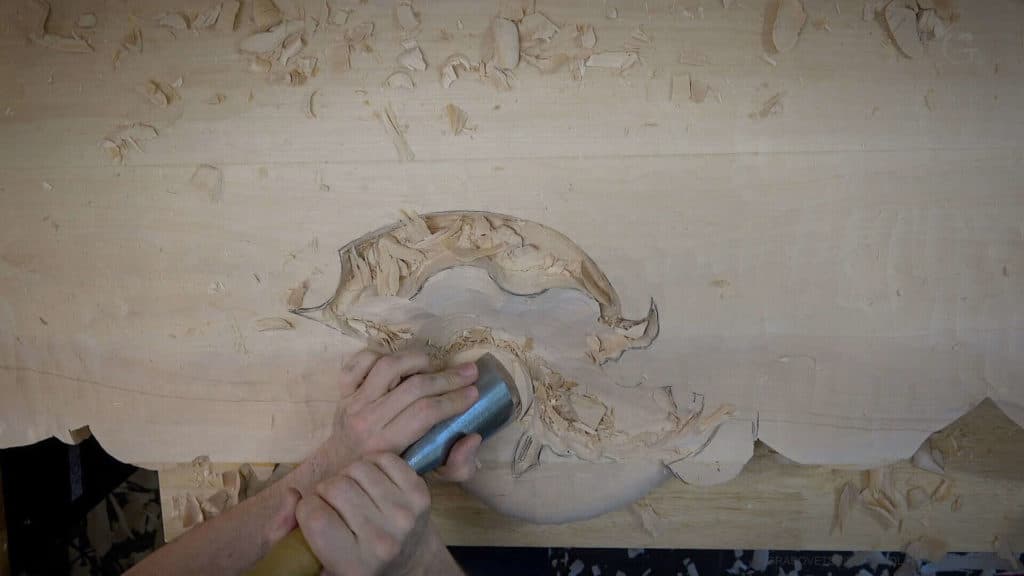
Alexander Grabovetskiy, woodcarver, School of Woodcarving · Published 2023
What does a wood carver mean by "productive"?
Quick answer: In part 5 of Venice Room 2, I said I'd rather skip small tools when I can, because I don't want anything to stop me to be productive. Other videos of mine use the same word with a drawer, a sharpening machine, and a live switcher.
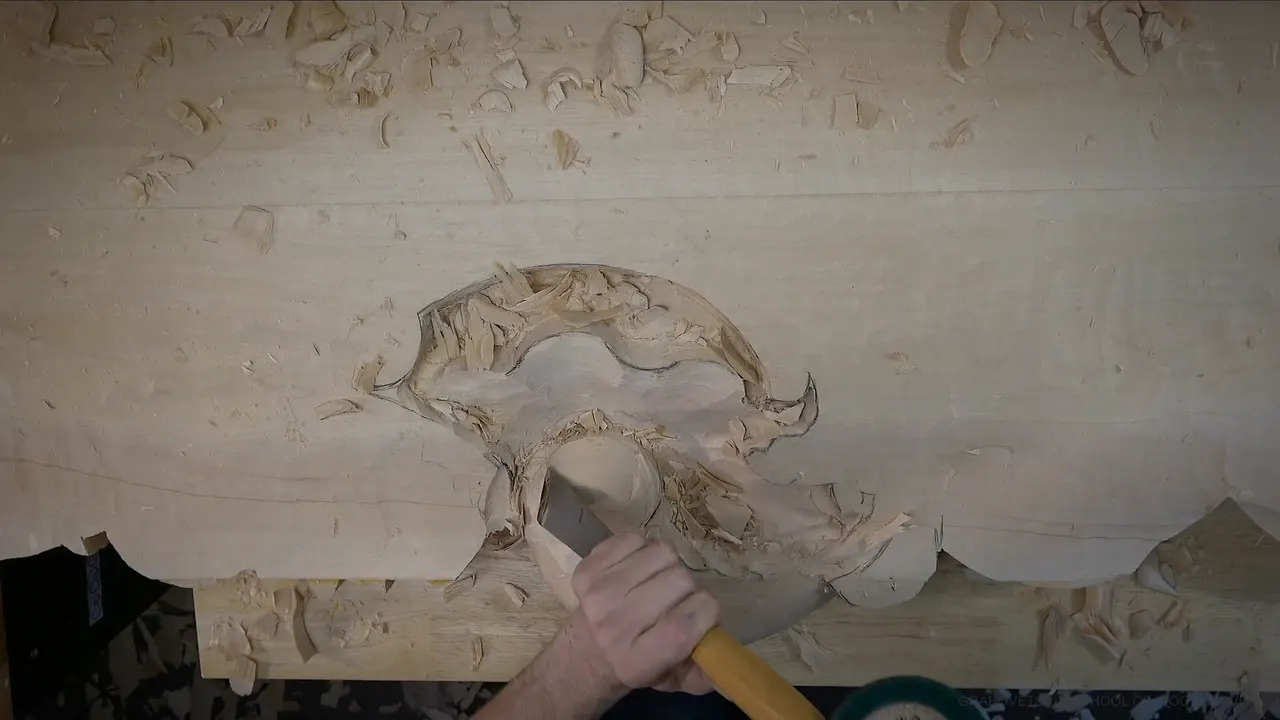

In part 5 of Venice Room 2, I said "If I don't have to use small tools, it's better not to use small tools, especially at this stage, because I don't want anything to stop me to be productive, okay?" That line sits in a short video where I name a lot of gouge numbers. Other videos of mine carry the same word beside a tool, a drawer, or a switch in how I film. I link every lesson I name.
Ever stopped carving to hunt for the right gouge? Did the wood just sit there, waiting, while you looked? Then you know what I am after. Below is what I said in this video, in the two beside it, and in lessons from other courses.
What this page holds
- The gouges I named in this video, from a flatter one to a number nine.
- The size I tried that fit perfectly.
- The same choice in videos 4 and 6, and a much quicker result in three more videos of this lesson.
- What I had in mind when I designed the job, from the lesson after this one.
- Lessons where I use the word productive, and lessons where I mention losing time.
Which gouges did I name in video 5 of lesson 2?
This short video has many gouge numbers. It opens on "But I need not to lose the overall idea." Next: "I need a flatter gouge." What could do it? "Maybe even number one in this case," I say, and "Or maybe two and a half."
"I really need to remove that part," I say. A plan follows. "Okay, let me use again number seven."

What did I say about the part that was on my way?
"Okay, and now I need to remove that. It's on my way." For that job, "let me think which tool I should use." My first idea is "Maybe I should use just a smaller number nine or number 11."
A size follows, "I'll use a number nine and quarter-inch" and a change of mind. "Actually, I need to use probably bigger than that. Quarter-inch is a little too small." A quarter-inch is about 6 mm.
The bigger size is "three-quarter," which I take to be three-quarters of an inch, about 19 mm. My plan for it: "I can use three-quarter and just go straight down."

What came after the line about small tools?
"Now I can probably switch to smaller one." It is a maybe, and next I say "But let me think which one." The size I try is "5/8 of an inch, 16 millimeters" and I want to see whether it fits. Five eighths of an inch is 15.9 mm, so 16 mm is right, and it comes to 0.63 in. Next: "And yes, it fits perfectly."

How did the next two videos handle the same choice?
In video 4 the same hunt starts. "Let me use number nine and 20 millimeters" is about 0.8 in. My verdict on it is "That's a little too big." I follow with "Let me see if I'll be able to fit number five" and the answer is "Yes. It fits perfectly." After that: "Let me get rid of that waste."
Further on I name a danger in plain words. "Okay, got to be really careful because it looks like I'm splitting all the way down, and I don't want to do that." Behind it comes "So I'm going to attack from two sides."

A correction sits in video 6. "And now I can use three-quarter of an inch. I'm sorry, three inches, not three-quarter of an inch, three inches gouge." Three inches comes to 76 mm.
For a mess I want to clear, I say "Number 9 or number 11 will work in this case." Near the end I name a size, "half an inch number 9" and add "I should use number 11, but it's okay." About 13 mm.

Where in lesson 2 do I mention much quicker?
Video 1 says it first. "And now I need to get the big gouge because it's going to give me a much quicker job." The tool is "my number seven" and I give its size both ways, "3 inches, 80 millimeters."
I weigh a rasp in video 7. "By the way, at this stage, I could use a big rasp." It "works fine," I say, "but I think I can do it without it." I follow with "Try to just use number three or number two, and it's going to give it much quicker result."
Then video 11 opens on a size, "The 35 millimeters number nine," close to 1.4 in. "That's going to help me make much quicker cuts." A little later: "Yes, much quicker, much better."

How does Venice Room 3 talk about the tools I have?
In Venice Room 3, the lesson after this one, I talk about my own choice of tool. "And yes, if you have that question and you notice that I'm using number seven and three inches a lot, the reason is when I was designing it, I had in mind the tool I have." Three inches is 76 mm.
The job comes next. "I needed to make sure I'm going to be able to do this job quickly and efficient." Next: "So also, if you are designing a certain job, keep in mind what tools you have." Last: "a tool which fits perfectly to the job" can "really expedite the process."

Where else does the word productive come up?
Carving Roman Acanthus 16 has it in video 2, while I stay with one tool. "I would like to use my tool as long as possible before I switch to another tool." A swap is possible, I say. "Of course, I could actually drop this tool and use right away the next tool for cleaning that, but that would not be productive." The surface gets a word too: "you can see it actually leaves a really, really nice and smooth surface."

Tools come up in Venice Room 76, video 5. "But I've got too many tools, which is not okay," I say. I go on with "I need to place them back where they belong. Otherwise, it just becomes too messy." "And when it becomes too messy, I am losing production," I say, and "I do lose production."
"So I'm spending time looking for tools." Also "I really can't see because all of the mess." With my tools in place, "I'm always much quicker able to find them." Then the word arrives. "So because I know the position of those tools in my drawers, now I become a lot more productive." I plan to "keep no more than couple tools" on my bench, and "at least I'll try."
The picks follow, and the first is "I'll use number seven." Next, "Number seven or number six will work."

A section that "takes forever" starts Venice Room 65, video 5. I tell you "I kind of don't like that it just takes me so long." Of the spot itself, "it's not that hard area, but because I was just streaming too much, I guess, I lost productivity."

The sharpening lesson on a skew bent gouge, video 2, puts the word beside a machine. "I love to do sharpening by hand, and that's absolutely fine if you do have enough time to resharpen all the tools and reshape all the tools," I say, "but it just takes so long." The machine gets "One minute on a really coarse grit" then "another minute on a finer grit" then an even finer one, "a 3,200."
"But I really like the idea you can do much quicker." For a living, "every minute you save, you can carve, more productive you're going to be." I say that about wood carving.

Filming gets the word in Lily Box 2, video 6. "But the reason why I switched to live switcher, because I do have a lot of projects going on," I say, "and if I would just shoot everything and just edit like I've done before, it just takes so long, okay?" Then comes "And I'm not as productive. But I have to be productive in projects for my clients and for the school."

Where do I mention losing time?
A piece I cannot turn is in Venice Room 53, video 5. "I'm carving against the grain, which is not the best idea, but sometimes I just can't change the position because this piece, particular project, I cannot rotate and I can't walk around my bench." Otherwise I would "lose too much time." My plain words follow. "I really don't want to lose time."

Letting a spot go for now is in Venice Room 14, video 5. "Okay, let me leave it for just now." After that I say "I can get carried away and lose focus" and "lose time."

Tools left out are the topic of Venice Room 25, video 4. "I am actually placing my tools back right away, pretty much." About tools left on a bench: "there's a moment when I can't even find the right tool because they all get mixed up," I say, "and that slows me down." Where they belong is "inside of the tool chest, in this case." My words go on: "I can always go back and grab the right profile, the right size, right sweep with no problem."

Markers get their turn in Lily Box 4, video 2. "That's one of the reasons why I'm using markers to mark my high and low spots." Working without marks: "And you're losing time, actually." With them, it is a "much quicker process once you do that."

Production work comes up in Carving Roman Acanthus 13, video 4. "Definitely when I'm doing a production work, I have to be much quicker, because I can't waste time, but I am more on the side of being more careful than rush it." My next words: "And when I rush, I have a tendency to make a lot more mistakes, and I break, and then I have to glue back, and that's not nice." A small tool shows up in that video too. "I'm using right now number three, just a small, tiny tool." It is "an eighth of an inch number three," which comes to about 3 mm.

Last, Venice Room 67, video 7. "I could actually do a bigger one, I guess. I think there's plenty of space for me to do a bigger one." Next comes "There is a big space. I don't have to waste time." I take "half an inch," about 13 mm, and say "I'm pretty sure it will" fit. And a limit: "It actually has a tendency to go deeper, and I don't really need to go deeper."

A tool I thought would save time is in Venice Room 56, video 5. I believe I could use one tool "at least at the beginning." Later I say I thought I would be "saving time," but "it doesn't look like I am." A fit problem follows: "I cannot fit big one." Then: "I can fit only about three millimeters, I'd say," close to 0.12 in. Even three is a "little too big."
Which videos hold these words?
The table lists each video and my words from it.
| Video | My words |
|---|---|
| Lesson 2, video 5 | Skip small tools when I can, I said |
| Part 4 of lesson 2 | Number nine at 20 millimeters, too big |
| Lesson 2, video 6 | A nine or an eleven will work here |
| Part 11 of lesson 2 | A number nine for much quicker cuts |
| Next lesson, video 1 | Tool that fits perfectly can expedite the process |
| Roman 16.2 | Using one tool longer before I would switch |
| Workshop 76, video 5 | Tools in drawers, and becoming more productive |
| Workshop 65, video 5 | Section that takes forever, and lost productivity |
| Skew bent gouge 2 | Sharpening by machine, with every minute I save |
| Lily Box 2.6 | Live switcher, and projects for my clients |
| Venice 53, video 5 | Piece I cannot rotate, and lost time |
| Venice 14, video 5 | Getting carried away, losing focus, losing time |
| Venice Room 25, video 4 | Tools left out on a bench slow me down |
| Lily Box 4.2 | Markers on high spots against losing time |
| Roman 13.4 | Production work, quicker, yet more careful than rushing |
| Venice Room 67, video 7 | Bigger number nine because there is space |
| Fifth video, workshop 56 | Tool I thought would save me time |
This lesson has its own page, lesson 2 of this course. The whole course sits on the Venice Room course page. Each video named here is inside tuition to the school, paid monthly or yearly and renewed automatically until you stop it.
Never held a gouge? Start with first cuts for beginners. My tools have their own course, All About Tools for Wood Carving, and Carving Tool Sharpening is the course for edges. Wikipedia has short pages on millimeters, inch, Venice and productive.
How it's done
- List the gouges you might use. In this video, I listed a number one and a two and a half as maybes, with a number seven as my plan.
- Test a size. I tried one size and said it fits perfectly, after another size looked too small.
- Leave the small tools alone. Small tools could wait if I did not have to reach for them, I said, and I could probably switch to a smaller one after.
- Put the tools away. My tools go back right away, inside the tool chest, I said.
- Use the bigger gouge when space allows. There was a big space, I said, and I did not need to waste time.
Frequently asked questions
Which gouge fit in video 5 of lesson 2?
A quarter-inch (6 mm) number nine looked a little too small to me. I tried 5/8 of an inch, 16 millimeters (0.63 in) instead, and my words were that it fits perfectly.
Which tool did I name for the part on my way?
A smaller nine or an 11 came first, then a quarter-inch size that I called too small. A bigger one, three-quarter, could go straight down, I said.
Which small tool shows up in Roman Acanthus 13?
Number three, an eighth of an inch (about 3 mm), which I called just a small, tiny tool. In that same video I named mistakes and breaks from rushing, and then gluing back, and I said that is not nice.
What to carve next