
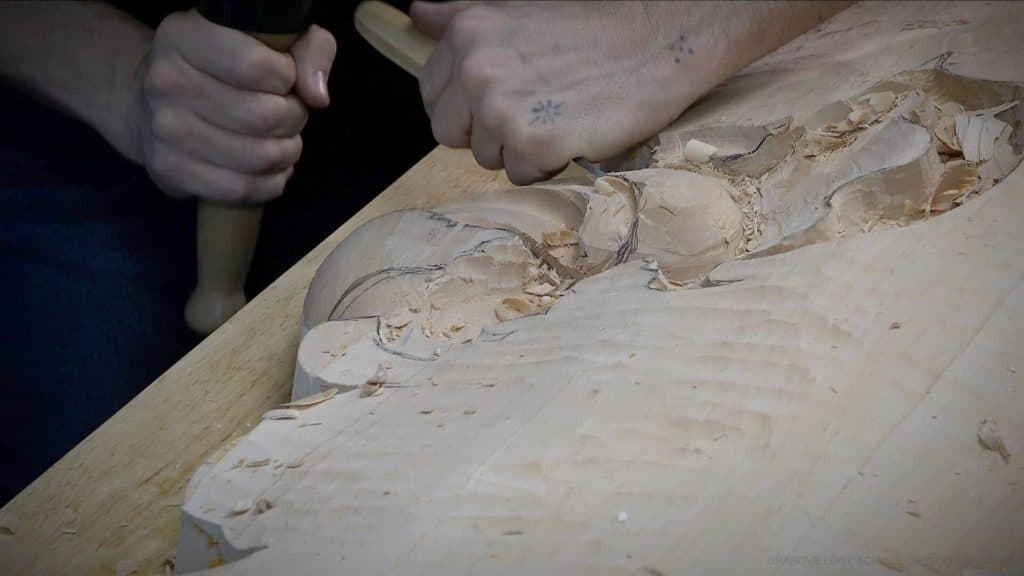
Alexander Grabovetskiy, woodcarver, School of Woodcarving · Published 2023
What does a wood carver mean by "looks okay"?
Quick answer: In lesson 2, part 7, I call a spot okay "at least to that point." In other lessons of mine the same verdict comes with far-off, low and high views, a screen and a sheet of paper. The table at the end lists every video I quote.
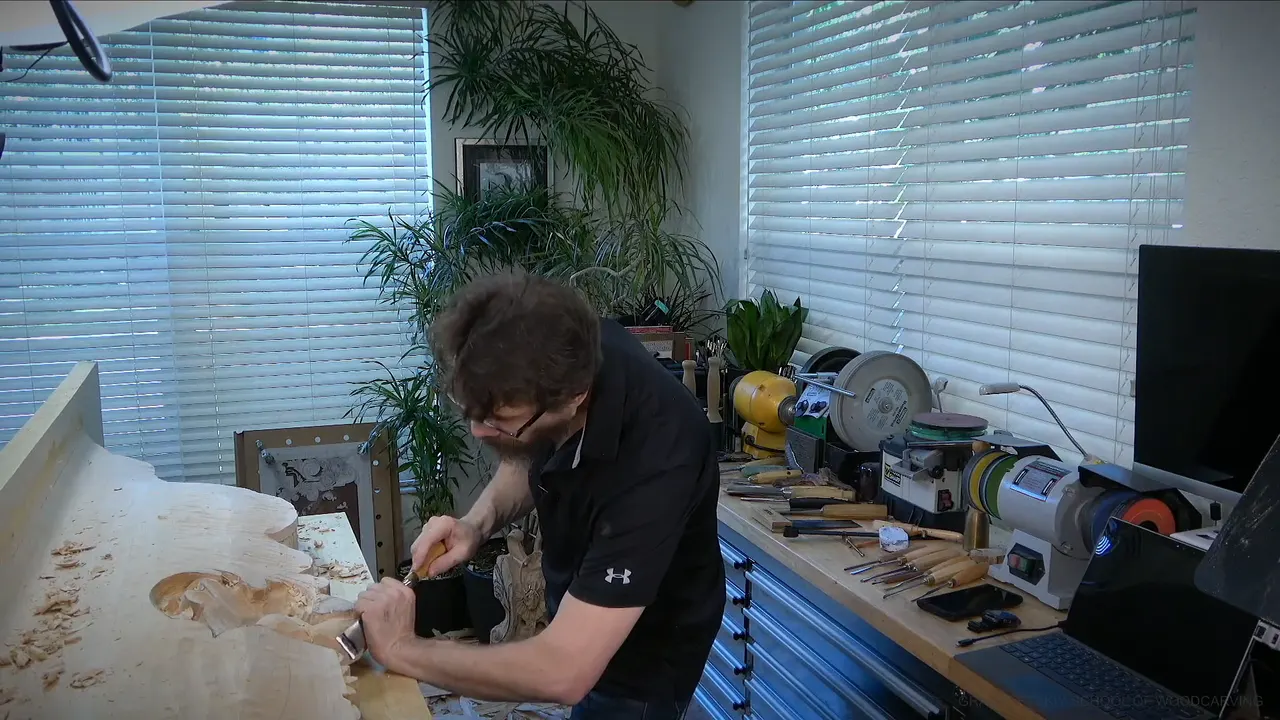

Part 7 of Venice Room 2 is where I say a spot "looks okay" while I keep checking my movement. Other lessons of mine put the same words beside a look from afar, from below, from above, on a computer and on paper. Each lesson I name is linked, and a table near the end sums up the words.
Ever looked at your own carving, felt it was fine, and then seen something off from the other side? Did you carve on anyway? Then you know the spot I am in, in these videos. I say what I see out loud, and I pick up a gouge.
What this page holds
- The seventh video of lesson 2, with what I say around the words I just quoted.
- Number nine, a half inch, and a look from another angle.
- Lines from parts 5 and 6 that sit on either side.
- Videos from Venice Room 5 to 127 and from five other courses and a livestream that carry the same words.
- A table at the end that lists them.
What did I say in part 7 about how it looks?
The video opens on a side view. "So really important for me to look from the side," I say. Then: "it could look really nice from above, but three-dimensional movement supposed to also in three dimensions just move nicely." If a movement needs a fix, I say, "so I would do it."
Next comes a spot I do not like: "For example, I really don't like how it looks right here." Later, a step farther away comes later, to check again how overall movement works. Then: "And in this case, it looks okay, at least to that point."

The next words set a new line: "Now I'm going to reestablish my line and use again the same number nine. Number nine and half an inch." That half inch is 13 mm. More care comes next, and I say "I'm still not undercutting anything, I'm just setting in overall picture."
Another angle is offered: "Maybe you're going to be able to see better from the different angle." What it shows: "See, it just gradually moves up." A doubt comes with an idea: "I think I should do something like that." I admit something. "I know it doesn't make sense for now what I'm saying, but it's okay, it will make sense."
Next, "Number seven." Then: "I need to use something smaller now, like number five." A verdict follows: "Now it looks much better, but I still don't like how this one is shaped." Later, "Now it's much better" and my plan is to go underneath one shape. Before that, the shape needs a fix, since "right now it doesn't look too appealing, especially I've got some rough spots."

For the clean-up I name a smaller sweep, and I say I will use a mallet: "Let me use maybe number three. And even number three is a little too big of a sweep right now." Then "Let me use number two or two and a half actually, to be exact."
A rasp gets a mention too: "By the way, at this stage, I could use a big rasp. I didn't use those big rasps before, but okay, let me try it." Afterward: "And yeah, it works fine, but I think I can do it without it. Try to just use number three or number two, and it's going to give it much quicker result."
Two verdicts arrive: "And it looks good" and "Okay, wonderful." Going underneath is the plan: "So now I can go underneath right there." The tool I name is a quarter inch (6 mm): "I can actually use a small quarter-inch number nine. Because this part is going to go deep underneath." The last words I say in the video are "And that is enough for now."

What sits right before and right after in lesson 2?
Part 6 ends on "And I need to see it from all the positions." The fifth video of the lesson begins with "But I need not to lose the overall idea." Lesson 2 keeps returning to how the movement looks.
How does it look from far away?
Afar comes first, over in workshop 5, part 4, where I work a line with a number nine: "Again, I'm not going to touch beyond that line." A double-check is on the list, "how nice it looks from afar" and the call is okay, then "It looks fine." Next: "Now I have to be more careful with my cuts to number nine."

An eye gets the same word in workshop 7, part 11. The position has to be "logically right," I say, and a doubt comes: "looks like I do have to move it slightly." Then I take it back: "Well, actually, no" and the eye is okay, "And it looks good there."
My next question is "Should I do the big eye or small one" and my plan is a quarter-inch eye, 6 mm. Also: "I really like, actually, big acanthus eyes. I think they look really good." A 3 millimeters number 11 is on my list after that, about 0.12 in.

What does a view from below or above change?
Below changes my answer in workshop 12, part 6: "From the bottom, it's actually looking really good." Looking straight at it is not too appealing, in my words, while from below, okay, though "I probably have to break it slightly." And it is "just a little too sharp."

Workshop 127 puts the idea in general terms: "to look from different points of view." My example: "From above, it could look okay, but when you look from the side, sometimes it looks like you have to change something." A line has to move a little bit, I say.

Part 1 of workshop 132 speaks to a viewer. For you, I say, it would not be lost, since from above the answer is okay. Then: "from different angle, you can see a little differently."
Acanthus over Moldings 10, part 2, echoes the side view of lesson 2. Seen from above, a part "looks okay," while the side gives another answer: "it does not look, okay." My need: "to make sure it just goes really nicely downhill." A side view is "really important if you're working in 3D," I say.
Lily Box 8, part 2, brings a limit. I give it an okay, but "not exactly the way I wanted to see." Seen from above, the transition is not as nice, as I put it, and "I'm not too happy."

One spot stays wrong in workshop 16, part 11. First I say "It still doesn't look like I want to see it." From one point the word is okay and fine, "but it still doesn't." And then: "For some reason, it's just not good." Maybe a small chop on that side will change it, I say.

How do paper and a screen fit in?
Paper comes first, in workshop 75, part 10, where I tell why I changed a design: "It doesn't change overall movement. It just changes minor details. And yes, once in a while, I have to do that because on a paper, sometimes it looks one thing, but in real life, it just doesn't look too good. It looks okay, I would say, but it's not excellent. And I really want to aim for excellency."
A screen behaves the same way in workshop 92, part 8, where a panel area gets a new design. The original is okay on the computer screen, I say, "but it doesn't really look good in real life." It is too small, and it has to be bigger.

What follows the word okay?
A fix can follow, as in workshop 17, part 5. One spot is okay "right there" and the next is another story: the plan is to "chop this side." A bit later: "And now this bridge I created looks much better."
Workshop 43, part 8, goes spot by spot. For one: "We have to add some of the movement this way." Then, of the next, "that one look okay." After that, the plan is "a couple separation cuts, outline cuts" and "probably 15 millimeters, number 11" first (about 0.59 in).
A long line shows up in workshop 55, part 7: "Let me see how that line is fluent." The line is okay, though "I don't really like this development." About the original plan I say "Originally, the overall movement's supposed to go like that." My idea now: "Maybe I will have to incorporate this movement in the main."
Sometimes a dislike follows. In workshop 35, part 6, the call is okay overall, "but I think maybe I've got too many separations in one spot" and "I kind of don't like it."
A rule comes before a verdict in workshop 93, part 6. First: "much better separation in this section. Otherwise, it's not looking good." After that, "That looks okay" and the next words are about a concave: "I can actually carry that concave all the way around." It will not be as deep in this area, I say.


And sometimes a hope follows. In workshop 74, part 6, I am not sure how nice it will look, and I say "I hope it's going to look okay."
A size can follow too, in workshop 21, part 6. A straight number 11 comes up again, with "maybe about 15 millimeters, 5/8 of an inch" in mind. That is 15 mm (about 0.59 in), and 5/8 in is 16 mm. Then "if the straight is not going to work, I'm going to switch to a spoon." Okay so far is my word, "fine, actually." A caution comes too: pushing too much risks a mistake, I say.

Furniture Panel 21, part 7, has it as well: "as of now, it does look okay." Then "But I don't like the ruggedness" and my idea is to "attack it somehow" with "number 23 and 4 millimeters" in mind (about 0.16 in).

Two spots in a row sit in workshop 100, part 4: "Looks okay right here. And it does look okay here too." Fuzz is covered by a plan: "if I do have some kind of fuzz, some kind of mess inside, I can go back with the number 11 and clean it a little bit."

Which other meanings does okay carry?
The word moves around. In Carving Modern Acanthus 7, part 1, I talk about smooth blending in fine art. I call it okay, and then: "for me when I see a brush mark, it looks better." In Carving Greek Acanthus Leaf 6, part 2, it is about where a line sits: "if I would put that right in the middle, it would look okay." My wish: "I would like to be offset of the middle."
Time enters the April 2020 livestream, where I describe a spoon gouge with a heel. The look is okay at the beginning, I say, "but later on, like a day later or two days later, those fibers, they're puffing back."
Which videos hold these words?
This table lists the videos and the words that sit next to "looks okay."
| Venice Room video, or the course named | The words beside it |
|---|---|
| 2.7 | Okay up to a point, and a new line with number nine comes next |
| 5.4 | A double-check from afar: okay, then fine |
| 7.11 | Maybe I move the eye, no, and it's good there |
| 12.6 | Good from the bottom, okay from below, with a slight break probably needed |
| 16.11 | From one point, okay, yet not what I want |
| 17.5 | Okay right there, then a chop planned on the next spot |
| 21.6 | Okay so far, and fine, actually |
| 35.6 | Okay overall, but too many separations in one spot |
| 43.8 | That one is okay |
| 55.7 | An okay line, with a development I don't like |
| 74.6 | A hope that it will look okay |
| 75.10 | Paper says one thing, the real piece is okay but not excellent |
| 92.8 | Okay on the screen, too small, so bigger |
| 93.6 | That is okay |
| 100.4 | Okay in two spots |
| 127.1 | Okay from above, then another view calls for a line to shift |
| 132.1 | A viewer would not lose it from above |
| Furniture Panel 21.7 | Okay as of now, with ruggedness I dislike |
| Acanthus over Moldings 10.2 | Above it is okay, sideways it is not |
| Lily Box 8.2 | Okay, but with a limit in my own words |
| Modern Acanthus 7.1 | A smooth blend is okay, a brush mark looks better |
| Greek Acanthus 6.2 | Okay in the middle, offset is my wish |
| Livestream April 2020 | Okay at the beginning, and a day or two later the fibers puff back |
This lesson has its own page, lesson 2 of this course, and Venice Room 3 picks up where it stops. The whole course sits on the Venice Room course page. Each video named here is inside tuition to the school, paid monthly or yearly and renewed automatically until you stop it.
Never held a gouge? Start with first cuts for beginners. My tools have their own course, All About Tools for Wood Carving. Wikipedia has short pages on wood carving, Venice, millimeters, inch and acanthus.
How it's done
- Check a different view. I say a look at the work from its side matters to me, because a movement has to move nicely in three dimensions.
- Name the spot you dislike. I tell you I dislike how one spot looks.
- Reestablish the line. The plan: the same tool once more, at the half inch I named (13 mm), with more care.
- Offer another angle. I offer another angle, and from there it just gradually moves up.
Frequently asked questions
Where in this lesson does a spot get called okay?
In part 7, after I say I dislike one spot and that a step farther away comes later.
Which plan came next?
A new line: "reestablish my line and use again the same number nine," at half an inch (13 mm), with more care.
Does "looks okay" mean I stop?
In the lines I quote here, other words follow: a chop on the next spot in workshop 17, and a slight break in workshop 12.
What do I say about looking from above?
What to carve next