
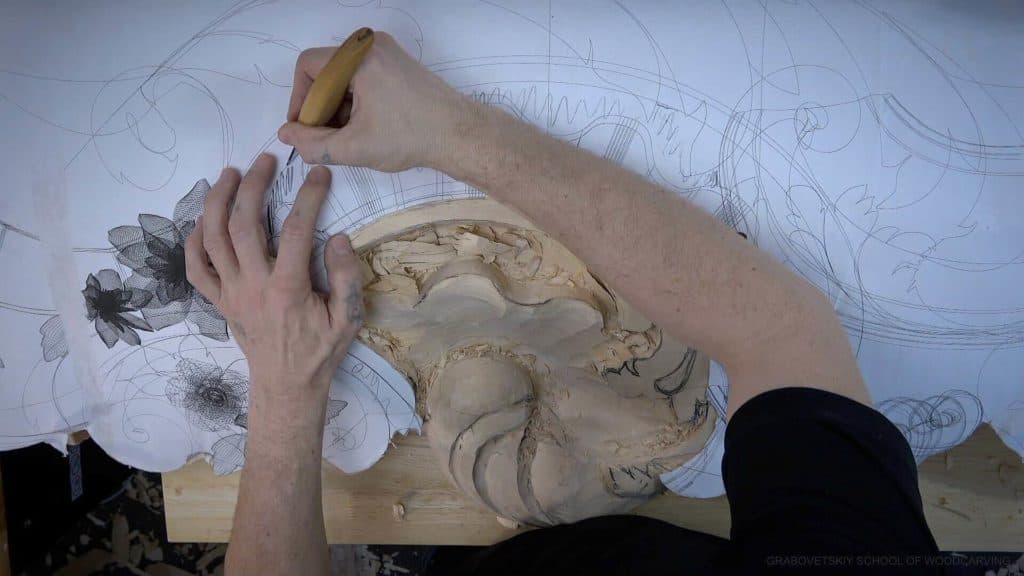
Alexander Grabovetskiy, woodcarver, School of Woodcarving · Published 2023
What does a wood carver mean by a "flow line"?
Quick answer: Part 9 of lesson 2 has me looking at my work from every side, and part 10 has me talking about losing a line. My other lessons use the same words beside a center line, a bump on an edge, a run downhill and a line nobody can see.
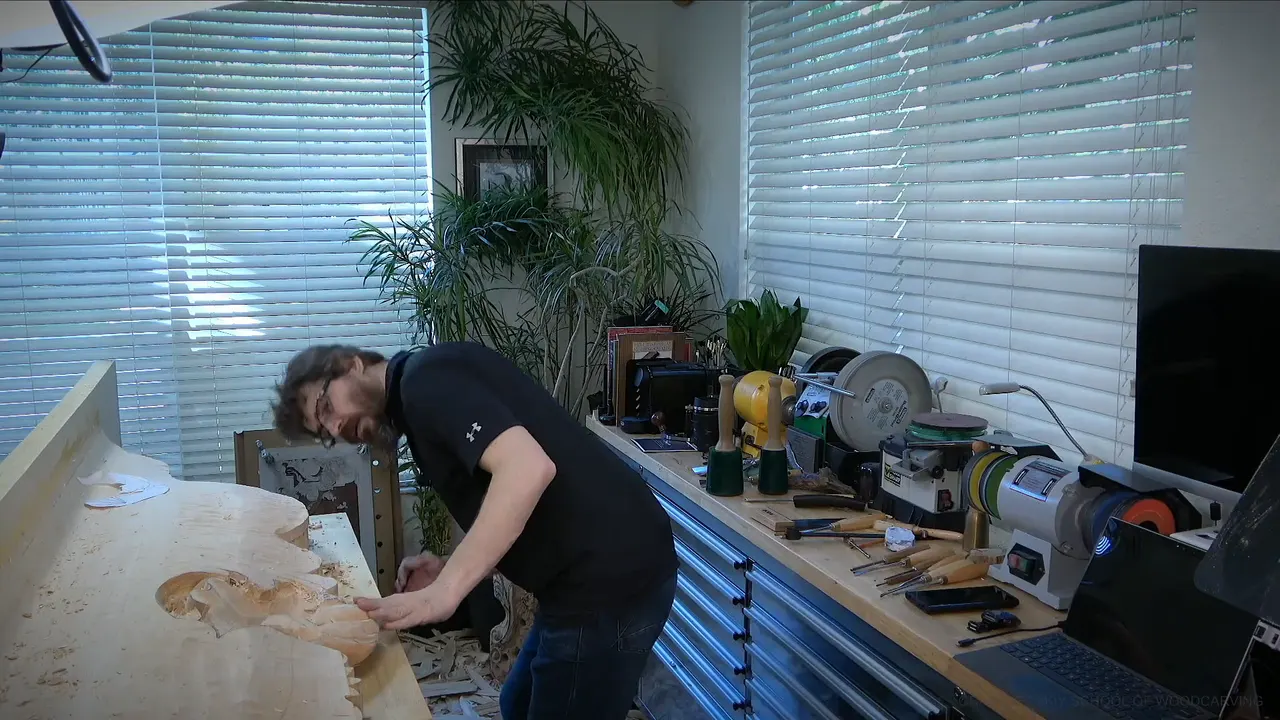

In part 9 of Venice Room 2, I said a part needed to flow better, and in part 10 I said "we're kind of losing a flow line." Other lessons of mine use the same two words beside a center line, a bump on an edge, a run downhill and a line nobody can see. Every lesson I name is linked, and a table near the end lines them up.
Ever stood over your carving and felt one curve was off, without knowing which cut would fix it? The rule for that is in part 9.
What this page holds
- Lesson 2, part 9, with a bump I see when I look from a side.
- In part 10, a line I leave alone for now.
- The same side look in part 7, said in longer words.
- Videos from my cutting board, acanthus, Hashemi, lily box and hazelnut courses with the same two words.
- A table at the end that lines them up.
What did I say in part 9 about flowing better?
Part 9 opens on the side view. "When I look from a side just like that, I see that this bumps too much, and that's just no good." I add "So I need to take care of this part." The rule comes right after: "Again, really important for me to look from all the sides, and if I need to take care of something, it's better to do it right away."
My next words are "Let me use opposite direction." Then "Okay, let me see again. Okay, that is much better." After a half sentence I say "But I should leave it like that." Next is "I want to outline probably this, okay? That way I'll see overall picture." My verdict at that point is "So far, I am happy with the results."

"It's a little bit confusing for me," I say. Then "let me cut this part, and that way I'll know exactly the position of this future acanthus." Of one line I say "No idea what that line is, but anyway, let me cut the acanthus line."
I even apologize. "I'm sorry if I'm just mumbling," I say, and then "Like I promised, that is a real work for me, it's not like I'm trying just to do a lesson or something." And "Yes, it is a lesson. You can use that for all types of carving, but it's not like a normal way."

Next comes a change. "I've got lots of different movements, but I think I have to change a little bit something. For example, I don't like this detail right here, and I can make this part of acanthus as a part of this movement, okay, so that would look nicer in my opinion, okay? And also this has to be flowing better, and that is going to go right there. Okay, that is good."

I say "I can actually put more details if I need to." Then "It's supposed to go all the way" and "Oh, I'm off that slightly, so it has to go this way."

A plan comes after that. "So in this case, what I could do, I could just cut the cavity out."
What do parts 7 and 10 add?
Part 7 gives the rule in longer words. "So really important for me to look from the side, what I mean by that, it could look really nice from above, but three-dimensional movement supposed to also in three dimensions just move nicely. So constantly, I'm just checking from my side." The tool comes next, "number nine and half an inch," which is 13 mm. Then another angle: "See, it just gradually moves up." I also say "I'm still not undercutting anything, I'm just setting in overall picture."

The Hashemi course has the side look too, in lesson 2, part 3. "I'm just looking sometimes just from the side, and if I'm happy with the flow line, then I'll continue to work on it."
The phrase itself sits in part 10. Before it I talk about space. "I need to make sure this has enough space for me to work, I need to probably move it a little closer, this space is too little." Then a figure, 13 mm: "maybe even more, about half an inch space."
The tool is "three-quarter of an inch, and that's number nine," which is 19 mm. Later, "I should use probably bigger number nine." Of one position I say "Yes, I should change that position, but it's okay because I still have to make my overall three-dimensional movement of this, so I'm okay."

The phrase follows. "But I need to fix overall movement because we're kind of losing a flow line, but I'm not going to touch it for now. I still have to excavate much deeper right here for the future shell." I put the fix off, and the next words are about the future shell.

This lesson has its own page, lesson 2 of the Venice Room, and workshop 3 comes next.
Where does every flow line go?
Workshop 4 of the curly cutting board course says it in plain words, in part 4, where I say I need to make sure "my lines are really clean and my flowing is really good." Then: "When I'm saying flowing, almost every line should go to the same line, so that is called flow line. Okay?" And it is "one of the really important rules in wood carving, especially ornamental."

A redraw opens Carving Corinthian Acanthus 3, part 3. "I see my main movement," I say, and then "I call it the main flow line right here." And "That is my center."

Carving Greek Acanthus 1, part 2, has me dividing a leaf. "I'll follow this flow line," I say, "and I'll subdivide it right here." Then "every center line goes to the center flow." About one of them: "You can see it's not flowing really nicely, so I have to kind of fix it and make sure it flows better." A little later: "So those are my main flow lines." Part 3 of that lesson has "Everything goes to the same flow line."

Carving Roman Acanthus 1, part 1, has the same words. "To do symmetrically, I have to establish also my flow lines and my main points of my leaves. So everything in the flow lines, they have to just, all flow lines, they have to go to the center or to the same line, to the same movement."

"I call it flow, F-L-O-W, because it's like a flowing all together." That is from the cutting board course too, workshop 14, part 4.
And when a line looks wrong?
In Hashemi Flowers 14, part 8, I am cleaning a ribbon and I say "Okay, I don't like the flow line." After that, "Okay, looks better" and a little later "So the flow line is good."

Hashemi Flowers 18, part 4, has a need: "Now, I kind of have to fix my flow line. But let me think first what I can do right here." What I could do, I say, is "make this leaf go right above that part."
Hashemi Flowers 11, part 8, has it too. "I still don't like the overall flow line. I will have to look from different points of view and fix that flow line." In the Venice Room I said it is really important to look from all the sides.
The Venice Room has the same words in workshop 9, part 5. "I don't like how it's moving, okay, so I don't really like my flow line. Yes, I can fix it, it's not a big deal." My plan is "let me get a bit bigger number nine." Then "Maybe about 10 millimeters right here" (0.39 in), "because I really want to go all the way to the edge, but I don't want to go deeper."

Lily Box 3, part 2: "I'm not too happy about flow line of this leaf because you can see it just jagged, it's not really nice." Then "Let me get bigger numbers. Number five."

Which gouge fixes an edge that does not flow?
In Hashemi Flowers 20, part 2, I look at a leaf and say "it doesn't look like my edge is actually flowing. Okay? So I need to fix that flow line, and the easiest way would be to find matching gouge to the edge."
I test a number eight: "Maybe number 8 is going to be too big. No, number 8 is actually perfect. And just place that straight down and carefully make your cut straight down." Then comes "how I call it, perfect flow line." My tool is "a number 8 and 1 inch," which is 25 mm.

Carving Greek Acanthus 13, part 4, names a knife. "I'll come back and I'll refine all outer lines to make them look like the true flow line." Then a figure: "there is a difference about 1/16 of an inch" (1.6 mm), "and that's like a bump, and I don't like it. So let me just take a knife."

In Furniture Panel 21, part 7, a number seven goes in. "Number seven actually works perfectly, and this number seven is huge." Then "Inch and a half, number seven." That is 38 mm. Then "it just fits perfectly" and "it just gives me a really nice flow line."
Over in Hashemi Flowers 15, part 5, I talk about removing a triangle and say "It's still going to have an inner flow line." Next, "Let me see if I can fit number seven."
Back to the cutting board, workshop 14, part 4. This is a plan: "This line should flow continuously, but I do have some spot right here which is not that nice. What I'll do, later on, I'll check everything, and I'll just recut with a single pass until I'll make this like a same continuous flow line."
Can a flow line run downhill or stay invisible?
In Greek Acanthus 14, part 3, my words are "So I'm talking about downhill flow line." In Floral and Molding for the Panel 11, part 1: "Unfortunately, you don't see what I'm doing underneath. Pretty much I'm just establishing overall flow line, and there is no way I can show that to you with the camera. But just to guess, I'm just making that really smooth transition downhill."
The Venice Room part 3 course, workshop 32, part 10, has "a really, really nice flow line, invisible one. So the position of my eye has to flow together." And I plan one in Furniture Panel 20, part 3: "now I can just create the middle line, and I can use just a pencil probably, and create a really nice and beautiful flow line."

Two videos speak of a flow line that is not final. In the lily box course I say, in workshop 3, part 4, that a leaf is part of a main movement "and it's going to go with the flow line. Okay? It's not going to be true flow right here, but still, as much as I can, I'll do it." And in the hazelnut course, workshop 7, a stem will "flow much nicer. It's not the final flow line."

Which videos hold these words?
This table lists the videos I read for this page, with the words that sit beside it, video by video.
| The video, and the course that holds it | Words beside it |
|---|---|
| Venice Room 2-9 | Flowing better, and it goes right there |
| Lesson 2, video 10 | Losing it, and not touching it for now |
| Cutting board 4-4 | Almost every line, the same line |
| Cutting board 14-4 | Recut with one pass, one continuous line |
| Corinthian Acanthus 3-3 | The main one, and my center |
| Greek Acanthus 1-2 | Every center line, to the center flow |
| Roman Acanthus 1-1 | All of them, to the center |
| Lily Box 3-2 | Not too happy, it looks jagged |
| Hashemi 20-2 | A matching gouge to the edge, perfect |
| Greek Acanthus 13-4 | The true one, and a small bump |
| Hashemi 14-8 | I don't like it, then it looks better |
| Venice Room 9-5 | I can fix it, with a bigger nine |
| Greek 14-3 | Downhill |
| Venice 32-10 | A nice one, and invisible |
| Hazelnuts 7-1 | Not the final one |
The whole course sits on the Venice Room course page. Each video named here is inside tuition to the school, paid monthly or yearly and renewed automatically until you stop it.
Never held a gouge? Start with first cuts for beginners. My tools have their own course, All About Tools for Wood Carving, and Carving Tool Sharpening is the course for edges. Wikipedia has short pages on wood carving, millimeters, hazelnut, mallet and relief.
How it's done
- Check the side view. The side view opens part 9, and the rule I give comes right after it.
- Change a detail you don't like. One detail was not to my liking, I said, and I could make that part of acanthus a part of the movement beside it.
- Say where the line goes. Next I said a line had to flow better, and that it goes right there.
- Leave a line you may lose. Over in part 10, I said I'd leave a flow line for now, with the shell still to dig.
Frequently asked questions
Which part of lesson 2 has the words flow line?
The answer is part 10, where I told you I'd leave it for now, and that I had more digging to do for the future shell. One video earlier, part 9 has my words about a line that had to flow better.
Where did I say a flow line looked wrong to me?
Two videos have it, Hashemi Flowers 14, part 8, and Venice Room 9, part 5. The second has me saying it's not a big deal, and that I'd get a bigger nine, maybe about 10 millimeters (0.39 in). The first one came out good: "So the flow line is good."
Which tool did I name for a bump?
For a bump of about 1/16 of an inch (1.6 mm) in Greek Acanthus 13, I said I'd take a knife. A number eight, a gouge of 1 inch (25 mm), was the match in Hashemi Flowers 20 for an edge that was not flowing.
What to carve next