
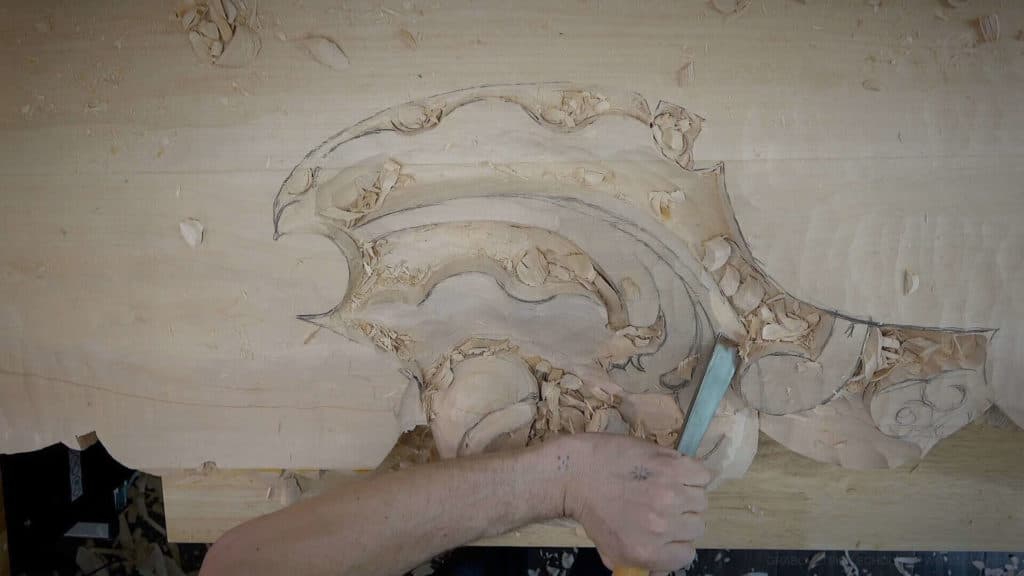
Alexander Grabovetskiy, woodcarver, School of Woodcarving · Published 2023
What does a wood carver mean by "the next detail"?
Quick answer: In video 3-1 of the Venice Room I propose the next detail, followed by a plan to establish "this one right here." Other lessons put the same words beside a convex, eye placement, leaf curls and cleaning, and I name each one.
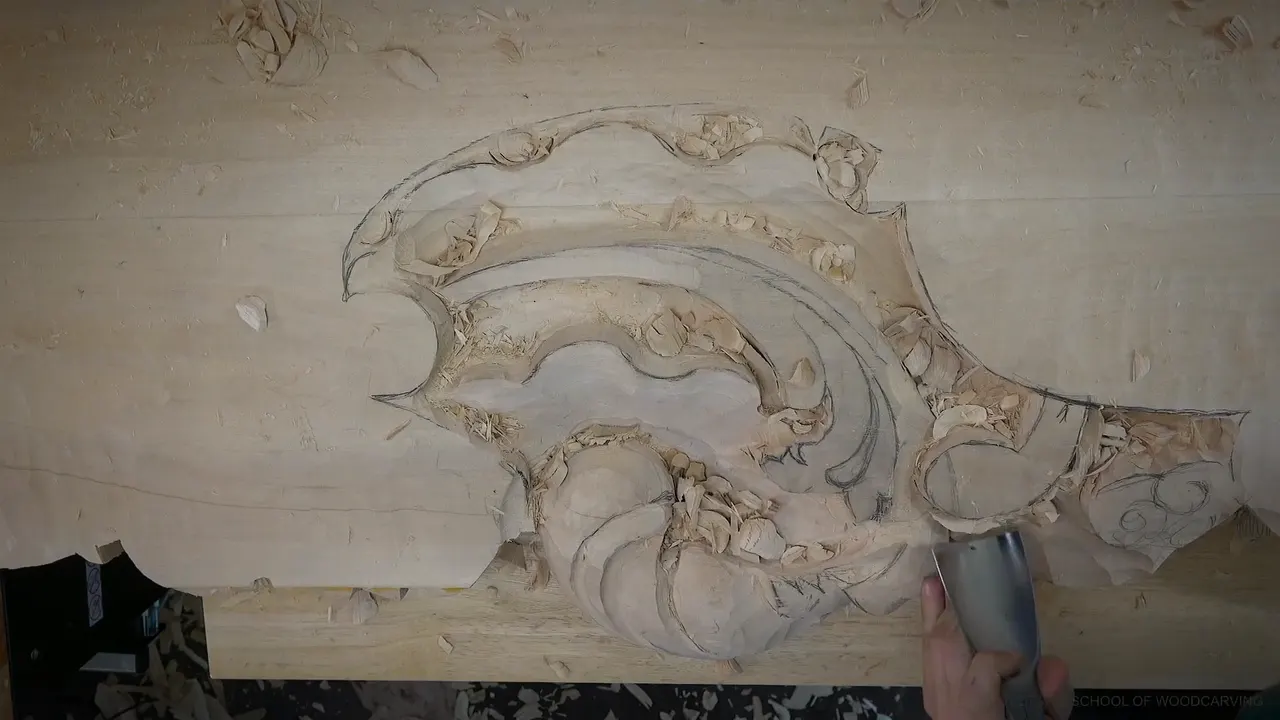

In part 1 of Venice Room 3, I said "Let's move to the next detail" and the line right after it was "And I can probably just establish this one right here." Videos from other lessons and other courses carry the same three words. Each lesson I name is linked, and a table near the end lists the videos.
Ever finished one spot on a carving and stood there looking at the rest of the board? Here is what I said around those words.
What this page holds
- The lines of part 1 around that line.
- What I say about details in parts 2 and 3 of the same lesson.
- Other Venice Room lessons that use the words.
- Courses on rosettes, moldings, a lily box and a cutting board.
- A table of the videos at the end.
What did I say in this video of workshop 3?
Part 1 has the single word "Flatter." There is "Let me chop that there" and a number for it: "I'll use number seven because it fits perfectly." About one part I say "I can gradually move this part, because right now it's just too bumpy." Then "Let me use number five, and I'm going to start."
One part will be higher than the other, I say, so "need to outline it." Of depth I say "And again, I got to go kind of deep" and "I want to make sure it looks deep." Then "Kind of establish a main form."

There is also a bare "Number two." A line about later reads "all of that is going to be undercut, and it's going to make more sense than it makes now."
Number seven returns with "I can use number seven again right here." I speak to a question you may have. The question is about a tool I use a lot, and "the reason is when I was designing it, I had in mind the tool I have." I add "if you are designing a certain job, keep in mind what tools you have." A tool "which fits perfectly to the job" can "really expedite the process."

I plan "some kind of flatter gouge and a smaller one" and "I don't want to lose the idea right here." It looks like I almost lost that line. "But that's okay." Then "I can always reestablish that line with no problem."

"I can probably outline right here with the same tool," I say. Then "That's good." The words this page follows come right after that. The part also has a plan to use a paper again, and "Oh, it's the wrong one."

What do parts 2 and 3 say about details?
The plan in part 2 is "let me work on that detail right here" with a pencil first, so as not to lose the idea of what is going on. One detail waits, "because I might going to change it."

Sizes are plain in part 2. For a "tiny spot," it is "probably the best idea to use just a 5/8 of an inch number nine," which is 15.9 mm. I also need "the smaller one and the number nine" and in this case I plan "just 10 millimeters, three-eighths of an inch." Ten millimeters is 0.39 in, and three eighths is 9.5 mm.

Part 3 plans "number five and 35 millimeters," which is about 1.4 in. After it comes "the straight down cuts." Maybe number seven again, I say.
Part 3 says "Let me work on this detail. Not detail, but main movement. It's not really details yet." Another detail will sit "right on the ceiling" and I say it will be "really looking nice." Also "I have to create the opening right here."

A flower is on the way as "the second layer" and "I really don't need that detail as of now." Why stay out of small parts? "I'm not going to go all the way to the details. It would be also a mistake because we are working in three dimensions, and once we're going to establish movements anyway, those small parts are going to move around, so they're not going to be in the same position." For me, "it's more important to establish overall movement." Then "Maybe just indication."

One more detail is missing, "this detail right here" and I can probably just draw it. Don't "pay attention to the final form of the acanthus leaves," I ask, because there will be much more detail later on. For now "it's just the main form."

Where else in the Venice Room do I say the next detail?
Part 9 of lesson 2 has one part above and another that will be my waste. Then comes "All right, then let me get the next detail." That detail is a shell: "I can actually cut the big movement shell."

In workshop 7, part 7, there is some point where I "can't use straight tool," but "now it's good. Now, I'm kind of happy." I am also "ready to move to the next detail." Convex is my plan, and the tool is back bend, "let me use first, probably just, number two."

Video 7 of lesson 12 has "I am ready to work on the next detail." About one section I say "it's supposed to have three subdivisions, the main ones, one, two, and three," "at least in my opinion." Once this part is done, we will "jump and develop this section."

In part 2 of Venice Room 15 I say I need to make the decision because another detail is coming, and "I don't want to place my eye somewhere right there." And "So I want to make it visible. I need to see that."
Part 1 of lesson 16 has "Good for now because later on, I'll have a chance to clean underneath of here with the next detail."
Video 5 of lesson 24 has "let me do the next detail," the one that "will be almost final one." "I have to find the middle line," I say, and of pencil marks "You don't really have to draw the whole line. You just eyeball in a section."

Part 3 of Venice Room 58 goes "I have to figure out what's the next detail I going to work on." No more details yet right there, "but maybe I could jump and start some development in this area." Maybe.
The plan in Venice Room 70, part 12, is "just number 11 and 7 millimeters," or 0.28 in, "and clean all that stuff out." The next detail "going to go underneath of it." I will not do too extreme a cleanup right now, I say, because the development of this detail gives "a better chance." Right now the part is "too chunky."
Part 8 of Venice Room 93 puts it on top: "this little tiny detail going to rest right on top of the next detail." Then "which means I need to lower that down much better and much deeper."
Video 3 of lesson 137 has "Pretty much right away. Get little undercut underneath of the next detail." Its tool is "number 11 and 2 millimeters," which is 0.08 in.
What do other courses have for the next detail?
Carving Furniture Panel 20, part 8, has "that's probably enough" and it "gives me really good shadow." It goes on, "I can probably move on to the next detail, which is I have to go underneath of here." For a tool I plan "a smaller number 11, half a millimeter," about 0.02 in.

In Carving Furniture Panel 22, part 9, I say "And it is good. It is good." Then I say that next time we go on to it.
In Carving Flower Rosette 1, part 4, "let me check if it fits to the next detail." It does. The gouge is "exactly the same," a number six, "and only quarter inch," which is 6.35 mm.
From Carving Floral and Molding for the Panel 8, part 3, I've "done both sides pretty much." I'm ready for a detail "not as complicated whatsoever, what's left to do." Some leaves are "sticking from underneath of the flowers."
Lily Box 8, part 7, has "I can move now to the next detail." Then "that is, of course, all waste." A pencil is the plan, "just to redraw overall movements." The third part of the same workshop has "Let me think how I can develop this part" and says we can go on to the next detail.

Carving Plate with Butterflies 4, part 3, proposes the next detail. Of the leaves I say "a couple ways I can do those leaves" and I'm leaving "approximately 1/8 of an inch," about 3.2 mm.
Acanthus over Moldings 1, part 3, carries "I'm happy with the result of it. So, I'm ready for the next detail." In lesson 3 of that course a spot is good "for now" and I say "I am ready for the next detail."
Another carver comes up in lesson 4 of the same course, part 2. "He would clean before he moved to the next detail." "He actually writes in the book," I say, and ask "if you're not clean right away, are you gonna forget that?" It's "probably somewhat true," I say, and "I found this better for me to divide in stages."
In Grinling Gibbons class in Maine 15, part 2, one petal is "little too close to the next detail." For one petal, "I would like to create a concave cut," "which means I have to start with the really tiny small." That is "Maybe number 11. I would say one millimeter," or 0.04 in.

Part 2 of Curly Kitchen Cutting Board 9 goes "Let me think what's the next detail I want to work on. Probably on this one." It's "a good detail." A second cut is my plan, as a center line, and straight down cuts after it.
Chamomile and Bow Rosette 1, part 1, says "It's time to move on to the next detail." Including that detail is my plan, "in my main project, which is part of Venetian room" and I "also do as a separate course." It is "small, doable" and you "could utilize some elements in furniture."
The Tray of Blessing 2, part 1, speaks of the grain: "I can see if I gonna do along the grain, I am pretty much safe." And "If, if I'm gonna attack and it's gonna be an escape, I'm not gonna catch the next detail." A drop is planned "to about three quarters of an inch from the surface," which is 19 mm.
Which videos hold these words?
This table lists the videos and what sits beside "the next detail."
| Where I said it | What sits beside the words |
|---|---|
| This video | Outlining, then a paper that was the wrong one |
| Video 3-3, same lesson | One detail missing |
| Lesson 2, video 9, Venice Room | Shell, and a part that is my waste |
| Workshop 7, Venice Room | Convex |
| Video 12.7 of the Venice Room | Three subdivisions, and a section to develop after this one |
| The Venice Room, lesson 15, video 2 | The eye |
| Lesson 16, part 1, Venice Room | Clean underneath, with it |
| The Venice Room, lesson 24, video 5 | A middle line marked by eye, section by section |
| Video 58.3, Venice Room | Figuring out what to work on, and maybe a jump |
| Part 12 of Venice Room 70 | Cleanup with a 7 mm (0.28 in) number 11 |
| Workshop 93, part 8, Venice Room | Tiny detail resting on top of it, which needs lowering much deeper |
| Venice 137.3 | A little undercut, 2 mm (0.08 in) number 11 |
| Furniture Panel 20, part 8 | Going underneath with half a millimeter (0.02 in) |
| Furniture Panel 22, part 9 | Good |
| Flower Rosette 1.4 | A fit check, with a number six at a quarter inch (6.35 mm) |
| Floral and Molding 8, part 3 | Both sides done pretty much, leaves to do |
| Lily Box 8.7 | All waste, and a pencil to redraw the movements |
| Butterflies 4, part 3 | Approximately 1/8 in (3.2 mm) left |
| Moldings course 3.3 | Ready |
| Fourth moldings lesson, part 2 | Clean first, or divide the work in stages |
| Grinling Gibbons class in Maine 15, video 2 | A petal near it, with a 1 mm (0.04 in) number 11 to try |
| Curly board, workshop 9, part 2 | A good detail |
| Chamomile Rosette 1.1 | Small, doable, and you could use it in furniture |
| Tray of Blessing 2.1 | An escape, and not catching it |
This lesson has its own page, Venice Room 3, and lesson 2 comes just before it. The whole course sits on the Venice Room course page. Each video named here is inside tuition to the school, paid monthly or yearly and renewed automatically until you stop it.
Never held a gouge? Start with first cuts for beginners. The tools have their own course, All About Tools for Wood Carving. Wikipedia has short pages on wood carving, the gouge, the chisel, relief, a rosette, a ceiling, Venice, millimeters and inch.
How it's done
- Say it is good, and say you are ready. The moldings course, lesson 3, part 3, shows "for now, it's good," and a line that I am ready.
- Name the next one. The cutting board course, workshop 9, part 2, shows me thinking about which detail to work on, probably this one.
- Look at what it touches. Venice Room 15, part 2, shows me not wanting my eye placed somewhere there. In Maine 15, one petal sat close to it.
- Go to it. Lesson 2, part 9, names a shell as the next detail.
Frequently asked questions
Which words came just before this line in part 1?
Right there, I could probably outline with the same tool, and I said that was good.
Which gouge numbers did part 1 name?
Seven, five and two, with seven back as an option. The seven and the five are plans in my words, and the two is a bare line.
Where did I mention cleaning?
Lesson 16 says I will have a chance to clean underneath later. Lesson 70 says there is no extreme cleanup yet, and that the part is too chunky. In the moldings course, lesson 4, I found it better to work in stages.
Which width does part 2 give the number nine?
What to carve next
- Venice Room Part 1 course page
- Venice Room 3
- Venice Room 2
- Venice Room 7
- Venice Room 12
- Venice Room 15
- Venice Room 16
- Venice Room 24
- Venice Room 58
- Venice Room 70
- Venice Room 93
- Venice Room 137
- Carving Furniture Panel 20
- Carving Furniture Panel 22
- Carving Flower Rosette 1
- Carving Floral and Molding for the Panel 8
- Lily Box 8