
Alexander Grabovetskiy, woodcarver, School of Woodcarving · Published 2023
Is wood carving a good workout?
Quick answer: In Venice Room 3-10, where I name a 35 millimeter (1.38 in) number nine gouge again, I called big carving a workout and a cardio. Other lessons of mine bring up the gym, sweat, warming up and getting tired, and each one is linked on this page.

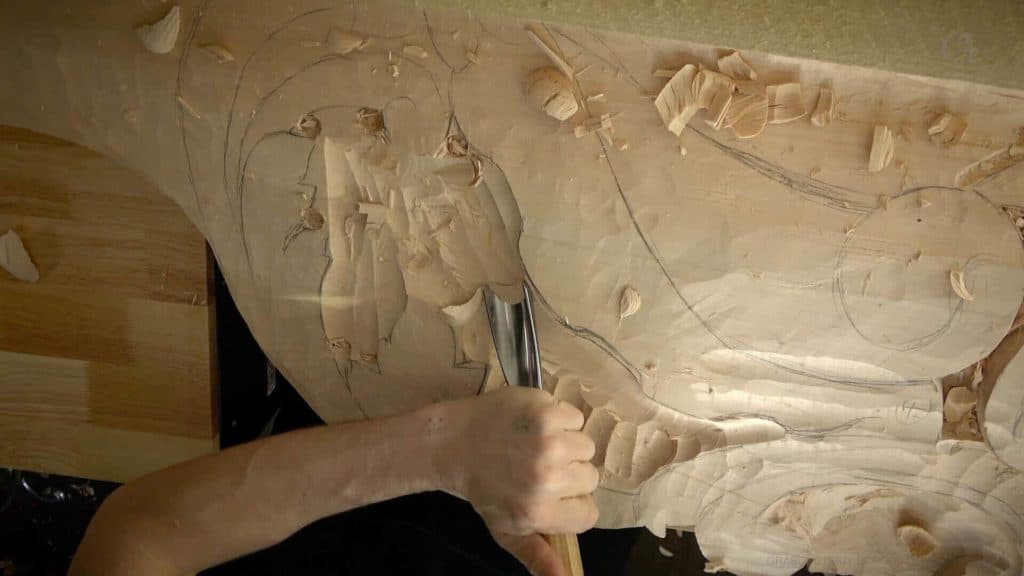
A really good workout is what I called big carving in Venice Room 3, part 10, where I name the 35 millimeters (1.4 in) number nine gouge again. The line is "I don't know how many calories I'm burning, but it's a really good workout."
Ever worked a big board and wondered if carving counts as exercise? Want to hear what I have said about the body when the gouge is in your hand? Then here is part 10, and the lessons where I say it again.
What this page holds
- The number nine, the deep passes and the relief cuts around my workout line.
- My words on calories, cardio and losing fat.
- Beginner, Furniture Panel and Tray lessons that mention sweat, the gym and getting tired.
- Molding, Hazelnuts, Acanthus and Venice Room lessons on the same.
- A table of my words.
What are my words in part 10?
Right before the workout line I say "Okay, let me grab again 35 millimeters." Just behind it comes "I'm definitely burning a lot."
A second line follows, "It's a really good cardio." Next comes a benefit: "So that is another benefit of wood carving big pieces like that." After it, "So you can lose fat." It comes back in fewer words, "Lose fat and create something." Last, "That's a good thing."
On the line itself I say "And if you noticed that I did not go all the way to the line here." Then "Because it's easier for me just to go around like that."

What was I carving when I said it?
The part opens with my tool, the 35 millimeters (1 3/8 in) number nine again, "at first." I add "That's always a rule. The bigger tool you have, the quicker your job is going to be done." Then a short line: "Hope you understand that idea."
Depth comes next. "I will go approximately about an inch and a quarter deep, which is about 35 millimeters deep." Written as numbers, 1.25 inches is 32 mm and 35 mm is 1.4 in, so my two figures sit close together without matching.

Corners get their own plan: "Got to be careful in corners like that, so let me make a relief cut." And "go around." For every corner with a triangle I say "I always like to make the relief cuts."
Those relief cuts get a smaller tool. "I'm going to use, in this case, 16 millimeters, number nine." I repeat it as "Number nine, 16 millimeters, 5/8 of an inch, and that's what I'm doing in this case, just make a rotation cut, just like that." Sixteen millimeters is 0.63 in.
I'm not sure you can see what I'm doing, I say, and I offer to show it from a different angle. Next, "So that's what I usually do, and I go deep, and deep, and deep" and "I just remove the plugs."

Why do I make relief cuts in the corners?
I know some people don't get it, and I tell a story about Tampa. It was a class in person. I tried to explain the idea, and one of the men said "Well, I'm carving for a long time already, so I never done it. I never had any problem."
What came next, I say, was "And guess what happened? He just messed up." He decided not to do it that way, and "he messed up his carving." My comment is short. "Well, it's not like it's unfixable. It is fixable. But still, why would you fix something if you can avoid that in the beginning?"
Back at the plugs I say "Okay, I've got multiple spots like that. So those triangles." Further along comes "And I've got one more right here." Then "Get those plugs out. And yes, I can go deeper, and I probably should go deeper, but it's okay."

What do I say of the grain and the depth?
The grain gets one line: "And yes, it is always better to cut like that across the grain." A short line follows, "Safer, I should say." About the layers I say "Okay, I've got all the way to another layer."
Near the end I give the depth again, approximately an inch and a quarter inside, "which is about 35 millimeters, let's say." The reason I give for the word approximately is "And I'm saying approximately because I'm not going to measure it. I'm going to just eyeball it."

The figure can move, I say, and it depends on whether I like it. "I could change it, either go deeper or I could just lower the upper layer. We'll see how it's going to look."

What do parts 9 and 11 say next to it?
Part 9 opens with "Well, I think I can continue to work on this one." Next comes "I'm not working on details yet." Part 11 has "I am pretty close to the final depth." A plan follows, "Let me make a straight down cut."
Later in part 11 the tool changes: "No, it's a little too small. I have to use a different gouge." Next, "I probably should use number five and one inch," which is 25 mm, and "I think it would be a really perfect fit right here."
One more line from part 11 is about the depth: "when I'm doing a clean cut down and clean it like that, it gives me a really good idea of my depth. Okay? So which is approximately where I want to be." The line after it is "So that is also one of the ways to measure the depth."

Where else do I use the word workout?
In First Cuts for Beginners, workshop 2, part 3, I say "Just follow the line. Some spots you have to cut two times, three times, maybe even more, until it just snaps out." Then "And it's a workout. Believe me, you're going to sweat when you're doing it."
A deep pass follows in that part, "That's really deep cut right here. Okay. One side is almost done."
What does the gym have to do with it?
In First Cuts workshop 1 I talk about my own gym. "I'm a member of a gym." Next, "I like to exercise" and later "I'm paying monthly fees actually." The point is about asking what you will get after one month.
A question I call not wise is "What results am I going to achieve in one month?" About the young kids at the gym I say "They just pumping and pumping dumbbells." And "That's impossible to grow in one day."
The gym comes up again in my Mastery video, where I say "And it's just like going to gym." Later on, "More you work, more you become a master."
Furniture Panel 19, part 4, has the gym as an example, with a router blade next to it. "When you go to a gym, and you're working out, you put your muscles in a stress, and then your body recovers, and your muscle's growing, and that's positive stress."

Overloading in a gym gives "too much stress," I say, and "You can damage your body." The blade follows. "Your tools, in this case, it's a router blade." One-sixteenth of an inch is 1.6 mm, and I say "It's only 1/16 of an inch blade." And "you really, really don't want to stress it too much."
In my April 2020 livestream on clay modeling I say "It's a good idea to model because it's like warming up your brain." And "For those of you who like to work out, okay?" Next, "I'm talking about lifting."
People who grab a barbell cold get hurt, I say: "A lot of injuries actually happens when people without warming up, grabbing that barbell or dumbbells." For the gouge I say "Even if you have a strength of your brains, if you are really powerful and you can take a gouge and just carve right away with no problem, you really have to warm up."
Muscles come up here too, and the brain follows them: "It applies to just the normal fibers to your muscles, it's same applies to your brain cells." And "The brain cells is actually also physical thing. So you really have to warm them up."
How do I keep from getting tired while I carve a big piece?
The Tray of Blessing, workshop 1 has "I don't push it at all." Then "I don't want to get tired. I let the tool do the work." Then comes "otherwise you're gonna get tired and you're gonna get frustrated."

In Tray of Blessing 6, part 2, comes "I always scoop this out with the rotation motion with slicing. That's why I am not getting tired and I don't have any blisters on my hand." Just before it, "I never push like this."

Byzantine Acanthus 2, part 1, has a rotation too: "every cut I do, I make a rotation." Then "Second hand is always on the blade."
On the palm, I use "muscles of your hand, of your palm. Okay? And that way, you're not going to get tired." Then "It's going to be like extension of your hand."

In Carving Hazelnuts, lesson 1, part 2, my depth is "no more than one-eighth of an inch", which is 3 mm. Then, "Don't try to just place the whole tool and just try to remove the whole thing."
And "you're going to get tired. There's no reason. Let the tool do the work and not you."

Floral and Molding for the Panel 1 has "You're slicing it." Then "When I'm teaching in person, I see that would be the biggest mistake what lots of people do. They just push just like that, and that's no good."
Of pushing I say you get "a lot quicker tired", and of the other way I say "So it's always better just to slice it."
In Modern Acanthus 1, I say "a lot of times you just using pretty much the left hand just to create those cuts." Next, "Look at my hand. See all the muscles is actually working that way and I'm not getting tired."

Beginner Workshop 8, part 2, uses a knife again. "I'm utilizing mostly my muscles inside of my palm, those muscles. So I'm not utilizing the whole arm, so just the muscles inside of your palm." Then "So you are controlling much better that way."
Greek Acanthus 4, part 4, says "And I'm utilizing just my hand muscles when I'm working." In Greek Acanthus 6, part 1, there is more. "I'm always placing my hand solidly against something." Then "That way, I can utilize just the muscles of my hand to make movements."

What tells me I am tired?
In Floral and Molding for the Panel 5 I name a sign. "First of all, the sign when I get tired, if I look at my bench and there's more than two or three tools, that means I am tired."
I go on with "Right now, I'm okay to keep those two guys while I'm working, but when I start accumulating tools, it's time to take a break." Later in that part I say "I'm sorry for my mumbling today, so kind of tired."

Venice Room 62, part 5, has a similar line. "Let me do some concaving. Convexing. I apologize. I guess I am getting a little tired. Convexing."
And Venice Room 83, part 4: "I say one thing and I say another thing sometimes. I know why. Maybe I also getting tired."

Which videos hold these words, and where do they sit?
| Words | Source |
|---|---|
| Another benefit of wood carving | Said after naming the number nine, Venice 3.10 |
| That's a good thing | Said right after lose fat and create something, Venice 3.10 |
| It's a workout | Following a line with a knife in First Cuts 2, part 3 |
| I'm a member of a gym | A question about results in one month, First Cuts 1 |
| Just like going to gym | The more work, the more mastery, in my Mastery video |
| Positive stress | A router blade of 1/16 of an inch (1.6 mm) in Furniture Panel 19, part 4 |
| Warming up your brain | Clay modeling before carving, in the April 2020 livestream |
| I feel the tool how it does | A quick pass shown slowly in Tray 1, part 1 |
| I don't have any blisters | Scooping with a rotation motion in Tray 6, part 2 |
| Controlling much better that way | Knife work without the whole arm in Beginner Workshop 8, part 2 |
| Extension of your hand | A rotation with every pass, in Byzantine 2, part 1 |
| Don't try to just place the whole tool | A depth of no more than one-eighth of an inch (3 mm) in Hazelnuts 1, part 2 |
| A lot quicker tired | Pushing a pass instead of slicing it in Molding 1, part 3 |
| Accumulating tools | The tools piling up on the bench, Molding 5, part 1 |
| A little tired | Said over a ridge while concaving and convexing in Venice Room 62, part 5 |

Where does part 10 sit in the room?
This part sits in lesson 3 of the room, and the whole course is on the Venice Room Part 1 page. The videos I name are all inside tuition to the school. Come and watch part 10 at the bench with me, then see how your own arms feel after a long day.

How it's done
- Start with the big tool. In part 10 I said the bigger tool you have, the quicker the job is done, and I named a number nine, 35 mm (1 3/8 in), at first.
- Relieve the corners. For triangles in the corners I said I always like relief cuts, and I named a 16 millimeters (5/8 in) number nine for them.
- Slice, don't push. In Molding 1 I said "it's always better just to slice it," and in Tray 6 I said "I never push like this."
- Look at your bench. My sign in Molding 5 was the bench: accumulating tools means a break.
Frequently asked questions
What did I say about calories in part 10 of the third Venice workshop?
I said I don't know the number of calories I'm burning, and that I'm definitely burning a lot. I called it a workout and a cardio, and I named a benefit, losing fat, and creating something.
Which gouge was I using when I said it?
The number nine at 35 mm (1.38 in), which I called the bigger tool that gets the job done quicker. For the corners I named a smaller one, 16 millimeters (0.63 in).
Why did I make relief cuts in the corners?
Relief cuts are what I always like in each corner that makes a triangle. I told of a class in Tampa, where a man said "I never had any problem" and then messed up the carving. Why fix something, I said, if you can avoid it in the beginning?
What to carve next