
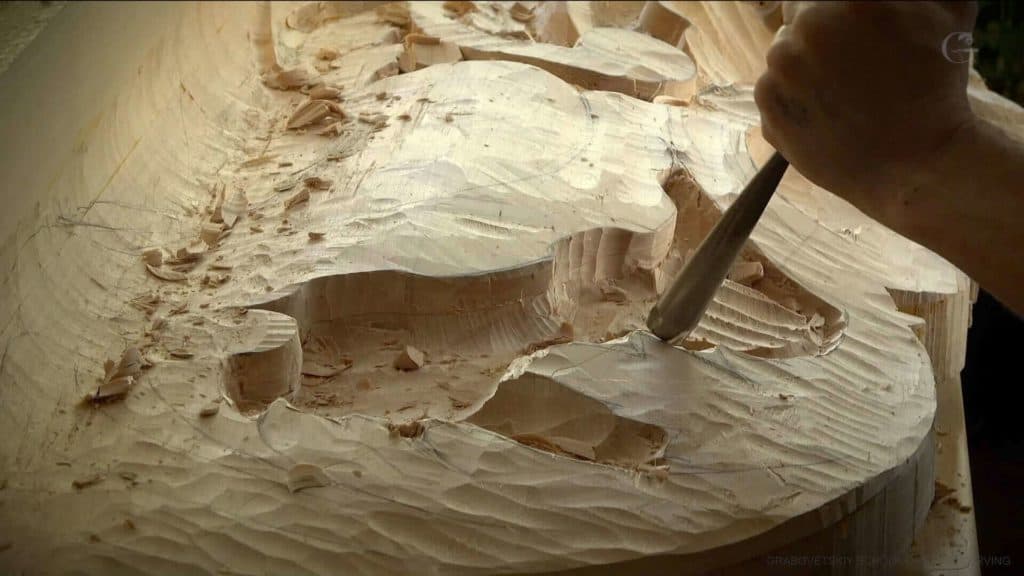
Alexander Grabovetskiy, woodcarver, School of Woodcarving · Published 2023
What does a wood carver mean by "be fair"?
Quick answer: In Venice Room 3, part 12, I said "be fair to everyone" while explaining why my tool sizes come in two systems. Other videos of mine use the word about a picture size, paying students, a client's price and my family.
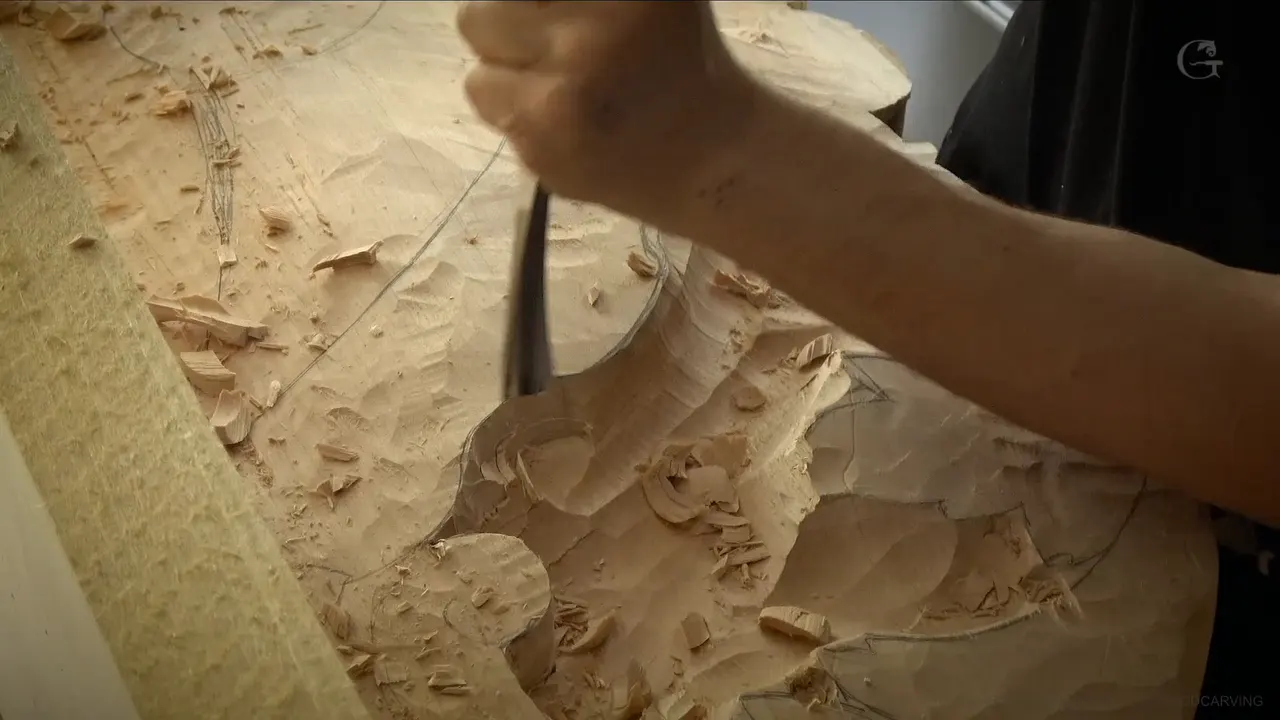

Part 12 of Venice Room 3 is where I explain why I name my gouges in inches and in millimeters, and where I say the word fair. The line is "So that's why I have to be fair to everyone."
Ever watched a video where the sizes meant nothing? Do you live where people measure in millimeters, or in inches? Here are my words from that video, plus the other videos where I use the same word.
What this page holds
- Why every size comes twice, in part 12.
- The rest of part 12: a rubber pad, a deep hollow and a talk about how long a carving takes.
- A student's question about millimeters, and other videos that give both units.
- A request about picture size.
- A livestream where I held something back, and one where I talked about a client's price.
- My family, and two small uses of the word.
Why do I name every gouge in inches and in millimeters?
Part 12 gets there from the tools. My words are "And please let me explain why I'm always saying in imperial measurements and also metric." My example is "5/8 of an inch, 16 millimeters, and so on" and then "it's not to show off, okay?" Five-eighths of an inch is 15.9 mm, so the two figures name the same tool.

Next come the people I have in mind. "I have a lot of people from all over the world, and, for example, in Europe, not every country, but some countries, they don't use imperial measurements in all." Of those countries I say "they have no idea of what's the inch is, what's the 5/8, what's 3/8, and so on. They use only metric, okay?"
Of the UK I say "you can use both with no problem." Of Eastern Europe I say "unless if it's just a specialty like plumbing, people don't use imperial in all."

After those lines I say the sentence you read at the top, and then "So that's why I'm saying in metric and imperial. Otherwise, I would just say big gouge, small gouge, big gouge, small gouge." Right after, I give a size: "This one is one inch, by the way. 25 millimeters." And "Let me get in, and that's number seven."
What else happens in part 12?
Early in the video I say "And that is a good fit on inside" then "So I'm really happy that is good gouge to use right here." After that, "And I can probably go from outside in."

Then a question I think you have: "Oh, by the way, you probably have a question how I fastened my piece on a work table, and I actually did not clamp anything. It's actually staying on my cookies." Of those pads I say "it's a rubber, it prevents that from slipping. And so if the piece is heavy, it's a good idea." Later I probably have to fasten it from the backside, I say, and for now "it works just fine."

The next tool is a number three. "I'm going to use number three and one inch and chop this way." One inch is 25 mm. About a straight line I say "I really don't want to see a straight line" and about a change to the design "I just moved approximately eighth of an inch, about three millimeters." An eighth of an inch is about 3.2 mm.

The depth gets its own answer: "And if you would ask me why I'm doing that so deep, because the shell, some of it's going to be higher, some of it's going to be lower." Then "So that is why I need the extra depth. Besides, I have plenty of material. Why not?"

What does part 12 say about how long a carving takes?
It starts from a question in the comments. "Some of you asked me in a comment" how long it would take me, approximately, and I call that "always the hardest question for me." About a customer I say "when a customer asks me the deadline, I usually give a range." The carving itself has days like this: "in some spots it gives you so much trouble sometimes, and you're not able to move past that place for the whole day sometimes."
I turn some work away, and I fix my own wording as I say it: "I'm not turning people away." The ones I turn away are "architects and designers who really don't get it, that is a manual work, so it's labor intense." The word fair is not in that talk. I use it about clients in other videos.

The talk goes on: "the idea of deadline nowadays probably is everywhere in every country, but it wasn't like that a few years ago." About the pace I say "But the problem with that, you are losing quality" and "You're just not paying attention to the details."

Did I give the same reason to a student who asked about millimeters?
Venice Room 56, part 10, has a student's question in it. The student comes up in my own words: "I had a guy, actually, one of the students, and of course, he's from United States." He asked "Why would you say that all that millimeters and metric stuff, nobody knows about it?" My answer: "You're kind of not right. You're really not right. You're wrong."

I give the reason in plain words, "people don't know inches, imperial measurements, and so on. Most of the people in the world, they're actually still using metric." Then I catch myself: "sometimes I forget to say if it's number one, if it's 1 millimeter, or let's say 1.5 millimeter, but it equals to 1/16 of an inch." One sixteenth of an inch is about 1.6 mm. The word fair is not in that part, and the reason is the same.

Do I give both units in other courses?
In Roman Acanthus 8, part 5, I say "Ten millimeters, which is a three-eighths, if you like imperial." And "Personally, I use both imperial and metric, but more I would say imperial." A little later: "I grew up, of course, in Russia, like most of the parts of the world, with the metric. And in the United States, it's used mostly imperial. And I really love the imperial approach to the measurements, I should say, okay." Ten millimeters is about 0.39 in, and three-eighths of an inch is 9.5 mm.

In Lily Box 4, part 10, I follow inch figures with "Ten millimeters, okay, for those of you who like millimeters better than imperial." In Venice Room 49, part 4, I say I could use even 18 millimeters, and "It's little less than three quarter of an inch, but approximately really close to three quarter of an inch if you like imperial measurement." Eighteen millimeters is about 0.71 in. In Plate with Butterflies 1, part 1, I call a board 3/4 of an inch thick, which I say is about 19 or 20 millimeters "if you are in the country with not Imperial but metric."
Why do I ask you to send a smaller picture?
Floral and Molding 13, part 3, has a request about the picture of your finished carving. The request reads "once you're finished, once you carved that and you're ready to submit to me." And "Reduce the size, because I have so many students and a lot of submissions, and if the picture is the full size, it slows down my server."

Next: "And I want to be fair" and the next words are "to everyone, and I have students from all over the world, and not all have greatest internet." About the cost I say "So you don't have to pay. It's free." And "You don't have to upload 20 pictures. All I need is just the one picture, and I can take a look."
Why did I hold back details on a livestream?
On my livestream of October 15, 2020, which sits in the October 2020 lesson, I say "what I working on right now, I am trying to clean everything." Then "later on, I'm going to carve details on inside, which I'm not going to show that on the live stream."
Reason why, I say, "there's a lot of people on my school site, and they paying every month, and that would not be fair for them to show the process openly and for free." And "So I have to be fair."

What about my family and the next sessions?
Later in that stream: "I've got lots of emails request if I would be able to teach one-on-one." I plan a session of "half an hour and maybe 45 minutes" and I say it will not be free. The plan has a limit, "one month or two months duration," because I'm afraid of too many bookings, so other people cannot get a place.
"I know what I'm talking about because when I was teaching in Indianapolis, even last class this year," I say, and "the classes were sold in seven minutes this year." After that: "So really, I want to be fair" and the next words are about everyone.
Near the close "be fair" comes up once more, then "but also to my family." After it: "if I'm investing some time in some of the stuff, it has to bring me some income." A one-on-one video session would mean "I have to spend a lot less time on real wood carving, like on project carving and so on."
What did I say about a client's price?
In my April 2020 livestreams, a viewer asks "Do you charge by time invested in making a piece or by art piece created?" I answer "By art." Then "I'm not charging by the time. That's easy, one-word answer." Of the client: "really fair for the client."

I explain it this way. "I can take as much time and then say, Hey, it took too much and charge. So it's not fair for the client, and I don't think it's fair for you, too. Because you can also lose. You can underestimate your time."
A little later I come back to it. "Because sometimes if you are carving, sometimes just one inch takes you a day long, and sometimes you can carve one foot in one day." One inch is 25 mm, and one foot is about 30 cm. And "sometimes you're just trying to polish everything, and you can't move too fast, and you can lose, and the client can get frustrated also. So I estimate by piece."

Another viewer asks about a piece I sold, and whether I overcharged or undercharged. "I always think I'm undercharging, but I don't have regrets. I'm always underestimating. That's the fact." Of my clients: "to be fair, again, to my clients. And if I underestimate it, that's my problem. It's not their problem."
Custom cabinetry comes up too. "Even when I was doing some other work, just the custom cabinetry and so on, and I used finishers who would finish for me. And they would estimate me a price, and I present that to my client." The finishers would come back and say "Oh, we are underestimated. We need more money." My view is "after you've gave a price, you cannot change it."
A change order is a different case, with "some additional work needs to be involved." But "if you're doing just the work what you estimated before and you're trying to get more money, it's just not fair to anybody." Then "So you got to estimate much better." About my own habit of always underestimating, I add "it's underestimate, but it's still fair. Because it's just psychological, I believe."
What is a fair price for your own work?
The April 2020 livestream about making money with wood carving has me saying "By the square inch, that's how I'm charging." And "but I also estimate the depth." Then "When I said $50 an hour" and a viewer calls it a "fair price, living in United States, in Georgia." My answer: "It does sound legit, but on another hand, think about that."
I go on: "You have to also consider what level wood carver you are, okay, and what kind of projects you do." For a master in the craft who still wants to make money, "you have to look at yourself a little differently. It's how much you would love to pay yourself, okay, and that's how you name it."

Do I say it about a gouge, or about my own story?
Greek Acroterion 4, part 4, has a small use of it. About my knife I say "I'm still going to use my knife and kind of angle it and create my bevel cut, initial bevel cut." Then "Now I'll take a gouge, because it's not fair to do everything by knife. It looks like my number five works perfectly right here."
My lockdown video has me introducing myself: "it would be probably fair to start from the beginning." Later in that video I tell part of my story: "When I came to United States long time ago, it's like 25 years ago, almost 25 years today, and I didn't speak any English, and I started woodworking firm."
Where are these words, side by side?
| What I called fair | Where I said it |
|---|---|
| Naming every gouge in two unit systems | Lesson 3, part 12, the talk on units |
| A smaller picture file | Floral and Molding 13, part 3, pictures |
| Students who pay every month | October 2020, inside details I held back there |
| My family | October 2020, one-on-one video sessions I plan |
| A client's price | April 2020, the hours and the piece |
| Underestimating, still fair | April 2020, a piece I sold and a viewer's question |
| $50 an hour, said a viewer | April 2020, making money with wood carving |
| Starting from the beginning | Lockdown video, a first look at my story |
| Doing everything by knife | Greek Acroterion 4, part 4, a gouge after the knife |
Where does this part sit in the room?
This part is in lesson 3 of the room, between Venice Room 2 and Venice Room 4, and the whole course is on the Venice Room Part 1 page. Every video named here is inside tuition to the school. Come and watch part 12 at the bench with me, and listen for the second size every time I name a gouge.
How it's done
- Name the size twice. In part 12 each gouge gets two sizes, since some countries know only metric.
- Shrink the picture first. In lesson 13 of the floral panel course I ask for a smaller picture of your carving, since a full-size file makes my server slow.
- Keep the inside for paying students. On my livestream in October 2020 I said I would not show the inside details there, since paying students are on the school site every month.
- Say what you charge by. April 2020 was where I said I estimate each piece, and that sometimes just one inch takes you a day long.
Frequently asked questions
Where do I explain inches and millimeters?
In part 12. Not to show off, I say, because people watch in many countries, and some of them know only metric. For the UK I say you can use both with no problem, and in Eastern Europe, unless it is a specialty like plumbing, imperial is not used.
What size picture do I ask students to send?
A smaller one. In lesson 13 of the floral panel course, part 3, I say a full-size picture slows down my server, and not all of my students have the greatest internet. All I need is just the one picture, and I can take a look.
Why did I hold back some carving on a livestream?
On the October 2020 livestream I said I would carve the inside details and not show them there. Many people pay every month at my school, and showing the process openly and for free would not be fair for them.
What to carve next