
Alexander Grabovetskiy, woodcarver, School of Woodcarving · Published 2023
What does a wood carver mean by "another movement"?
Quick answer: Part 2 of workshop 3 of the Venice Room has me saying another movement was underneath, a few lines after my pencil. Later in that video I said "That is another head." Other lessons of mine put the words near shells, pipes, eyes, acanthus leaves and a vine.

In part 2 of Venice Room 3, I said "I think I've got another movement underneath," right after saying I would use a pencil first. Other lessons of mine carry the same two words near shells, pipes, eyes, vines and a flower. Each lesson is linked, and a table near the end lists them.
Ever looked over a carved board and spotted one more line running under the one in your hand? In these videos you hear me spot it.
What this page holds
- The lines of part 2 around my pencil, and my tool for a tiny spot.
- What the two parts beside it say about the board.
- Lessons from the Venice Room where the words sit near a shell, an eye or a pipe, plus an acanthus.
- Lines from my furniture panel, grape onlay and rosette courses.
- A table at the end.
What did I say around that line in part 2?
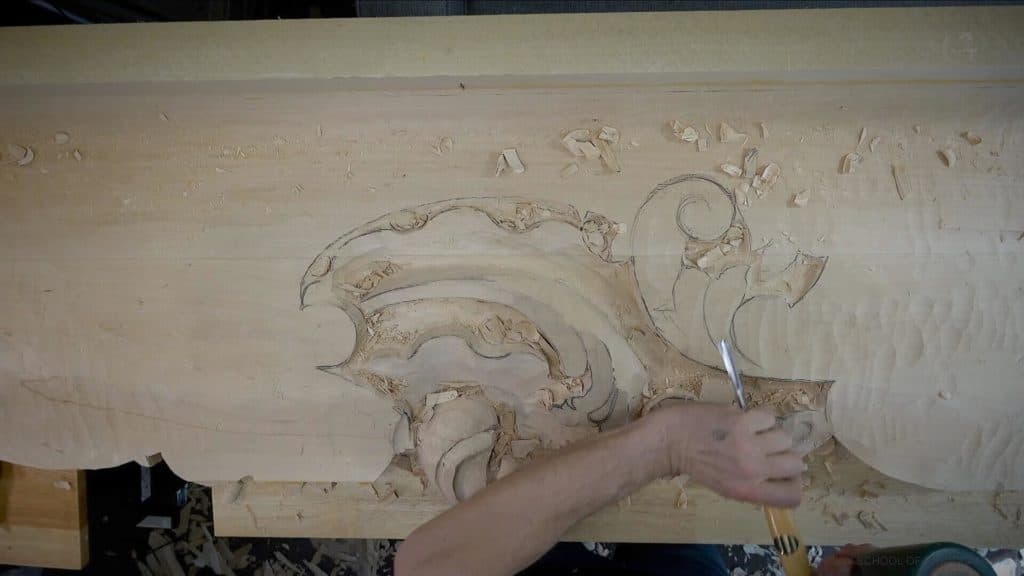
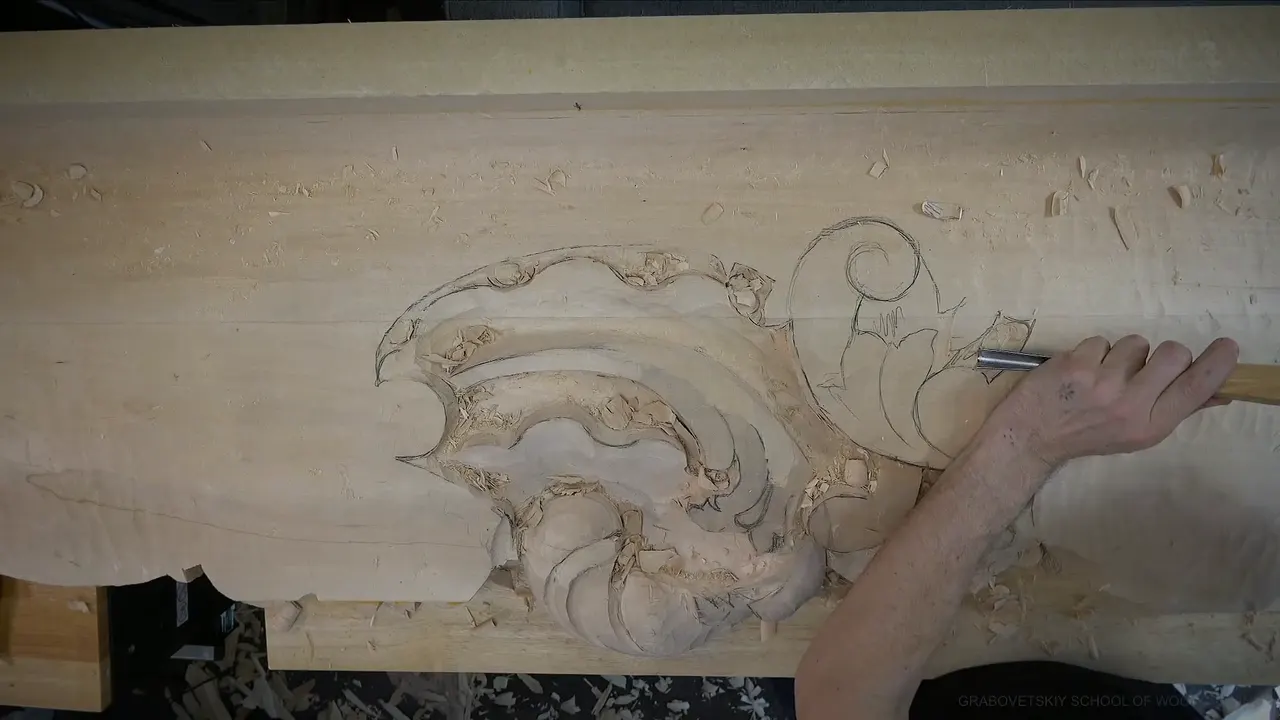
Part 2 opens with "All right. I got that" and "I can take this apart." Next I say "let me work on that detail right here." A pencil comes next: "Let me use a pencil first because I don't want to lose the idea what is going on and what's that." The line this page follows comes right after: "Okay. I think I've got another movement underneath."
A little after, I say "So which I have to take care of and double think. Or should I say think again?" And "Double-check, I should say." Of one spot I say "And I'm not going to go inside of that detail yet because I might going to change it." After it, "That is another head."

My pencil goes missing: "Okay, where's my pencil" and "Back wherever it belongs to." A cut is in the wood by then, and I say "I actually do have a cut. I am able to see it." I check again with "Okay, double check" and I say "And I do have a movement like that."

The head gets a plan: "That is going to be another head, and that head's supposed to be connected like that." Then "So now I can remove that." The apology is "Sorry if you can't see that, what I just showed to you, but it's okay." Then "I was working just on this part."
A tool is named for a small spot: "And this is a tiny spot, so probably the best idea to use just a 5/8 of an inch number nine." The 5/8 figure is about 16 mm. Farther in I say "Okay, got to be careful here" and "Straight down cuts and a little bit of cleaning."

The part ends on plans. "Let me think." "I need the smaller one and the number nine," I say. Last is "in this case, I'm going to use just 10 millimeters, three-eighths of an inch to get an area like that." Ten millimeters comes to 0.39 in, and the three-eighths figure to 9.5 mm.

What do parts 1 and 3 of the same lesson add?
Part 1 begins on the tool: "I'll use number seven because it fits perfectly." A line about the wood is "now I can gradually move this part, because right now it's just too bumpy." I plan a smaller tool, "Let me use number five" and I note a height, "higher than that part, so need to outline it." An undercut is still to come in part 1: "it's going to make more sense than it makes now."
Later, in part 3, I say "number five and 35 millimeters" and "Get the straight down cuts." Thirty-five millimeters is about 1.4 in. On that spot I say "Not detail, but main movement." I follow it with "It's not really details yet." Near the end I say "I've got big spot right here, and I've got that one underneath."
Where does another movement sit near a shell?
Venice Room 41, in part 2, has the words inside a line of outlining: "another movement right here." Next comes "Again, what I'm doing right now, it's just outlining." Then "Maybe I have to lower this down a little bit." My reason is "a little too deep excavation later on" with "this part of a shell" named.

A shell is in the first line of Venice Room 37, part 7: "start on my shell." Movement follows movement, and the first "has to go like that." One line sums them up, "So all of those movements, they kind of have to go to the center."

Over in Venice Room 75, part 1, I say "So yes, there's supposed to be a shell and another movement this direction." Of my plan I say "my original plan is to get an acanthus." It is an acanthus movement, and "the shell will overlap that acanthus movement."
Eyes come in a row in Venice Room 117, part 2: "For now, let me get another eye." Then "another eye and another eye right there and that way." The row ends on "the main idea" and I add "Hopefully, it makes sense."
Venice Room 50, part 2, has me naming another movement ahead and say "I can concentrate on that." Another line names a shell. My pick is "number 11" at "15 millimeters again," which is 0.59 in. "Approximately five-eighths of an inch," I say. And "It's not exactly five-eighths of an inch, but approximately." That size is 15.9 mm.
How do the words sit beside a pipe or an eye?
Two pipes are in Venice Room 162, part 3, "pipe number one" and "a second pipe." The second is "a little smaller." I also say "this is the main one." The tool I plan to take is "maybe 16 millimeters or 15 millimeters," a number 11, "about 5/8 of an inch." Sixteen millimeters equals 0.63 in.

An eye is in Venice Room 66, part 7: "Here you go. That is going to be an eye." After it comes "start creating approximate divisions of this movement" and another movement is coming "right there." On depth I say "see why I did not undercut that right away really too much because I really need that depth." "I can always undercut, but it would be a big mistake," I say.

A detail tool is in Venice Room 133, part 1, right after "another movement." The need is "I'm going to also need, again, micro tool or detailing tool in this area." The size I name is "two millimeters, number 11," which is 0.08 in.
The maybe grows in Venice Room 82, part 7: "Maybe another movement. Maybe even bigger, just like that." Another one is "right here" and I say "I can expose this and make it look really, really, really, really nice." The reason is "that way, I will reveal that main body form, okay?" Later I say "I'll take number 11 again" at "7 millimeters." Seven millimeters is about 0.28 in.

What about an acanthus, a leaf or an inside line?
Underneath a flower is the picture in Venice Room 74, part 6: "the idea it's growing from underneath of that flower." The line is "another movement, which is going to go right underneath." Then comes "I can get that movement inside. Again, I'm just creating three divisions pretty much."

Cleaning around, I say, in Venice Room 52, part 2, "you can see there's another movement going all the way inside." It "ends up with this acanthus head."

Depth is the question in Venice Room 59, part 2: "how deep should I go in this area?" Then "I don't want to be too crazy removing too much of material, and then I could be in trouble." Then "Three and one-eighths. Number seven, 80 millimeters." Three and one-eighths inches measure about 79 mm, and 80 millimeters measure 3.15 in.
Growth from below is in Venice Room 58, part 5, after "maybe a little deeper": "another movement growing now from underneath pretty much." Farther on I say "it does go right on the ceiling."
Wrapping is the subject in Venice Room 51, part 1: "Let me think how I can develop this side." Then "That movement is going to wrap on inside." And "which means I have to excavate on the side."
An inside line has a size in Venice Room 88, part 6: "create another movement on inside, like this." The size is "Also about half an inch or so." I check with "Let me double-check." Then "pretty close, about half an inch, or maybe 9/16." In millimeters that is 12.7, and 9/16 of an inch is 14.3 mm.

A maybe sits in Venice Room 17, part 6: "But what I could do, I could actually create another eye, and let me fix this side." The maybe goes on with "I could do another eye." The movement would "go underneath of here." Then "So that will make sense."

An acanthus is the topic in Venice Room 31, part 11: "I do have an acanthus, and there is a division going downhill, which you don't see." "But I could actually get another movement of the same acanthus this way," I say. "I'm not sure I should or not," I say. A maybe about "too much" turns it, and I end on "Let me just do original."
In Venice Room 19, part 11, I say it is done: "I just added another movement right there, a little bit." Then "And yes, I'm still able to because I still have some material." "Of course, I need to outline this side," I say.
Which other courses of mine carry the words?
A leaf is in Designing Furniture Panel 8, part 3: "another movement like this." Then "Nicer, smoother" with a leaf "underneath of this one." Next is "let me do overlapping one."
Flowers come first in Designing Furniture Panel 6, part 1. "Again, about 3/16th or 5 millimeters. I'm talking about line-to-line measurement." The plan is to "develop some kind of flowers" and "another movement" then "hide that." Then "As of now, I like what I see." Three-sixteenths of an inch comes to 4.8 mm, and 5 millimeters to 0.20 in.

A lower one is in Carving Furniture Panel 19, part 4: "And I have another movement on inside" with "little lower, even lower." The comparison is "lower than the main design." A tool follows: "I think the best tool would be, in this case, number 23. And 4 millimeters is what I have." That size is 0.16 in.

A vine is in Grape Onlay 5, part 2: "another movement." It goes under "this main vine" and I say "So I gotta make sure I have some material right there."
A grape leaf is in Carving Grape Onlay 7, part 2: "I can take advantage of this part" and then "another movement just like that." Next, "Keep that little higher, that way I can lower down this part of the leaf." And "But I'll do it little later."

Carving Grape Onlay 9, part 1, begins with two: "we've got two major movements, obviously, that is gonna be the bottom part, that is gonna be the upper part." "The one movement goes that direction and another movement goes this direction," I say of the pair. I say "I would like to just create the flow, okay? That is important for me."
A boundary is in the April 2020 livestream: "my boundary" and "So that is not the design." Then "But also I know I want to get another movement going that direction."

Last, the Carving Hazelnuts course, lesson 7, part 1, opens on "Because I do have some of the movement already kind of I can see." Then "There is another movement, but there is another leaf which is gonna go right underneath of this part." I start with a number six, "about 10 millimeters or so, about three-eighths of an inch." Those figures come to 0.39 in and 9.5 mm.
Which videos hold these words?
This table lists the videos and the words that sit next to another movement.
| Video, or course | The words that sit beside another movement |
|---|---|
| 41.2 | Right here, with outlining only |
| 37.7 | A shell, then movements that have to go to the center |
| 75.1 | One more in this direction, with a shell |
| 162.3 | A second pipe, a little smaller |
| 66.7 | An eye, and a depth I did not want to lose |
| 74.6 | Right underneath |
| 59.2 | A number seven at 80 mm (3.15 in), after a question about depth |
| 88.6 | A line on the inside, close to 9/16 (14.3 mm) |
| 19.11 | One I just added |
| 31.11 | The acanthus again, then back to the original |
| 58.5 | Growing from underneath |
| Furniture Panel 6, video 1 | Flowers, and a line about 5 millimeters (0.20 in) apart |
| Furniture Panel 19, video 4 | Even lower |
| Grape Onlay 9, video 1 | Two major ones, and the flow |
This lesson has its own page, Venice Room 3, and lesson 2 of this course comes before it, with Venice Room 4 after. The whole course sits on the Venice Room course page. Each video named here is inside tuition to the school, paid monthly or yearly and renewed automatically until you stop it.
Never held a gouge? Start with first cuts for beginners. My tools have their own course, All About Tools for Wood Carving, and Carving Tool Sharpening is the course for edges. Wikipedia has short pages on wood carving, Venice, relief, hazelnut, millimeters and inch.
How it's done
- Start from the pencil. My plan was a pencil first, so the idea would not get lost.
- Name the line underneath. My words were about a movement underneath, a few lines after the pencil.
- Leave the detail open. I held off on that detail, since I might change it.
- Pick the tool for the spot. For the tiny spot I named a number nine, and a smaller tool with it.
Frequently asked questions
Why did I reach for a pencil first?
My plan was a pencil first, so the idea of what was going on would not get lost. The next line was about a movement underneath.
Did I go inside that detail?
I said not yet, because I might change it, and right after that I said the next one would "go around."
What is a 35 millimeter gouge in inches?
A 35 millimeter gouge measures about 1.4 in. I named that size with a number five in part 3 of this lesson.
When did I say a movement was already added?
What to carve next