
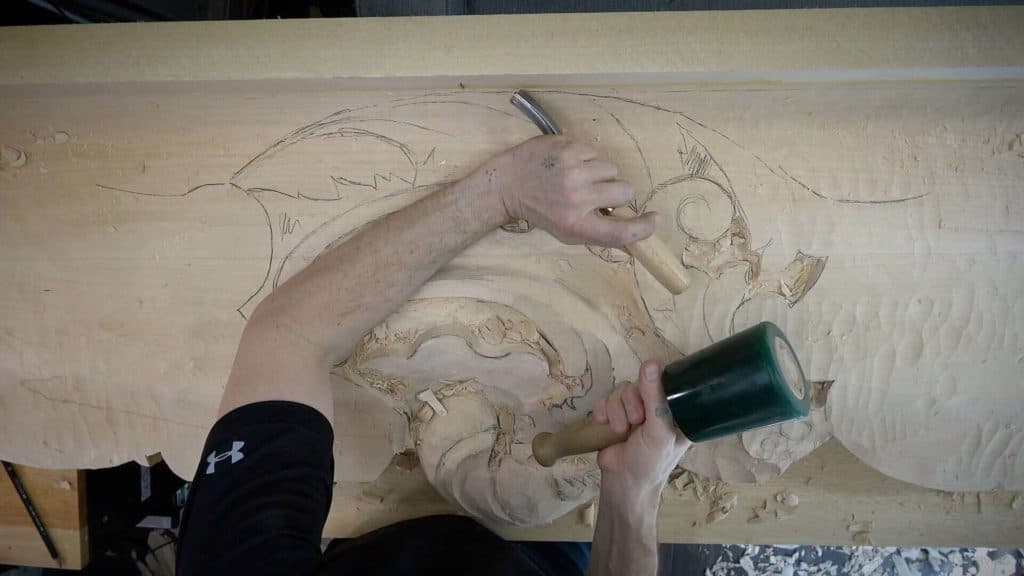
Alexander Grabovetskiy, woodcarver, School of Woodcarving · Published 2023
What does a wood carver mean by "quite a few"?
Quick answer: Part 4 of this lesson has my line about this project's flowers, and it puts quite beside a count. Other videos of mine put quite beside how far a part goes down, beside a size short of a round number, and beside how a spot looks to me.
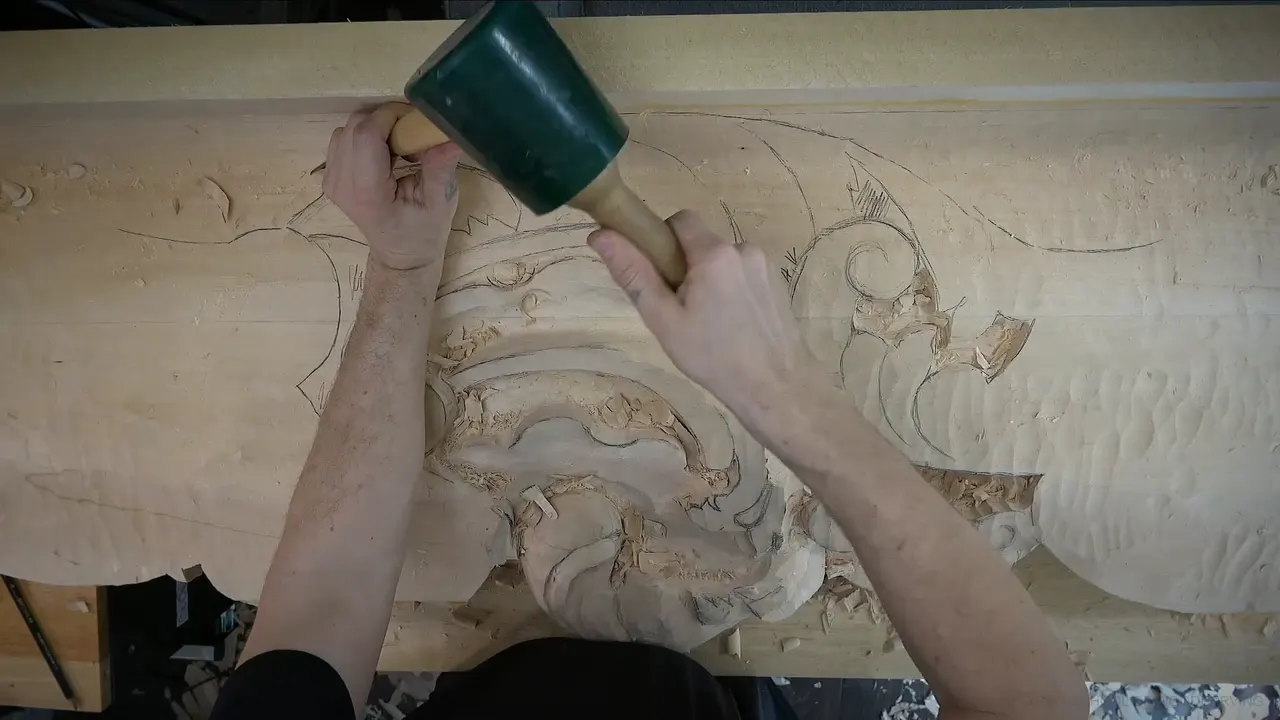

In part 4 of Venice Room 3, I said "there's going to be quite a few flowers in this project." That line is a count. In other videos I use the word for how far a part can go down, for a gouge a little off a round size, and for how I feel about a spot.
Ever wondered how much a carver means by quite? Here are my own lines from part 4, and from lessons where the word does another job. Each lesson I name is linked, and a table near the end sums them up.
What this page holds
- My lines from part 4: the tools, the depth, the flowers and the last move.
- Other videos that use it for a count.
- Lines where a part comes down, and lines where a size is not a round number.
- Lines on spots, then quite deep, quite low and a tool.
- A table of the videos at the end.
What do I say in part 4?
Part 4 opens with a tool pick: "Okay, I'm going to take number nine again." A moment later the tool changes. "It's kind of not convenient with this tool, so I need to use a bent." I probably should go with "the long bent and number 11," I say. A little later comes "Maybe even with the short bent."
Number nine returns, and I name its width: "Same number nine. 20 millimeters," or 0.8 in. Then, about the grain: "Actually, I can go across the grain like that."

Depth is next. "Yes, again, I could go as deep as about an inch or even deeper, inch and a half, if I wish." An inch is 25 mm, and an inch and a half is 38 mm. My reason is "a lot more dimension, especially this part going to go underneath, so I really need the depth."
A bigger gouge follows. The next tool is a plan too, 35 millimeters (1.4 in): "let me use the bigger one right here." Then "Okay, let's switch back to 20 millimeters" and "let me chop down this way."

A spot comes next. It will be "my flower," I say, and also "my gluing point and dowel point." The line after that is the count of flowers this page is about.
The word complicated comes next. "This is going to be even more complicated," I say, and "I'm talking about the design-wise, okay?" Design is what I mean, and not how hard the work will be. "It's about the same," I say, and "It's just the flowers."

A smaller tool is the plan after that. "I'm going to need the 5/8 of an inch, 16 millimeters," I say. That checks out, since 5/8 in is about 16 mm. The plan starts "right here at first."
The part ends with a move, and its first line is "Let me get inside of those spots." Then "And what I'm doing, I'm just cutting from both sides and just removing blocks. You see? It's just like that. And I use that technique a lot, actually, to go really, really deep if I need to."

Which other videos use it as a count?
Venice Room 74 has a plan for the main body. There will be "quite few flowers all over on the main body also," I say, and I will probably carve them "not on the camera." The link is that video.

Photographers come up in Hashemi Flowers 24, video 1: "Many, but not too many, who do understand the composition, all the laws of composition and so on, but still, quite few."
Where does a part come down?
Here the word is about wood that goes lower. The claw video, part 14 of lesson 2, has "that has to be a claw, which means I can actually lower down quite a bit." One more line follows: "A lot." I call it a claw but "it's not necessarily a claw" and it is "a head of the acanthus, to be more accurate."

Hashemi Flowers 38, video 2, adds a reason: "I have a lot of meat, so I can actually take down quite a bit." Then "Although it's better probably to attack from this side."

In part 7 of this same lesson, "this shell is not how I want to see it" and "that section has to go down even more." Then "Hold on. Let me think." The phrase comes out, and a plan follows: "Let me use number nine again." Also "I carefully, carefully going to attack from this side."
Back in Venice Room 45, part 11, the phrase comes with a goal: "the goal is actually to do really low in this moment. So I really need to lower that down." Then "Number 11, that's what I'm using." It is "three-quarter of an inch," I say, "about 20 millimeters."

The same video asks for a measure first: "Let me think first how much I should take out." Of what is there, I say "it's not as gradual as I want to" and the answer is a plan, "maybe I'll just knock down" and then the phrase. The tool is "number nine, pretty much 20 millimeters, about 3/4 of an inch." A mallet is possible: "I could use some force and use a mallet."
Next comes Venice Room 107, part 3, where a number sits in the same breath as the phrase. With "lower that down about four millimeters" I weigh a depth, about 0.16 in, and I say "I can't make it too tight because this becomes also kind of fragile." After the phrase I say "Okay, I lowered that, and it looks like it's solid."

Then part 1 of Venice Room 34 gives a reason: "right now it feels like this one is higher, actually, than that one." Next, "I can safely excavate a lot more. And get much deeper right here." The gouge is "10 millimeters, about three-eighths of an inch."

Over in Carving Greek Acanthus Leaf 6, video 3, it is a section: "I think I need to lower down this section" and then the phrase. "And let me do that first." My tool is "just a V-tool."

The Maine class has it too, in Grinling Gibbons 11, video 1. I look at the original and say "that is supposed to be dropped quite lower."
How close is a size to a round number?
Say a gouge is a little off a round size. In Hashemi Flowers 12, video 3, I say "It's more than half an inch, a little bit. It's not quite 5/8, maybe about 9/16." In metric, the pair is 16 mm and 14 mm. Then "attack that from both sides."

A second size comes in Furniture Panel 23, video 6: "I've got number seven and four millimeters. Okay. And four millimeters. It's not quite 3/16 of an inch." It is about 0.16 in. Then "Little smaller than 3/16 of an inch."

A width comes in Venice Room 60, part 11: "Maybe about 17 or even closer to 18 millimeters. But not quite 3/4 of an inch." It comes to about 0.7 in, since 3/4 in is 19 mm. In Venice Room 99, part 3: "not quite 10 millimeters. It's a little less than 10 millimeters, but I would call it 10 millimeters, three-eighths of an inch."

Sweeps get the same treatment in Carving Roman Acanthus 16, video 2, where a tool is "not quite number three" and then "It's a two and a half."
What does not quite say about a spot?
Spots get the two words as well. In the claw video, "I'm not quite happy how it looks right here." I add that I still could "just go outline it."

A need comes in Furniture Panel 7, video 4: "I am not quite happy what I see, but I'll take care of it." The next line is a need: "I think I need to do a nicer transition from this point."
Half steps come in Furniture Panel 4, video 2, where "I am semi-happy, but not quite yet" is followed by "I'm not happy with this point."
A choice not made sits in Venice Room 12, part 5: "I'm not sure should I do that notch or not? Not quite sure yet."
How does quite go with deep, low and big?
Depth takes the word too. In Venice Room 87, part 9: "How deep am I going to go? Well, I could go quite deep because I need to create that idea that is also sloping this way." Then "maybe about even half an inch or so," which is 13 mm. Later, part 12 turns to a tool: "my number nine needs to be sharpened now." Later "It is quite dull already. Yeah, it still cuts, but I have to create a lot of force to create my cut."

Then Venice Room 134, part 3: "I've got quite deep undercut. I think about five millimeters, I'd say." Five millimeters is about 0.2 in. The same lesson, part 1, has "I can go also quite low."
Furniture Panel 19 has more. Video 11 has "how deep you want to do" and "in this case, I want to go quite deep." Over in video 6, "quite big movement, by the way," sits beside "really nice undercutting effect right here" and "really good shadow."
Which tools sit beside quite?
A rasp comes in Venice Room 89, part 3: "That rasp helped me actually establish a really nice and smooth transition downhill." Then "And it's quite fast also."
A blending cut sits in Venice Room 102, part 4. "See, it's really nice and smooth going that direction. And quite often, I already used on this project my rasps, so I can use it again."
Straight-down cuts come in Lily Box 3, video 8, where I say "you could use a gouge like this, straight down 90 degrees" and "make couple rotations in a couple spots, just like that." Then "Remove whatever you just created, the small chips like this." On a bigger project I do that "quite often when I have to and remove a lot of material." "Even with the bigger gouges, I do that also." Sometimes it is "just much quicker."
And Carving Flower Rosette 4, video 1, has a step: "this is a quite simple step. What I'll do, I'll actually take my V tool and make my initial cut."
What is the other way round?
Lily Box 8, video 12, picks between two ways, in its twelfth video. "There's more than one way you can develop it. You can do this one below that one, or quite the opposite, do this one growing from underneath of this one."
Which videos hold these lines?
This table lists the videos and the words that sit next to quite.
| Venice Room video, or the course named | The words beside quite |
|---|---|
| 3.4 | A count of the flowers in the project |
| 74.4 | Quite few flowers on the main body, and a measure of what to take out |
| Hashemi 24, video 1 | Quite few photographers who understand composition |
| 2.14 | A claw that can go lower, and how a spot looks |
| Flowers 38, video 2 | A lot of meat, so it can come down |
| 3.7 | Shell, down even more |
| 45.11 | Take it down, with number 11 at about 20 mm (0.8 in), a goal of really low |
| 107.3 | Lowering about four millimeters (5/32 in), then solid |
| 34.1 | Safe to excavate a lot more, with 10 mm (3/8 in) |
| Greek Acanthus 6, video 3 | Lower down this section first, with a V tool |
| Gibbons Maine class 11, video 1 | Dropped lower, after a look at the original |
| Hashemi 12, video 3 | Maybe about 9/16 (14 mm), not quite 5/8 |
| Panel 23, video 6 | Four millimeters (5/32 in), a little smaller than 3/16 |
| 60.11 | About 17 or 18 millimeters (0.7 in), short of 19 mm (3/4 in) |
| 99.3 | A little less than 10 millimeters (3/8 in) |
| Roman Acanthus 16, video 2 | A tool not quite number three, a two and a half |
| Furniture 7, video 4 | A nicer transition needed from one point |
| 12.5 | Whether to do the notch is still open |
| 87.9 and 87.12 | About 13 mm (1/2 in), quite deep, and a number nine that needs sharpening |
| 134.3 | Undercut quite deep, about five millimeters (0.2 in) |
| Panel 19, video 11 | The veiner, and the depth I want |
| 89.3 | A rasp for a smooth transition downhill, and quite fast |
| 102.4 | A blending cut, and the rasps already used on this project |
| Lily 3, video 8 | Straight down at 90 degrees, a couple of rotations |
| Flower Rosette 4, video 1 | A step I called simple, with a V tool |
| Lily 8, video 12 | One below that one, or the other way round |
This lesson has its own page, lesson 3 of this course, and the whole course sits on the Venice Room course page. The other courses I quote have pages too, Carving Hashemi Flowers among them. Each video named here is inside tuition to the school, paid monthly or yearly and renewed automatically until you stop it.
Never held a gouge? Start with first cuts for beginners. My tools have their own course, All About Tools for Wood Carving, and Carving Tool Sharpening is the course for edges. Wikipedia has short pages on wood carving, Venice, acanthus, pencil and mallet, and the millimeters.
How it's done
- Pick the tool the spot needs. "It's kind of not convenient with this tool, so I need to use a bent," I said in part 4.
- Set how deep you could go. 25 mm (1 in) or deeper, and up to 38 mm (1.5 in), I said.
- Mark the spot for the flower. My plan is to use the spot for the glue and the dowel.
- Take wood out as blocks. Work in from two sides, as I said.
Frequently asked questions
What did I say about depth in part 4?
About an inch (25 mm), or up to 38 mm (1.5 in), if I wish. The extra depth gives "a lot more dimension," I said.
Which gouges did I name in part 4?
Number nine at 20 millimeters (about 3/4 inch), a bigger one at 35 millimeters (1.4 in), and "the long bent and number 11" as my probable pick. For the smaller gouge my plan was 16 millimeters, which is 5/8 of an inch.
What job did the flower spot get in part 4?
A plan. I called the spot "my flower," then "my gluing point and dowel point." The line after it is the count of flowers in the project.
What to carve next