
Alexander Grabovetskiy, woodcarver, School of Woodcarving · Published 2023
What does a wood carver mean by "one of the ways"?
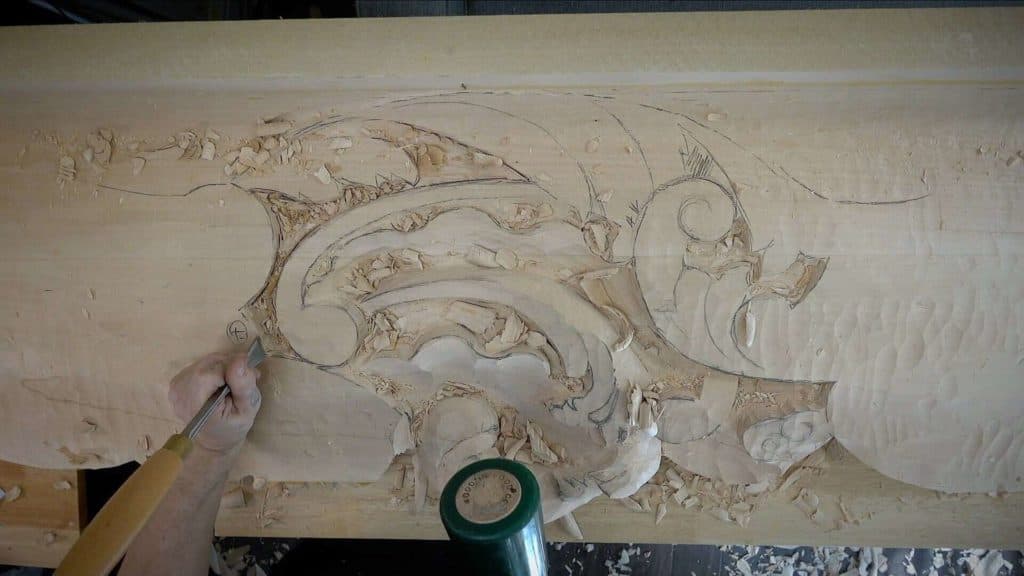
Quick answer: In video 5 of this lesson I talk about a rotating down cut that takes out plugs, and I call it one way "to do that type of work." Other lessons of mine use the same phrase beside a rasp, a marker pen and a drill, and beside a blower and a scroll saw.
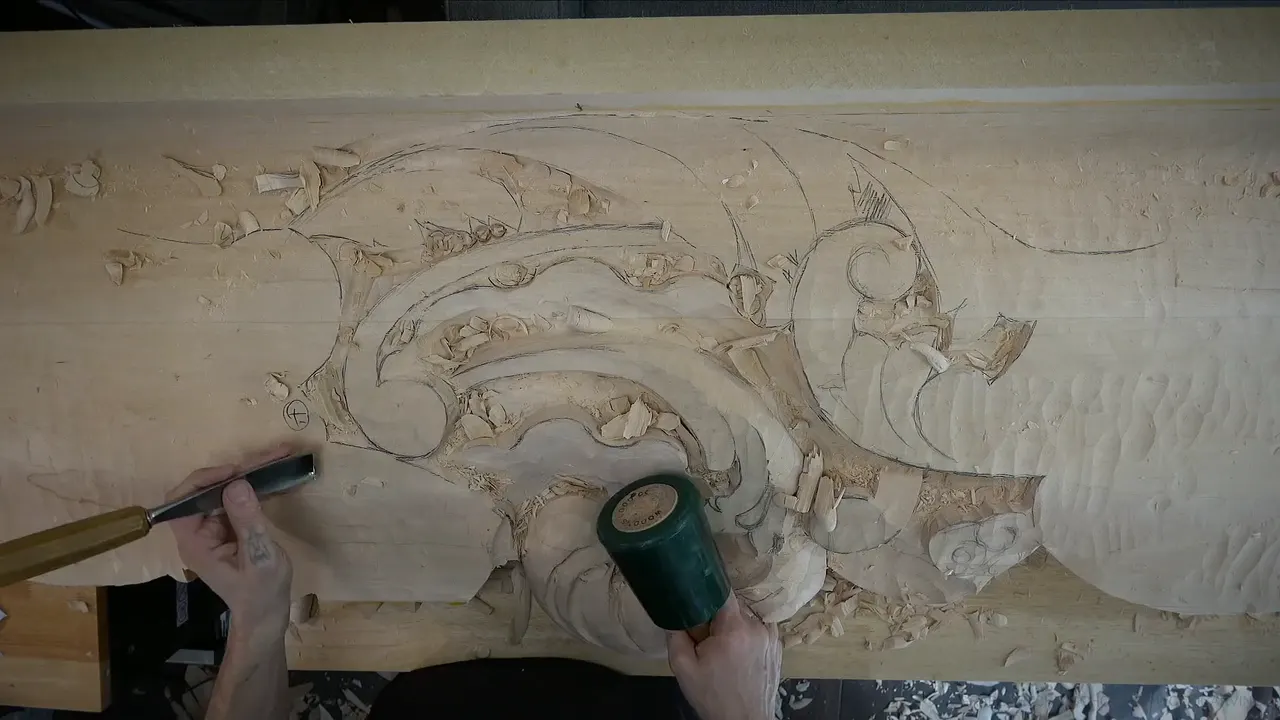

In part 5 of Venice Room 3, I say that when you rotate and make a down cut, "it just removes plugs" and then I say "So one of the ways to do that type of work." Other lessons of mine put the same words beside a rasp, a marker on plastic, a drill, a scroll saw and a blower. Each lesson I name is linked, and a table near the end lists them.
Ever watched a carver finish a move and wondered what else he could have tried? Here are my own words from that video, and from the lessons where the same words come right before something else.
What this page holds
- The gouge sizes and the plug cut of part 5, with my words about the wall.
- Three more parts of this lesson.
- Other Venice Room workshops, then Furniture Panel, Hashemi Flowers, Roman Acanthus, the Maine class and more.
- A table of those videos at the end.
What do I say in this part?
The part starts with a gouge pick: "Let me use number five and 35 millimeters, inch and a quarter." That is about 1.4 in. Next I say "clean little bit the outlines, which is still too big of a sweep. I'll use number two."
A swap follows. "Well, actually, I can use the number seven. Number seven right here. It's going to fit perfectly." I add "Perfect fit" and "I can always clean with number five or even, in this case, number seven."

Then come the sizes. "I'm sorry, number nine and 5/8 of an inch, 16 millimeters." "I need something smaller right here," I say, and a number nine is sized "maybe let me see, 10 millimeters, 3/8 of an inch." For smaller still I plan "like a quarter inch, number nine" (6.4 mm). A bigger one follows: "little bigger, number nine. Half an inch" (12.7 mm). Of that one I say "that's actually little bigger than half an inch. Maybe about 15 millimeters, I'd say" (0.6 in).
On depth I say "I can go deep because I want to see that shadow."

"Let me chop little bit right here" is my plan. Next I explain: "See what happens? When you rotate and create a cut downhill, I mean, down cut, so it just removes plugs." And "So that way you can go whatever depth you need. You can pre-establish how deep the cut's supposed to be and just work around that hole." Right after that come the words from the top of this page.

The wall comes next. "Now I'm going to need to clean a little bit the side," I say. "I'm talking about this wall." My first thought is "Maybe number five will do" and right after that comes "No, it's a little too risky." Then "I should use probably just the number three." After that, "I'll use the number three and one inch" (25 mm). I plan to do "exactly the same on this line" and I say "I just want to make sure I'm not undercutting."

What do parts 4, 6 and 11 of the same lesson add?
The block removal comes at the end of part 4, in my words: "I'm just cutting from both sides and just removing blocks. You see? It's just like that." "I use that technique a lot, actually, to go really, really deep if I need to," I say. The depth I name is "about an inch or even deeper, inch and a half, if I wish." That runs from 25 mm to 38 mm. It would give me "a lot more dimension, especially this part going to go underneath, so I really need the depth."

In part 6 there is a tool plan and a catch: "I could actually use number three, just a spoon gouge." Then "Well, actually, I need to cut a little deeper. I didn't cut deep enough right here." On the shell: "I don't want to destroy my shell. I want to keep my shell."

The page for lesson 3 also holds part 11, where the words sit beside a way to measure depth. "When I'm doing a clean cut down and clean it like that, it gives me a really good idea of my depth." It is "also" a way "to measure the depth," I say.

Which tool comes next in other Venice Room workshops?
The words follow, in Venice Room 28, video 4, "So which means I safely could excavate a little deeper on the sides of the eye." The tool I name is "number seven and four millimeters or so and kind of get in." Four millimeters is 0.16 in.
A bend shows up in Venice Room 29, video 3: "just the back bend, maybe number five." I ask whether it is "too big of a sweep" and then "Maybe not."
For Venice Room 58, video 8, I say "just to take a big gouge and start your excavating" and name "maybe number eight." A warning follows: "Although I have to be really careful how I do it because the grain."
The plug cut is the subject of video 2 of Venice Room 60. I want to "create a deep shadow" and I say "I think it's my favorite way anyway, just to get my plug cut." Then "the only problem is the angle of this plug. I can't go in underneath of this leaf with a straight tool." And "I really need that shadow."

Not every way is the safe one. In Venice Room 72, video 9, I say "I could start with my back bend pretty much, and pre-establish whatever the convex part I want to see." Then "It's not the safest way, by the way." And "fibers are tearing, but it's going to give me approximately the depth."
A chop appears in Venice Room 14, video 4: "I could just chop like that and clean it like that, but it's not the way I like to do." I go on with "I like to do what the original carvers did." I plan to "start my concave cut from almost nothing, almost no pressure at all."
What else do I put those words beside?
A blower enters in video 4 of Venice Room 33, for the chips. "Oh, by the way," I say, and then "to clean all those chips without air compressor taking all the space." The tool is "a blower like that." And "It doesn't create too much mess as an air compressor."

A pen does the job in Venice Room 39, video 3: "how to recreate, and I use that pretty much a lot, I just draw with the marker on plastic." My reason: "if I want to reuse that detail on the same design in a different position, I can just always flip and do that."

In Venice Room 54, video 7, I draw a circle: "find the best place for the separation if you want to be authentic to that period, so you kind of draw the circle, like this."
A rasp comes with the words in Venice Room 46, video 5: "think maybe it's not bad idea at all, just use a rasp just on that edge." About the edge, I say "I create really nice and gradual movement."

Shadows are the topic in Venice Room 62, video 5: "I don't have a lot of depth to give a frame, but I still need to get about the same amount of shadows." Then "Just exaggerate those pipes. They're going to cast some shadows."
One limit is named in Venice Room 57, video 8: "there's a limitation of this technique. The limitation is it doesn't taper."
Then Venice Room 36, video 6, says it outright: "that is not the only way to do, actually, this operation. There is multiple ways how you can approach this."
Where else in my courses do these words turn up?
Furniture Panel, lesson 19, video 3, has a finger doing the work: "this same finger just goes right on top of that molding, and it just gives me really, really good control." Then "how deeply my tool going to penetrate inside of the fibers." I call it a way "to control it" and I say "There's more than one."

A second way comes in Furniture Panel 15, video 6: "Another way, which is also probably one of my favorite ways, just get number 11 and 3 millimeters and just outline it." The 3 millimeters come to 0.12 in. Then "We're going to get exactly the same results with this technique."
Small flowers are the subject of Furniture Panel 23, video 6. "You can do them in different ways." Then "just excavate on inside, take a small gouge just like that. Okay? Place it and rotate a few times and just excavate and pop out that middle part." Later: "Maybe that tool was little too big. That's okay."
A drill turns up in Hashemi Flowers 45, video 3, for a deep spot. "A couple ways I could do that." Then "sometimes I do, I just take a drill and a tapered bit, and I drill that inside."
Hashemi Flowers 11, video 2, starts with "a couple ways, definitely." Then "we could take the same V tool, like number 16, and six millimeters, and carefully working against the grain." Six millimeters come to 0.24 in. Then "keep an eye how much pressure you create."

Roman Acanthus 16, video 3, has "to make it look more classical. So there's multiple ways." And "I really like a really sharp edge, but I want to be more authentic, in this case, to history."

The Lily Box course, lesson 7, video 12, goes back to fit. "Couple ways I could approach it." Then "if you do have a bigger tools, you can find really matching profile. And in my case, it's one inch and number five, and kind of give a cleaning cut." One inch is 25 mm.
In Grape Onlay 8, video 2, I say what I showed you is a way to twist the look of the leaf. Then "But there's a lot of different ways."
In the Maine class, class 2, video 3, I say "you could take it to the scroll saw and scroll this out which is going to be the easy way." Then I ask "how would they attack those areas" and say "I mean you can get the drill and just drill it."

The sharpening course has the words in the stropping lesson: "just a piece of leather." Then "Or belt, old leather belt." I call it a way "to strop it."
Big tools vs small, from the Woodcarving Techniques Q and A, takes the words away from the bench: "Three different ways" to get to a class, I say, and the first is "just to buy airplane ticket, fly to closest city." Then "It's one way, airplane. The second way, I could actually, like I said, I really wish to buy" a van, "and just to drive and enjoy the road."
Which videos hold these words?
This table lists the videos and what each one puts next to the phrase.
| Video, or the course named | What I say beside it in the video, in a few words |
|---|---|
| Lesson 3, video 5 | Plugs removed, then working around the hole |
| Video 11 of that lesson | Measuring the depth with a clean cut down |
| Venice Room workshop 28, video 4 | The number seven at four millimeters (0.16 in), to get in |
| Workshop 29, video 3 | Back bend, and a check of the sweep |
| Venice Room 58, video 8 | Big gouge to start the excavating, maybe number eight |
| Part 2 of workshop 60 | My favorite way to a deep shadow, the plug cut |
| Video 9 of workshop 72 | Back bend again, and not the safest way |
| Part 4 of workshop 14 | A chop, and what the original carvers did |
| Workshop 33, video 4 | A blower, to clear all the chips |
| Lesson 39, video 3 | Drawing on plastic with a marker, to reuse the detail |
| From Venice Room 46, video 5 | Just a rasp |
| From Venice Room 57, video 8 | A technique with a limit, and the beads do not taper at all |
| Furniture Panel 19, video 3 | Finger on the molding, to control the depth |
| Hashemi Flowers 45, video 3 | Drill with a tapered bit, for a spot that has to go really deep |
| Roman Acanthus 16, video 3 | Making it look more classical, and there are multiple ways |
| Maine class, lesson 2, video 3 | Scroll saw, or a drill |
| Woodcarving Techniques Q and A, Big tools vs small | Airplane ticket, to get to a class |
This lesson has its own page, lesson 3 of this course, and the whole course sits on the Venice Room course page. The Hashemi course has its own page too, Carving Hashemi Flowers. Each video named here is inside tuition to the school, paid monthly or yearly and renewed automatically until you stop it.
Never held a gouge? Start with first cuts for beginners. My tools have their own course, All About Tools for Wood Carving, and Carving Tool Sharpening is the course for edges. Wikipedia has short pages on wood carving, gouge, millimeters, mallet, molding, acanthus, air compressor, leather and Venice.
How it's done
- Pick a gouge that fits. Of the number seven I said "Perfect fit."
- Go deep where the shadow is. The reason in part 5 is the shadow, and I said "I can go deep."
- Rotate to take out plugs. A down cut like that lets you go "whatever depth you need," I said.
- Clean the wall with a smaller gouge. My plan for the wall was a number three at 25 mm (1 in).
Frequently asked questions
What comes just before the phrase in part 5?
A down cut with a rotation. I said you can "just work around that hole."
Would number five do for the wall?
First I named it, and then I said "No, it's a little too risky." A smaller one, at 25 mm (1 in), became the plan.
Which gouge was a perfect fit?
Number seven, which I said fits "right here." Then "Perfect fit," I said.
How deep could part 4 go?
What to carve next