
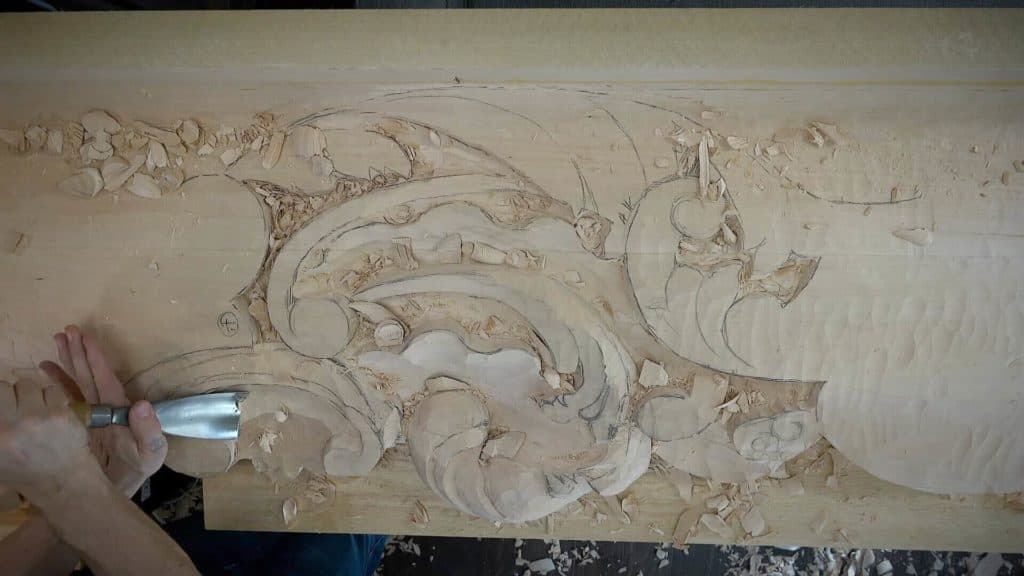
Alexander Grabovetskiy, woodcarver, School of Woodcarving · Published 2023
What does a wood carver mean by "good progress"?
Quick answer: At the close of Venice Room 3-8 I used with the words good progress, after naming two gouges and saying I would leave about 20 millimeters (0.8 in) of thick wood to work with. Other videos of mine have the same word, said about other work.
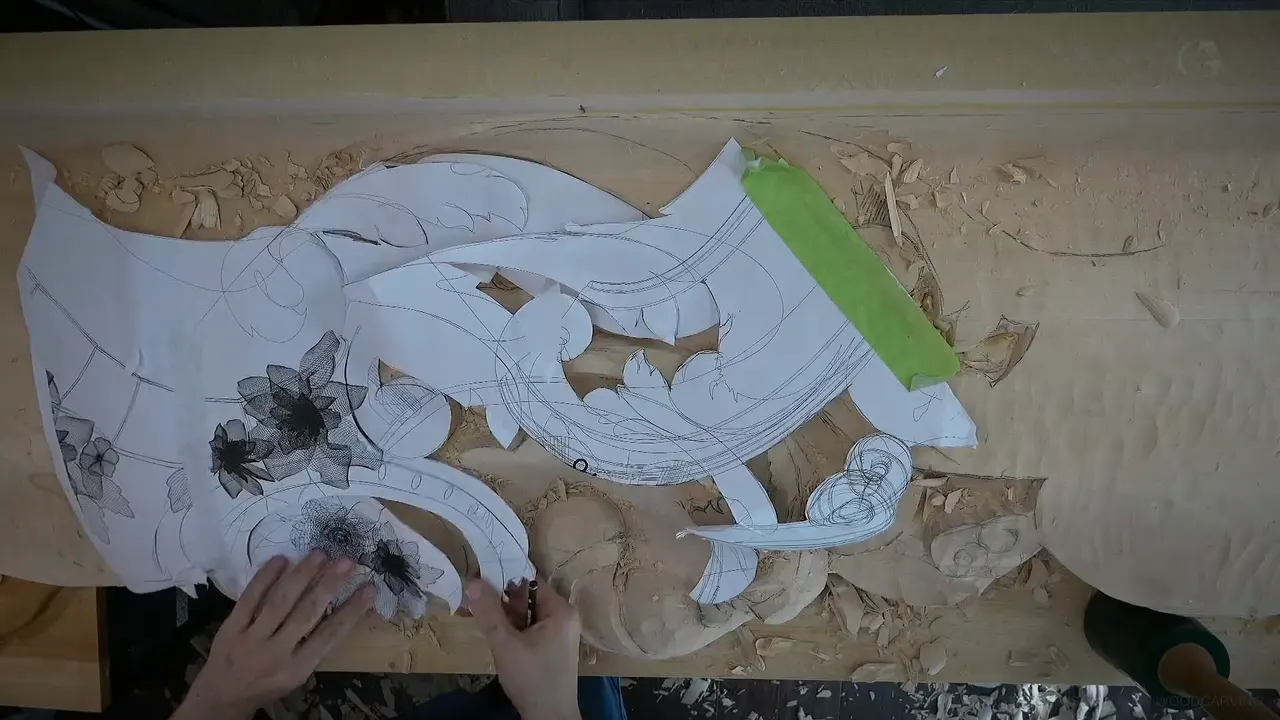

Good progress is what I said at the end of Venice Room 3, part 8, with a number nine and a number seven gouge named along the way. The line is "Okay, wonderful. I think it's good progress."
Ever stood back from a board and asked yourself whether you got anywhere? Do you like to check a piece against what you meant to do? Then here are my words from that video, and from other videos where I say it too.
What this page holds
- The flowers I planned to apply in part 8, and the wood I planned to leave.
- Lines from parts 7, 9 and 12.
- Workshops 9, 59, 66 and 68 of the Venice Room, then my Furniture Panel lessons.
- Beginner and sharpening videos.
- Livestream and lockdown videos, with a table to finish.
What did I decide about the flowers in part 8?
Part 8 opens with "that can go down, and we're going to have some flowers right there later on." Next I say "Well, actually, you know what? I'm just thinking maybe the first layer, like the leaves, I could actually do from the same material because some of the leaves going right on top."
The following lines read "And that would be probably a mistake if I would just apply them. Maybe not a mistake, but let me see. Should I or should not?" After that: "Maybe not. I'll just completely apply those flowers and save myself some time because those leaves, they're taking time."

Which gouges and how much wood did I name?
The tool comes next: "I'm going to take number nine, a huge one, 35 millimeters, inch and a quarter." Thirty-five millimeters is about 1.4 in. Then I say "And yes, I can go really far on this point because it's going to be just a leaf of the flower, and it has to be tiny anyway."
The wood I plan to keep gets a number. "I'm going to leave approximately maybe 20 millimeters, about three-quarter of an inch thick material to work with. And the rest of it could be gone." Twenty millimeters comes to roughly 0.8 in, a little under an inch.

A second tool shows up. "Let me use number seven, 3 inches," I say, which is 76 mm. Later comes "And again, 20 millimeters, number nine" and then a line about direction: "But it would help me if I were just to do it in the right direction."
Close to the line, I say "Okay, I don't want to undercut it, and it looks like I'm already getting a little too close to the line. Got to be careful." The seven comes back as "3 1/8, 80 millimeters," about 79 mm. Then "Okay. That is good."

What do the parts next to it say?
In part 7 I say "Oh, it's a mess" and then "Okay, wonderful. Okay. So I see the main movements right here." About the shell I say "Well, this shell is not how I want to see it." One section "has to go down even more" and "I think it has to be going down quite a bit." One more line from that part: "I should use a pencil, not a charcoal."
A paper turns up in part 7 as well. I say I will take a paper again, and of the flowers I say "All I need is just the indication, okay? Hope you get it." Of a line inside I say "And I still don't have any idea what is this line inside." Further on: "I need to make a little deeper cut. Now I can see it."

A plan follows for the carving itself. The plan is number nine again, and "I carefully, carefully going to attack from this side." I plan to make that side a little lower and fix it later on, and "at least I want to give overall shape right here."
Over in part 9 I say I will work on the center's left side, and "I'm not working on details yet. I'm working only on a main idea, okay?" After that I say "Just on the main idea."

Also in part 9: "I think I should probably use some kind of pushpins. It would help me a lot." Then "I can probably do my shell outline." While I trace the lines, I say "I am using an 8B pencil. I really like the idea that it's soft." Of the details, I will develop some at the moment I carve them, and "It's just preliminary."
Part 9 has a tiny cut in it, and I say "I know it's almost impossible to see on a camera because it's just a tiny cut. But it's all right." Another line reads "I don't like what I see right here. It's not flowing. The movement going to go upward like that, so right on the ceiling." Near its close I say "Let me double-check if I missed anything, because I really don't want to miss anything. And nope, looks fine."

In part 12 of this same lesson, Venice Room 3, I use the word for a fast stretch. "Sometimes you're working like Speedy Gonzales and you're doing a lot of progress," I say, and then "in some spots it gives you so much trouble sometimes, and you're not able to move past that place for the whole day sometimes."
Where do I say progress in other Venice Room lessons?

In Venice Room 9, part 10, I say "Remove some of the background. I hope you already see the progress." The line before it is "Kind of outline around. That's what I need to do." There is also "I could just give a little bit of a shape because it's still going to make sense to give some shape". And "so far it looks good."
Venice Room 66, part 10, has the word too. "Here's what my progress is. I did some work just off camera, and I think I just want to explain what I've done. Okay? Because it's actually nothing special." Next: "I excavated that eye, excavated that inside right here, and like I said, nothing that special."

More from that part: "You saw the main idea, how I developed that, and now it's all about the detailing and just the getting extra divisions and stuff like this." Also "we have three main divisions, and then I divide those divisions in another three." Then "I'll just try to develop this side. I'll take care of cleaning up later."
In Venice Room 68, part 6, the line is "I know it doesn't look like Acanthus. I know it doesn't, but it's okay." Then "It's in progress. Actually, I can start blending pretty much." The next words are "And this side going to go almost all the way down to our first layer because I really need a really good, smooth transition."
Further on in that part: "I don't need that high. I could actually use even three inches again just to establish the main form, the main movement downhill." Three inches is 76 mm, and the plan is to blend. Later: "Very simple. Really simple acanthus."

Venice Room 59, part 2, has the word near an installation. "That's going to be in another country." Then "And yes, I will go there and just watch the installation progress." I do not think I will be able to make a picture, I add, unless they let me.
How does the word sound in the Furniture Panel course?
The second Furniture Panel course has it too. In lesson 23, part 10, I say "Well, we are getting there little by little. So we got some progress. So let me continue to work on this flower." My plan for the gouge is "number eight and 7 millimeters. Really, it doesn't have to be number eight, 7 millimeters, but any small gouge will work." Seven millimeters works out to about 0.28 in.
The flower gets a shape plan in that part: "So it has to roll that way, and the opposite side is going to roll that way. It's going to give us some roundness." And "I know approximately the movement of my flower, so I can actually start my rolling movement like that."

Furniture Panel 22, part 7, has this: "Some of you sent me pictures, and it made me feel really good. I'm talking about this project, okay? So you are working along with me and you're doing a really good progress." And "when I look at those pictures, it means a lot to me. That means I'm not doing it in vain."
The same part adds "But on the other hand, now some of you do understand that is not as simple as it looks. It takes a lot of time and a lot of control" and "It trains you to control micro cuts."

In Furniture Panel 36, part 1, a lesson of its own, I say "that is actually just in progress yet." And "working on it." Of what is left I say "multiple flowers" and "some leaves and so on."
What about my beginner and sharpening videos?

The word shows up outside carving, too. In Sharpening Straight Gouge, video 3, I say it is time to change the wheel from coarse grit, which is 80, and flip it to the other side. Then "So let's see the progress. So you can see it's already clean and kind of nice, even with the 80 grit." Also "It's not about how much pressure you create. Also, pay attention. The pace of your rotation of your tool."
Then comes the name of a stage, "This stage is stage number two. The first one, if you remember, it was grinding." Later in the video: "we have to remove all the coarse marks. But you can see it's already taking really good shape."
In Beginner Workshop 4, part 4, of the cutting board course, I say "And you see what I'm doing." Then "If you can blow, and all the chips, the smallest ones, even if they fly out, so that means the progress is really good."
In First Cuts for Beginners, workshop 1, I talk about an email from someone interested in the school. He asked what level he would reach in one month, in two months, and in a year. My answer: "that's hard to tell because it's impossible to tell. It all depends on you and only you and the progress only you do." Further: "I show what to do, but if you're not working on it, so you're not going to get any results."

In Flower Rosette 7 I say "I am leaving those rosettes just like it is. I'm not doing any sandpaper, anything." Then "that is our rosette 100% done." Later "So you just make pictures of your progress, of your work. You can upload some pictures."
Do I say it about finished work, too?
In my April 2020 livestream I say "Here you go. That is the progress. Okay, so you're looking at the left side." Of the piece I say "you already see those shadows, they're giving me pop." And "that is just only one detail out of many details in this room."
A viewer asks what the piece will be, and I answer "So that piece, it's only 10 feet section. It's a big piece. It's only one section of the whole movement in a room." Ten feet is about 3 m.

The lockdown video has the same use: "Let me just show you the progress of this piece." In the same sentence I plan to take a gouge, a chisel and a veiner.
Which videos hold these words?
| Words | Source |
|---|---|
| Good progress, wonderful | Last words of the video, Venice 3.8 |
| A lot of progress | Fast days on a board, Venice 3.12 |
| Hoping you see it | Outlining and removing some background, Venice 9.10 |
| What my progress is | Work done off camera and extra divisions, Venice 66.10 |
| It's in progress | Ahead of a plan to blend a side down, Venice 68.6 |
| Watch the installation progress | A plan to go there overseas, Venice 59.2 |
| Getting there little by little | Before a flower gets its roll, Panel 23.10 |
| Doing a really good progress | The pictures that came in, Panel 22.7 |
| Just in progress yet | More flowers and leaves still to do, Panel 36.1 |
| Pictures of your progress | Once the rosette is called 100% done, Rosette 7 |
| Clean and kind of nice | A wheel to flip to a finer grit, Straight gouge 3 |
| Progress is really good | The smallest chips that fly out, Cutting board 4.4 |
| The progress only you do | An email about the level after a month, First Cuts 1.1 |
| Here you go | The left side of a big piece, April 2020 livestream |
| This piece's progress, shown | Planned tools, a gouge, a chisel and a veiner, Lockdown video |

Where does part 8 sit in the room?
This part sits in lesson 3 of the room, and the whole course is on the Venice Room Part 1 page. The videos I name are all inside tuition to the school. Come and watch part 8 at the wood carving bench with me, then step back from your own board and look.

How it's done
- Start from the main idea. Part 9 had me working only on a main idea, with the details to come at the moment I carve them.
- Decide what to apply. My plan in part 8 was to apply the flowers completely, since the leaves take time.
- Leave wood to work with. I planned to leave about 20 millimeters (0.79 in) of thick material and let the rest go.
- Say where you stand. Part 8 closes on a short verdict about the work, and the word progress is in it.
Frequently asked questions
How does part 8 of the third Venice workshop end?
The video ends on the word wonderful and then a short verdict on the work. Before that I named my number seven as 3 1/8, 80 millimeters, roughly 79 mm, and said "That is good." The last line itself is "I think it's good progress."
How thick was the wood I planned to keep?
Maybe 20 millimeters, near three-quarters of an inch (20 mm is about 0.79 in), for me to work with. And the rest of it, I said, could be gone. The number nine I named first was a huge one at 35 millimeters (1.4 in).
What did I plan for the flowers in part 8?
To apply them completely and gain time, since the leaves take time. Earlier I asked whether the first layer of leaves could come from the same wood, and I answered myself with a maybe not. The flowers themselves, I said, would come later on.
What to carve next