
Alexander Grabovetskiy, woodcarver, School of Woodcarving · Published 2023
What pencil grade do wood carvers use to draw on wood?
Quick answer: An 8B pencil is the soft pencil I named in part 9 of Venice Room 3. It's soft, and I like that, I said, and I get good results from it. A harder one or a 2B would do too.

My pencil in part 9 of Venice Room 3 was an 8B, a soft one, and I told you any pencil would do. Other lessons of mine name softer, harder, short and colored pencils, and a few pens. A table near the end lists them, each one linked.
Ever held a pencil over a clean board and wondered how soft it should be? Did you pick it up without thinking about the grade? I named my grade in a Venice Room video, so here are my own words from it and from the lessons where I reached for something else.
What this page holds
- My words from part 9, in the order I said them.
- The same grade in the first workshop.
- Softer, harder, short and colored pencils, and a pen, from other videos.
- What a pencil leaves on the wood, and the colored pencils I took instead.
- A table of the videos.
What did I say in part 9 about my pencil?
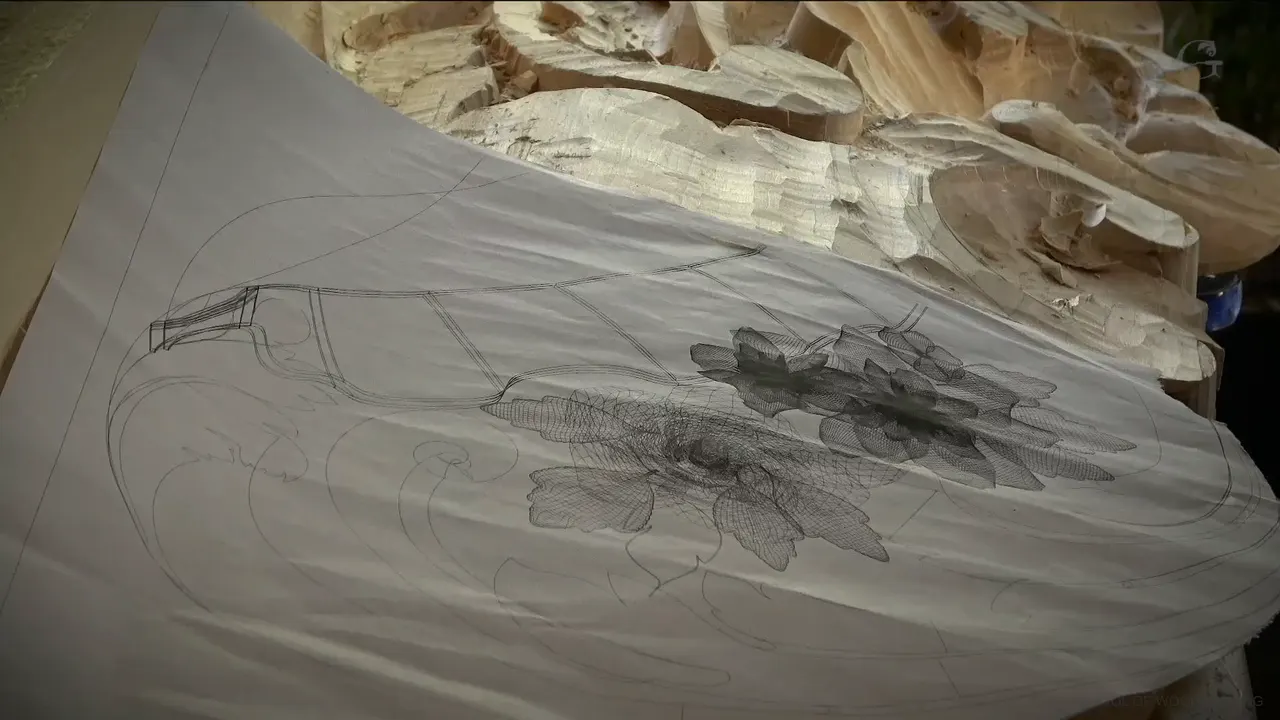
My plan for the part was the left side of the center. "I'm not working on details yet," I said, "I'm working only on a main idea, okay? I hope it makes sense." Then came a thought about pushpins: "I think I should probably use some kind of pushpins. It would help me a lot." Next I said "Let me position it approximately where it's supposed to be, which is right there."
"And this side has to go lower," I said. Then "Probably turn my camera angle and you'll be able to see it." A line came next: "I don't know what I don't like about this line, but that's okay." My plan was "Let me create my cut and then I'll figure out what is going on right here."
I named a part of the design, "that would be another acanthus development right here." Then "now I can probably do my shell outline."
Next came a word about the Rococo and Baroque styles. "By the way, Rococo style, some people don't really understand what's the difference between Rococo and the Baroque style," I said. "The biggest difference, Rococo, the name of it actually, just Rococo, means shell. Okay? That's the meaning of it." Then, about the flowers: "those flowers, I can probably develop later as a separate layer."

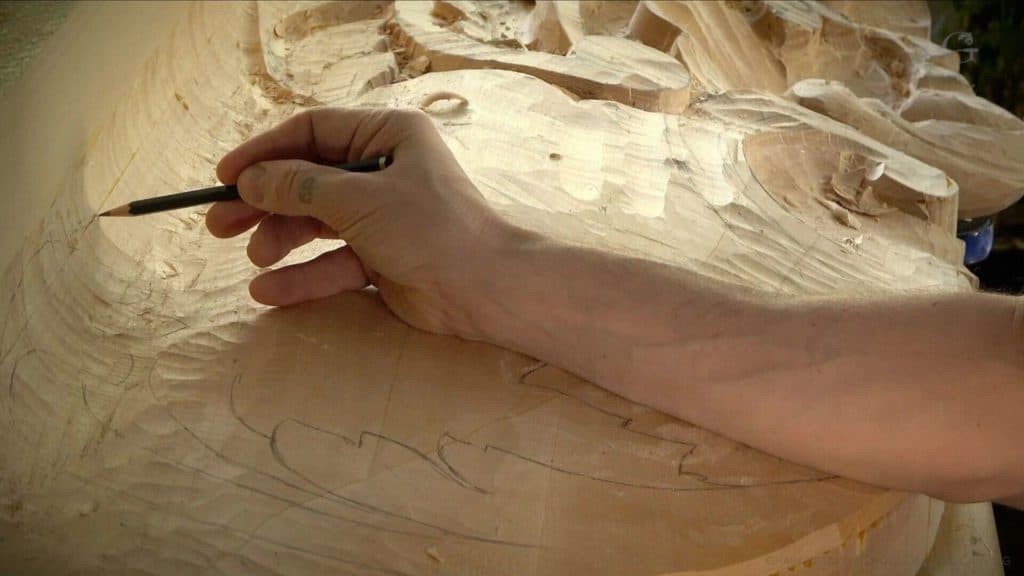
Now the pencil. "And now I'm going to trace it with the pencil," I said, and a little later "I am using an 8B pencil." Then "I really like the idea that it's soft."
My line about the grade came next: "You could use any pencil. You could use 2B, you can use harder ones or soft ones, so it doesn't really matter." My reason for this one followed: "But I really like this one because it's soft, it gives me good results." Then "All right. So now I can clearly see my lines."

"It's just preliminary," I said, and some of the details I would develop right at the moment I carve.
One line was hard to see. "I probably should cut a little deeper right here because I can't really see the line," I said, and "Unless if I can use some light." Then "Yeah, that's better now." "I know it's almost impossible to see on a camera because it's just a tiny cut," I said, and "Sorry if it was in your way."
Back on the design: "And my shell is going to continue underneath, and that is going to be the flowers." On one spot I said "I don't like what I see right here. It's not flowing." The movement was "going to go upward like that, so right on the ceiling." Then "So let me start digging" and "Let's do that." Nothing in parts 8 and 10, on either side of this one, names a pencil.

What did the first Venice Room lessons say about pencils?
The same grade sits in workshop 1 of the Venice Room, video 12: "And I'm using just a pencil. And in this case, I'm using just a 8B pencil. Okay?" "Really soft," I said, and then "You don't have to use really soft, but again, I'm not going to do the details. I don't need the details as of now." Last came "You can use any pencil, pretty much. I just like that just so soft I can do quick outline." Before all of it I had said "that is a big shell. All right? And let me outline it."

Does the grade of a pencil matter?
In Venice Room 67, video 10, I said "And I'll use just a HB pencil" and "It doesn't really matter. It's not about the pencil I use, okay?" Then "It's not about the pencil I use." About my middle line I said "it has to be pronounced." I even said "I even don't need to draw anything. I can probably just do by eye."

Furniture Panel 14, video 4, gives my reason for keeping charcoal off an area: "I shouldn't touch it with charcoal yet, this area, because it's really hard to get rid of the charcoal." A little later came "the reason why I don't use charcoal right away, because like I said, it's really hard to erase it. Almost impossible to erase it. So it's better to use some kind of pencil."
Then "Any pencil will do, but in this case, I'm using 8B. Now, 8B pencil, it's really soft. But any pencil, 2B, 6B, 4B, even the hard ones are also going to work out. No problem." Earlier in that video I had said "I kind of like the charcoal" and "Although it leaves my hands dirty, but it's okay."

When did I reach for a softer or a harder pencil?
Over in Furniture Panel 12, video 2, I was working on leaves and filler flowers, and I said "Let me use a different pencil, maybe a softer pencil a little bit, let me do a 4B." Video 3 of that lesson has "I kind of like it, but let me also with the softer pencil, maybe make the ends of those two intersecting details looking like that." The next line was "I think it's going to look better."

A softer pencil comes up again in Furniture Panel 13, video 1: "And let me get the softer pencil and kind of make another petal underneath." Those are plans in my words, and each one names a softer pencil.
In Venice Room 32, video 6, I went the other way: "Okay, let me put the final line, but I need the really sharp pencil, I think, and maybe harder pencil I should use, maybe like a 2B pencil." And "let me think how thick I should leave that edge." Every grade there is a maybe.

Then, in Venice Room 64, video 11, "my pencil broke," I said, and "After a few attempts of sharpening my pencil, I've got my beautiful and not cheap pencil, 8B, really short." Then "But I'm glad I have a lot of them, okay? I have a lot of them."

Other lessons keep it to a few plain words. Over in Hashemi Flowers 30, video 1, I was talking about a flower in five petals, and I said "You can divide in seven if you wish, or eight" and then "get different pencil." A marker comes up right after "Take a different pencil" in Hashemi Flowers 33, video 1. Hazelnuts 2 has "And I don't have any colored pencils close by, but let me actually find one" in video 2.
Acanthus over Moldings 2, video 1, brought a different tool for the line: "Just mechanical pen." I called those "cheap ones" and I said "I do have some expensive ones, I really don't need expensive ones." Then "it gives me good result. It just kind of somewhat fine line." Beside it I said "that one I don't have to sharpen all the time."

What does a pencil do to the wood?
In Hashemi Flowers 49, video 2, I said "I am using my pencil just because I'm filming it." Next, "I try not to use pencil. I try to avoid as much as possible pencil use." The reason came in my next words: "the pencil marks and pencil itself just makes your carving dirty."

Both sides show in Hashemi Flowers 43, video 4, within seconds, and I said I would pick up a marker because I was filming. "But I encourage you not to use marker, just to use pencil. It's better. Well, I'm not sure if it's better or not. Actually, pencil is also not the best idea because your piece becomes really dirty after too much use." Then "What you could use, actually, just a V tool. Use as a marking tool and make some cuts."
In my April 2020 livestream, I said "pencil I'm using right now, it's a 8B. It's really soft pencil. That's what I'm using." Then "Usually, when I carve, I don't use those pencils, because they leave a lot of dirt markings. It's better to use a marker because it doesn't leave that much. But sometimes I'm just grabbing."

Another livestream that month, on the 14th, has the grade too. "what type of pencils I prefer. And I prefer 8B, which is really soft." Later: "8B pencil. Okay? So 8B pencil, it's excellent pencil." I called it "little inexpensive side, but I love that." And then "that is a little softer. You got to be careful to do that on the wood because you can leave marks. Okay? I'm talking about it's going to become dirty."

Next, workshop 76, video 7: "Of course, I just got really dirty, that doesn't look too good, that's why I hate pencils sometimes. Let me clean that little bit."

Why did I reach for a colored pencil or a marker?
A line I could not see sits in workshop 5, video 6. "And I don't really see this line. I need to probably use a marker or colored pencil. Let me use just a colored pencil for this middle line, it does not work, I can't really see." Then "red one. Okay, that is better."

A red marker comes up in workshop 75, video 5: "And I'm using red marker, I shouldn't probably use that red marker because it penetrates deeply." Then "But maybe I just should to switch pencils. Just color pencils. For future, that's what I'm going to use. It is better."

The sixth video of that workshop has "I promise I'm not going to use marker right now." Then I named a blue pencil, and after it a teal or teal-ish one.

The Dining Table Apron 15 video answers people who asked about my pens. "this is architectural colored pens, and they are dry safe, so they don't bleed through the paper. That means it's not penetrating deep inside of the wood grain." And "I'm safely using different colors."
Which videos carry these pencils?
Every video below carries a pencil or a pen, with my words beside it.
| Source | My words beside the pencil |
|---|---|
| This part, workshop 3 | A soft 8B pencil, and any other pencil too, even a 2B |
| Workshop 1, video 12 of the Venice Room | Really soft, an 8B pencil, so I can do a quick outline |
| Workshop 67, video 10 of the Venice Room | A HB pencil, and a middle line that had to be pronounced |
| Furniture Panel 14, video 4 | Charcoal that is hard to erase, so a pencil, here an 8B |
| Video 2 of Furniture Panel 12 | Different pencil, maybe a softer one, and a 4B |
| Same lesson, video 3 | A softer pencil for the ends of two intersecting details |
| Part 1 of Furniture Panel 13 | The softer pencil, to make another petal underneath |
| Venice Room 32, video 6 | I need a really sharp pencil, I think, and maybe a harder one, maybe a 2B |
| Part 11 of Venice Room 64 | Pencil broke, then my 8B, really short |
| Acanthus over Moldings 2 | A cheap mechanical pen with a somewhat fine line |
| Hashemi Flowers 49, video 2 | Pencil use I try to avoid, because the marks make the carving dirty |
| Hashemi Flowers 43, video 4 | A marker for filming, a pencil that gets dirty, and a V tool to mark |
| Livestream of April 5 | Pencil that is really soft, an 8B, and pencils that leave a lot of dirt markings |
| Livestream of April 14 | My preferred 8B, called excellent, a little softer, with marks you can leave |
| Venice Room 76, video 7 | A really dirty result, and a plan to clean it |
| Fifth Venice Room workshop, video 6 | Colored pencil that did not work, then a red one that was better |
| Seventy-fifth Venice Room workshop, video 5 | A red marker that penetrates deeply, and color pencils for the future |
| Same workshop, video 6 | Blue pencil, teal or teal-ish, and no marker |
| Dining Table Apron 15 | Architectural colored pens that are dry safe and do not bleed through paper |
Where can you watch part 9?
You can watch part 9 inside workshop 3 of the Venice Room course. The workshop 3 page covers the whole lesson, and part 10 comes right after this one. Everything on the site sits inside the tuition.
What pencil is lying on your bench right now? Any pencil would do, I said, so go to your bench and give your wood carving one more pass with a gouge.
How it's done
- Start to trace. In part 9 I said I was going to trace it.
- Name your grade. Mine was an 8B, a soft one that I like.
- A different grade works. Harder ones, soft ones and a 2B were fine too, I said.
- Look at your lines. After the tracing I said I could clearly see my lines.
- Check the line that hides. I probably should cut a little deeper, I said, and I could use some light.
Frequently asked questions
Which pencil was in my hand in part 9?
An 8B. It's soft, and I really like that. A 2B or a harder one would be fine too, I said.
How soft does a pencil have to be?
In my first workshop, video 12, I said you can skip really soft, and pretty much any pencil works for me. I just like it so soft that I can do a quick outline.
What came up when I wanted a harder pencil?
In workshop 32 I said maybe a harder pencil, maybe like a 2B, and that I need a really sharp one, I think. Those were maybes, and nothing there says which one I picked up.
Do pencils turn into a problem on the wood?
What to carve next