
Alexander Grabovetskiy, woodcarver, School of Woodcarving · Published 2023
Is a 35 mm gouge 1 1/4 inches wide?
Quick answer: In Venice Room workshop 4, part 2, I picked a nine gouge, called it 35 millimeters, and gave it an inch figure. Then came "That is not actually really accurate." Divide 35 by 25.4 and you get 1.38 in, so the closer fraction is 1 3/8.
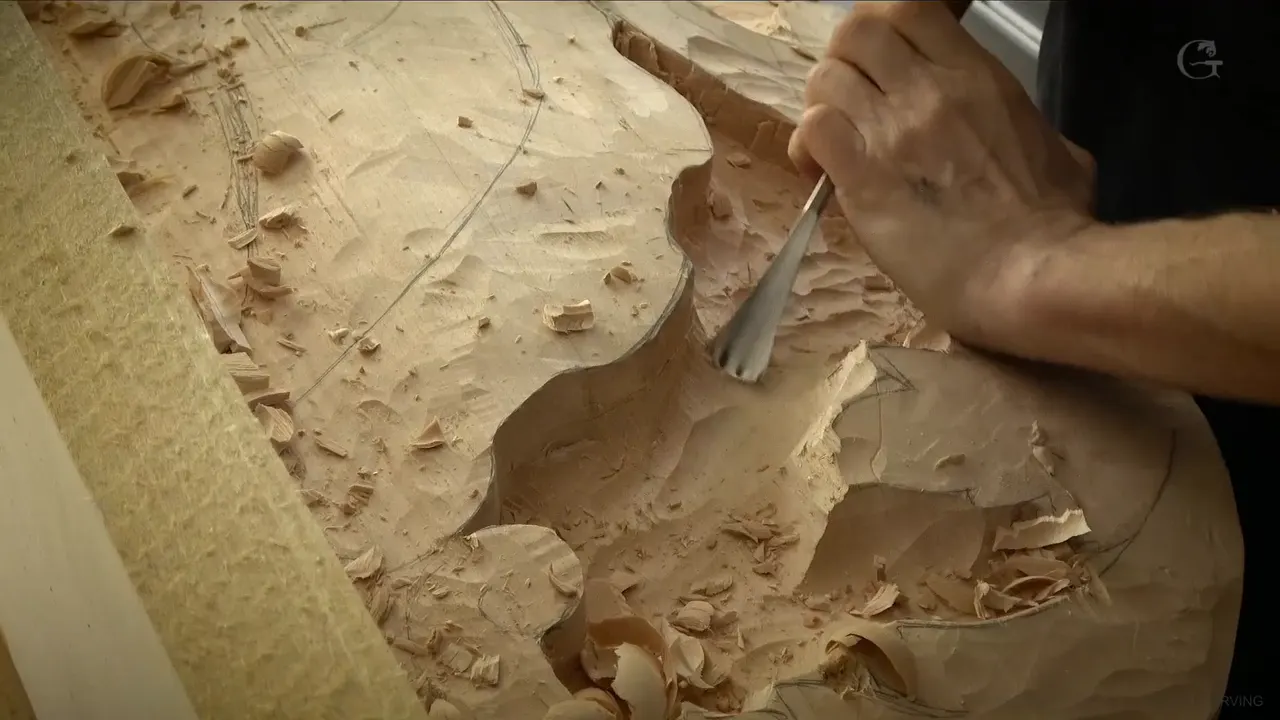

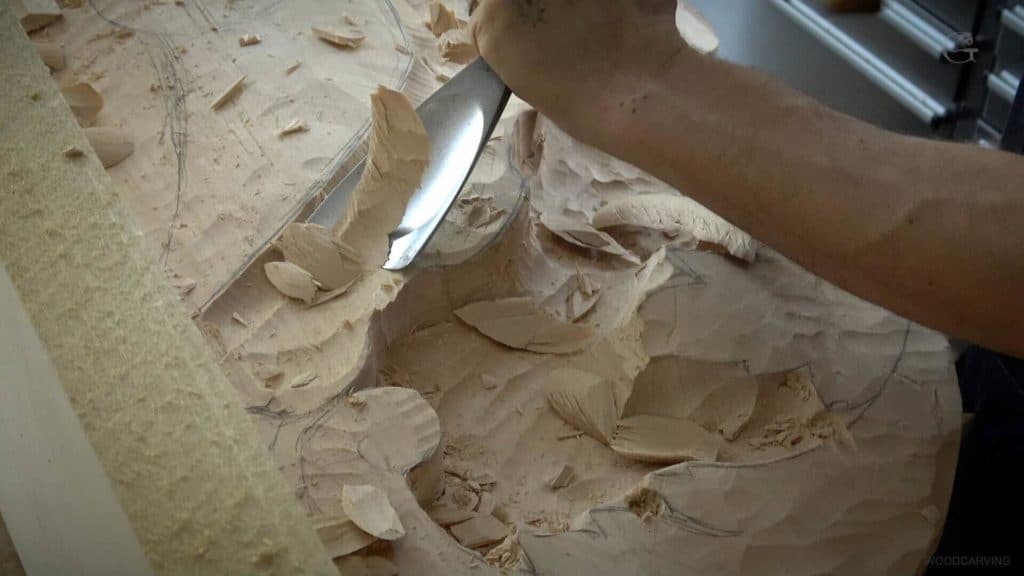
In part 2 of Venice Room workshop 4 I said I would go "really deep right here" and I picked up a nine gouge, naming it 35 mm wide with an inch figure beside it. A moment later I told you that figure was not accurate.
Ever read 35 mm on a gouge and wondered what fraction of an inch that is? I had to fix it myself. Below is what I said in part 2, then the lessons where the same figure turns up next to a tool in one video and a depth in the next. It even shows up beside a screw.
What this page holds
- Part 2 in my own words, including the fix.
- What 35 mm comes to in inches, and what the first figure I named comes to in millimeters.
- Other lessons where the same figure measured a tool or a depth.
- How I checked it, and the number I landed on after a check.
Is a 35 mm gouge 1 1/4 inches wide?
No, and I said so in part 2. First came the pick: "let me take number nine, 35 millimeters, inch and a quarter, and go in." I stopped there: "That is not actually really accurate." After a beat I said "It's not inch and a quarter, I should say, okay?" And I tried again: "pretty close to inch and three-eighths."
The arithmetic backs the retry. One inch is 25.4 millimeters, so 35 mm works out to 1.38 in. A 3/8 on top of an inch is 34.9 mm, which lands almost on the same spot. The 1.25 in that came out of my mouth first is 31.75 mm, or about 32. That leaves my gouge 3.25 mm wider than the number I gave it.
My other pairs in that first stretch of workshops sit closer. My 20 mm nine got "three-quarters of an inch" in part 1 of workshop 4, and 20 divided by 25.4 is 0.79. A 16 mm nine in workshop 3 got "5/8 of an inch" and 5/8 is 15.9 mm. A seven in part 1 of workshop 4 was "one inch, 25 millimeters," which is 0.98 in. Each of those is within 1 mm. My 35 mm pair was the one that drifted most.

What did I carve in part 2 of workshop 4?
The video opens with a squeak from my bench: "It's just my workbench does it, which in this case is just a tool chest on wheels." Why not a normal bench? "I really have to be really mobile," I said. I added "I do have actual wheels, but usually they're still not convenient for me."
The work came next. I explained it this way: "This one has to go above that one, okay?" I also said "I need to lower this down." My tool plan was "I can probably use just the number nine" with "the 20 millimeters." Twenty mm comes to 0.79 in.

Next I turned to an edge. "Now I can take care of this edge," I said, and "I could use just probably number seven," followed by "number three." Then I said "It's not the final shape" and "That's just an indication of overall movements."
The shell came next. "This part of the shell has to go underneath of this line right here," I said. I needed to make sure I was "going all the way" and about the acanthus I said "let me think about this acanthus development, how I want to see it." Last in that stretch came "Or maybe I shouldn't even worry about it."

Then the deep spot. "What I'll do, I'll go also really deep right here," I said. The pick came right after that, and then the fix.

Once the fix was out, I said "Okay, well, got to be careful right here." A plan came with it: "I need to cut inward, inside." The tool I named was "probably big number seven" with "3 1/8" after it, and I said "that's going to be a spot for the flowers."

Near the end I said "Take care of this side." My last line was "now I can continue to work with the big number nine, 35 millimeters" with no inch figure at all.
Where else did I call a tool 35 millimeters?
The same pair of figures sits in several lessons of this first Venice Room course. Back in workshop 1, part 14, I asked whether "a smaller number seven, like 35 millimeters," would work on the inside. The inch figure came right behind it, and then I said "It's a little too big, but that's okay."

Workshop 2, part 11, starts with a 35 mm nine and a reason: "That's going to help me make much quicker cuts." Over in workshop 3, part 5, a number five carried the pairing. Next to it came "which is still too big of a sweep" and then "I'll use number two."

Part 8 of that lesson has "a huge one," a nine of that same width, and my words were "I'm going to start moving around." I also made a plan for the wood to keep: "approximately maybe 20 millimeters, about three-quarter of an inch thick material to work with."
The long chisel belongs on this list. In Furniture Panel 15-11 I said "Now we're going to take number one, and the longer one" with an inch figure, and the metric twin came after it. The next words were "And go down, just like that."

Was the figure also a depth?
Yes. Part 10 of workshop 3 has the same pairing for a depth I planned, about 35 mm. After that: "Got to be careful in corners like that, so let me make a relief cut."

Later in that part I said it again, with a new word: "let's say." And I told you why I said approximately: "because I'm not going to measure it. I'm going to just eyeball it." A change was still possible: "it could change." I could "either go deeper or I could just lower the upper layer."
Part 3 of workshop 4 has me approximately that far "to the lowest part." In metric, that is about 32 mm.

Workshop 39-7 has a question I put to myself: "Do I want to go too deep or not?" Next I gave the distance between two points as an approximate inch-and-a-quarter figure, and planned to round it up later: "we'll see if I should go deeper or not."
Hashemi Flowers 27-2 has the same figure with a hedge, "Almost, I would say" and a promise: "I'll check that." Then: "I have to double-check it, but this chunk has to be gone."

Workshop 74-5 gave me the same figure again: "I've got approximately, I would say" and then "left right in the middle." Then: "probably it's enough because I still want to excavate kind of deep."

Workshop 83-10 was a gentler case. My words were "I think" I could "take down with no problem" about that much. My plan after that: "let me round this side."

How did I check the number?
A check shows in workshop 87-5. First I said "a lot of material needs to be removed" and I gave the figure "to the final height." Then: "Let me double-check." The number that came out was an inch. I added "Well, I do have other calipers. Let me see if I'll be able to make sure I am going to get the same result." The answer: "Yes, about an inch I have to lower that down."

Workshop 79-12 is a drill spot, and the figure there added up. I said I have to drill approximately one and a half inches down, and "That's a lot in this spot." About the inch-and-a-quarter reading I said "there is a quarter-inch difference between my line and the upper part right here." So I said again that I have to drill that depth, which is 38 mm.

In workshop 102-1 I planned a step from an edge and gave it the figure with "maybe about 35 millimeters or so." I weighed it: "Not sure, maybe not." My last words on it were "I think it's going to be better" with a step of an inch. That is 25.4 mm, a bit under what I started with.

Was it a distance too?
Yes. In workshop 43-10 my point would sit that far "lower than this point." Then workshop 53-5: I pointed at a chunk beside a movement and said "I have approximately" the same amount "in this area." After that: "I need to translate that on another side."

Hazelnuts 4-2 measures the gap to an edge, approximately. The line was "I'm just eyeballing it" and then "But you also have to check and recheck."

In Hazelnuts 5-1 I gave a distance from the center, "or something, maybe about 35 millimeters or so" and "Up to you." For the end of the husk I said "approximately 16 millimeters, about five-eighths of an inch or so." A true 5/8 in is 15.9 mm.
Hazelnuts 8-1 has the easy way, in my words: "Take this spot. Take that spot." The gap between them was my figure, and I said "that is gonna be my undercut."

Which tools did I give the same size?
Chisels and big sevens. In Furniture Panel 38-1 the line was "Any carpenter's chisel will work" and I said I'll get the big one, with the figure and "Double size it by the way, double sided." Then Furniture Panel 16, where I used "a little bigger" one for a straight cut: "I need to chop just straight down."
Furniture Panel 18 has "I'll get again the big one" in part 10. Part 11 holds a plan: "I could use probably the same number one."
Hazelnuts 4-1: "I'll use probably a number seven" and "that would be a big number seven." Then "So the huge one." Hazelnuts 6-2 gave a second reading. I called a big seven about the same figure, "or maybe a little more" and then "maybe 30 millimeters, I'd say." Thirty mm is 1.18 in, a bit under the 1.25 in, so my two figures sit less than 2 mm apart.

Acanthus over Moldings 3-1 has "I've got number seven." Then: "It doesn't have to be" that figure. Next: "That's a good idea. Like I said to have a bigger tool and it goes really low."
What about screws?
The figure shows up outside the carving too. In Grape Leaves Vase 1-1 I said "This one is a two inches carver's plate" and I gave the screws the same figure and said "I would say." Right after: "Just make sure don't use, please, any drywall screws." And: "It's too brittle. You could break it inside." In metric, that screw is about 32 mm.
Which videos carry the figure, and what did it measure?
Each row of the table is a video from this page, with the thing the figure was measuring.
| Video | What the figure measured, and how I said it |
|---|---|
| Venice 4-2 | A nine gouge, named by width, then corrected to the next fraction up |
| Venice 4-3 | The reach to the lowest part, said as an approximate figure |
| Venice 1-14 | A smaller number seven that I called a little too big |
| Venice 3-8 | A huge number nine, with a plan to start moving around |
| Venice 3-10 | A depth I planned, then the same tool again, with a plan to eyeball it |
| Venice 39-7 | A distance between two points, to be rounded up later |
| Venice 43-10 | A point planned lower than another point |
| Venice 53-5 | A chunk beside a movement, to be matched on another side |
| Venice 74-5 | An amount left in the middle, probably enough |
| Venice 79-12 | A drill spot where a quarter-inch gap changed the answer |
| Venice 87-5 | Material to the final height, checked a second time |
| Venice 102-1 | A step from an edge, weighed and then an inch |
| Hazelnuts 4-2 | The gap to my edge, eyeballed, with advice to check twice |
| Hazelnuts 6-2 | A large seven gouge, with a second figure of 30 mm after it |
| Furniture Panel 15-11 and 38-1 | Two chisels: a longer number one with its metric twin beside it, and a big double-sided one I picked over any other carpenter's chisel |
| Acanthus over Moldings 3-1 | A seven gouge, with permission to pick another size |
| Grape Leaves Vase 1-1 | The length of the screws in a carver's plate |
Where can you watch part 2?
Part 2 sits inside workshop 4 of the Venice Room course, on the lesson page for workshop 4. Everything on the site sits inside the tuition.
Next time you read a size on a chisel or a gouge, say it in fractions and in millimeters, then check it once. Which of your own numbers would not survive a second look? Pick up a tool and try it on a piece of wood carving.
How it's done
- Name the tool and its width. In part 2 I picked a nine gouge and named its width before I went in.
- Say the inch figure too. I put an inch figure beside the 35 millimeters, then called it not accurate.
- Fix the fraction. My second try was "pretty close to inch and three-eighths," which is nearer to 35 mm.
- Eyeball it, then check it. Workshop 3 has a plan to eyeball a depth, and Hazelnuts 4 tells you to check twice.
- Take the new figure. The second check in workshop 87 gave an inch, and I told you an inch is what I have to lower.
Frequently asked questions
Does a nine gouge at 35 millimeters equal an inch-and-a-quarter gouge?
No. I called my own figure off in part 2, and the check is easy: 35 mm lands almost on 1 3/8 in.
How many millimeters is an inch-and-a-quarter?
It is 31.75 mm, about 32. Two other widths I named in workshop 4 were 20 mm and 35 mm.
Did I measure the depth, or eyeball it?
Both. Workshop 3, part 10, has "I'm not going to measure it." Hazelnuts 4 tells you to check twice. Workshop 87 brings out other calipers, and I landed on an inch.
What did I do when the figure changed?
What to carve next