
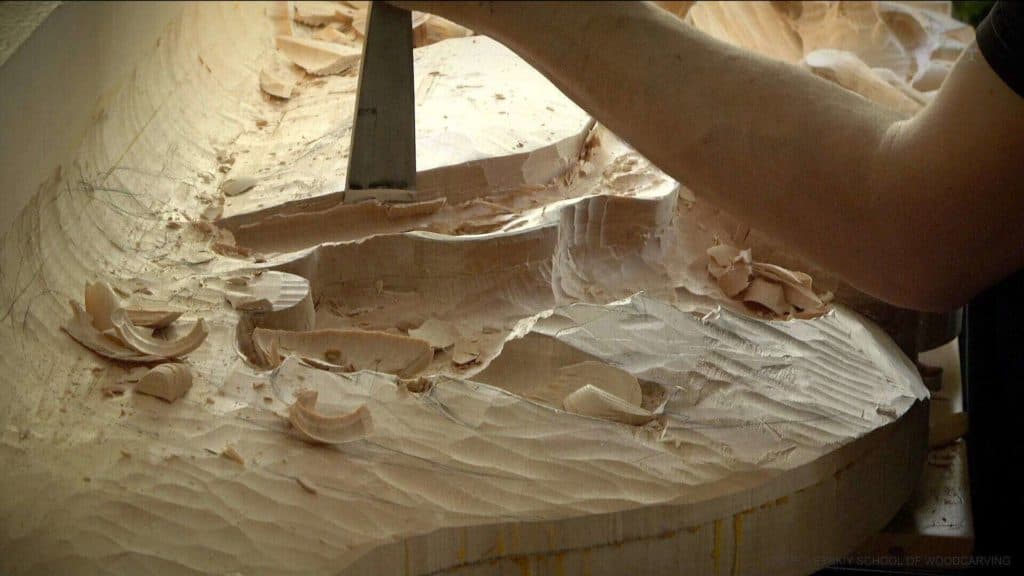
Alexander Grabovetskiy, woodcarver, School of Woodcarving · Published 2023
What does a wood carver mean by a "straight chisel"?
Quick answer: In Venice Room workshop 4, part 3, I named a straight chisel for a cut that goes straight down, and I said "Let me use a big 80 millimeters number one." Other lessons of mine hold the same words beside walls and steps, and next to the knife and the strop.
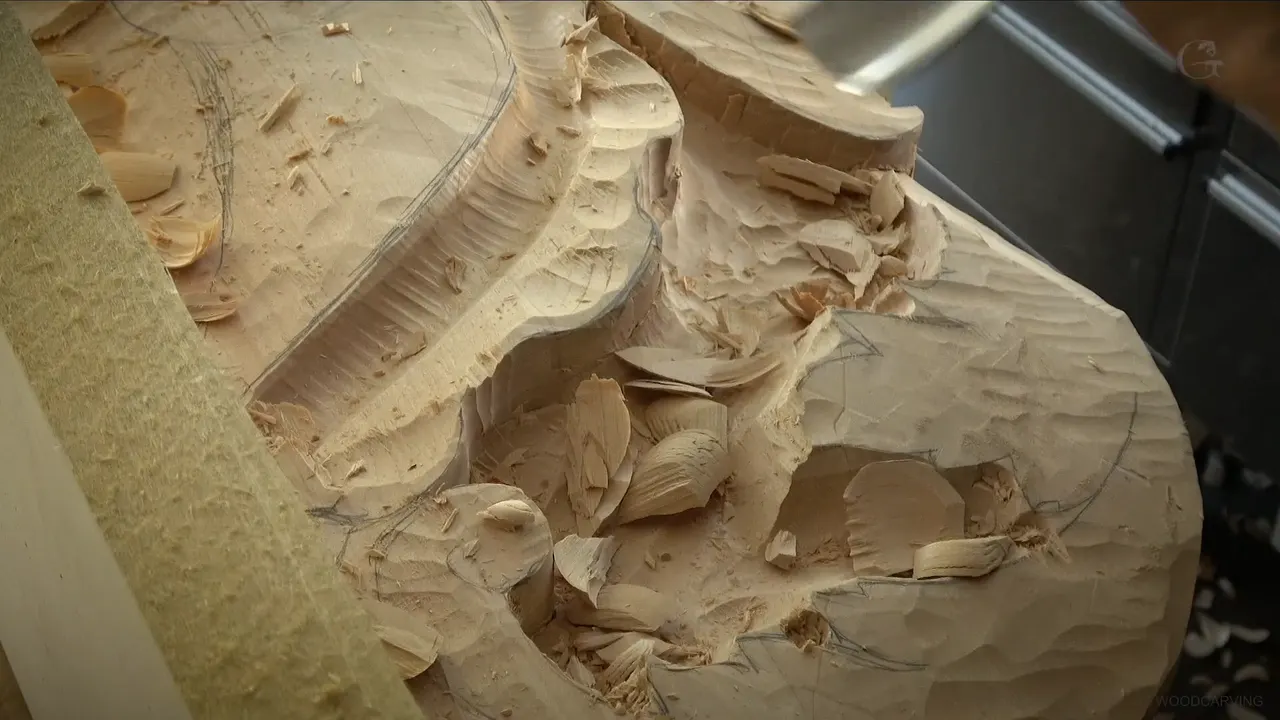

Part 3 of Venice Room workshop 4 is where I named the tool, while I planned a cut that goes straight down. Those two words turn up in lessons from other courses of mine, beside walls, knives, a router plane and the strop. Each lesson is linked below, and a table near the end lists them all.
Ever stood at the bench with a gouge in your hand and felt that one wall wanted something flatter? Here you get my words about that. After it come my words from other courses.
What this page holds
- My words in part 3 before and after the tool.
- A chisel with no sweep.
- The jobs I gave it on walls, steps and outlines.
- Knives, planes and strops, in lessons beside it.
- The times I said a straight tool is not enough, and what I picked up instead.
What came before the straight chisel in part 3?
At one spot I held back: "I'm not going all the way to my acanthus right now because it's going to create a lot of stress if I go farther, and I don't want to do that." Then a tool: "number seven. Big one." After it: "And get a clean little better over that cut."

Deeper was my next thought: "And maybe even deeper because I want to see." Then: "Here you go. I'm all the way to another layer." I also said what comes later: "And that's going to be even deeper later on once we're going to establish the inside details."
About the gouge I said "And now I'm going to probably use just the number nine and the smaller one, 20 millimeters." Twenty millimeters is 0.79 in, close to the three-quarters of an inch I name later in this part.
Which chisel did I say I needed?
Here is the line itself. "And next, I will create my straight-down cut. But I don't think number three will do in this case, so I need some kind of number two or even maybe number one, just a straight chisel."

A size followed: "Let me use a big 80 millimeters number one. This one is a single bevel." Eighty millimeters is 3.15 in, about 3 1/8 in. Chopping was the plan, in plain words, and a second tool was to follow: "Just chop most of it. And then I'll just follow it with a different one." Then "This one going to give me quick results."
"Number two and a half," I said, and right after that: "And that is good." I did not say what was good.

A nine comes up again: "I need to use, again, number nine." And the size: "20 millimeters, three-quarters of an inch." My depth: "That's it. I am approximately inch and a quarter to the lowest part." That inch and a quarter is about 32 mm. Over in part 4: "Let me check if I'll be able to use number three right here. Yes, I am."
What else did I plan in part 3?
"So now I need to make sure I'm doing the right thing right here," I said. "Okay, there's going to be my acanthus right here. Not acanthus, but this big movement." And: "another acanthus go this direction."

Then my plan: "I need to make that really low, and then I also have to slope, make my concave right here." I even described a way in: "I could take care of overall first, make it a big concave, and then make a deeper area on inside." I had to outline first, I said, "and of course, around my future head of acanthus."
How do I tell a chisel from a gouge?
Roman Acanthus 5, part 2 has the plainest version: "if it's a straight, so if there is no sweep, it's called chisel" and "If it does have a sweep, then it's a gouge until number nine. Until the true half round." Past that: "if it's more than half round, if it's more like a U shape, then it's already veiner."

On a livestream in April 2020 I talked about the sweep. It is "a curvature of a tool, okay? How curved it is." An "absolutely straight sweep" means "that is a chisel" and "those ones usually marked as a number one."
Greek Acanthus 7, part 4, carries a choice of tools. I would take "the eight millimeters number 1, which is a double bevel" and I said: "it's a chisel because it's a straight and it's number 1." Eight millimeters is about 0.31 in, close to 5/16 in. One more line from that video: "But number 1, they have either single bevel or double bevel."
Chamomile and Bow Rosette 3, part 2 spoke of the skew. "A normal skew has only one bevel," I said, and I ran through some angles: "22 and a half or 45 degrees, or 60 degrees." Then: "90 degrees is just a straight chisel."
What job did a straight chisel get on a wall?
My goal was "to take a straight gouge, not a gouge, straight chisel, and remove the sides going downhill, right straight cut down." On size, I said "If you do have a big chisel like this, number one, that's three inches, it would help a lot." Three inches is about 76 mm. A smaller one works too: "smaller chisel will help you also to achieve the same results."

My plan for it: "I'll just place that on a line" and "I'm placing that on a harder line, and I'll drive that chisel down, straight down 90 degrees." In my words: "just because I have that big chisel, it's really quick, and that creates the real straight line."

The second line got the same. "Place it on a second line and drive it down." Of big tools: "That is a good representation why big tools really good idea to have." We could take "our V tool, the same V tool," I said, and "remove waste." Then: "Now it's much easier." And it was "just because we had the straight down cut." A warning: "Don't undercut." I added "Make sure your V tool stays really straight to the edge."
In the same video I said "I'll take again straight chisel" and then "I'll take again number one, but a lot smaller" with a size: "Number one, that's about seven-eighths." For the middle section I said there were a couple of ways to approach it: "I can actually cut just normal way, and I'll just lower down gradually."

How did it set a step and an outline?
Furniture Panel 26, part 3 has a step that was off. "I can definitely see the step," I said, "although it's not really straight, which is absolutely fine." Then: "I can always take a chisel, like a straight chisel." Next: "In my case, I'm gonna take number one." The size, as I gave it: "14 millimeters, little bigger than half an inch" and 14 mm is 0.55 in. For the job: "Find the line and just create the cut down."

On size I added "I could use, actually bigger right here, but it's already straighter." On that step I said "Not really straight yet" and then "I'll take care of it."
Outlines got a chisel too. In Furniture Panel 17, part 7 I said "let me cut around this area with the same tool." Then I named a chisel: "And straight now." And "Place it right in the mark." For cleaning: "same number seven, quarter inch could be used." A quarter inch is about 6 mm.

On depth I said "Again, please make sure you don't go too deep, because you really want to keep and be consistent with your depth." Then: "now I can probably get my router plane and get one sixteenth of an inch." One sixteenth is 1.6 mm. What I got: "exactly the same depth."
I talked about leaning in Furniture Panel 38, part 3. "Remove some of it like that with the same number one," I said. "Be careful when you are cranking like this." Next: "You have to lean on this edge and you don't want to just lean too much and you're going to break it." My tool: "I'm using just that straight chisel." Then "deeper you go more you have to lean, be careful with that."

Can a straight chisel stand in for a knife?
Knife work comes up in Cutting Board 12, part 2. "Most of what we're doing with the knife," I said, "most of that carving you can do" with a straight chisel, "which also used to be a big practice in ancient times." And I said "So you are able to utilize it, actually," about the chisel. Against that: "Although you have more flexibility with the knife."

Old times come up in Cutting Board 14, part 2. "The only tool those people had," I said, was either a knife or a straight chisel. The way it works, in my words: "the principle is the same. You're just using one point of the chisel. You're still utilizing only one side of it."

Greek Acanthus 7 has "I could actually use just the knife, or other approach would be just to use number 1." And: "I'm still utilizing just a corner of my tool, and I kind of like that."
Hashemi Flowers 14, part 6 puts small tools next to it. Small tools came up: "I know I'm using smaller tools, but for me, in this case, it makes more sense because I can control smaller cuts, a lot less pressure right now." I could clean "with the straight tool or with the straight chisel or even knife, all my cuts, all those facets." Then: "Although I don't need them."
Rosette workshop 1 had a router plane for the background: "probably the best way to remove the background if you have enough space to use your router plane." "You don't have to use it," I said. "You could just use straight chisels." Then "But like I said, I have to make 15 of them" and "I always have to think how I can make it quicker."

For Venice Room 76, part 10, I was describing a vise setup. "I've got that handle, but it's a good idea to make it like octagonal, just to shave little, the edges of it." For that: "I'll just take any straight chisel, I would say, like number one." Then: "You don't have to use a chisel, by the way. So you could use just a knife. It would work."

Where does the strop come in?
In the stropping lesson I said "it's okay if you are just a carpenter or furniture maker, and if you're just working with straight chisels." As for the tool: "If you just got a number one chisel." And: "you can strop only one side on a gouge, and a gouge always has a sweep." My question: "what about inside?" This one sits in the stropping lesson of the sharpening course.

Roman Acanthus 6, part 2 shows it with a drawing. "Do a lot more stropping on inside of the tool than on outside," I said, and I showed why on a straight chisel: "That is an outside bevel, and we do have a small bevel on inside."

On the leather I said "when you're stropping on the leather, it's actually rounding this." A rounded outside bevel is "much, much harder to carve" and "much harder to push through the wood." The rule I gave: "more stropping on inside than on outside."
When is a straight tool not enough?
Venice Room 74, part 1, has "I should probably take a spoon gouge because the straight tool doesn't cut it anymore." Right after: "It is not working anymore."
Venice Room 62, part 6, is about a back bend. My plan was a back bend: "I'll just use a different back bend." My reason: "Because everything is in my way now. I can't use a straight tool." And: "It's not convenient for me to use a straight tool."
One more, in Venice Room 76, part 4: "that is almost impossible to do with any straight tool." Then: "the back bend allows me not to damage opposite side because it just rides above it."
Which videos hold these words, and with what?
Every video below holds the words, with a note on what sat beside them.
| Course and video | What sat beside the words |
|---|---|
| Venice 4-3 | An 80 mm number one (3.1 in), single bevel, named for that cut |
| Venice 4-4 | A check on number three for a spot |
| Roman 5-2 | A big number one, three inches (76 mm), to drive down on a line |
| Roman 5-2, same video | A smaller number one, about seven-eighths |
| Roman 6-2 | Tool shown for an outside bevel and a small bevel inside |
| Stropping 3 | A number one chisel, in a lesson about the strop |
| Livestream April 2020 | An absolutely straight sweep, marked number one |
| Greek 7-4 | An 8 mm number 1 (0.31 in) with a double bevel, beside the knife |
| Board 12-2 | Most knife work, and a practice from ancient times |
| Board 14-2 | A tool of ancient times, next to the knife |
| Panel 17-7 | A plan to cut around an area, then a plan for a depth of 1/16 in (1.6 mm) |
| Panel 26-3 | A number one, 14 mm, a little bigger than half an inch |
| Panel 38-3 | What I held while I leaned on an edge |
| Hashemi 14-6 | Listed beside the straight tool and the knife |
| Chamomile 3-2 | A skew at 90 degrees |
| Rosette workshop 1 | Another way to clear a background, instead of a plane |
| Venice 76-10 | Any straight chisel, like number one, to shave the edges of a handle |
| Venice 74-1 | A straight tool that stops working |
| Venice 62-6 | A straight tool I could not use there |
Where can you watch part 3?
You can watch part 3 inside workshop 4 of the Venice Room course. Parts 2 and 4 sit beside it on the lesson page. Everything on the site sits inside the tuition.
Which wall on your own board is waiting for a flat tool? Pick up a chisel and a mallet, look at the grain, and give it one more pass of wood carving.
How it's done
- Name the job. In part 3 I said I would create a cut straight down, and that number three would not do in that case.
- Reach for the flat tool. I named a straight chisel, a number two or one, and then a number one with a single bevel.
- Set it on the line. In Roman 5, part 2, I said I would place the chisel on a line and drive it straight down 90 degrees.
- Match the size to the job. Something big is really quick, I said, and a smaller chisel will help you reach the same results.
- Know when it is not enough. In Venice 74-1 I said I should probably take a spoon gouge, because the straight tool does not cut it anymore.
Frequently asked questions
Which tool did I name for that cut?
I said number three would not do in that case. The 80 mm (about 3 1/8 in) number one with a single bevel was the one I named to chop most of it.
How wide were the chisels in these lessons?
Venice 4-3 named 80 mm (3.15 in), Roman 5 named three inches (about 76 mm), Furniture Panel 26 named 14 mm (0.55 in) and Greek 7 named 8 mm (about 5/16 in).
Can a chisel do knife work?
In Cutting Board 12 I said most of that carving you can do with one, and I called the knife the more flexible tool. Greek 7 has me naming either the knife or a number 1.
What to carve next
- Venice Room Part 1 course page
- Venice Room 4
- Venice Room 74
- Venice Room 76
- Venice Room 62
- Roman Acanthus 5
- Roman Acanthus 6
- Stropping, Honing and Buffing
- Carving Tool Sharpening
- Greek Acanthus 7
- Cutting Board 12
- Cutting Board 14
- Furniture Panel 17
- Furniture Panel 26
- Furniture Panel 38
- Hashemi Flowers 14
- Chamomile and Bow Rosette 3
- Antique Style Rosette workshop 1