
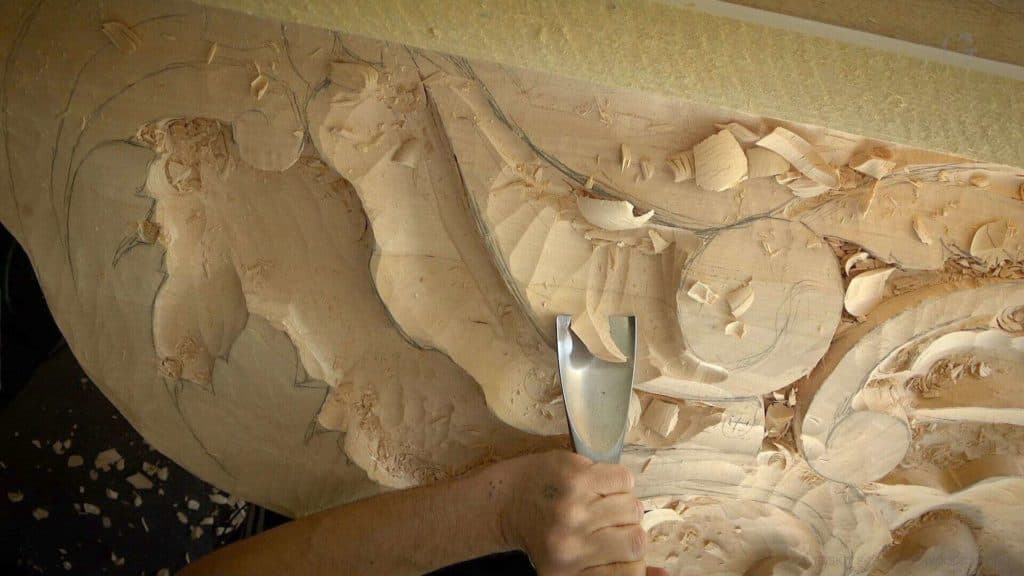
Alexander Grabovetskiy, woodcarver, School of Woodcarving · Published 2023
What does a wood carver mean by "that mess"?
Quick answer: In part 4 of Venice Room workshop 4, I said I needed to clean the mess, and right after it I checked whether a number three would fit. My other lessons put the same words beside a number 11, a number nine, a flatter tool, a hairdryer, and sometimes a plan to leave it for now.
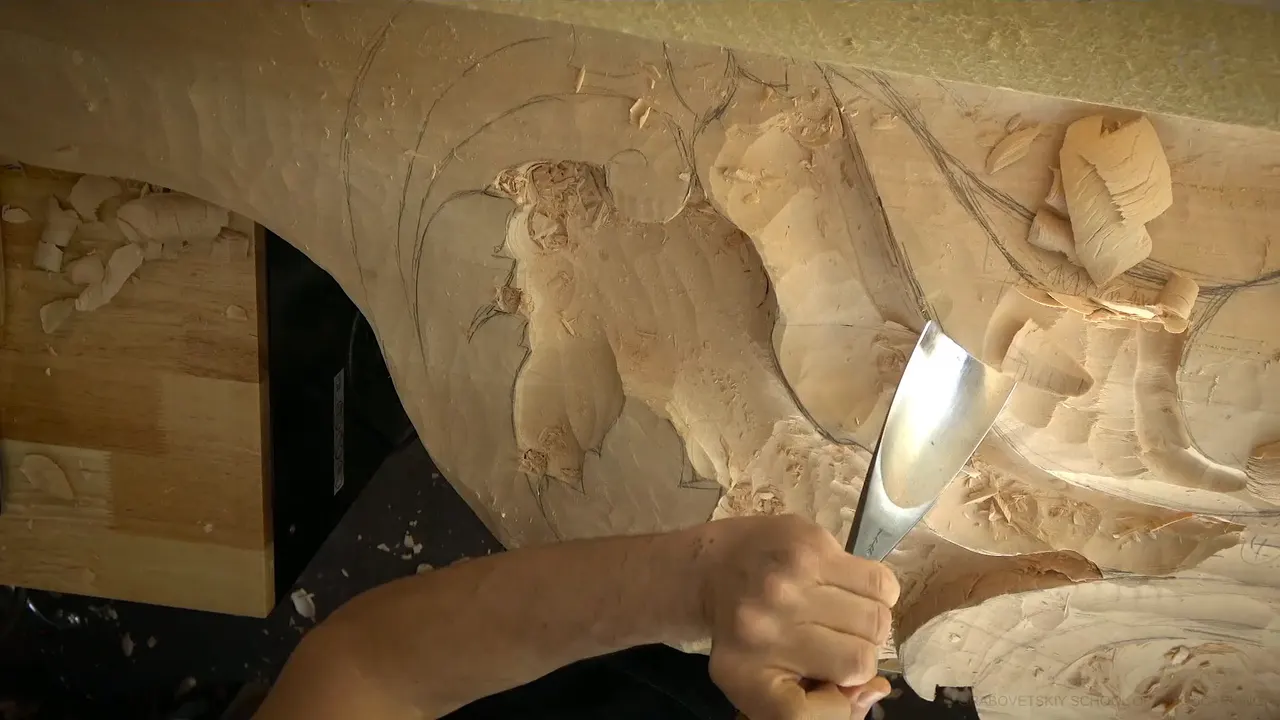

I said it in part 4 of Venice Room workshop 4: "And now I need to clean that mess." A check on a number three came next. Other lessons of mine hold the same words, beside a tool I named or a plan to wait, and one of them beside a hairdryer. Where a lesson has a public page I linked it, and a table near the end sums them all up.
Ever dug a hollow and looked at what was left in it? Did you stop there, or pick up another tool? In these videos I said the words out loud and then I named my tool. Here is what I said in part 4, and after that, what I said in the other lessons.
What this page holds
- My own words in part 4, in the order I said them, with pictures from that video.
- The next video, part 5, where I said nearly the same.
- Which tools came up in other Venice Room workshops.
- Other courses, with a hairdryer.
- A table of the videos near the end.
What did I do in part 4 before I said it?
The part opens on a gouge. "And now I could probably use just a number seven, big one." A plan for depth comes next. "So it has to be like a gradual movement from this point," I said, "go deeper, deeper, deeper, and the deepest is going to be closer to the head."
A cut and a size follow. I needed to "create my initial cut with the number nine" and I said I would use "just the 20 millimeters." My 20 millimeters comes to 0.79 in, and after that a number seven comes back.

Near the edge I held back. "I don't think I should go all the way to the edge," I said, "because I want to create probably a chamfer look on this side. We'll see." Reaching the edge could wait. I can always do it, I said, "later on with no problem."

Later in the part comes this: "That is probably enough, but I still want to cut a little deeper right here." After a while I was "all the way to another layer of wood."

Then comes the line from the top of this page. Before it, I said "I think that is enough." After it, a check follows. "Let me check if I'll be able to use number three right here." The answer is "Yes, I am."

The part ends on a head, a triangle and a plan. "And this head," I said. Then I needed to "relieve inside of this triangle." My last words are a plan: with the same number nine, "I'll just go around."


Which lines does part 5 hold?
Part 5 of the same workshop says it nearly the same way. It opens on "Put that waste right here" and later I said "Now, two and a half big gouge." Next in my plan came a #7 at one inch, which is 25.4 mm, "to take care of this mess."

What tool followed the words in other Venice Room workshops?
Workshop 2, part 3 puts the words at a switch of tools. My own words were "switch my tool" and I planned on a number nine, three-quarter of an inch spoon gouge. That is 19 mm. Sharpening came next in my plans: "this one needs to be sharpened a little bit. That's exactly what I'm going to do."

Workshop 6, part 6, gave a size and a reason. "Number 11, three millimeters, and kind of clean all that mess," I said. Three millimeters is 0.12 in. A reason followed too: "Because I know it doesn't look too appealing when it's too messy."
Workshop 7, part 11 says it with a number 11 spoon. The plan was to "cut underneath," carefully, and I added "I need to find the right position."

Workshop 10, part 1 sets the cleaning before the details. Cleaning what I left was my need, and then, I said, "we're going to start on working on details." The tool I named was a number nine, 1/8 of an inch (3.2 mm). A bigger one crossed my mind, maybe 1/4 inch (6.35 mm), along with a worry: "I don't want to make the same mistake what I did previously."
Workshop 13, part 5 has a number nine at a quarter inch, or 6.4 mm. A long cut was on the list too. Of it I said: "It's going to give me, again, those ridges which I want to keep. The movements, overall movements."

Workshop 24, part 8 has a reason for care: "I have to be kind of careful because I still want to keep it strong." Seven millimeters (0.28 in) were my words "for the beginning" of the cleaning, and maybe I could use a mallet for that. A warning followed: "When I'm pushing in it, it's moving the whole thing." A straight tool came into my plans, a number 12 at a quarter inch (about 6 mm), and then my doubt about getting in.

Over in workshop 51, part 3, I had a flatter tool in mind, "maybe number five or even number three." Of the marks, I said "Just get rid of those tool marks I don't need." Then I said I would create "a clean canvas."

Workshop 59, part 10 puts an apology beside the words. The tool named was number nine again. I was sorry you can't see what is going on inside, I said. "All I'm doing is just getting rid of the mess" and "creating even deeper shadow."

Workshop 66, part 12 has lots of mess on the side. I called it okay, and it "can be cleaned with no problem," I said. Number five or maybe six was my plan, with five checked first. That side could wait: "Doesn't have to be now."

Extra wood comes with workshop 150, part 2: "Really good idea to have extra material," I said. The plan for the cleaning was a number 11, 5 millimeters (0.2 in), and the same size would go around a volute, carefully. Finishing that volute right away was not in my plans. The final look from above still had to be established.

When did I leave the mess alone?
In workshop 53, part 6 I did not worry about the mess, which would be removed later. "All I need is just pretty much just a really good outline." Going deep was not on the list yet, because the concaves and convexes still had to be created.

Workshop 57, part 10 opens on a plan to wait. Cleaning could stay undone. The thing I did worry about was to "pre-establish the main idea." A much deeper excavation, probably in the middle, would come later, and for now it was enough.
A plan with a condition sits in workshop 8, part 5. Deeper was out "at least for now." The mess "needs to be cleaned, but I can take care of it once I work on this detail."
Short orders sit in Furniture Panel 19, part 13. "Careful. Just go and clean." On the mess: "don't worry about it yet."
A 1 millimeter (0.04 in) tool crossed my mind in workshop 37, part 2. "I probably should, but it's a little too early yet because I still have to develop the edge of the shell." Then came the mess itself: "just take out some of that mess, or it's not going to distract my eyes" with "just little bit of cleanup."

Which tool came with the words in other courses?
Hashemi 13-5 has lots of cleaning. A small gouge, 1/8 of an inch (about 3 mm), was my choice for it. The piece, I said, was "completely in the air," not connected to the lower one.

Cleaning from underneath is the plan in Hashemi 36-2. The smaller V-tool was my need, "only eighth of an inch, 3 millimeters." Under a petal, the mess would get a number nine at 4 millimeters (0.16 in). I added that "it could be eighth of an inch."
A V tool is my plan for the mess in Hashemi 40-1, and cleaning my whole carving could wait for later, off camera. Filming it takes a long time, I said, and "there's nothing exciting about cleaning." You take the same tools you used and make clean cuts.
In Furniture Panel 16-6 the plan was number 11 at 3 millimeters (0.12 in). A warning came with it: "Just make sure you don't dig too deep." What I needed was to get "as close as possible to the detail, but not to overdo it, because we still have to develop those details."

A veiner opens Furniture Panel 19-9: "First, just remove the mess with just veiner." It is a number 11 at three millimeters, one-eighth of an inch. A little bigger than its mark, I said.

Lesson 2 of the Venetian Flowers Rosette course comes after a plan to chop. My number nine would sit "right on the line." The wood left to the background was "about quarter inch or so," I said, or about 6 mm. On the opposite side of the rosette my plan was "exactly the same," "just a straight down cut."

Pencil marks come up in lesson 3 of the same Venetian rosette course. "I got too many pencil marks just because I was showing to you," I said. "And those pencil marks, they don't help." A one millimeter (0.04 in) number 11 spoon gouge would take out the mess I just produced.
Floral and Molding 6-2 has a hair dryer in it. The words here are "let me blow that" and I meant "just a hairdryer, a hair fan." After it: "Now it looks clean, and I can continue working." In that video I was "pretty much just undercutting right underneath," a preliminary undercut, with "a lot less resistance" from a smaller tool.

Chamomile 2-3 goes to the flatter tool, a number three. To take out the mess I planned a half millimeter, and that is 0.02 in. Then the plan: "just hook out whatever the mess I created."

Workshop 11, part 2 has a plan to lower a section later, and then the mess I had just created had to go.
Workshop 129, part 1 puts a size beside it: "Again, 30 millimeters, number 11," I said, and again the mess had to go. Thirty millimeters is 1.18 in.
Floral and Molding 5-3 has a number one at work and then a half millimeter: "I have to grab, again, half a millimeter," I said, to get rid of the mess. That is 0.02 in.
Which videos carry the words, and with what?
Every video below carries the words, with its tool and what sat beside it.
| Video | What I named, and what came with the words |
|---|---|
| Venice 4-4 | A check on number three, then a triangle to relieve. |
| Venice 4-5 | Straight after the words, a #7 at one inch (25.4 mm). |
| Venice 2-3 | Spoon gouge number nine, three-quarter inch (19 mm), and a tool to sharpen. |
| Venice 6-6 | Three millimeters (about 1/8 in) and a reason about looks. |
| Venice 7-11 | Spoon number 11, with care underneath. |
| Venice 10-1 | Details waiting, a nine at 1/8 inch (about 3 mm), and a mistake I did not want to repeat. |
| Venice 11-2 | A section to lower later, and a mess I had just created. |
| Venice 13-5 | Ridges to keep, and a nine of 1/4 inch (6.4 mm). |
| Venice 24-8 | Seven millimeters (0.28 in), a warning about moving the whole thing, then a twelve. |
| Venice 51-3 | Marks to lose with a flatter five or three, for a clean canvas. |
| Venice 59-10 | Number nine again, with a deeper shadow inside. |
| Venice 66-12 | Five or six, after I called the mess okay. |
| Venice 150-2 | Eleven at 5 mm (0.2 in), with extra material around a volute. |
| Venice 53-6 | No tool yet, only a good outline. |
| Venice 57-10 | Waiting, with no worry about cleaning yet. |
| Venice 8-5 | None named, with the cleaning left for the detail. |
| Venice 37-2 | A smaller tool, a little too early. |
| Venice 129-1 | Number 11 once more, and the mess to remove again. |
| Hashemi 13-5 | Small gouge, on a piece hanging in the air. |
| Hashemi 36-2 | V-tool, then a nine at 4 mm (0.16 in), for a petal. |
| Hashemi 40-1 | A V tool, with the full cleaning left for later. |
| Panel 16-6 (furniture) | Number 11 with a warning not to dig too deep. |
| Panel 19-9 (furniture) | Veiner, a little bigger than its mark. |
| Panel 19-13 (furniture) | None named, and no worry yet. |
| Rosette 2-1 (Venetian) | A nine on the line, with about a quarter inch (6.35 mm) left to the background. |
| Rosette 3-4 (Venetian) | Spoon gouge number 11 to take it out, pencil marks beside it. |
| Molding 5-3 (floral) | Number one, then half a millimeter (about 1/50 in). |
| Molding 6-2 (floral) | A hair dryer first, then a smaller tool. |
| Chamomile Rosette 2-3 | Number three, then a smaller size. |
Where can you watch part 4?
You can watch part 4 inside workshop 4 of the Venice Room course. The next video follows it on the same lesson page. Everything on the site sits inside the tuition.
What is the one hollow on your own board you want to clean this week? Pick up a chisel or a gouge and give it one more pass of wood carving.
How it's done
- Say the hollow is enough. In part 4 I said "I think that is enough" before I turned to the cleaning.
- Name what needs cleaning. My words were "And now I need to clean that mess."
- Check the tool before you cut. "Let me check if I'll be able to use number three right here," I said, and then "Yes, I am."
- Relieve inside the triangle. Again, I said I needed to relieve inside of this triangle.
- Go around with the nine again. My last words in part 4 were that with the same number nine I'll just go around.
Frequently asked questions
Which gouge did I check right after saying it in part 4?
Number three, said straight after the words, to check whether it would fit there. My answer to myself was yes. Earlier in the part I had named a number seven and a number nine, 20 mm (0.79 in).
Where did I say I would leave the mess for later?
In Venice Room 53, part 6, I said I did not worry about that mess, which would be removed later. Furniture Panel 19, part 13, has "don't worry about it yet." Venice Room 8, part 5, leaves the cleaning for the detail.
Which sizes came with a number 11?
Number 11 came at 3 mm (about 1/8 in) in Venice Room 6 and in Furniture Panel 16. Venice Room 150 had it at 5 mm (about 1/5 in), and Venice Room 129 at 30 mm (1.18 in).
What to carve next