
Alexander Grabovetskiy, woodcarver, School of Woodcarving · Published 2023
What does a wood carver mean by "boom"?
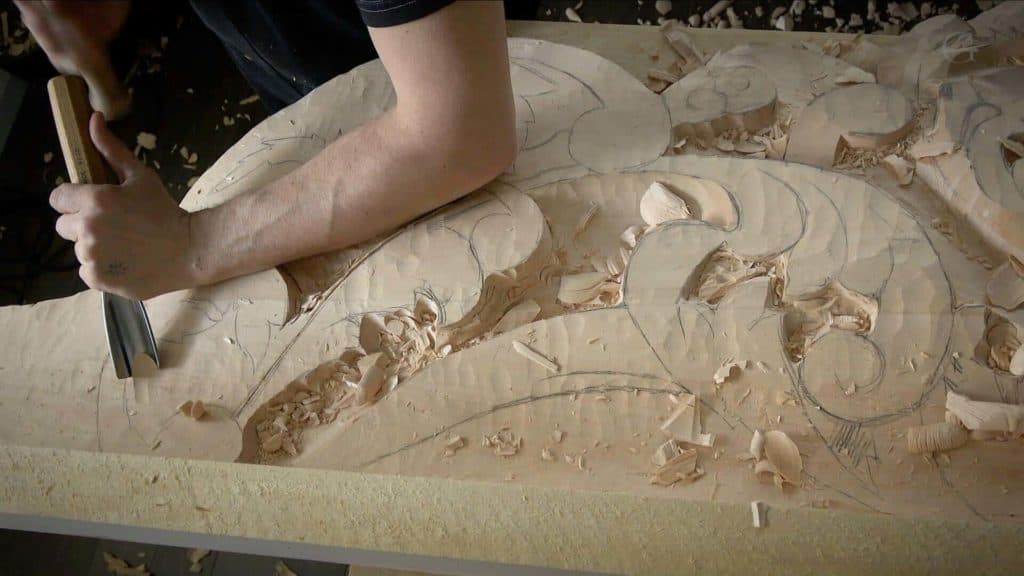
Quick answer: In Venice Room workshop 4, part 8, I chopped around an acanthus head with a number seven, 80 millimeters (3.15 in), and said "Boom." Other lessons of mine put the same word beside plugs, drill holes, a mallet and a detail that breaks.
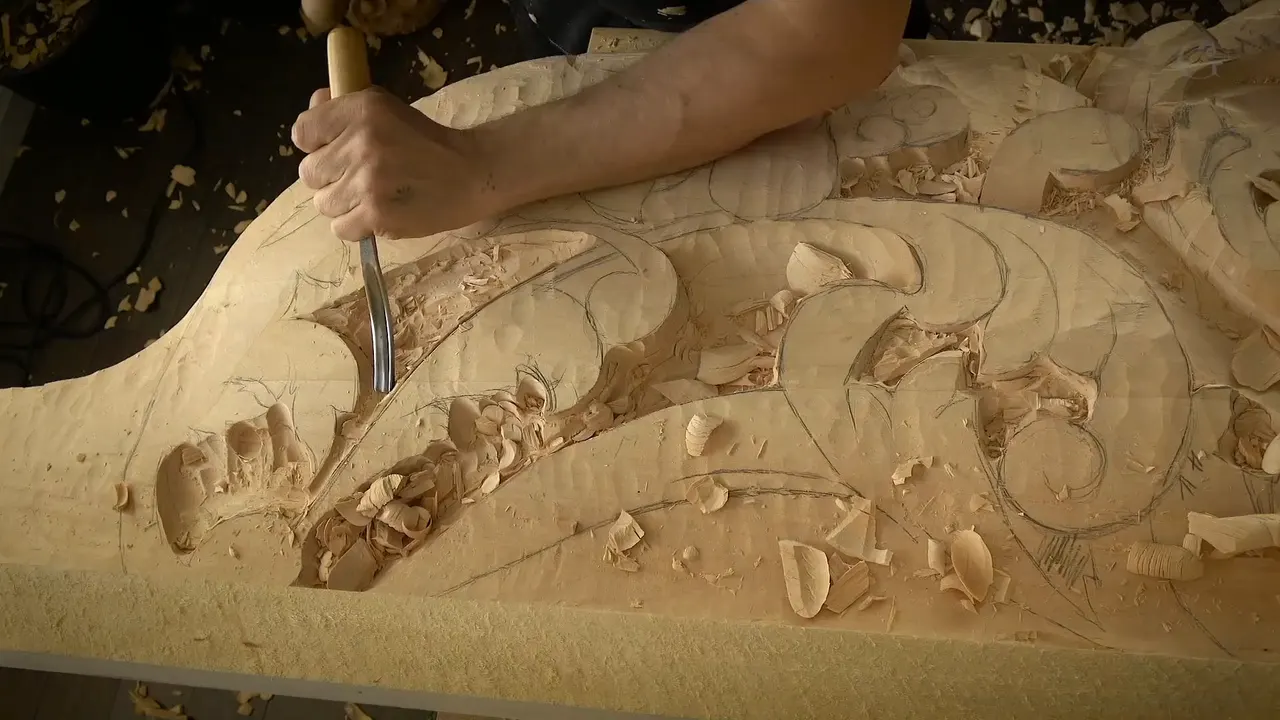

In part 8 of Venice Room workshop 4 I named a number seven, "three inches, 80 millimeters" and said: "But here, I just chop. Boom." Other lessons of mine put the same word beside a plug, one small pass, a drill hole and a detail that breaks. Each lesson I name is linked, and a table near the end lists them.
Ever picked up a big gouge and wondered whether one pass could do the job? Here are my own words from part 8, from the parts beside it and from lessons in other courses. Pick up your gouge and follow along.
What this page holds
- My words in part 8, in the order I said them.
- Parts 7 and 9 of the same lesson.
- Lessons where the word came with a plug or a single pass.
- A few where a warning sat beside it.
- A table of those videos, so you can find each one fast.
What did I say in part 8 before the word?
The part opens on a tool swap: "And now I need to use a smaller number nine, or even I could use probably just number 11. Number 11 will work also. Half an inch" (12.7 mm). After that came "Anyway, I love number 11s."
A smaller tool followed: "I'm going to need a lot smaller tool, maybe about quarter inch, number nine will work" (a quarter inch is about 6.4 mm).

A piece came off, and I said so: "And I just broke the end of this element. I did not touch the pencil mark, but it's okay. I still have plenty of material, so I would not consider that as a mistake."
Number three came up in the same part: "Number three, straight down cut. Straight down, straight down." I floated a plan, too: "maybe just to turn this way and kind of chop the edge."
For a cleanup I said: "again number nine, but let me try 5/8 of an inch to clean this area. 16 millimeters." Five-eighths of an inch is 15.9 mm, so my 16 is a rounded figure.

How deep did I plan to go around the acanthus head?
One spot needed more depth, and I gave my reason: "I really want to see this head of Acanthus movement nicely." For the depth I said: "So I have to go really deep right here."
That depth did not have to come right away, since "I'm still not working on details."
Which tool did I name for the heads?
"Number seven. That's what I'm using right now, number seven." A plan sat beside it, "And let me chop around that head" and the size came as "I use number seven and three inches, 80 millimeters." Eighty millimeters is 3.15 in, so my three inches is a round figure.
About the heads: "And see, almost every spot where I have the heads, it fits perfectly because I thought about it when I was designing it." Right after: "So that is a really good rule. Just think about the tools which you have, how you're going to carve it, and carve it quickly."

The words in bold at the top come after "Because I can carve it without that, but that's just going to take much longer." After them comes "And that's pretty much done." The part itself stops on "leave it like that. I've got about an inch more to do" (an inch is 25.4 mm).

What did parts 7 and 9 say beside it?
Both parts sit on the workshop 4 lesson page, next to part 8. Part 7 has a swap of its own: "Okay. Now I need to use probably two and a half and distinguish that line. Well, actually two and a half not going to work in this case." Then the need: "probably number three and a smaller one."

A second swap came later in part 7: "And probably this is not going to work with number three. No, it's not." The 2 1/2 was back, and "it fits perfectly." And "that's going to disappear underneath of the shell." Then "That is already the shell."
About stress in that part: "I'm not supposed to do what I'm doing because I'm creating too much stress on both sides. But anyway, it's going to just give me an indication. That's why I'm not hitting that really heavily."

A depth came up there as well: "There is a lot of material. I can probably use just 35 millimeters. Number nine" (35 mm is 1.38 in). Close to the end of the part: "I'm going to use a smaller number nine now." And a leftover: "We've got that triangle situation again at a couple spots" with an offer, "I could actually take care of them pretty much right away."
Part 9 holds a plan to outline the acanthus: "But first I need to outline that acanthus right here." For size: "Let me use just about half an inch. Approximately 14 millimeters is what I'm using. Okay. Again, it's approximate. It's not exactly 14 millimeters" (0.55 in).

Depth got a number in that part: "I want to go exactly the same, about an inch and a quarter, inch and a half on inside. So that's going to give me a beautiful shadow" (32 mm and 38 mm).
A rule came up: "I'm supposed to attack from this side" and my plan then was "to change the position and attack from this side inward."
Near the shell line I said "I am barely removing any material right now" and "I will remove, don't get me wrong" then "I am pretty close to the shell line." One more line: "I don't want to make the mistake."
Two lines on the shell and the acanthus in that part: "And I don't want to forget about this acanthus going underneath" and, later, "And yes, that shell is supposed to go underneath of this acanthus."
Where else did I say boom, and what came with it?
In Furniture Panel 20, part 9, a small tool came up: "So in this case, I'll take one eighth of an inch Number eight" (3.2 mm). A technique followed: "You can actually place your tool straight down like that and make the rotation movement just like that, but don't do too much, and crank it, and take it out. Okay? Those are like small plugs."
Boom came after the plugs: "So again, place it straight down, rotate like that, and boom, remove it. It's really quick." A limit followed: "But don't overdo it because you can go deep." Later in that part I said "Boom, remove it" for two sides, and "it's a really nice trick." In between: "I need to excavate my depth first right in the middle, and then I'll take care of the edge."

A triangle comes up in Furniture Panel 22, part 7, with two lines: "sometimes you can damage the surrounding area" and "It is always better to relieve it." For the relief I planned "the one millimeter number 11" (0.04 in), and the finish was "Just one cut" and "Boom." Compare that tool with the 80 millimeters of my number seven in part 8.
In Venice Room 54, part 5, I said: "maybe number five. I don't have to, by the way." Of that tool: "It just gives me a perfect cut in one movement." And: "I could just do with a knife or with something else, but see how quickly it's going to be" then "Boom, and it's already gone." On the edge: "Really perfect edge." The other side differs: "I have to be a little more careful on this side."

Byzantine Acanthus 9, part 3, has a small tool: "I'm not sure if you have a small tool, but 3 millimeters, that's what we used" (0.12 in). Then: "But what you could do, plug cut, boom, and it's all the way through." A knife follows: "And then take a knife or other small tool and create that shape like a water drop shape all the way through." My verdict on the hole: "Even without it, still going to look good, but take a look. With that hole, it looks even better."

In Carving Plate with Butterflies 9, part 3, I placed some cuts and said: "I mean, I could leave it like that. Or what I could do, I could create the cut right between those cuts." The spot I named was "about the golden ratio of that point, that point, and 60 % right here." Then: "Boom, just like that. Boom. See the effect?" And: "That just gives extra dimension."

Another triangle shows up in Lily Box 5, part 4. Lines from that part: "how nicely it just develops the details" and "that triangle, so I could give a small half a millimeter cut to indicate even better movement." The finish: "Just really small cut. Boom." Half a millimeter is 0.02 in.

Venetian Flowers Rosette 3, part 4, has an offer: "I could actually create a small concave right at the edge and just drop a little bit closer to the background." Then: "Let me show what I mean by that. Just go like this, okay? Boom."

On a Floral and Molding panel, lesson 5, part 2, I measured and said "about six millimeters, I'd say. About a quarter inch" (6 mm is 0.24 in). Then came "what I can do, I can just pretty much just grab my drill and drill it. Why not?" Next: "let me check if I did make mistake or not, and I hope I did not." The check came with "See, boom. And that's already touching the bottom." Tool talk follows, "I could use number 11 or number nine even" and "Let me use just the number nine" with "Number nine and 10 millimeters" (0.39 in).

Not every one happens at the wood. In Floral and Molding 3, part 2, I flipped a picture on my iPhone, saying "I'm using iPhone, and I know it's kind of dark" then "That is the option" and "Boom, and that's done." After it: "That would be my acanthus movement. I don't know. I think it's a good tip." At the Maine sharpening class I said "it takes one second to change the grit" and "Boom, and there's a second sandpaper."
When did the word come with a warning?
In Hashemi Flowers 23, part 4, I weighed "maybe just a bigger number nine" and said: "This is about 5/8 of an inch" (15.9 mm). Then: "I know it's tempting to take a big tool and just take a mallet and just boom." My next words: "But it just doesn't work on that type of carving. So this type of carving is actually not the fastest." And: "Maybe this is too big. Take a smaller one."

Hashemi Flowers 49, part 4, has "So step number one" and "I'll just follow with one millimeter number 11. Get that as deep as I can." A note on the petals comes with it: "Again, please don't crank against the petals, so just to crank against the fingers." On the warning I said: "probably because I've done it many times, and I learned that hard way. When your project is almost done, and you already clean everything, and just really fragile, and you decide to do extra cut, just because you don't feel like it's enough, and boom, you crank against some detail, and you just break it."

In Lily Box 11, part 10, I said: "even when I'm removing with the number one, I'm still slicing. Okay." Then: "move a little too much, boom, I can develop cracks somewhere. Maybe I should slow down, be more careful."

In those three lessons the word sits beside a mallet, an extra cut and a piece that moves.
Which videos carry the word, and with what?
Every video below carries the word, with a note on its neighbors.
| Video | Beside the word |
|---|---|
| Venice 4-8 | A chop around a head, with number seven |
| Furniture Panel 20-9 | A plug set straight down, and a nice trick |
| Furniture Panel 22-7 | A triangle, and "just one cut" |
| Venice 54-5 | Number five, and a perfect edge in one movement |
| Byzantine 9-3 | A plug cut, then a knife for the water drop shape |
| Butterflies 9-3 | A cut between two cuts, near 60 % |
| Lily Box 5-4 | A half millimeter cut (0.02 in) at a triangle |
| Rosette 3-4 | An offer of a small concave at the edge |
| Floral Molding 5-2 | A drill, and a bottom already touched |
| Floral Molding 3-2 | A picture flipped on my iPhone |
| Maine sharpening 1-3 | A second sandpaper in one second |
| Hashemi 23-4 | A mallet, and a carving that is not the fastest |
| Hashemi 49-4 | An extra cut on a fragile piece, and a break |
| Lily Box 11-10 | Number one, and a piece that moves too much |
Where can you watch part 8?
You can watch part 8 inside workshop 4 of the Venice Room course. The whole lesson sits on one page. Everything on the site sits inside the tuition.
Where on your own board will one pass finish the job, and where will you slow down? Pick up a chisel or a gouge, watch the steel, and give it one pass of wood carving.
How it's done
- Name the tool for the spot. A smaller nine was my need in part 8, or maybe a number 11.
- Go smaller near a line. My plan was a lot smaller tool, maybe about a quarter inch (6.4 mm), number nine.
- Plan the deep spot. Around the acanthus head the plan was to go really deep, though not right away.
- Chop around the head. Around the head went number seven, at 80 millimeters (about 3 1/8 in): "But here, I just chop."
- Stop where you are. My plan was to leave the area as it was, with an inch (25.4 mm) more to do.
Frequently asked questions
Which tool did I name in part 8 for the heads?
A number seven, in the size I gave as 80 millimeters (about 3 1/8 in). Almost every spot with a head "fits perfectly," I said, because I thought about it when I was designing.
How did I describe the broken end in part 8?
I broke the end of an element and did not touch the pencil mark. My words were "I still have plenty of material, so I would not consider that as a mistake."
Which lessons say the word with a plug?
Both Furniture Panel 20 and Byzantine Acanthus 9 do. In the first the word follows "place it straight down, rotate like that." In the second it sits with "plug cut, boom."
What to carve next