
Alexander Grabovetskiy, woodcarver, School of Woodcarving · Published 2023
What does a wood carver mean by "historical"?
Quick answer: In Venice Room workshop 5, part 10, I put the word on the piece after answering why I go so deep. In other lessons it sits beside old work with no deep undercut, a cut inside a Greek leaf, opposite direction pipes and a design.
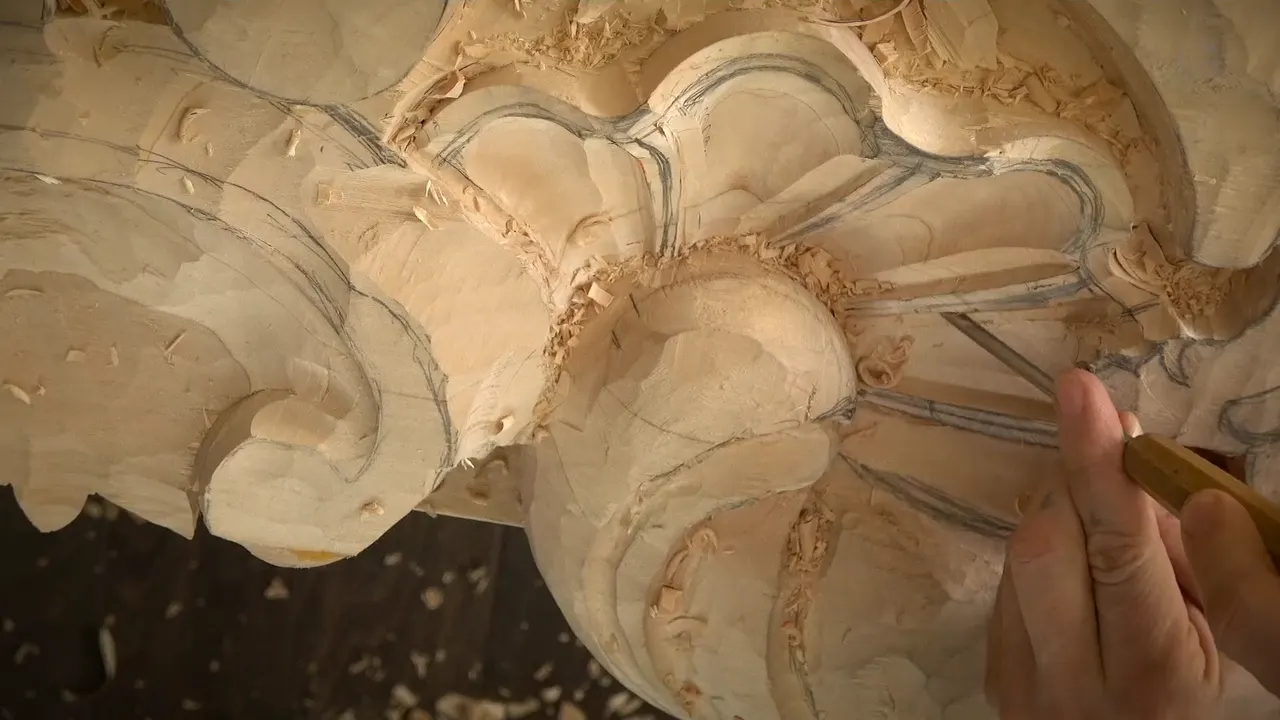

In part 10 of Venice Room workshop 5 I called our carving a historical piece, and in other lessons the same word sits beside undercutting, moldings, pipes, a Greek leaf, a design. Each lesson is linked below, and a table near the end lists them all.
Here you get my words from the Venice Room, then the lines from other lessons where the same word came up.
What this page holds
- Workshop 5, part 10: its deep cuts, its shadows and one line about the piece.
- The two parts that sit beside it.
- Old work and its shortcuts, in my own words from other lessons, with the reasons I gave.
- A shape to follow.
- A piece I was making.
- A table of every video that holds the word, with a note on each.
What came before the word historical?
It opens with "And again, number 11 and 3 millimeters" (0.12 in). One word follows, "Veiner" and after it comes "Number nine will work also, by the way." Then: "I'm not limited to this one."
Next came a line about the depth: "And if you would ask me why I'm doing so deep, again, that is all about the shadows." Then came "So the whole arrangement, the whole room, is going to be a bedroom."

About the lights I said "lights behind, actually, also installed" and "everything is going to cast beautiful shadow." My limit was "For me, it's almost impossible now because this is in my way, and it's already creating some limitations."
A plan for one side followed: "And let me do this side a little deeper." Then "Okay. Got really deep and good."
How did the word come in?
It came as "So we are creating very much historical piece." I added "Well, I should say I create."

What did I plan next?
"And I'm going to get probably a bigger number three," I said. Then "Well, I could get number three, and let me think." One size came with it: "I think I should probably use 14 millimeters or so, half an inch" (14 mm is 0.55 in, and half an inch is 12.7 mm).
About the day before: "I don't think I did enough my number seven cuts when I was working on it yesterday." And "I should create little deeper, but it's okay." Also "I should be all right."

A challenge came next: "So now I do have a challenge. I don't want to destroy the chunk of wood for future acanthus, but I still need to somehow attack this area." My plan was "So I'll just turn to small one in this case." Also "Small number three. Maybe big again."
Then: "Don't worry, we're not going to lose beautiful shell look." Then "Okay, let me see my number 11 again" and "A couple spots I can clean."

"I really want to see the smooth transition, if you know what I mean," I said. "Okay. That is good." Near the end came the concave cuts of the day before: "And if you would ask me why I did my concave cuts in the middle yesterday."
"So if I wouldn't do those concave cuts, it would be much harder for me to get a really consistent look." Its last words were "This one needs to be sharpened."
What did the two parts beside it add?
In part 9 I said "I need to make the decision" about the side for my bead. Then "Gradually going downhill." And "I clean it, and I check with the finger how nice my movement is, and I can feel."

Then in part 11: "I did not do enough concave yesterday. And it's okay. That's fine." Also "we can always dig deeper with no problem." The rasps came in with "lately, I really like the idea of using rasps."
"I should be honest with you, I really didn't use them before too much. I kind of thought it would be like a fake to the wood carving, but not really." After that: "especially in production, I got to save time also."
On authenticity I said "Yeah, the design is going to be authentic, but I already broke some of the rules, even when I used the machining, like when I used to plane my wood." And "those rasps actually called carver's rasps. They made for wood carving, pretty much."
Which old work did people carve quicker, and why was that?
Lily Box 8, part 8, opens that thought with "And that's what makes a wood carving beautiful and three-dimensional, all about those shadows." Next: "And I know some people don't like to use extreme undercutting, because a lot of times when you look at the historical work and you don't see that deep undercut."

From the Lily Box lines: "and you can see, especially on a classical wood carving, if you go to some palaces, you don't see that deep undercutting sometimes. And there is a reason." Then "Not because it looks better. It's just much quicker, and they've done tons of work."
I went on with "and they would get paid only after the work is done." Then "For common people, it still would look nice. Overall movements, they still would look really beautiful and nice."
"And only people who would know, it's just other tradesmen, they know exactly why they've done it, okay?" Then "It's all about money, all about how quickly you can get the payment for your work."
In Roman Acanthus 16, part 2, I said "And once you're going to start undercutting on all other projects, you'll see that extreme undercutting." Then "Some people don't like it, actually, okay? So nothing wrong with if you don't like it, extreme undercutting."

"And a lot of times, actually, in the classical designs, you can see on the historical pieces People actually didn't even worry about that deep undercut or extreme undercut." Next: "But it wasn't just because it looks good, it's just a lot quicker not to undercut extremely."
"It wasn't by design. So it was just to save time because everyone wants to get paid."
Take Venice Room 58, part 9: "But this one is approximately maybe 13 millimeters, I would say" (0.51 in). Then "there's actually interesting story behind those moldings."
The story pointed at the historical work. I said "inside of those molding, there's details on inside. Just cross details." Then "if you think it was just done on purpose, yes, in some cases."

"But how it started," I said, and then "they didn't want to spend too much time cleaning that." Next: "And see, just because I'm doing exactly the same thing, and that's hard to make it smooth, really smooth transition all the way."
I went on: "They would create the rough shape, and then they would create some shapes on inside that would distract from smoothness." And "You would not catch that, that is not really smooth." And "Hope it makes sense. I tried my best to explain."
Where does the word go with a shape to follow?
Greek Acanthus 1, part 2, has me saying "on a Greek style acanthus leaf, inside of the leaf, you will still see somewhat like a V cut."
The word comes in "If you want to be accurate to historical Greek style acanthus leaf." Further on came "And I don't have space. I didn't leave enough space for number four."

Later: "But if I want to be accurate historically, I would probably follow this rule." Then "Let's move this one a little farther. Make that one number three and number four."
In Greek Acanthus 5, part 4, I said "if you remember, when we started to work on this one, the Greek acanthus leaf, it's like a V cut inside of those leaves." Then "It will not be V cut, but in this case, we have to be accurate to the history."
"And historically, Greek acanthus leaf has that V cut on inside. So that's what we have to maintain." For the tool I said "like any 60-degrees V tool or 45-degrees V tool. Any will do." And "For example, I'll take probably just the 45."
Furniture Panel 26, part 2, has me talking about where a concave should start: "That would be big mistake." Then "it's not gonna be accurate" and "to the historical." Then "So the concave I have to do just somewhere right here and all the way to this point, okay?"

Further on in that part came a plan for the shadow, a little deeper excavation. Then came "it is because historically it's how it's done."
Over in Venice Room 72, part 7, I said "Although, logically, it just works opposite. It's supposed to be opposite direction, and I have pipes going in other areas raised up, but logically, it's supposed to be opposite direction."
"Okay, so in the area of pipes, it should be almost concave, but I'm not going to do it." Next: "Nobody's going to know it except you and me, okay?" Then "yes, I saw some of the historical work, and they did opposite direction pipe."

My view of the look: "Do I like how it looks?" Then "Sometimes it looks good, sometimes it doesn't look so good." And "It all depends on the overall design." Next: "In this case, I'm going to do the normal way, which means my pipe right here."
And "which means I have to put concaves right on the side of my pipe."
Where did the word fit a whole piece or a project?
The client came up in Venice Room 1, part 1: "they asked specifically for research and to match the design, match the details, what they did in Italy in Venice in 15th century."
Next: "So I had to research, I had to design" and "even 3D model on my computer until we agreed, yes, it looks authentic." And "We're talking about PhD level research level in historical ornaments and designs."
"People checked and rechecked everything and that would be really accurate."
In workshop 58, part 3, I said "I going to add flowers, the layers of flowers." Then "at the end, once I going to get this done, this piece on its own going to become historical piece."

In Venice Room 52, part 3, I said "By the way, nothing complicated about acanthus leaves. It's really not that complicated at all." Next: "All you have to understand the main idea, the main structure of acanthus leaves."
"What is complicated, the knowledge of history and the historical use and in different cultures."

This line in the Plate with Butterflies 10 video, part 2, was "I don't know if I can say that or not, because we are designing right on the fly." Then "Although I shouldn't say that we are designing on the fly because those butterflies used to be carved for centuries."

"Well, approximately the same idea. Not those, but there's different variations, but it's not like original design. It is historical, I'd say, design." Then "That is only about one millimeter deep" (0.04 in), and "Don't need more than that."
Part 1 of Venice Room 163 turns to gold leaf: "That's why sometimes when you go to Turkey, modern Turkey, and go to some old churches they saved, like historical preservation and so on" and then "you'll see some gold leaf."

"and inside of the cracks of the gold leaves, you can see the red clay. So that is one of the technique." Next, "I think it's really interesting that they developed that approach by keeping in mind how they in the world going to apply that gold." Then "I think it's really, really smart what they did. It's my personal opinion."
Which videos hold the word, and with what?
Every video below holds the word, with a note on what sat beside it.
| Video | What sat beside it |
|---|---|
| Venice Room 5-10 | A deep shell for shadows, and a piece I said we create |
| Venice Room 1-1 | Research level in historical ornaments and designs, checked and rechecked |
| Room 52-3, Venice | Acanthus leaves are not complicated, but history and its use are |
| Room 58-3, Venice | A piece on its own going to become historical, with flowers to add |
| Workshop 58-9, Venice | The story behind cross details inside a molding |
| Lesson 72-7, Venice | Pipes in the opposite direction on old work, and my pipes convex |
| Lesson 163-1, Venice | Old churches saved, with red clay under the gold leaf |
| Lily Box 8-8 | Work of the past without extreme undercutting, and why it was quicker |
| Roman Acanthus 16-2 | Historical pieces and extreme undercutting, with a 4 mm tool (0.16 in) |
| Greek Leaf 1-2 | Accurate to historical Greek style, with a cut inside the leaf |
| Greek Leaf 5-4 | The cut inside the leaf, and a V tool, maybe the 45 |
| Furniture Panel 26-2 | Not accurate to the historical, with a concave placed elsewhere |
| Butterflies 10-2 | The design I called historical, with a small gouge |
Where can you watch part 10?
You can watch part 10 inside workshop 5 of the Venice Room course. Parts 9 and 11 sit beside it on the lesson page. Everything on the site sits inside the tuition.
Which old piece have you looked at and wondered how long it took? Pick up a gouge, look at the shape in front of you, and give it one more pass of wood carving.
How it's done
- Answer why you go deep. The deep cuts are "all about the shadows," I said, with lights planned behind the carving.
- Name the piece. Next, the word for what we are creating: a historical piece.
- Choose the next tool. A bigger number three came next, maybe 14 millimeters or so (0.55 in).
- Protect the chunk. The chunk of wood for future acanthus was not to be destroyed, and for that area I planned a small number three.
- Look for a smooth transition. "I really want to see the smooth transition," I said. Of my concave cuts I said that without them "it would be much harder for me to get a really consistent look."
Frequently asked questions
Which lines sit just before "historical" in part 10 of workshop 5?
My answer to why I go so deep came first, with the shadows as the reason I gave. Then I said the room will be a bedroom, with lights planned behind it and dimmed down. Last came the word, for the piece.
What does Lily Box 8-8 say about palace carvings and quicker work?
In some palaces, I said, the extreme undercutting is sometimes missing. Looks were not the reason. It was much quicker, and "it's all about money."
Which cut belongs inside a Greek leaf, in lesson 5-4 of that course?
The V cut, I said: "that V cut on inside." Any 60-degree or 45-degree V tool will work, and I planned the 45.
What to carve next