
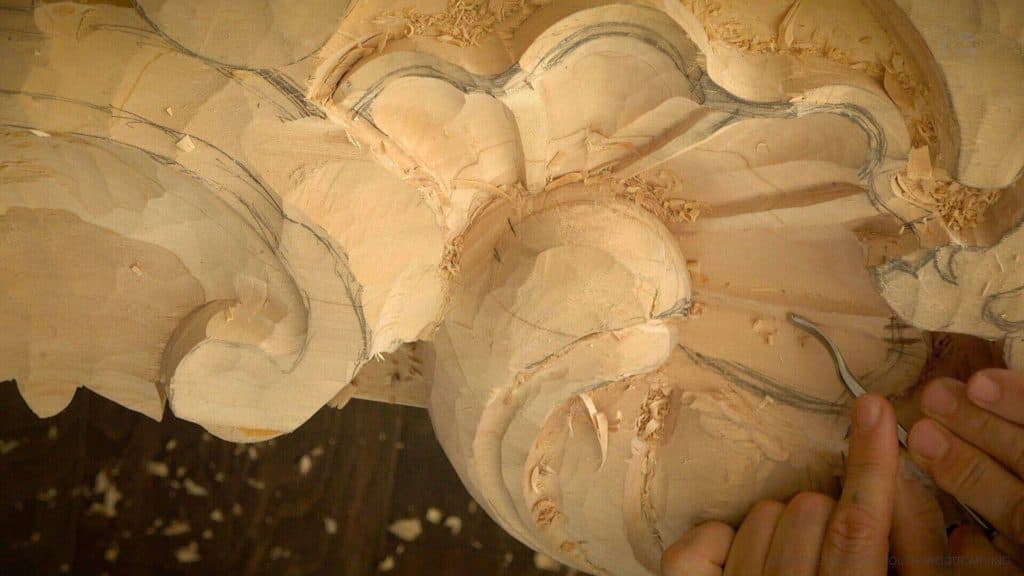
Alexander Grabovetskiy, woodcarver, School of Woodcarving · Published 2023
What does a wood carver mean by "pulling cut"?
Quick answer: In Venice Room workshop 5, part 12, I named the pulling cut right after describing a cut, a pull back and then a second cut. Other lessons put a pull beside my knife, hooking, small tools and a jigsaw blade.
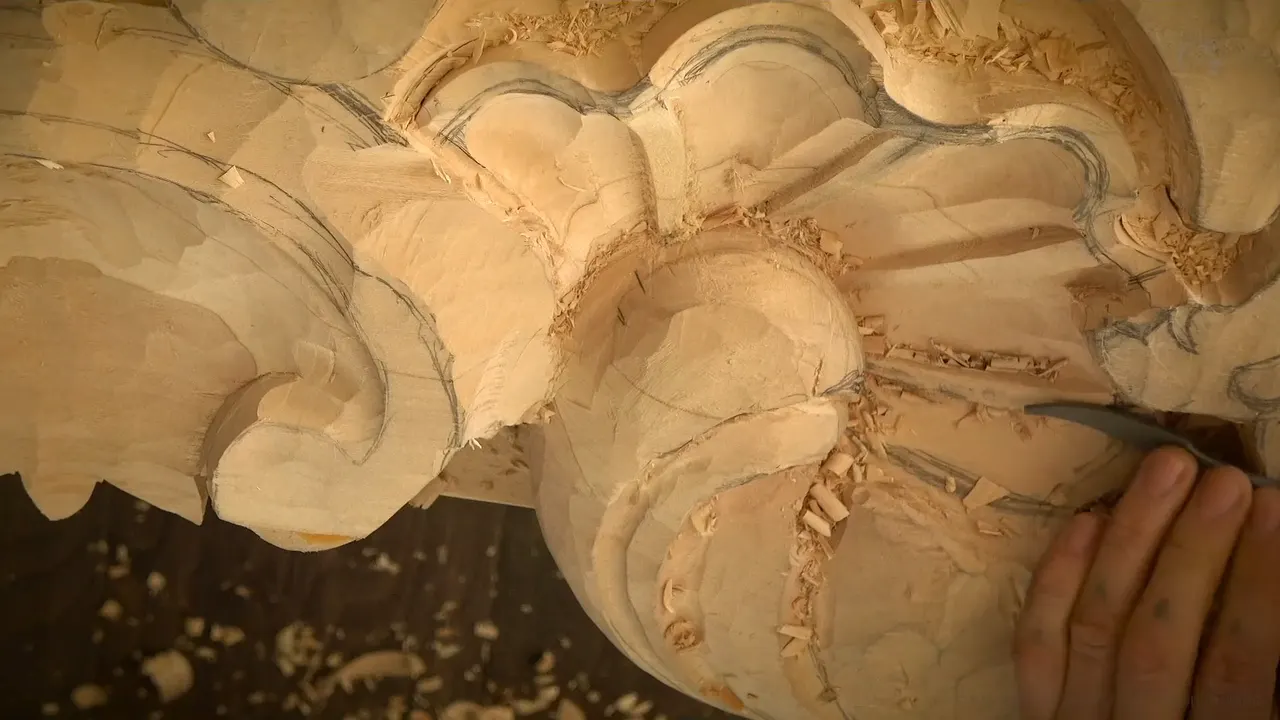

In part 12 of Venice Room workshop 5 I put a name on a move: "So I call it the pulling cut, just like that." Other lessons of mine carry a pull too. It shows up with my knife drawn toward myself, with hooking, and with a jigsaw blade pulled slightly back. Each lesson is linked below, and a table near the end lists them all.
You get part 12 in my own words first. The two parts before it come next. After them come the lines from other lessons where I pulled something.
What this page holds
- Part 12 of workshop 5, an early line through a line near its end.
- The parts just before it.
- My knife in rosette, panel, plate and Venice Room lessons.
- Small tools, hooking and a jigsaw blade.
- Every video in one table, each with a note on the pull.
What came before the name?
An early line in part 12 is about whether anyone will touch this carving: "And I know nobody's going to touch it, I should say." Next comes "It's just for me."
"I really want to see this project turn out really nice, and I really want to be satisfied myself." The light gets a line too. When it hits the carving, "a slight variation is going to give a different shadow" and I add that I want to see really good consistency.
The waste got a plan: "Let me brush out a little bit, all that waste." I then said I was ready for the next step.
Which tool did I want, and which one did I put down?

My next step was "I have to make this just like a half-- Not half round, but almost half round." For it, I said, the tool would be "just a back bent."
Sizes came as a plan: "Let me see which one's going to fit really good." One was "maybe a little too big." After it came "I don't want to dig inside of the finished part" and then "That was number eight."
Another idea was "Maybe I just have to do that gradually, just chamfer it little by little." My choice came with "10 millimeters" (0.39 in), and I said I would start.
"That is a back bent, by the way, but I need to sharpen this one," came next, and then "Carefully."

Why did I carve against the grain?
"I am carving against the grain in this case," I said. A line about direction followed, and I broke off in the middle of it. "Logically, I'm supposed to go from this side, but absolutely no way, because this is on my--"
"No way. I'm not able to use the tool the right way." Then: "So I really have to break the rule." A thought about where to begin followed: "Well, actually, I should start from the beginning, not from the center."
What name did I give the move?
About the wood I said "I have to keep an eye on the grain of the wood, for it's not splitting the wrong direction." My own reason for the move came next: "And that's why I'm pulling sometimes backward."
Here are the words that gave the page its subject: "So I make my cut, then I pull, then cut again, then I pull, then cut again." After those words I put a name on the move, the same one that opens this page.

Speed came up: "I'm doing it quickly, but you'll know once you're going to try it, what I mean by that."
A pencil came into it. Professional artists, I said, say you are "supposed to do just in one long line." My answer was "Yes, it's true, but not always possible." A long stroke is open to me too: "I can do one long cut also once I get closer to that result I want."
Of the shape I said "it gives a really nice almost half a sphere look." A correction followed: "Not the sphere, I'm sorry, just the true half a pipe, I should say."
Which checks and finishing cuts came with the ribs?
Next came a run of lines: "Let me hit that top a little bit" then "I am happy with this one" then "Maybe a little more." After that, "Okay, that is good."
"Let me check," I said. Next came "Double-check" and "I can always try another one more." Right after it: "Somewhere closer right here, and make that upper part even more round, which is sometimes a good idea."
"Okay. It looks like it worked in this case," I said, and "Let me get to the next one."

For the next one I said "I am actually breaking the rule, but that's why the tool must be absolutely sharp if you want to do it that way." The side I could not carve from came up too, and no tool can fit in it, I said.
With really sharp tools, I said, "you should not have a problem." What I felt right then was "I'm feeling like I'm catching something." I fixed the word at once, with "I'm catching the grain, of course, not something, but the grain."
"I have to be almost just shaving," I said. Then "Absolutely no pressure." Next, "Carefully."

On the side with the grain I said "so I can be more aggressive if I have to." A clarification came with it, "With my cut, I mean, not with my behavior."
Another plan: "And let me hit the upper part until those two cuts meet."
What did the two parts before it hold?
Part 10 has "number 11 and 3 millimeters" (0.12 in), then the word "Veiner." My answer to why I go so deep was "that is all about the shadows."
The whole room, I said, will be a bedroom. Near the end of part 10 I wanted "the smooth transition, if you know what I mean."

Part 11 has "I did not do enough concave yesterday. And it's okay. That's fine." Then: "we can always dig deeper with no problem."
On the surface, I said "you can see I'm just hitting the high spots" and that "which means it's not really smooth." Rasps get a line as well: "lately, I really like the idea of using rasps" and they are "actually called carver's rasps."
Where else do I pull a knife toward myself?
In Flower Rosette 5, part 1, I said of my knife "I'm holding as like a pencil, okay" and added "that's easy for me to create the pressure." Its pull came in "I'm pulling my knife toward myself," right after "Just outline it."

About basswood or limewood, I said "it should not be any problem." The wood is soft, I said, and "it just digs really nicely."
Part 2 of Flower Rosette 6 set a plan first, to reestablish my middle line. A new way to cut came next. I called it "also other way to make a cut" and described pulling the knife toward yourself.
Since I made that cut, I said it would be "a lot easier to remove the background even more to get the same level this side and that side." Then "you have to keep an eye what your grain does."

Over in Furniture Panel 17, part 8, I planned to leave the wood a little thicker and said "I'm staying away a little bit from the final detail, okay?" Then: "So I can always make it smaller, but I can't make it bigger."
Same part, other words: "I'm pulling my knife" and then "I'm carving on a pull right now." "I control from both sides, and I am trying to do 90 degrees cut," I added.

In Butterflies 9, part 1, I planned a straight down cut. "My first cut my knife gonna be really like a 90 degrees," I said, "but still just because I'm pulling".
Next: "So I'm using the logic of the pulling it's going to be a lot easier to pull like that." I planned to "pull my knife right on that line" and I said "I am somewhat deep. I don't know how deep I am."

How deep? A guess: "maybe about even 3/8 of an inch something like that" (about 9.5 mm).
Butterflies 8, part 1, holds a plan to "create that cut again" at the same spot. That pull came "but really carefully without forcing it."

Two cuts open Butterflies 12, part 3, one outside and a second one inside. Then came a plan: "I'm going to do my cut right on this line, pulling toward myself."
My plan went on, to "lean my knife slightly toward myself" and to go "carefully, carefully, carefully just to follow my line."

Chamomile and Bow Rosette 3, part 3, holds a plan for the angle, slightly off straight down. Its pull comes with "this cut going to be on a pull, and I don't have to force it."
Of a second cut I said "my cut was from this side" and planned to "flip my knife just on the opposite direction and remove a small chip."

Part 11 of Venice Room 101 has "I'll take just my knife I love." Its plan: "create just a cut like this with the knife, pulling it over myself." Then another side: "create V cut."

Which small tool did I pull, and what is a hook?
A small tool gets its own words in Greek Acanthus 6, part 4. "This spot right here, it's a really tiny spot, and that would be really tough to get with the knife." Then: "And this tool, I am able to."
On how I move it: "I am pushing, pulling toward myself and clean it." Then "Beautiful tool. Really easy to use."
The plan in part 1 of Greek Acanthus 12 has a hook in it: "let me make it second pass and hook it." A line about the work followed: "I can see my shadow line."

That tool can push as well. "It's also possible to push it just like that and kind of clean it."
The hook gets a name in Greek Acanthus 9, part 4. "I'm kind of hooking," I said, and then I explained: "I'm actually using just the edge of my tool, and you can see micro-moves, and I just hook the excess material underneath until I can grab it and just move it out."
"And that's hooking." One more line with a pull in it comes from Grape Onlay 12, part 3. My tool sits "upside down with flute down to six o'clock" and I said "I excavate."

"And sometimes you can hear, you know," I said, and then "I'm pulling slightly like, uh, hooking and dragging out." In the same part: "I cut. I don't leave it right there. I'm hooking."
Then: "cut, hooking, cut hook, cut hook." The effect was that "those chips are flying out right away" and "it's cleaner on inside and you're able to see much better on inside."
When does a blade get pulled back?
The saw in part 7 of Venice Room 1 is a jigsaw: "that jigsaw, it just has a guard." For its blade I gave this tip: "if it starts jumping, just go back a little bit, just pull it slightly back, and you should be fine."

Near the point of a detail I meant to pull the blade back and continue my cut, and I did not want "to twist too much and place too much stress on my blade."
"Going like a gradual movement. Okay?" Then I planned to pull back a little bit.

My April 2020 livestream about lighting a bench shows two knives that a knife maker sent me. "They work on a pull. Well, actually, you can do on a push also. It depends what kind of work you do."
In my April 13, 2020 livestream, which was about knives, I said "I can use either on a pull like that" and, for the other side, "on a push another side." That was a knife cut.
Which videos hold the pull, and with what?
Every video below holds a pull, with a note on what sat beside it.
| Video | What sat beside the pull |
|---|---|
| 5-12, Venice Room | A cut, then a pull back, then a cut again, with the grain in mind |
| Rosette 5-1 (Flower) | My knife held like a pencil, drawn toward myself |
| 6-2, Flower Rosette | Another way to make a cut, toward yourself |
| Panel 17-8 (Furniture) | Carving on a pull, with a 90 degrees cut |
| Butterflies plate 9-1 | A straight down cut, and the logic of the pulling |
| Plate 8-1, Butterflies | A pull that stays careful and unforced |
| 12-3 (Butterflies) | A cut on a line, knife leaned slightly |
| Chamomile and Bow Rosette 3-3 | A slightly angled cut on a pull, with no force |
| 101-11, Venice Room | A planned knife cut pulled over myself, then a V cut |
| 6-4 Greek Acanthus | A tiny spot, and a tool pulled toward myself |
| 12-1 Greek Acanthus | A planned second pass and hook, and a tool that can also push |
| 9-4 Greek Acanthus | The edge of my tool, hooking waste out from underneath |
| Grape Onlay 12-3 | Cut, then hook, with chips flying out |
| Venice Room 1-7 | A jigsaw blade pulled slightly back when it starts jumping |
| Livestream, April 2020 | Knives that work on a pull and on a push |
Where can you watch part 12?
You can watch part 12 inside workshop 5 of the Venice Room course. Parts 10 and 11 sit beside it on the lesson page. Everything on the site sits inside the tuition.
Which cut do you pull back, and which one do you carry through? Pick up a gouge, check your grain, and give it one more pass of wood carving.
How it's done
- Choose a tool that fits. A number eight was a little too big. I did not want to dig into the finished part, I said.
- Watch the wood. Grain can split in the wrong direction. I have to watch it, I said.
- Cut, pull, cut again. The name comes from cutting, pulling back and cutting again.
- Shave where the grain catches. Where I felt the grain catching, I said I had to be almost just shaving, with absolutely no pressure.
- Check, then go once more. After a check, one more cut is possible, closer to the spot, to make the upper part rounder.
Frequently asked questions
Which line about the wood comes before the move in Venice Room 5-12?
I said I should watch the grain so it is not splitting the wrong direction, and that this is why I sometimes pull backward.
Why did a sharp edge matter once I broke the rule in part 12?
I could not carve from one side, and no tool would fit in there. I said that is why the tool must be absolutely sharp if you want to do it that way.
Which line about a single long stroke comes in that part?
Professional artists say you are supposed to draw in one long line. Not always possible, I said, though it is true, and I can make one too once I am closer to the result I want.
What to carve next
- Venice Room Part 1 course page
- Venice Room 5
- Venice Room 1
- Venice Room 101
- Carving Flower Rosette 5
- Carving Flower Rosette 6
- Carving Furniture Panel 17
- Carving Plate with Butterflies 8
- Carving Plate with Butterflies 9
- Carving Plate with Butterflies 12
- Chamomile and Bow Rosette 3
- Carving Greek Acanthus Leaf 6
- Carving Greek Acanthus Leaf 9
- Carving Greek Acanthus Leaf 12
- Carving Grape Onlay 12