
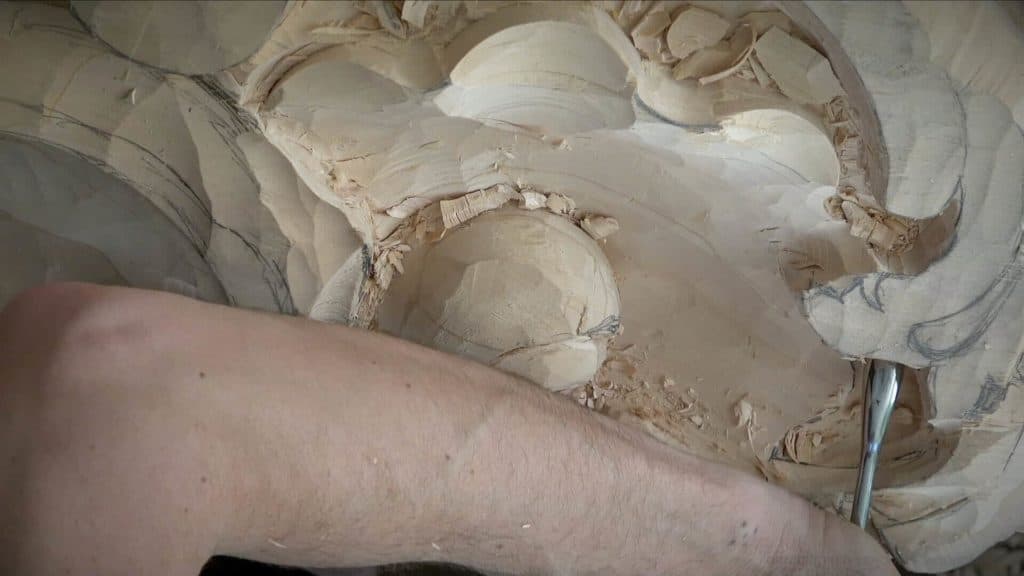
Alexander Grabovetskiy, woodcarver, School of Woodcarving · Published 2023
What does a wood carver mean by "preliminarily"?
Quick answer: In Venice Room workshop 5, part 2, the word came with a deep hollow I would have to dig under in the future. In workshop 53, part 4, I gave my reason for a preliminary blend, "Because it has to roll," and a ridge I would make much lower later.
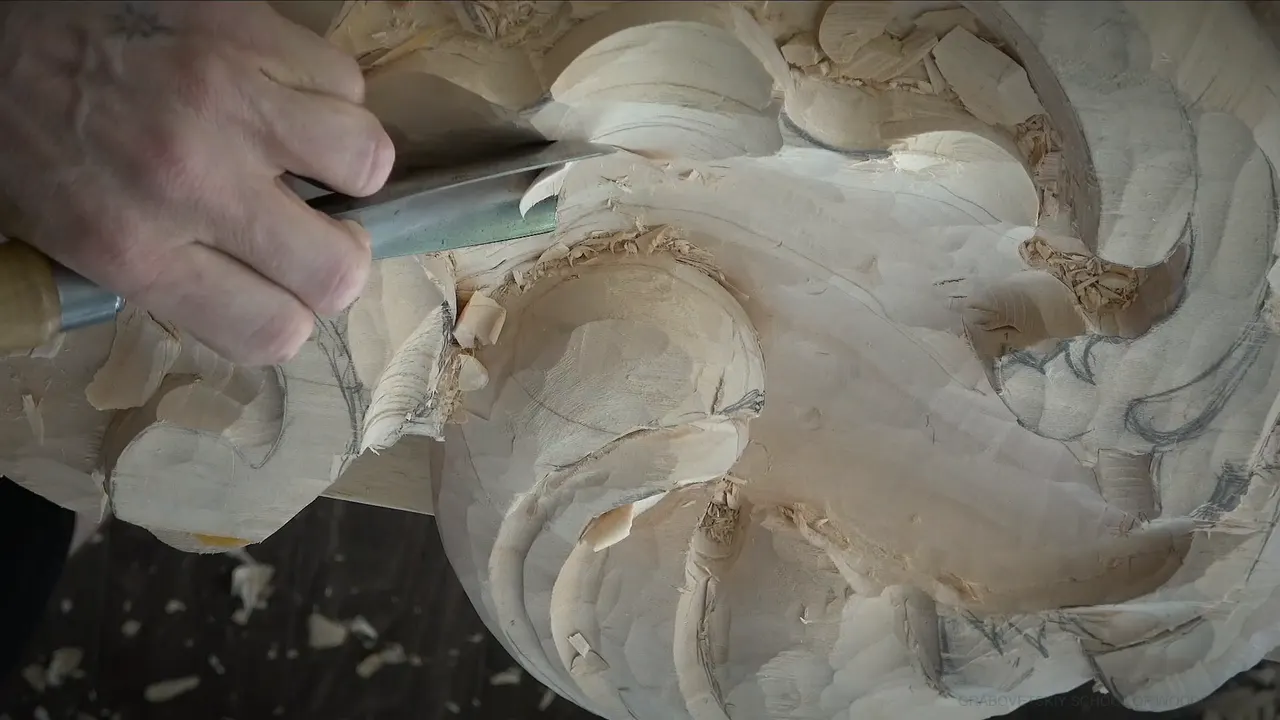

In part 2 of Venice Room workshop 5, I said the word over a detail I would have to dig under, and my other lessons put it beside cuts, outlines, rounds, a knife and a clean-up. Each lesson I quote is linked below, and a table near the end lists them all.
Ever stood over a wood carving piece and wondered how much of a dig belongs to the first visit? You get what I said around the word in workshop 5, part 2. My own words with it from other courses come after that.
What this page holds
- A dig beneath a detail on a shell, in part 2.
- Tool sizes I named there, and in the two parts next to it.
- Cuts, lines and rounds where I said the same word.
- Jobs I left for later.
What did I mean by preliminarily in Venice Room 5.2?
Early in the part I said "That is the shape I like, except I lost one of the details, I think" and a moment later "I didn't lose it, but I need to recreate." I even apologized, "Don't want to confuse nobody." Then I pointed at the spot: "That is also part of a shell, and that part's supposed to go deeper."

The word comes later, and a plan sits beside it. I put the job this way, "What I have to do, I have to kind of dig underneath of that detail." The reason followed in the next breath: "Well, maybe not right away, but in the future, I will have to because otherwise it's not going to look like it's flipping on the top of this shell." Of the dig itself I said "So it's going to be really deep excavation."
Here is the line itself, "I can preliminarily just excavate some of it." Close behind it came "Just dig in." By my own words, then, the full dig waits for the future, and the small first part is what I could do now.

Which tools did I name in that part?
My first pick came with a reason: "Let me get number 11 and half an inch and a long bend because I do have, right now, this part in my way." In metric that size is about 13 millimeters. Soon after, I said "In this case, I'm using veiner."
A second thought followed, "And maybe I have to switch to a short bend." For its size I gave "About 10 millimeters, that's what I'm going to use right now, short bend. 3/8 of an inch." Those are two figures for one tool, and in the other system they read 0.39 inch and 9.5 mm.

The tool was not fixed: "It doesn't have to be the number 11. I could use number nine. It would give me exactly the same result." The wood needed watching too: "I also have to keep an eye how the thickness of my material, how much I have left right there. I am already in the first layer." Then came "Constantly have to check, and I have plenty."
Then a spoon gouge came up: "Let me use number nine, a little bigger. Okay, spoon gouge. I'll use 15 millimeters, so that would be almost 5/8." The pair works out to 15 mm (0.59 inch) and 5/8 in (about 16 mm). "It should be beautiful," I added.
What did the dig under the detail ask for?
Depth was one ask, and a clean cut on the inside was the other. The second one came as "And also, it's going to be visible from the bottom, so I have to make sure it's a really clean cut on inside, okay? It cannot be not clean, I should say."

I said "Okay, that is good" and then "Now my canvas is almost ready" before I reached for a smaller tool with "Let me get a smaller gouge." Its size came aloud, "I'm going to use probably just quarter-inch number nine." A quarter inch is about 6 millimeters.
How did the two parts beside it sound?
Part 1 of workshop 5 has a nearby form of the word: "And although I probably still could use number five, make preliminary cut." It goes on, "Just a straight-down cut is what I'm doing right now. But be careful. Don't press it too hard."

Later in that part I said I probably could use something even smaller, "like 3/32 or even 1/16" and then "Make that excavation a little deeper." In metric, 3/32 in is 2.4 mm and 1/16 in is 1.6 mm.
Part 3 holds a plan of its own, "pre-establish my main movements on inside," along with an allowance, "They don't really have to be exact, but as close as possible." I also called it "a double layer shell" and said the line at three-eighths of an inch (10 mm) would be "a part of another concave cut later on."

Which tools came with the word in other lessons?
Part 9 of Venice Room 12 names the tool again: "But the good tool would be, again, number 11, I would say." My plan followed it, "And I could preliminarily excavate whatever I don't need. But I don't want to damage that crisp line also." A number nine turns up in Venice Room 10, part 8, with "my number nine and I can start preliminarily outlining."

Part 7 of Hashemi Flowers 13 has a V tool, in the words "Let me take the V tool and preliminarily establish my movement." The look did not please me, so I went on with "let me take a flat gouge, almost flat, 20 millimeters, number three, three-quarter of an inch." The two figures are 20 mm (0.79 inch) and 3/4 in (about 19 mm). The V tool returns in Roman Acanthus 2, part 4, where I said "just a V tool to preliminarily establish" and then the movements and lines it was for. The volute sits close by, and I added "Just the same idea as we're using V tool for undercutting."
In Roman Acanthus 12, part 2, the knife takes the place of a gouge: "I could use just a gouge or even a backbend would work really nicely in this case. But I'll use preliminarily just a knife." I also named "probably the backbend gouge, and in my case, it's number 25 and 3 millimeters, will work the best just to make it more round." Three millimeters is 0.12 inch.

Hashemi Flowers 11, part 2, holds a knife as well, in the words "take a knife and preliminarily establish the form." My caution sat just before it: "I'm not going to do too much pressure because I can always attack that from the backside also, and remove all that waste." Butterflies 3, part 1, hands a chip to the knife: "you could actually preliminarily just remove some of that chip with the same knife." A warning follows, "Just make sure you don't dig too deep to the wing."

Bent tools come into Venice Room 28, part 9: "easier for me to attack with the number 11 short bent and clean all that stuff if I preliminarily just use back bent." My reason was "Because everything is in my way, and it's the only tool I can get in here." Over in Venice Room 41, part 2, I called a back bend "more proper tool for this operation" after "I'm using number seven. Just a straight tool."

Which lines and movements came with it?
Part 10 of Venice Room 60 has the word over a whole movement: "What I want to do, I want to preliminarily establish this movement, how it's supposed to look with all those divisions and stuff like this before I create my concaves and convexes."

A slope needed lines in Venice Room 90, part 3, in my words "to get the lines in place where I would just understand if I'm on the right slope, I'll preliminarily just draw those lines."

Boundaries came up in Venice Room 22, part 2, with "So that's what I'm after, just creating those boundaries." My next idea there was "preliminarily just do that subdivision." Between two lines in Venice Room 53, part 3, I made a choice aloud, one of them the main middle line. "Let me preliminarily put it," I said.
When did the word sit beside a dig into the wood?
Workshop 22, part 2, has a dig next to the word too: "Which I could probably preliminarily excavate upward a little bit from this point on." I held back on the rest, "Because I might create some detail underneath. But little bit I can excavate."

Over in Venice Room 9, part 7, the line was "Now I can probably preliminarily remove some of the material on inside." Right after it I did not want to go all the way to the edge, "because I still have to create the right movement, okay?"
Small sizes showed up in Hazelnuts 8, part 2: "1/8 of an inch. 3 mm. I preliminarily excavate some of the stuff out. Undercut it." One wish came with them, "But I still want to make sure I'm leaving enough material for future." Those two sizes agree, because 1/8 in comes to about 3.2 mm.
Part 9 of Venice Room 54 aims at a shadow. I gave the tool as "One quarter of an inch, six millimeters," which is 0.24 inch, and the goal as "Let me preliminarily create some spot where it's supposed to go, and that's going to go all the way deep inside, okay? So that is the goal. Just the goal create that deep shadow."

A border and a careful dig share Venice Room 133, part 2: "Now take number three and preliminarily establish my border" and then "Number 11 and two millimeters to excavate this area carefully." Two millimeters comes to 0.08 inch. I called the spot "kind of becoming weak" and said "But I need that shadow. I really need that shadow."
Butterflies 1, part 3, puts a depth on the first pass: "if you need to carve little deeper, you can always go little deeper. Okay, but preliminarily I'll just go no more than six millimeters deep." Workshop 9, part 12, names a cut instead, "And I have to preliminarily probably just create one big cut with the number five, maybe."
Which jobs did I leave for later?
A clean-up waited in workshop 12, part 10, with "And I will have a chance to clean later" then "Now it's just preliminary. And that side also, I can probably just preliminarily clean." A round waited in Venice Room 41, part 7, with "And of course, this has to be rounded later on. I could preliminarily just give that roundness."
Workshop 53, part 4, holds a reason. I called it a preliminary blending and went on, "Because it has to roll, and I have to make it lower, much lower, actually, this ridge later on. But preliminarily, I can see exactly how my development develops."

A cut could be done right away in Tray of Blessing 2, part 1: "Yeah, well, well we could preliminarily do it. Why not? I mean, you can do it right away approximately. That way you're not gonna lose it." Its tool was "same number nine, but it's gonna be 10 millimeters, three eighths of an inch." The two sizes agree closely, since 10 mm is 0.39 inch.
How did I treat a mistake, a loss or a deep spot?
A big tool came into Venice Room 34, part 5: "And I could actually preliminarily just chop with the bigger gouge, just chop down." I added that I did not want to take "too much of the material." Later in that part came "Maybe it was a mistake. I shouldn't do that."

In Venice Room 27, part 2, I lost a section of the leaf and said "This section I just lost, that's absolutely okay. I can reestablish it, no problem." Lily Box 10, part 6, starts with a break: "And now, just because I broke the edge, I have to attack that and preliminarily clean it."
Which videos hold these words, and with what?
Every video below holds the word, with a note on what sat beside it.
| Course and video | What sat next to the word |
|---|---|
| Venice 5-2 | Digging below a detail, then a smaller gouge for that area |
| Venice 5-1 | A possible number five, a straight-down cut, and a warning on pressure |
| Venice 9-7 | Material on the inside, with number nine in view |
| Venice 9-12 | One big cut with number five, maybe a mallet |
| Venice 10-8 | Number nine, and the start of outlining |
| Venice 12-9 | Number 11 again, with a crisp line to protect |
| Venice 12-10 | Clean-up now, with the real clean-up later on |
| Venice 22-2 | A boundary, a subdivision, and a small excavation |
| Venice 27-2 | A movement, then a section I lost on the leaf |
| Venice 28-9 | Back bent tool, because everything was in my way |
| Venice 34-5 | Bigger gouge, and a wish not to take too much material |
| Venice 41-2 | Rounding it, with number seven in hand |
| Venice 41-7 | A roundness that has to come later on |
| Venice 53-3 | A choice between two lines, one the main line |
| Venice 53-4 | Blend, with its reason given in the next line |
| Venice 54-9 | Deep spot for a shadow, at a quarter inch (6 mm) |
| Venice 60-10 | A whole movement, ahead of its concaves and convexes |
| Venice 90-3 | Lines, to find out if I am on the right slope |
| Venice 133-2 | A border, then a careful dig of 2 mm (0.08 in) |
| Hashemi 11-2 | A knife, used to establish the form |
| Hashemi 13-7 | A V tool, and then a flat gouge |
| Roman Acanthus 2-4 | A V tool for the movements and the lines |
| Roman Acanthus 12-2 | A knife, with a backbend gouge named beside it |
| Tray 2-1 | Number nine at 10 mm (0.39 in), and a plan to keep material |
| Lily Box 10-6 | A broken edge, and a first clean-up of it |
| Butterflies 1-3 | A depth of no more than 6 mm (0.24 in) |
| Butterflies 3-1 | A chip taken out with the same knife |
| Hazelnuts 8-2 | An excavation of 3 mm (0.12 in), then an undercut |
Where can you watch part 2?
You can watch part 2 inside workshop 5 of the Venice Room course. Parts 1 and 3 sit beside it on the lesson page. Everything on the site sits inside the tuition.
Which spot on your own board needs a first pass today? Pick up a gouge and a mallet, look at the grain, and give it one honest pass of wood carving.
How it's done
- Say what waits for later. A really deep excavation lies ahead under that detail, I said.
- Name the first pass. Right after the word came "Just dig in."
- Check the wood left. The thickness of my material needs a look, and I was already in the first layer.
- Plan the clean wall. The dig will be seen from below, so the cut on the inside must be really clean.
- Pick the clean-up tool. For the clean-up I said I would use a smaller gouge, probably a quarter-inch (6 mm) number nine.
Frequently asked questions
Which dig did I plan?
Beneath a detail on the shell, so that the detail would flip on top. My words were "maybe not right away, but in the future, I will have to."
What tools did I name there?
A number 11 at half an inch (13 mm) with a long bend, a short bend I said I might switch to at 10 mm (0.39 in), and a number nine spoon gouge at 15 mm (0.59 in). For the clean-up I said I would use a quarter-inch (6 mm) number nine.
Was a clean wall part of the plan?
From below the dig will be seen, so the inside must be clean, and I put it as "It cannot be not clean, I should say."
What to carve next