
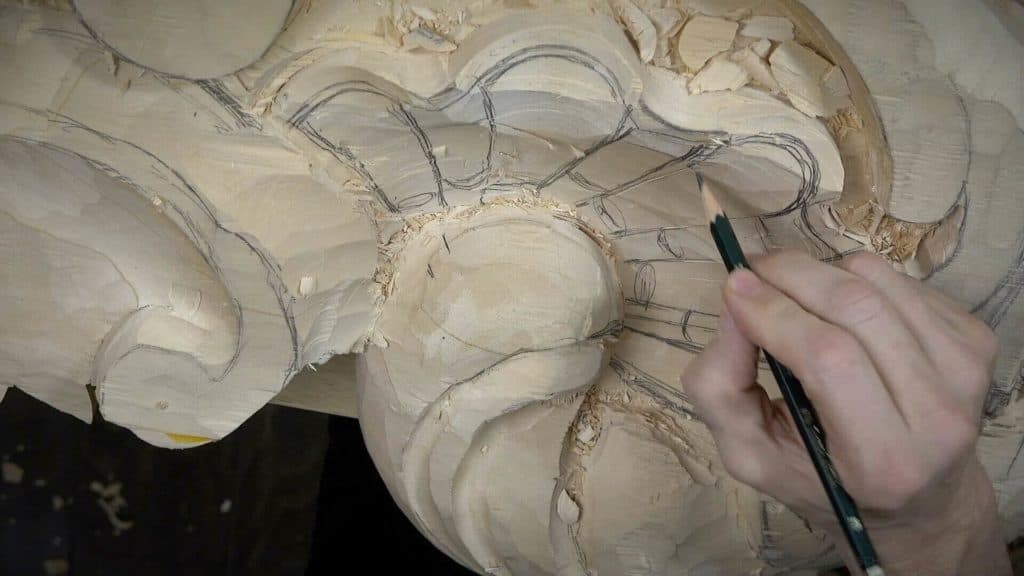
Alexander Grabovetskiy, woodcarver, School of Woodcarving · Published 2023
What does a wood carver mean by "lip"?
Quick answer: In Venice Room workshop 5, part 3, I pointed at a lip part of the shell and gave the reason for the name at once. I added that part has to match the gaps beside it. Other lessons of mine put lip beside curls, edges, a frame and a 2 mm thickness.
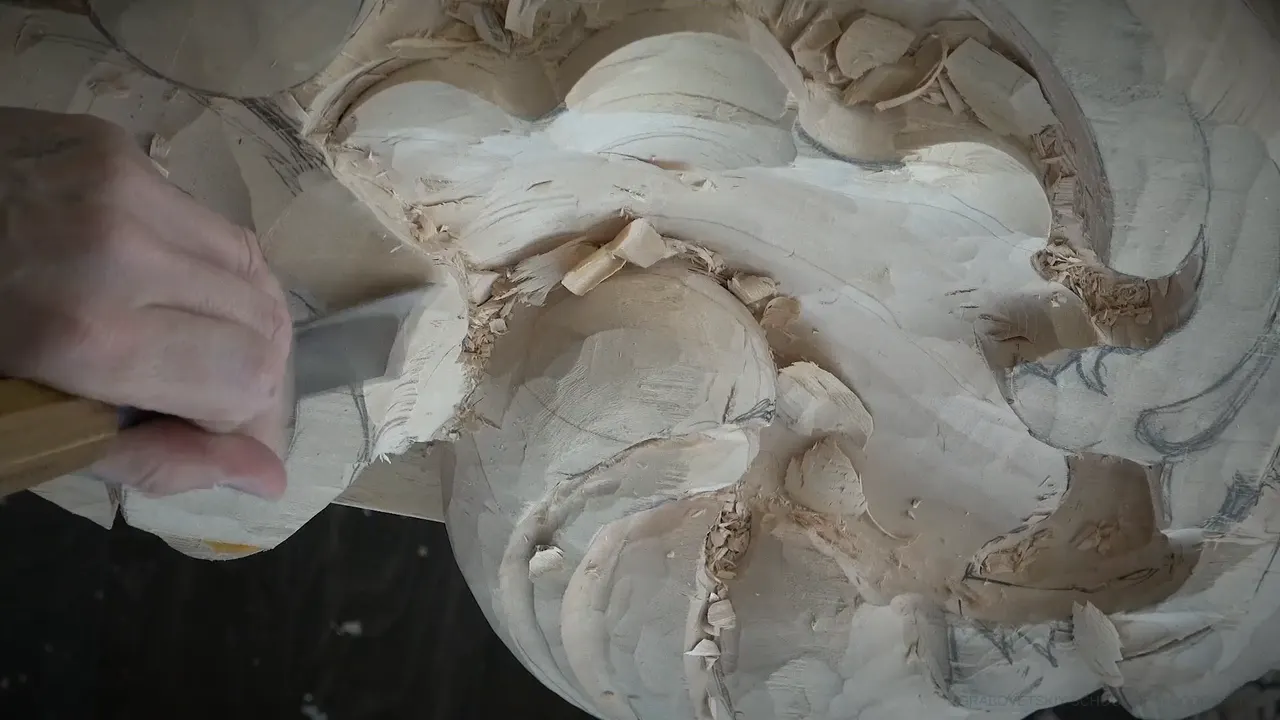

In part 3 of Venice Room workshop 5 I said "I call it lip because it lips backward little bit" and in other lessons the word sits beside curls, edges, a frame and a thickness of 2 mm (0.08 in). Each lesson is linked below, and a table near the end lists them all.
Ever looked at the edge of a shell and felt one part of it should turn back a little? Here you get what I said about it in part 3. Then come my words from other lessons.
What this page holds
- Part 3 of workshop 5, with a movement to clean and the double layer line.
- The two parts that sit beside it.
- Lessons where the word comes with a curl, an edge or a frame.
- A table of every video that holds the word.
How did part 3 begin?
It opens with "You know what" and then "Maybe I shouldn't go too deep with that." One more line followed: "Maybe I can just clean little bit that movement."
My pick was "number five" and the size was "35 millimeters" (about 1 3/8 inch). I said too: "I'm going to chop a little bit this side because it just doesn't look too good."

What was my plan after that?
"That's probably enough," I said. A need came next: "a separation cut right here." On the angle I said "Just got to attack that from the right position."
Another tool came up, "the number seven and one inch" (about 25 mm). For that tool: "Let me clean little bit straight there." Then "exactly the same right here."
On a fit I said "Maybe yes, maybe no." Then a thought about the tool: "I could change to number five. Because number five is much better in this area." A line about the light followed: "Well, it is getting a little bit dark, and that's probably time to change my lights."
How close did I want the main movements?
"Now I'm going to pre-establish my main movements on inside." About them I said "They don't really have to be exact, but as close as possible." And "That's my goal."
A knife came in: "And let me make a couple cuts with the knife, actually. It's a good idea." My reason was that the movement would be "pretty close to the original."

The plan went on: "All right. Let me place it back, and I can see it, and I can reestablish it." Then "So now, that's the fun begins." I hedged the line about the shell: "Well, in my opinion, it's going to be a beautiful shell."
Where did I say the word lip in part 3?
First a gap check: "So let me double-check. The distance right here has to be approximately equal everywhere, which is not the case right here."
Then "Now it's close. I'm talking about that distance, that distance, that distance, and inside right here, about the same."

The lip followed: "And the same applies to that part, which is, you can see a lip part." My word for it was "I call it lip because it lips backward little bit." And "So it also has to be approximately the same, which is not the case right here."
I went on with "Oh, pretty close, but right here it's not." A plan for changes: "And if I need to make little changes, I'll make them." The reason came with it: "Because I want to make sure the shell looks really nice."
What came next in part 3?
"So I guess I have to reestablish this part because it doesn't look too natural." For it I said I would use the same number seven, "which I used before." And "Okay. Make that cut. And this part going to go underneath."

The next line was "Now, what I want to do, I call it, it's like a double layer shell." Next came "approximately three-eighths of an inch" and a plan to "create a line." Then "Three-eighths of an inch. Ten millimeters." In decimals, 3/8 inch is 9.5 mm.
Then "a part of another concave cut later on." Next: "I need to get another eighth of an inch before I start my inner cuts" then "So we're talking about 3 millimeters." An eighth of an inch is about 3 mm (0.12 inch).
And later: "I need to make sure the distance right here equals that side, and I need to bring probably this side a little bit from both sides inward." And "Double check."

What did the two parts beside it add?
Over in part 2 I said "But I do have a challenge because I have to attack that with the right position." It also holds "That is the shape I like, except I lost one of the details, I think" and "I didn't lose it, but I need to recreate."
Its sizes: "number 11 and half an inch and a long bend" (about 13 mm). Then "About 10 millimeters" and "short bend" (0.39 inch), and "3/8 of an inch" (9.5 mm).
"Okay, spoon gouge. I'll use 15 millimeters, so that would be almost 5/8" (0.59 inch). As for the material: "But I also have to keep an eye how the thickness of my material, how much I have left right there."
Over in part 4 I said "I don't want to make mistake on that detail. Really don't. Because it's a main focal point." Next: "Again, I'm not going to touch beyond that line. And you will understand why later on."
Its tools: "Okay, I'll use the number seven and one inch." The reason I gave: "much deeper right here" and "more shallow closer to the head of the acanthus." And "And number seven gives me that control." A line on the finish: "see the difference when you cut with a really sharp tool, it leaves beautiful finish."
Which lessons use lip for a curl?
In Roman Acanthus 15, part 2, I said "See, I got too close to the edge. I got too excited." Later I said "Clean cut is how I call it." Then "And I can always refine my lip, the curl lip or return lip, later on."
Further on came "let me refine this lip." After that I said "I just noticed that this lip is not really good" and named the tool: "Take number six first, clean it a little bit." Its size: "3 millimeters number six" (0.12 in). Then "I'll just use this one to recreate that lip."

Around lips I said "if you don't feel comfortable to do those really deep excavations around those lips, you really don't have to." Then "So I'll follow with number 11 and 1 millimeter and create undercut on both sides" (0.04 in), and "I can follow with the half a millimeter number 11" (0.02 in). On shadow I said "But it just gives me really good shadow."

Hashemi Flowers 46, part 1, has "take number four and clean the edge a little bit." That came before "Oh, by the way, what I could do, I could create a small lip, lipping out."
About it: "So if I can remove some section right here, it looks like it has a natural tendency to do that, and I have to just follow the natural tendency." Then "Use a knife carefully. Create concave cut." And "It just looks like it naturally wants to curl out, in my opinion."

Hashemi Flowers 49, part 7, starts with "Now, what I could do, it looks like I could create some kind of lip out a little bit." For the tool I said "let me use number five first." Then "Kind of refine my outside shape."

The next plan: "a small, tiny concave on the side just really carefully, just because of the grain already not in my favor." Then "Okay, and I kind of like that look. So it's just like it lips out from inside out."
In Flower Rosette 6, part 4, I said "So you see, knife is your friend." Tool for it: "number 12, little longer knife." Later "Let me do this side" and "I need to establish my lip."

Next: "Same knife, opposite direction, just remove it." And "Exactly the same idea. Just don't overdo it, because you can always remove too much, and you don't really want to do that." My reason for showing a knife technique was "just to encourage you, if you don't have too many tools yet, that should not stop you from carving."
Where else did I put lip beside an edge or a frame?
In Venetian Flowers Rosette, part 3, comes "I've got the initial depth, which is about, I'd say, about half an inch or so" (about 13 mm). Then "Some spots maybe a little more, maybe about 14 millimeters" (0.55 inch), and "But to go deeper, I want to remove that lip."
About it: "I don't need that, and that part is going to become a curved molding with some kind of carving." I named one: "flat gouge, maybe number two. Number three will work. Yeah, just remove it." As for the line, I said "keep those calipers with the measurement. That way, I can reestablish the line quickly."
In Lily Box 10, part 14, I said "Now it curls inside, but I also can curl it outside, backward, right here." Then "If it doesn't make sense, you just watch what I'm doing, okay?" "I can move backward this lip," I said. The undercut: "Okay, so just to create undercut on this side, and naturally, it's going to flip backward."

The spot itself: "But again, not the easiest spot to do something like that, but I'll try." And "And I already can see my flip. Flip backward." Later: "I think it's a really nice movement, what we just created. Now I need to kind of blend it, and maybe give a little more roundness to it."

Grape Onlay 8, part 3, puts a number on it: "approximately two millimeters" (0.08 in) for "the thickness of the lip," a little thicker than 1/16 in (1.6 mm). Then "but this part gonna be raised up and I'm gonna remove all that stuff underneath, which I don't need anymore."
Tool talk there: "Maybe it's time for me to switch to a smaller tool" and "I could use just the number 11, whatever the tool gonna fit, okay?" And "So if you can get it from the other side, it's probably gonna be much safer."

In Grape Onlay 9, part 1, I said I changed the design of the leaves, and that "if you look at the original, you not gonna see this part." Then "I made this part, that little section as a part of that lip right here, that circle." Later in that part: "I think it's gonna be better to create the flip going uphill to create the one deeper shadow."
Furniture Panel 2, part 2, has the word beside a frame: "usually inside of the frame, the lip is still going to cover about 10 millimeters" (0.39 inch). Before it I said "why I did 5/8 of an inch" (16 mm).
Then came the golden ratio and a Fibonacci number: "one plus one is two, two plus one is three, two plus three is five." Later: "20 plus 30 millimeters, it would come about 50 millimeters" (about 2 inches).
In Venice Room 66, part 7, I said "I'm not sure if you're going to be able to see that or not, but its lip going on like this." Then "There's another division right here." And "there is a beautiful movement going uphill."

Then "now I need the smaller concave going all the way on the side of the pipe." And "Let me use a small three millimeters, number 11" (about 1/8 in).

Which videos hold the word lip, and with what?
Every video below holds the word, with a note on what sat beside it.
| Course and video | What sat beside the word lip |
|---|---|
| Venice 5-3 | A shell part that lips backward, and a gap to match |
| Roman 15-2 | Curl lip or return lip, refined with small tools |
| Hashemi 46-1 | Small lip, lipping out, with a knife beside it |
| Hashemi 49-7 | Lip out a little bit, then facets to take out |
| Rosette 6-4 | My lip to establish, with the same knife |
| Venetian rosette 1-3 | Lip to remove before going much deeper |
| Lily 10-14 | A lip I could move backward, with an undercut |
| Grape 8-3 | Lip thickness of about 2 mm (5/64 in) |
| Grape 9-1 | That circle as part of a leaf section |
| Panel 2-2 | Frame lip covering about 10 mm (0.39 in) |
| Venice 66-7 | Its lip going on like this, then a smaller concave |
Where can you watch part 3?
You can watch part 3 inside workshop 5 of the Venice Room course. Parts 2 and 4 sit beside it on the lesson page. Everything on the site sits inside the tuition.
Which edge on your own board turns back a little? Pick up a gouge, look at the grain, and give it one more pass of wood carving.
How it's done
- Check the gaps first. The gap check: "approximately equal everywhere," I said, about a distance.
- Name the lip. After that I pointed to "a lip part" and gave the name with its reason.
- Adjust the gaps. A plan for little changes, if I needed them. Next came a need to reestablish a part, and a plan to use number seven.
- Draw the double layer line. The line I planned: 3/8 in (10 mm), then another 1/8 in (3 mm) before the inner cuts.
- Bring a side inward. A need: bring "probably this side a little bit from both sides inward." Then "Double check."
Frequently asked questions
Which spot on the shell did I call the lip?
Venice Room 5-3 has me pointing at a part of the shell and saying "you can see a lip part." I gave the reason for the name next, and said the lip part had to be approximately the same as the gaps. In that spot it was not.
How thick was the lip in Grape Onlay 8-3?
Approximately two millimeters (about 5/64 in) was my figure for the lip, a little thicker than 1/16 in (1.6 mm). Right after, I planned to remove "all that stuff underneath," and later I said it might be time to switch to a smaller tool.
Which tools did I name beside lip in Roman Acanthus 15-2?
A number six at 3 mm (0.12 in) came first, to recreate the lip. Next in my plan came a number 11 at 1 mm (0.04 in) for an undercut on both sides, then maybe a number 11 at half a millimeter (0.02 in).
What to carve next