
Alexander Grabovetskiy, woodcarver, School of Woodcarving · Published 2023
What does a wood carver mean by "oh, no"?
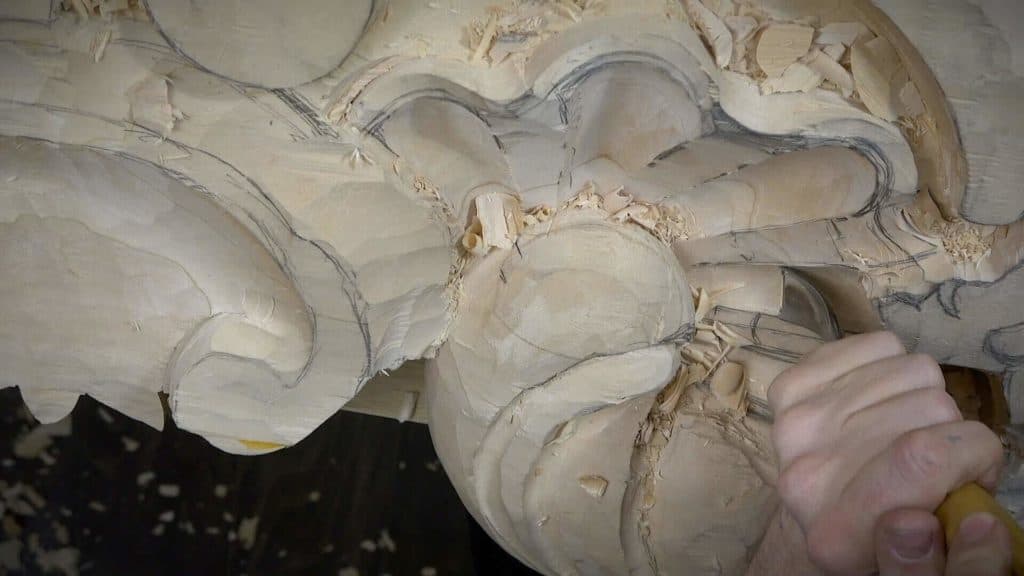
Quick answer: In Venice Room workshop 5, part 5, I asked myself which tool to use, said "Oh, no," and called the first idea "a big mistake." Other lessons of mine put the same words beside sizes, tools, drawings and a slip of my own.
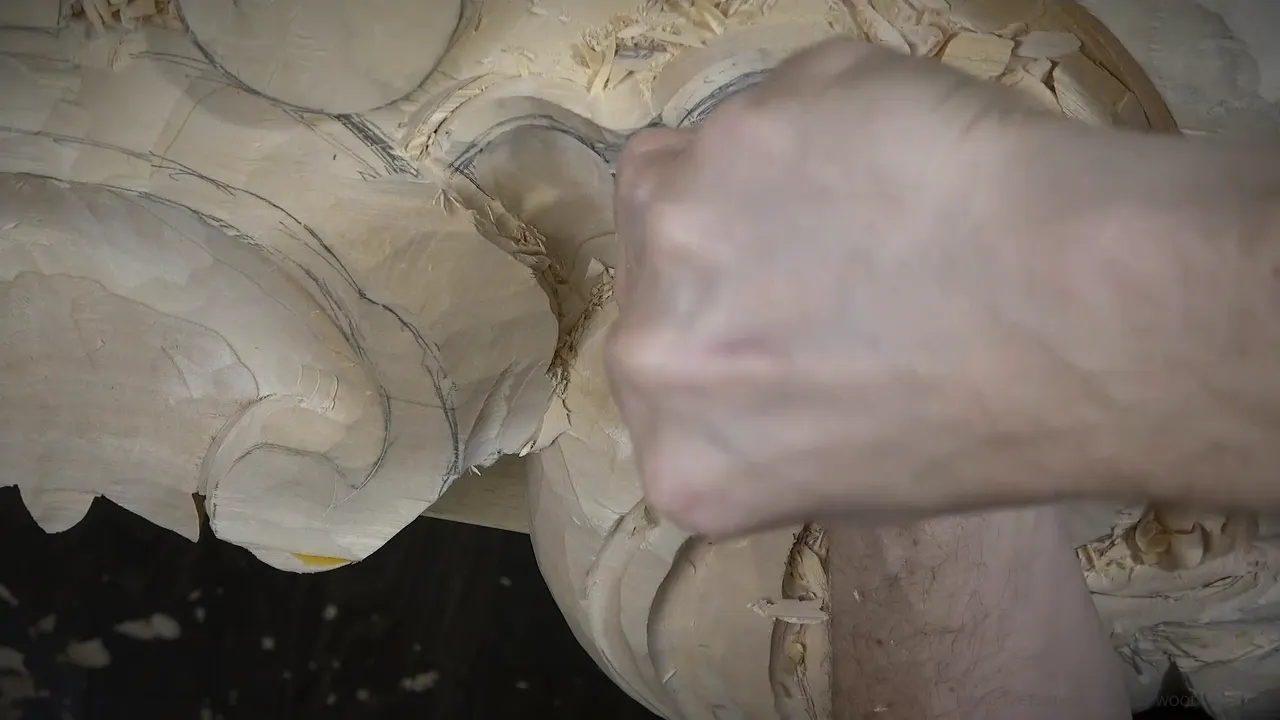

In part 5 of Venice Room workshop 5 I said "maybe number eight," a spoon gouge to attack from one side, and then: "Oh, no, I'm not. That would be a big mistake." Other lessons of mine put the same two words before a wrong size, before a tool that caught, and before a line I did not like. Each lesson I name is linked, and a table near the end lists them.
Ever picked up a gouge and put it back down? Ever drawn a line, looked at it, and not liked what you saw? Here are my own words from part 5, from the parts beside it and from lessons in other courses.
What this page holds
- My words in part 5, in the order I said them.
- Part 4, with its "Oh, dear."
- Lessons where the words sat beside tools, sizes and spots on the wood.
- One slip, one drawing.
- A table of those videos, so you can find each one fast.
What did part 5 say before the words?
The part opens on a size. "I probably need to use a little smaller number seven in this area because this one barely fits right here." Next came the shell, which I said was not going to be "just a simple shell" but "actually interesting shell." It would be "authentic to the original design in Venice."
One detail I named was beads on one side of the inner concave. For them: "I want to make sure I do have plenty of the material there." I also said "make a little nicer middle section" then corrected myself, "A little cleaner, I should say." About one spot: "It doesn't look right because this has to be going a little bit skewed this way."
The concave has to go underneath a leaf that is not carved yet, so "I need to undercut first, and I'm going to use number 11." My size was "probably three-eighths of an inch, 10 millimeters" (3/8 in is 9.5 mm, so my 10 is a round figure). I added "But carefully" and then the word "underneath."

A tool change came next. "Okay, maybe I need to use long bent," I said, and "Long bent would be probably better for the beginning stage." Its width was "half an inch" (12.7 mm). Then came "Okay, that is good."
My next words were these: "And that is probably enough for now. I don't want to overdo it. Otherwise, they're going to create a problem I don't want to see." Then a question to myself: "And why do I need extra problems?"
What sat around "Oh, no, I'm not"?
The line has company on both sides, and the words fall in the middle. Before it came "Let me think which tool I should use. Maybe number eight. A spoon gouge and attack it from this side." After it came a need, "And I'm going to need a heavier mallet."

Later came a size: "And that is one inch, 25 millimeters, number eight, by the way" (an inch is 25.4 mm). Care went with the work, too: "Okay, be careful."
The area got a name. "It is a little challenging area, but that doesn't mean it's impossible to do. It's still possible." My reason followed: "That area is challenging right here because grain of the wood right here is going to be kind of challenging a little bit, but it's still doable."
I planned to "come back and clean that better" and the part ends on one word, "Wonderful."
Where does "Oh, dear" sit in part 4?
Workshop 5 has a version of its own in part 4. My number nine "needs to be sharpened," I said, then thought about "for this operation, number seven from the beginning stage." The reason I gave for the seven was a hollow that goes much deeper in one place and "more shallow closer to the head of the acanthus."
"Oh, dear" follows "I'm probably going to do this one." A worry follows: "I'm not sure if it's deep enough right here" and "I can fix it if I don't like it." On the grain I said "And here, the grain of the wood changes direction, so I've got to be really careful how I cut this side."

Its neighbor, part 6, has "Okay, let me double-check this. This one is not too nice." And a stage remark: "I don't worry right now that I do have a mess, a little bad underneath of here, because I'm still at that stage when that doesn't really matter."
Which tool sat beside the words?
A rasp was my plan in Venice Room 6, part 3: "It still doesn't look like what I want to see. Let me use a rasp, and figure out what is going on with this edge." My verdict was "Yeah. I'm too aggressive." Right after "Oh, no," my old way came up: "Just gouge and touch out this side."

Over in Lily Box 9, part 1, I said "Let me give a nice shape to overall movement" with "maybe a big tool." The tool was "number seven at three-quarter of an inch" (19 mm). A catch followed: "Oh, no" plus "it's catching. It's a little too dangerous." The fix is a plan: "let me use number three and 14 millimeters, half an inch" (0.55 in for the 14 mm).

I listed options in Venice Room 21, part 1: "a small number three, or number one will work also, by the way, or even small knife sometimes works with it." A correction came next: "Oh, no, it's actually not going to work." A micro tool was my need, with "1/16 of an inch" of excavating (1.6 mm), since I wanted the separation "more exaggerated, more detectable, closer to the edge."

The Dining Table Apron course has it in workshop 16. In that video I said "I need to separate this section" with "my small flat chisel." Later: "Oh, no, not yet, I still have to work right here." For tools I named "my small gouge" then "number five."

The two words answer my own question in Furniture Panel 21, part 4. "I can now scrape a little bit," I said, and then "Let me think which tool I should use for scraping this side." I put the question "Do I need to scrape it" and answered "Oh, no, absolutely not." On the method itself: "I think it's one of the techniques" and "I don't use it a lot, but I think I like it."

Over in Venice Room 76, part 4, has an aside: "Do I have to do that?" I answered "Oh, no, absolutely not" and went on with "But I like shadows, okay?" The piece would be "painted with one color, just pretty much white" and I said the shadows would be "really important." Of a pass underneath I said "which I probably should" and for a tool, "I'll take a back bend. Number five will do."
How did I fix a slip after the words?
A slip sits in part 9 of Venice Room 24. First came "And even skew, it's not too convenient for this" and "Oh, no. See?" I called it a mistake: "I just hit the point with the tool and I just knocked it down." A turn followed: "So actually, you know what? I just created extra notch." Then "Now it would look like it's done on purpose."

A different tool was needed to fix it, I said, and number seven was the plan. After the fix: "There you go" and "I've got the extra notch," which I called "just extra detail." About the slip I added "that is indication I have to be really careful what I'm doing" and "I'm probably rushing too much when I'm grabbing my tools. I have to slow down a little bit."
Venice Room 73, part 4, has a curve with the same number five. "Not too quick," I said, and "I cannot do that too quick." The slip is in the same part, with "Oh, no, that is not good" and "I wasn't too careful." Then came "But anyway, so I'll fix it. It's not like end of the world." My plan for the fix was a curl, which I said would still be visible.

When did the words correct a size or a spot?
Venice Room 147, part 2, has me sizing an outline: "And I still have to outline it. Like maybe 3/16 of an inch" (4.8 mm). Then I said "Maybe even less, maybe about four millimeters or so" (0.16 in). The words came: "It's actually a full 3/16."

A plan followed: "let me create a blending cut to those leaves." For a tool I said I would need "some kind of flatter gouge" and "I could use maybe number four or number three."
In Lily Box 8, part 4, a wall came up, and I said "attack this wall" and "kind of undercut it." I said it was "better to use the number 11" and "I'll start with three millimeters." The two words stand alone: "Oh, no." After them I said I need "probably two millimeters first, and then go down with the sizes" (3 mm is 0.12 in, 2 mm is 0.08 in). I added "Three millimeters was too big."

Hashemi Flowers 30 has a spot on a flower, in its first part. "Not right in the center, but somewhere right there," I said. I broke in on myself with "Oh, no" and moved the spot to "this direction here." The reason I gave was that it is going to grow on an angle, a little bit. "So all my rays have to go from this point out."
Did I say them about a drawing?
Yes, in Furniture Panel 10, which belongs to the design course for a furniture panel. In its first part I said "Maybe I can just get another acanthus return this way" and "just because we do have that invisible line, I still would like to make it feel like there is one." Out came "Oh, no" then "Too much" and "That is too much."

Its third part has "I don't like how it moves right here" and I said I still wanted to make it "look unified." The line in part 3 is "Oh, no, I don't think I like what I see." A single "No" followed, with "Too small" and "hard to carve." The next plan was "Refine this."

Was there good news in Venice Room 72?
Good news sits in workshop 72, part 5, where I talk about an undercut. I said "And I create beautiful undercut" and my next words were "But oh no" then "it's looking good." The lesson is Venice Room 72. One more line: "if I know it, even if you don't see it, you still will feel it, that it's done with love."

A near cousin of the words sits in Venice Room 14, part 7: "This eye is going to give me a semi-final look, I would say, but this needs to be gone." Next I said "Oh, not really, actually. It's actually underneath." The plan after it: "That is too big of a wall, but on the other hand, what I could do, I could create an even more exaggerated concave on inside. Maybe I should. Let me do that."

It sits in Venice Room 95, part 5, too: "Supposed to twist, although I'm carving wrong direction, so I have to attack from the side." Next: "Oh, not really. So I guess it's still better from this side. That is good."

Which videos carry the words, and with what?
Every video below carries the words, or the near cousin, with a note on its neighbors.
| Video | Beside the words |
|---|---|
| Venice 5-5 | Number eight, and a heavier mallet |
| Venice 5-4 | A depth I was not sure of |
| Venice 6-3 | A rasp plan, then my old way |
| Lily Box 9-1 | A number seven at three-quarter inch (19 mm), catching |
| Venice 21-1 | A micro tool for 1/16 in (1.6 mm) |
| Furniture Panel 21-4 | A scraping question, answered with absolutely not |
| Venice 76-4 | Shadows, and a piece painted white |
| Apron 16 | A small gouge, and number five |
| Venice 24-9 | A point knocked down, then an extra notch |
| Venice 73-4 | A curve, a slip, and a curl |
| Venice 147-2 | An outline near 3/16 in (4.8 mm) |
| Lily Box 8-4 | A 3 mm (0.12 in) number 11, too big |
| Hashemi 30-1 | The middle of a flower, moved on an angle |
| Panel 10-1 | An acanthus return, and too much |
| Panel 10-3 | A shape I did not like, and a plan to refine |
| Venice 72-5 | A beautiful undercut, and good news |
| Venice 14-7 and 95-5 | A wall and a side, with a near cousin |
Where can you watch part 5?
You can watch part 5 inside workshop 5 of the Venice Room course. The whole lesson sits on one page, Venice Room 5. Everything on the site sits inside the tuition.
Where on your own board would one tool turn out to be the wrong one? Pick up a chisel or a gouge, watch the steel, and give the wood one pass of wood carving.
How it's done
- Name the tool for the spot. My plan in part 5 was a little smaller number seven, since one barely fit.
- Start the undercut small. I planned number 11 first, probably three-eighths of an inch (10 mm).
- Stop at enough for now. The stop came with "overdo it" and a wish for no extra problems.
- Say no to the wrong tool. The number eight was named, rejected, and followed by a need for a heavier mallet.
- Watch the grain. Of one area I said it was challenging, and still doable.
Frequently asked questions
Which tool did I mention just before the words in part 5?
Number eight, for a side attack with a spoon gouge. A heavier mallet was my next need, and the size of the eight came later: one inch.
What size did I give the number eight?
"One inch, 25 millimeters, number eight." An inch is 25.4 mm, so my 25 is a round figure. That remark came well after the words themselves.
Which depth worry sits in part 4?
"Oh, dear. I'm not sure if it's deep enough right here. I can fix it if I don't like it." The grain changes direction there, so care was needed on that side.
Which lesson has the words after a drawing?
What to carve next